Your Payroll Just Got More Expensive: What the New Labour Codes Mean for Gujarat Employers
A client called Akshit last month, completely confused. His payroll software had, without anyone touching a single salary structure, hiked the employer's PF contribution by nearly ₹38,000 across his 58-person unit. It wasn't a software glitch. It was the new Labour Codes, which came into force on November 21, 2025, quietly rewriting how "wages" are defined for every employer in the country — Gujarat included. If your HR or accounts team hasn't revisited your CTC structures since then, there's a good chance you're already sitting on a compliance gap you don't know about.
The 50% Wage Rule Nobody Budgeted For
Here's the core change: under the Code on Wages, an employee's "wages" — meaning basic pay plus dearness allowance — must now add up to at least 50% of the total CTC. For years, many employers structured salaries with a small basic and a long list of allowances (special allowance, conveyance, HRA top-ups) precisely to keep PF and gratuity contributions low. That workaround is gone. If your basic-plus-DA falls short of the 50% mark, the excess allowance gets reclassified as "wages" by law, and your PF, gratuity and leave encashment all get recalculated on that higher base. Industry estimates put the resulting jump in statutory cost at 5–15% for a typical employer. It's not a one-time hit either — it recalculates every appraisal cycle.
Gratuity for Fixed-Term Staff — No More Five-Year Wait
This is the one that catches employers off guard the most. Previously, gratuity kicked in only after five years of continuous service. Under the new Code on Social Security, a fixed-term employee is now entitled to pro-rata gratuity regardless of tenure. So a person hired on a one-year contract, who leaves when that contract ends, still walks away with gratuity — calculated proportionately for the months worked. If you rely heavily on fixed-term or project-based hiring (common in manufacturing units and export houses across Saurashtra and Kutch), this changes your cost-per-hire math meaningfully. Gujarat went a step further: the state's own Code on Social Security (Gujarat) Amendment Rules, 2026, effective February 13, 2026, cut the continuous-service requirement even for regular employees from five years down to one.
Gujarat Has Added Its Own Layer on Top
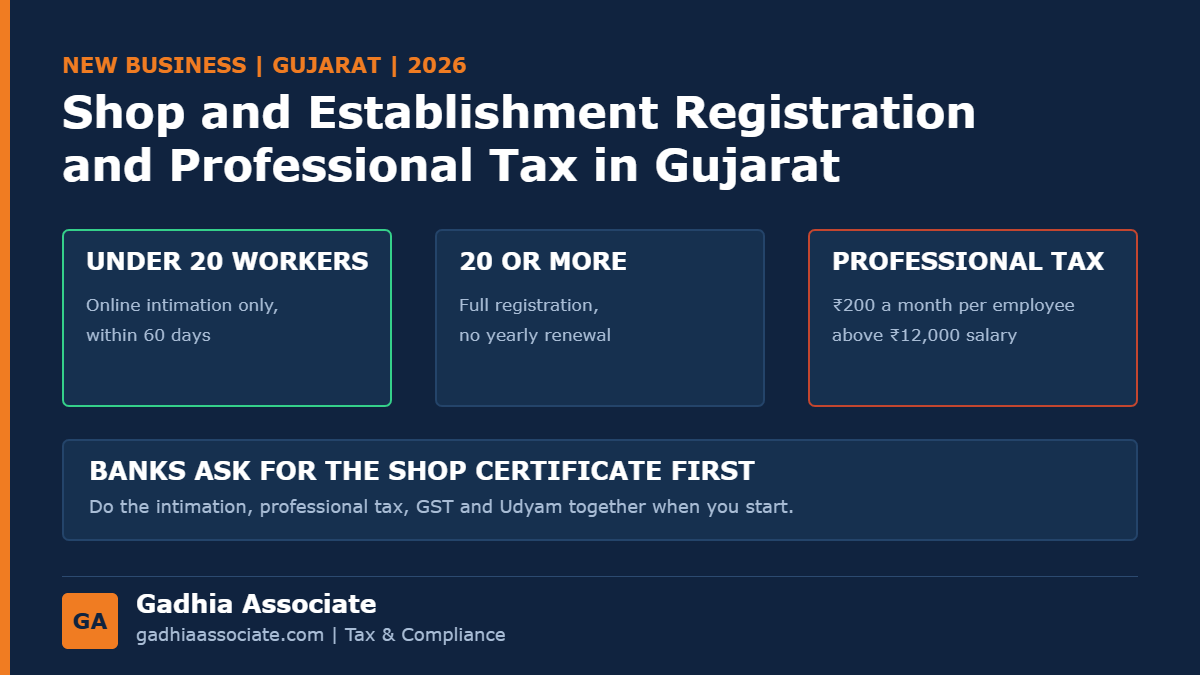
It's worth knowing that Gujarat isn't simply waiting on Delhi. The state notified rules under all four codes around the time of the central rollout, and in February 2026 it went further with the Gujarat Shops and Establishments (Regulation of Employment and Conditions of Service) Amendment Act, 2026, notified on February 27. That amendment revised applicability thresholds for which establishments the Act covers, adjusted permissible working and overtime hours, and set out fresh conditions for employing women on night shifts, including the safeguards employers must put in place. If you run a shop, showroom, clinic or small office anywhere in Gujarat, this one applies to you directly — not just to factories.
Gig and Platform Workers: Recognised, Not Yet Costed
For the first time, the Code on Social Security formally recognises gig and platform workers and creates a framework for a dedicated social security scheme, to be funded by the aggregators that engage them. The catch: contribution rates, benefit structures and the operational mechanics of that scheme are still pending notification. So if you run a delivery, logistics or services platform, or simply engage gig workers regularly, there's no fresh cost sitting on your books today — but there almost certainly will be once the scheme is notified. Worth budgeting for rather than being blindsided by later.
What Gujarat Employers Should Do Right Now
Don't wait for the final central rules to be notified before acting — Gujarat's own rules are already operative and enforceable. A few practical steps: re-audit every employee's CTC structure against the 50% wage test and fix the ones that fail; recompute your PF and gratuity provisioning for the next financial year rather than being surprised at year-end; update fixed-term employment contracts and offer letters to reflect the new gratuity entitlement; check whether your establishment now crosses (or falls under) the revised Shops and Establishments thresholds; and if you engage gig workers at scale, start setting aside a contingency for the social security scheme once it's notified. What most business owners get wrong here is treating this as an HR-only issue — it touches payroll, accounting provisions and contract law all at once.
How Gadhia Associate Can Help
We're already helping clients across Junagadh, Rajkot and Ahmedabad re-audit their CTC structures, recompute statutory provisioning and update employment contracts to stay compliant with the new codes — without overpaying or getting caught out later. If you're not sure whether your payroll structure passes the 50% wage test, get in touch with Gadhia Associate for a compliance review before your next audit cycle.