Startup Registration in India 2026: Step-by-Step Guide to Pvt Ltd, LLP and Company Incorporation
Starting a Business in India in 2026: Your Complete Registration Guide
Starting a startup in India has never been easier — or more important to get right. With India ranked among the top 3 startup ecosystems globally, thousands of new businesses are being registered every month. But many founders make costly mistakes in choosing the wrong business structure, missing registrations, or skipping compliance steps that come back to haunt them later. This guide tells you everything you need to know about registering a startup in India in 2026, in simple language.
Step 1: Choose the Right Business Structure
Before you register anything, you need to decide what type of legal entity you want. This is the most important decision you'll make for your startup, so get it right. Here are the main options:
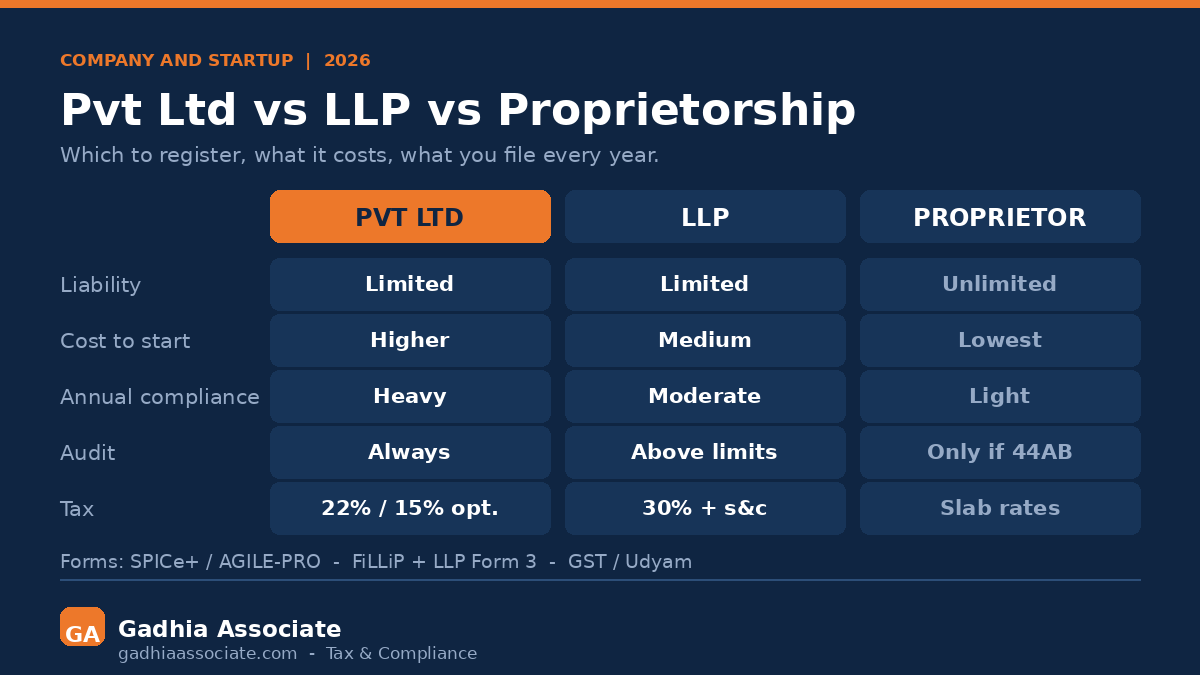
Private Limited Company (Pvt Ltd) is the most popular choice for startups that plan to raise funding. It gives you limited liability (your personal assets are protected), allows you to issue shares to investors, and is the preferred structure for VC-backed companies. It requires at least 2 directors and 2 shareholders. Compliance is higher than other structures but it is the gold standard for serious startups.
Limited Liability Partnership (LLP) is great for service businesses and professional firms. It combines the flexibility of a partnership with limited liability protection. Compliance requirements are lower than a Pvt Ltd, and it works well when you do not plan to raise VC funding. Minimum 2 designated partners required.
One Person Company (OPC) is ideal for solo founders who want the protection of a company structure without needing a co-founder. You are the only shareholder and director. However, OPCs cannot raise equity funding from investors, so it is best for bootstrapped solo businesses.
Sole Proprietorship or Partnership is the simplest and cheapest to set up, but it gives you no liability protection. Not recommended for startups with serious business plans, as your personal assets are at risk if the business faces legal trouble.
Step 2: Get Your Digital Signature Certificate (DSC) and Director Identification Number (DIN)
All directors of a Pvt Ltd company must have a DSC (Digital Signature Certificate) and a DIN (Director Identification Number). These are mandatory for filing documents with the Ministry of Corporate Affairs (MCA) portal. The DSC is a USB token that you use to digitally sign forms, and the DIN is a unique identification number for each director. Both can be obtained online — DSC from approved certifying authorities, and DIN through the SPICe+ incorporation form.
Step 3: Name Reservation via MCA Portal
Once you have your structure decided and DSC/DIN ready, the next step is reserving your company name. You do this through the MCA21 portal using the RUN (Reserve Unique Name) service or as part of the SPICe+ form. Choose a name that is unique, not similar to existing company names, not offensive, and not using restricted words (like "Government", "National", "Bank", etc. without special approval). It is a good idea to check the MCA name database before applying to avoid rejection.
Step 4: File the SPICe+ Form for Incorporation
SPICe+ (Simplified Proforma for Incorporating Company Electronically Plus) is the master form for company incorporation in India. Filing SPICe+ in 2026 gets you multiple registrations simultaneously: Company Incorporation (CIN), PAN and TAN for the company, GST Registration (if opted), ESIC and EPFO registrations, Professional Tax registration (in states where applicable), and Opening of a bank account.
This one-form approach has drastically reduced the time and cost of company registration. In most cases, a company can be incorporated within 2-7 working days of submitting the complete SPICe+ form with all required documents.
Step 5: Startup India Registration (DPIIT Recognition)
If your company qualifies as a startup under the Government of India's Startup India scheme, you should apply for DPIIT (Department for Promotion of Industry and Internal Trade) recognition. To qualify, your entity must be less than 10 years old, have an annual turnover of less than Rs 100 crore, and be working towards innovation or improvement of a product, process, or service. DPIIT recognition gives you access to tax benefits (3 years tax holiday under Section 80-IAC), faster patent examination, self-certification for labour laws, and government tender benefits.
Documents Required for Pvt Ltd Registration in 2026
For Indian Directors: PAN Card, Aadhaar Card, Passport-size photograph, Recent bank statement or utility bill as address proof. For the Registered Office: Rent agreement or property documents, NOC from owner (if rented), Utility bill (not older than 2 months). The entire process can be done online — you do not need to visit any government office in 2026.
Common Startup Registration Mistakes to Avoid
The biggest mistakes we see at Gadhia Associate are: choosing the wrong structure (then having to convert it later at significant cost and time), using a personal address as the registered office without proper documentation, not maintaining statutory registers from day one, ignoring annual compliance after incorporation, and not applying for DPIIT recognition when eligible.
Let Gadhia Associate Handle Your Startup Registration
At Gadhia Associate, we handle the complete startup registration process — from structure consultation to incorporation, GST registration, DPIIT recognition, and ongoing compliance. We work with founders across India and have helped hundreds of startups launch legally and compliantly. Contact us at Contact@gadhiaassociate.com or visit gadhiaassociate.com to get started today.