Paid an MSME Vendor Late? Here's What Section 43B(h) Costs You This Tax Audit Season
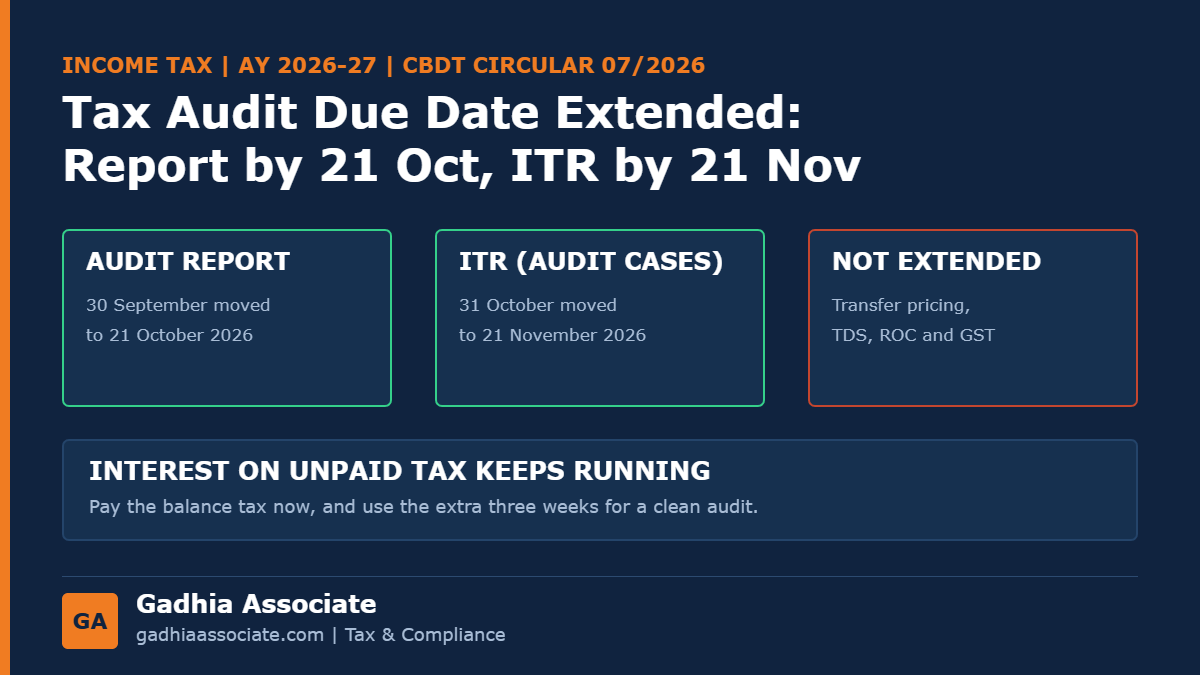
Quick question for anyone whose books are subject to tax audit this year: do you know exactly how much you owe your Micro and Small Enterprise vendors right now, and whether any of it has been sitting unpaid for more than 45 days? If you're shrugging, you're not alone — but this September, that shrug could cost you real money. Form 3CD, the tax audit report due by 30 September 2026 for FY 2025-26, carries a dedicated clause where your auditor has to report exactly this. And unlike most compliance line items, this one flows straight into your tax bill.
The Rule, Stripped to One Line
Section 43B(h) of the Income Tax Act says any amount payable to a Micro or Small Enterprise for goods supplied or services rendered can be deducted only in the financial year you actually pay it — if you don't pay within the timeline set by Section 15 of the MSMED Act, 2006. It doesn't matter whether you follow cash or mercantile accounting; the rule overrides both. It's been in force since 1 April 2024, applies from AY 2024-25 onward, and it carries forward under the new Income-tax Act, 2025 (effective 1 April 2026) with equivalent clause numbering — so nobody escapes it by waiting for the new law to kick in.
15 Days or 45 Days — and It's Not Your Invoice Terms
Here's where most business owners get caught out. If there's no written agreement with your MSME vendor, you have exactly 15 days from acceptance of the goods or services to pay. If there is a written agreement specifying a credit period, you get more room — but only up to 45 days, no matter what the contract says. A vendor agreement promising 60 or 90 days of credit doesn't help you here; the tax law caps it at 45 regardless. And the clock starts from acceptance, not from the invoice date — if you raise no objection within 15 days of delivery, the goods are treated as accepted whether you formally said so or not.
Who's Actually Covered — and Who Isn't
The rule applies to every kind of buyer: companies, LLPs, partnership firms, proprietorships, even a freelancer buying a service from a Micro Enterprise for business purposes. But the seller side is narrower than most people assume. Only vendors registered as Micro or Small Enterprises under the MSMED Act count — Medium Enterprises are explicitly excluded, even though they're technically "MSMEs" in everyday conversation. A vendor with turnover up to ₹5 crore and investment up to ₹1 crore is Micro; up to ₹50 crore turnover and ₹10 crore investment is Small; both are covered. Cross into Medium territory and Section 43B(h) simply doesn't apply to that vendor. The only way to know for sure is to check the Udyam Registration Certificate — don't take a vendor's word for it, verify the category yourself on the Udyam portal.
What Missing the Deadline Actually Costs You
Say you owe an MSME vendor ₹20 lakh and you pay it 60 days late instead of within the 45-day window. Two things happen, and both hurt. First, that ₹20 lakh gets added back to your taxable income for the year — you end up paying tax on money that's still sitting in your own account. The deduction isn't gone forever, it just shifts to whichever year you finally pay, which creates a timing mismatch that can genuinely hurt your cash flow at year-end. Second, under Section 16 of the MSMED Act, delayed payment attracts compound interest at three times the RBI bank rate — and that interest is not tax-deductible, so you're paying it out of profit that's already been taxed. If your business is a company, there's a third layer: outstanding MSME dues beyond 45 days must be disclosed in Form MSME-1, filed with the Ministry of Corporate Affairs twice a year, and skipping that filing brings its own penalty under the Companies Act.
Getting Ready Before Your Auditor Asks
If your turnover crosses the tax audit threshold, your auditor is legally required to report, through Form 3CD, exactly how much you owe MSME vendors, how much was paid on time, and how much was delayed and therefore disallowed. There's no quiet way around it — the disclosure goes straight to the Income Tax Department. Even if you're not subject to audit, filing under presumptive schemes like 44AD or 44ADA doesn't give you a free pass; the department increasingly cross-checks GSTIN-linked transaction data and can flag a mismatch on its own. So before your books close for the FY 2025-26 audit cycle, pull a payables ageing report, tag every vendor by Udyam category, and settle anything that's crept past its deadline. It's a lot cheaper to clear a pending payment today than to explain a disallowance to the tax department later.
How We Help Clients Stay Ahead of This
At Gadhia Associate, we build MSME payment tracking into our clients' regular compliance calendar rather than leaving it as a year-end scramble — verifying Udyam status, flagging at-risk payables before they breach the 15 or 45-day window, and making sure Form MSME-1 and Form 3CD disclosures are accurate when the time comes. If you're not sure where your business stands on outstanding MSME dues right now, get in touch and we'll run a quick payables review before your tax audit deadline arrives.