GST 2.0 in 2026: New Tax Slabs, ITC Hard-Locking and Landmark Case Laws Every Business Owner Must Know
Last updated: 24 July 2026 · By the Gadhia Associate compliance team
If you run a business in India, 2026 is the year GST stopped being "the same old return every month." Between the GST 2.0 rate overhaul, the portal quietly locking your input tax credit, and a run of court rulings that actually went in the taxpayer's favour, the rules you filed under last year are not the rules you file under today.
This guide breaks down everything a business owner needs to know — in plain language, no jargon. If you would rather someone just handle it, our GST services team in Junagadh does exactly that for 7,000+ clients across Gujarat and Pan-India.
1. GST 2.0: the new slab structure (effective 22 September 2025)
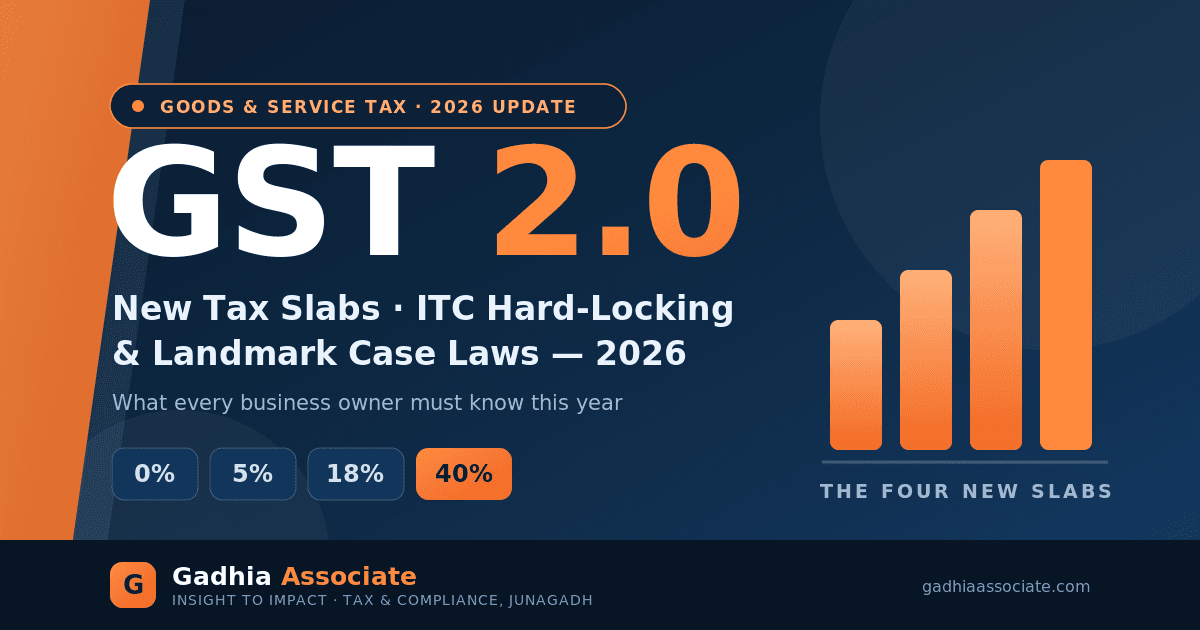
At its 56th meeting on 3 September 2025, the GST Council did what businesses had asked for over eight years — it simplified the slabs. From 22 September 2025, the old five-tier system (0%, 5%, 12%, 18%, 28%) became a cleaner four-rate structure:
- 0% (exempt): Essentials — UHT milk, paneer, all Indian breads (roti, paratha, etc.) and most unbranded staples.
- 5%: Around 99% of items that were in the 12% slab moved here — dairy, personal care, packaged snacks, many medical devices.
- 18% (standard rate): Roughly 90% of the old 28% items dropped to 18% — including air conditioners, TVs and small cars.
- 40% (sin & luxury): A new rate for pan masala, gutkha, cigarettes, chewing tobacco, aerated drinks and high-end luxury goods.
The two big deletions: the 12% and 28% slabs are gone. And the compensation cess was scrapped on almost everything from 22 September 2025 — it now survives only on a short list of tobacco and pan-masala products.
What this means for your business
- Re-price and re-label. If you sell goods that shifted slabs, your MRP, invoices and billing software all need updating — charging the old rate is now a compliance error.
- Check your HSN mapping. A wrong HSN code can put a product in the wrong slab. Use our free HSN / SAC Code Finder to confirm the correct rate.
- Watch your margins on the 40% items. Sin/luxury sellers need to model the cash-flow impact of the higher rate plus surviving cess.
2. The quiet game-changer: GSTR-3B ITC hard-locking
The rate cuts got the headlines. But the change that will actually catch businesses off guard is happening inside the return itself.
From the November 2025 tax period, Table 3.2 of GSTR-3B (inter-state supplies to unregistered persons, composition dealers and UIN holders) became auto-populated and non-editable — you must file the system-generated figure.
Then comes the bigger step. From July 2026, the portal is rolling out ITC hard-locking: your eligible input tax credit in GSTR-3B will be driven by GSTR-2B and the Invoice Management System (IMS), with no free-hand manual entry for B2B credit. In short — if your supplier hasn't reported the invoice correctly, you can't claim the credit.
How to protect your credit
- Act on your IMS every month. Accept, reject or mark invoices as pending before you file — don't leave it to the last day.
- Reconcile GSTR-2B against your purchase register before every GSTR-3B.
- Chase defaulting suppliers early. Under hard-locking, a vendor who files late or wrong directly costs you cash.
This is exactly the kind of monthly discipline our team builds into every client's GST filing and ITC reconciliation workflow.
3. Annual returns: a new penalty with teeth
For FY 2025-26, the GSTR-9 annual return (and GSTR-9C reconciliation, where applicable) is due by 31 December 2026. Late filing attracts a fee of ₹200 per day (₹100 CGST + ₹100 SGST), capped at 0.25% of turnover.
The sting is new: from April 2026, a pending GSTR-9/9C for FY 2025-26 will block your FY 2026-27 monthly GSTR-3B filings. Miss the annual return and your entire monthly compliance chain freezes — which can stall e-way bills, ITC and, ultimately, sales. Don't treat the annual return as a December afterthought.
4. Case laws that went the taxpayer's way
Recent rulings have given businesses real protection on input tax credit. A few worth knowing:
- Safari Retreats (Supreme Court): a commercial building can qualify as a "plant" under Section 17(5)(d) of the CGST Act, opening the door to ITC on construction cost where the building is essential to a leasing/renting business. Big for real-estate and warehousing.
- ITC for mandatory pre-deposit (Supreme Court, 2025): the Court allowed the Electronic Credit Ledger to be used for the pre-deposit required to file an appeal — Section 107(6) does not force you to pay it in cash. This preserves working capital when you contest a demand.
- Supplier errors can't kill your ITC: courts have ruled that a purchaser shouldn't lose credit because of a supplier's clerical or technical filing mistake — a useful shield in genuine cases.
- Telangana High Court (2026): Rule 39(1)(a) of the CGST Rules was held ultra vires Section 20, quashing the related audit report and show-cause notice — a reminder that not every departmental demand stands up.
Every case turns on its facts. Before relying on a judgment, get your specific situation reviewed — a wrong reading can cost more than the credit itself.
Your GST 2026 action checklist
- Update billing software, MRP labels and invoices for the new 5% / 18% / 40% slabs.
- Re-verify HSN/SAC codes so nothing sits in the wrong slab.
- Act on IMS and reconcile GSTR-2B every month ahead of ITC hard-locking.
- Calendar your GSTR-9/9C for FY 2025-26 well before 31 December 2026.
- Review any open GST notice or demand against the latest case law.
Don't let a rule change cost you money
GST 2.0 rewards businesses that stay organised — and quietly penalises those that don't. If you'd rather focus on growing your business than tracking every notification, we're here to help.
Gadhia Associate has handled GST, income tax and compliance for 7,000+ clients since 2007. Your first consultation is free. Book a free consultation at gadhiaassociate.com/contact, chat on WhatsApp, or call +91 82005 28355.
Frequently asked questions
What are the new GST slabs in 2026?
Since 22 September 2025, GST has four main rates: 0% (essentials), 5%, 18% (standard) and 40% (sin and luxury goods). The old 12% and 28% slabs were removed.
What is GSTR-3B ITC hard-locking?
From July 2026, the eligible input tax credit in GSTR-3B is auto-driven by GSTR-2B and the Invoice Management System, with no manual entry for B2B credit. If a supplier doesn't report an invoice correctly, the buyer can't claim that credit — so monthly IMS action and reconciliation are essential.
When is the GST annual return due for FY 2025-26?
GSTR-9 (and GSTR-9C where applicable) for FY 2025-26 is due by 31 December 2026. From April 2026, a pending annual return can block your monthly GSTR-3B filings for FY 2026-27.
Can I still claim ITC if my supplier made a filing error?
Courts have held that a buyer shouldn't lose credit for a supplier's genuine clerical or technical mistake, but outcomes depend on the facts. Have your specific case reviewed before relying on this.