E-Invoicing Under GST: Who Must Issue It, the 30-Day Reporting Limit, and What Happens to an Invoice Without an IRN
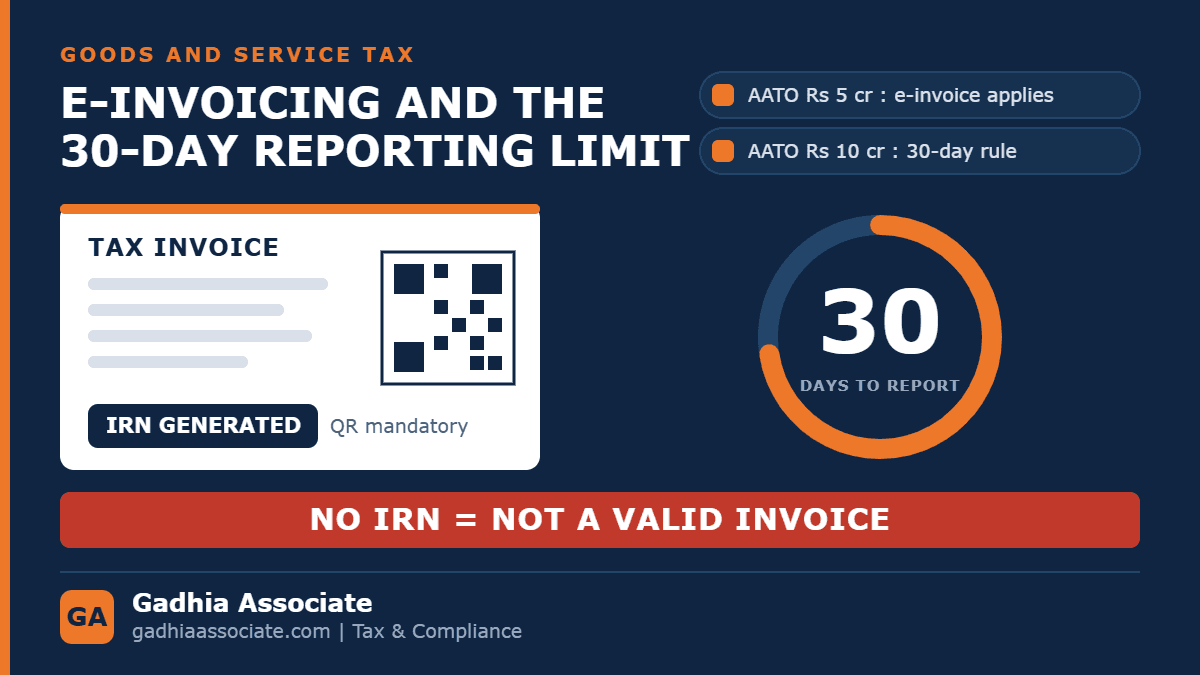
Two calls bring people to us on this. Either a customer's accounts team has bounced your invoice back saying there's no QR code on it, or your own staff tried to upload a March invoice in May and the portal flatly refused it. Both mean the same thing: e-invoicing applies to you and something has gone wrong with it. If you're a trader, manufacturer or service provider in Junagadh or anywhere in Gujarat whose turnover crossed Rs 5 crore in any year since GST began, this is your problem, not your software vendor's. Left alone, your buyer blocks payment, claims back the tax he can't take credit for, and you carry a penalty of Rs 10,000 per invoice or the tax involved, whichever is higher.
How do I know whether e-invoicing applies to my business?
Check the highest aggregate annual turnover you have ever recorded in any financial year from 2017-18 onwards, not just last year. Cross Rs 5 crore once and you're in permanently. That threshold has applied since 1 August 2023, brought down from Rs 10 crore.
The any-preceding-year test surprises people every month. A firm that touched Rs 5.4 crore in FY 2022-23 and has since settled at Rs 3.8 crore is still required to issue e-invoices. Turnover coming down does not take you out. Aggregate turnover is also computed PAN-wise across all your GSTINs, taxable and exempt supplies and exports included, so a business with a second registration in Maharashtra adds both together.
What it covers:
- B2B supplies to any GST-registered person, whether goods or services
- Supplies to government departments, agencies and local authorities holding a GSTIN
- Exports, including deemed exports and supplies to SEZ developers
- Reverse charge invoices you issue as a supplier
What it doesn't cover: B2C invoices to unregistered customers. Your retail counter bills stay as they are.
If you're unsure, the e-invoice portal has an e-invoice enablement status search where you punch in a GSTIN and it tells you whether that taxpayer is enabled. Two cautions from experience. It's a facility, not a legal determination, so an entry showing "not enabled" doesn't excuse you if your turnover crossed the line. And enablement can be self-requested where the portal's figure is stale.
What is the 30-day e-invoice reporting limit and what happens if I miss it?
An invoice, credit note or debit note dated more than 30 days ago will be rejected by the Invoice Registration Portal, so no IRN can ever be generated for it. From 1 April 2025 this applies to every taxpayer with an AATO of Rs 10 crore and above. Earlier it caught only those at Rs 100 crore and above, which is why so many mid-sized firms in Saurashtra were taken by surprise last year.
The arithmetic is unforgiving. An invoice dated 1 April has to be reported by 30 April. Report it on 1 May and the portal says no. There's no late fee to pay, no condonation window, no helpdesk override. The document simply cannot become an e-invoice.
Which leaves you with a document that isn't a valid tax invoice, and a customer who can't take credit on it. In practice the fix is to cancel or write off the stale document in your books and raise a fresh invoice inside a valid window, reporting it the same day, with your GST position for the earlier period corrected in the return. Whether that is clean depends on how much time has passed, whether goods have moved, and whether the earlier period's GSTR-1 and GSTR-3B are already filed. Get it looked at rather than improvising, because a mismatched period is what pulls DRC-01B and notices your way later.
Illustrative example. A Junagadh engineering unit with AATO of Rs 14 crore raises 240 B2B invoices in a quarter. The accountant is on leave in June and 18 invoices worth Rs 62 lakh, tax about Rs 11 lakh, go unreported past 30 days. The portal won't take them. Two buyers refuse to release payment without an IRN, one has already claimed credit that his GSTR-2B never supported, and the unit faces penalty exposure across 18 documents. Fresh invoicing plus a corrected return sorts most of it out, but it takes weeks and one buyer relationship never fully recovers.
Not sure whether your invoices are actually reaching the IRP?
Send us one month of your sales register and we'll reconcile it against the IRNs actually generated. You'll get a written list of the gaps, the ones still inside the 30-day window, and what to do about the ones that aren't.
Free first consultation. Call or WhatsApp +91 82005 28355.
Why is an invoice without an IRN my customer's problem too?
Because he loses the input tax credit, and he'll come after you for it. Rule 48(4) of the CGST Rules requires notified taxpayers to prepare an invoice by uploading the specified particulars to the IRP and obtaining an Invoice Reference Number, and Rule 48(5) says an invoice issued in any other manner shall not be treated as an invoice at all. Not defective. Not an invoice.
Section 16(2)(a) then requires the recipient to hold a tax invoice before claiming credit. So the recipient of a no-IRN document is holding paper that doesn't support his claim, and if he has already taken the credit it is liable to be reversed with interest. This is why large buyers' payment systems now check for the QR code and IRN before releasing anything. They aren't being difficult. They're protecting a credit that legally isn't there.
A related point worth stating plainly: the IRN is what makes the invoice valid, and the QR code is the machine-readable proof of it. Printing a QR code your software generated locally, without an IRN behind it, is worse than printing nothing. We see it in accounting packages that were never properly configured for the IRP. Our article on GST input tax credit goes into the conditions on the buyer's side in more detail.
Who is exempt from e-invoicing regardless of turnover?
A short list of notified classes is exempt however large the turnover, under Notification No. 13/2020-Central Tax as amended:
- Special Economic Zone units. SEZ developers are not exempt, which catches people out
- Insurers, banking companies and financial institutions, including non-banking financial companies
- Goods transport agencies supplying transport of goods by road in a goods carriage
- Suppliers of passenger transportation services
- Suppliers of services by way of admission to exhibition of cinematograph films in multiplex screens
Government departments and local authorities have also been given relief by later notification. Read all of this narrowly. The exemption attaches to the notified class and to the specified supply, so a company doing a bit of transport work alongside its trading business is not a goods transport agency, and treating itself as one is expensive. If your business sits anywhere near one of these lines, get a written view rather than assuming.
Do credit notes and debit notes need an IRN, and what about GSTR-1?
Yes, credit notes and debit notes are covered by the same reporting requirement and the same 30-day limit. The clean-up credit note discovered while preparing a return, dated two months back, is the classic casualty. Date it today, not retrospectively.
On returns, e-invoice data auto-populates into GSTR-1, which saves keying but also means errors travel. Two things to watch. Auto-population isn't instant, so give it a day or two before you assume something is missing. And if you report a document to the IRP after GSTR-1 for that period is already filed, it will not auto-populate into any later GSTR-1 either; you add it manually, though the e-invoice details can still be downloaded as an Excel file from the GSTR-1 dashboard for the relevant tax period.
Reconcile the sales register against IRNs generated before you file, not after a buyer complains. Where the numbers have already drifted, our articles on the GSTR-1 versus GSTR-3B mismatch and DRC-01B and on replying to GST notices cover what the department does next. The GST Calculator on our site is useful for checking tax on a corrected invoice quickly.
What is the penalty for not issuing an e-invoice?
Section 122 of the CGST Act is the exposure, and it bites per document. Non-issuance of a required invoice commonly attracts Rs 10,000 or the amount of tax involved, whichever is higher. An incorrect or improper invoice commonly attracts Rs 25,000. Twenty missed invoices, therefore, is not a Rs 10,000 problem.
Add the practical costs, which usually hurt more. Payments held by buyers. Goods detained in transit where an e-way bill was generated against a document with no IRN. Credit reversed at the buyer's end and recovered from you commercially. In our experience the penalty is rarely the largest number on the page.
Get your e-invoicing checked before a buyer does it for you
Gadhia Associate is a tax and compliance firm based in Junagadh, Gujarat, working with businesses across India and with NRI clients. In practice since 2007, more than 7,000 clients across Saurashtra and Gujarat, and a 5.0 Google rating from over 100 reviews. Same-day appointments at the Junagadh office, fully digital service if you're elsewhere, and fixed-fee or monthly compliance plans so you know the cost up front.
Free first consultation. Call or WhatsApp +91 82005 28355.
Frequently asked questions
My turnover has fallen below Rs 5 crore. Can I stop issuing e-invoices?
No. The test is whether aggregate annual turnover crossed Rs 5 crore in any financial year from 2017-18 onwards. Once crossed, the requirement continues even if turnover later falls. There is no automatic exit, and disabling e-invoicing in your software because last year was quieter is one of the more common ways businesses end up with invalid invoices.
Does e-invoicing apply to my B2C shop bills?
No. E-invoicing covers B2B supplies to registered persons, supplies to government departments holding a GSTIN, and exports. Bills to unregistered consumers are outside it, so your counter sales continue on normal tax invoices. Watch the boundary though, because a walk-in customer who gives you a GSTIN converts that sale into a B2B supply needing an IRN.
Can I generate an e-invoice for an invoice dated 45 days ago?
Not if your AATO is Rs 10 crore or above. The IRP rejects any invoice, credit note or debit note older than 30 days from the document date, and there is no condonation route. Businesses below Rs 10 crore AATO are not currently subject to the 30-day restriction, though that threshold has already been lowered once and may be again.
Is a tax invoice without an IRN completely invalid?
For a taxpayer required to issue e-invoices, yes. Rule 48(5) provides that an invoice not issued in the prescribed manner shall not be treated as an invoice, and Section 16(2)(a) requires the recipient to hold a valid tax invoice for input tax credit. So the document fails at both ends, and the buyer's credit is exposed to reversal with interest.
Do I need a separate e-way bill if I have generated an e-invoice?
The e-invoice and e-way bill are linked, and Part A of the e-way bill can be generated along with the IRN where transport details are supplied at the time of reporting. That doesn't remove the e-way bill requirement itself. If transporter details come later, Part B is completed separately, and goods moving on a document without a valid IRN can be detained.
Position as of September 2026. Thresholds, exempt categories and reporting time limits change through CBIC notifications and GSTN advisories, and outcomes depend on the facts of each supply. Please confirm your own position with us, or with your adviser, before acting on anything here.