Do I Need GST Registration? The Turnover Limits, the Cases Where Limits Do Not Apply, and What Happens If You Skip It
Your sales are climbing and you cannot tell exactly when the line gets crossed. Or a corporate buyer in Rajkot has asked for your GSTIN before they will release the purchase order. Or you have started selling on Amazon and somebody in a WhatsApp group told you registration is compulsory from the first rupee. Guess wrong and the cost is not theoretical. You end up paying GST out of your own pocket on sales already invoiced, with interest, plus a penalty under Section 122 of the CGST Act, and you cannot claim input tax credit for any of that unregistered period.
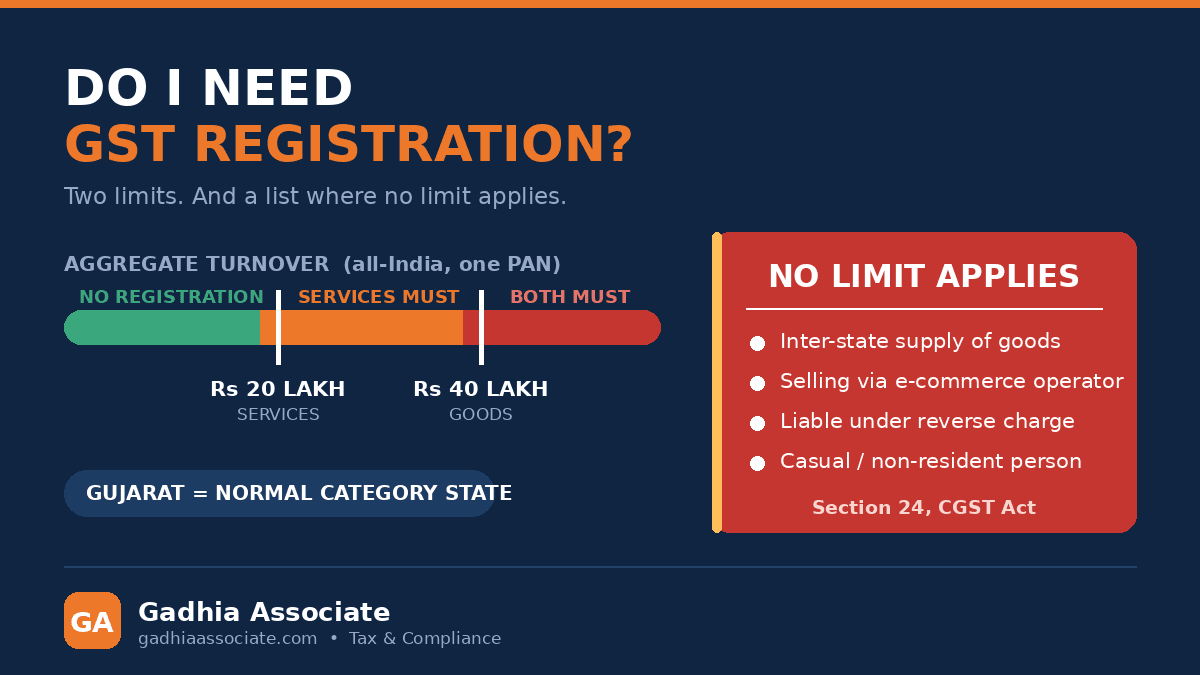
Short answer: You need GST registration once your aggregate turnover crosses Rs 40 lakh for goods or Rs 20 lakh for services in a financial year, in Gujarat and other normal category states. But Section 24 of the CGST Act makes registration compulsory from the first rupee in certain cases, including inter-state supply of goods, casual taxable persons and e-commerce operators.
How do I calculate aggregate turnover for GST registration?
Aggregate turnover is your all-India, PAN-level figure, not the turnover of one shop or one GSTIN. Section 2(6) of the CGST Act defines it as the total value of taxable supplies, exempt supplies, exports of goods or services, and inter-state supplies of persons having the same PAN, computed on an all-India basis. It excludes CGST, SGST, IGST and cess. It also excludes the value of inward supplies on which you paid tax under reverse charge.
- Counts: taxable sales, exempt and nil-rated sales, exports and zero-rated supplies, stock transfers to your own branch in another state.
- Does not count: the GST charged on your invoices, and purchases where you paid tax under reverse charge.
- Added across: every GSTIN and every state on the same PAN. Two firms on two different PANs are counted separately.
The thing people get wrong, almost every time, is exempt supplies. A trader assumes only taxable sales count and stays quiet at Rs 34 lakh, forgetting the exempt line entirely. Illustrative example only: a Junagadh trader sells taxable goods worth Rs 32 lakh and exempt agricultural produce worth Rs 9 lakh in one financial year. Aggregate turnover is Rs 41 lakh, not Rs 32 lakh. The Rs 40 lakh limit has been crossed and registration is due.
One more point that trips people up. The threshold is tested against turnover in the financial year as it runs, not against last year's audited figure. The day you cross it, the 30-day clock under Section 25(1) starts. And once you are registered, you stay registered even if next year's turnover falls back below the limit, unless you formally cancel.
Which businesses must register for GST even if turnover is below Rs 40 lakh?
Section 24 of the CGST Act overrides the threshold completely for a defined list of persons. For these, there is no limit at all.
- Persons making any inter-state taxable supply of goods. Even one invoice to Maharashtra triggers it.
- Casual taxable persons, for example an exhibitor taking a stall at a trade fair outside their home state.
- Persons required to pay tax under reverse charge.
- Non-resident taxable persons.
- Agents supplying on behalf of another taxable person.
- Input service distributors.
- Every electronic commerce operator required to collect tax at source under Section 52.
- Persons supplying through an e-commerce operator, subject to the relaxation described below.
- Persons required to deduct tax under Section 51.
Service providers get a real carve-out here that most people have never heard of. Notification No. 10/2017-Integrated Tax dated 13 October 2017 exempts persons making inter-state supplies of taxable services from compulsory registration where aggregate turnover stays within Rs 20 lakh (Rs 10 lakh for special category states). So a freelance designer in Junagadh billing a client in Bengaluru does not need registration at Rs 8 lakh of turnover. A trader shipping goods to Bengaluru does, at any figure. Same customer, different answer, and the reason is the notification.
Gujarat is a normal category state, so the Rs 40 lakh and Rs 20 lakh limits apply here. The lower Rs 20 lakh and Rs 10 lakh limits are for the special category states listed in the GST Council's decisions, mainly the North-Eastern states along with Himachal Pradesh and Uttarakhand.
Can someone just tell me whether I need to register?
Usually, yes, in about ten minutes on the phone. Gadhia Associate is a tax and compliance firm based in Junagadh, Gujarat, doing GST registration, returns and departmental work for businesses across India. Send us your last twelve months of sales, split into taxable and exempt, and tell us where your buyers are.
First consultation is free. Call or WhatsApp +91 82005 28355.
Do I need GST registration to sell on Amazon, Flipkart or Meesho?
For goods, not necessarily, since 1 October 2023. Notification No. 34/2023-Central Tax exempted persons supplying goods through an e-commerce operator from compulsory registration, provided the conditions are met. The conditions are strict: you must not make any inter-state supply, you must supply from a single state or union territory, you must have a PAN, and you must declare your PAN, your place of business and the state on the common portal and obtain an enrolment number before making any supply. One enrolment number per state. Your aggregate turnover still has to stay under Rs 40 lakh.
For services through an e-commerce operator, the position is different and this bit is genuinely confusing. That relaxation was written for goods only. Where the operator is liable to pay tax under Section 9(5) for notified services, the operator discharges the tax and the supplier's position differs again. If you supply services through a platform, do not assume the goods relaxation applies to you. Get it checked against your actual contract with the platform.
In practice, most marketplaces will not activate a seller account for goods without a GSTIN anyway, whatever the notification permits. The commercial reality and the legal position are not the same thing here.
Is voluntary GST registration worth it if I am below the threshold?
It is worth it when your buyers are registered businesses, and it is a burden when they are not. Section 25(3) lets any person register voluntarily. A B2B supplier who registers can charge GST, pass on credit, and stop losing tenders. A retail shop selling to walk-in customers gains nothing except monthly compliance.
Be honest about what you are signing up for. Registration means GSTR-1 and GSTR-3B on schedule, every month or quarter, whether or not you traded. Miss them and late fees accumulate quietly until the portal blocks your e-way bills. If your margins are thin and your buyers are consumers, look at the composition scheme instead before you register normally. We have written separately on the GST composition scheme and on what to do when GST returns are pending for several periods, and our GST Calculator on the site will show you the tax on an invoice value in seconds.
I crossed the GST limit months ago and did nothing. What should I do now?
Apply now, and do not wait for a notice. Section 25(1) required the application within 30 days of becoming liable. Missing that window does not close the door; it just means the liability for the intervening period sits with you. Under Section 122 the penalty for supplying without registration when liable is commonly Rs 10,000 or the amount of tax evaded, whichever is higher, and that is before interest and the tax itself.
The practical fix is to compute the tax on supplies made after the liability date, keep the working ready, apply on the portal, and pay up once the GSTIN is issued. You cannot issue a valid tax invoice or collect GST for the past period, and you cannot claim input tax credit on purchases made while unregistered, which is usually the more painful half of the bill. On the portal itself, expect the application to take under an hour to fill and considerably longer to clear. In Gujarat many applicants are routed to biometric Aadhaar authentication at a GST Suvidha Kendra, and the officer's query is almost always about the principal place of business: the rent agreement, the consent letter and an electricity bill whose address matches exactly. If your application has already been queried or rejected, our article on what to do when GST registration is rejected or stuck sets out the reply route.
Who does not need GST registration at all?
Section 23 of the CGST Act keeps two groups out entirely. First, any person engaged exclusively in supplying goods or services that are wholly exempt from tax or not liable to tax. Second, an agriculturist, to the extent of supply of produce out of cultivation of land. If every rupee you earn is exempt, no threshold applies to you and no registration is required, no matter how large the number gets.
Get the answer in writing before you invoice again
Gadhia Associate has been in practice since 2007 and works with over 7,000 clients across Saurashtra and Gujarat, with a 5.0 Google rating from more than 100 reviews. Same-day appointments at our Junagadh office, fully digital service across India and for NRIs, fixed-fee registrations and monthly compliance plans.
Free first consultation. Call or WhatsApp +91 82005 28355 and we will tell you the same day whether you are liable and from which date.
Frequently asked questions
Does the Rs 40 lakh GST limit apply to service providers too?
No. In normal category states including Gujarat, the Rs 40 lakh threshold applies to suppliers of goods only. Suppliers of services must register once aggregate turnover crosses Rs 20 lakh. If you supply both goods and services, the lower Rs 20 lakh limit applies to your combined aggregate turnover. Special category states use Rs 20 lakh and Rs 10 lakh respectively.
Do I include exempt sales in my GST turnover calculation?
Yes. Section 2(6) of the CGST Act includes exempt supplies, nil-rated supplies and exports in aggregate turnover. Only the GST component itself and inward supplies taxed under reverse charge are excluded. This is the single most common miscalculation we see, and it pushes many businesses over the threshold months before they realise it.
How long does GST registration take on the portal?
The application itself takes under an hour if your documents are ready. Approval timelines vary by officer and by whether your case is flagged for physical or biometric verification. Where a query is raised, you get a limited window to respond, and a missed reply usually ends in rejection rather than an extension. Budget for two to three weeks in practice.
Can I claim input tax credit for purchases made before I registered?
Generally no for the ordinary unregistered period. Section 18 of the CGST Act allows credit on inputs held in stock on the day immediately preceding the date of liability, in specified circumstances and subject to time limits and Form ITC-01. Credit on services and on capital goods used earlier is far more restricted. This is fact-specific, so get it reviewed before you claim.
What is the penalty if I never register at all?
Under Section 122 of the CGST Act, a person liable to register who fails to do so faces a penalty commonly stated as Rs 10,000 or the amount of tax evaded, whichever is higher. That sits on top of the unpaid tax and interest. The department can also assess unregistered persons under Section 63, so the exposure grows the longer it runs.
This article reflects the position as of September 2026. GST thresholds, notifications and deadlines change through CBIC notifications and GST Council decisions, and outcomes depend on the specific facts of your business. Confirm the current position with a professional before acting on anything here.