Made a Mistake in Your ITR? Revised Return, Rectification or ITR-U: Which One Applies to You
You filed, you felt relieved, and then you opened your AIS and saw a fixed deposit interest entry you never reported. Or an intimation under Section 143(1) landed and the TDS you were sure about is missing from the credit column. Or you claimed a deduction your accountant now says will not hold. Whatever brought you here, the fix depends entirely on which door is still open, and the doors close on fixed dates. Sit on it and a small correction that costs nothing today turns into extra tax of 25 to 70 percent under the updated return route, or a notice that puts the whole return under the scanner.
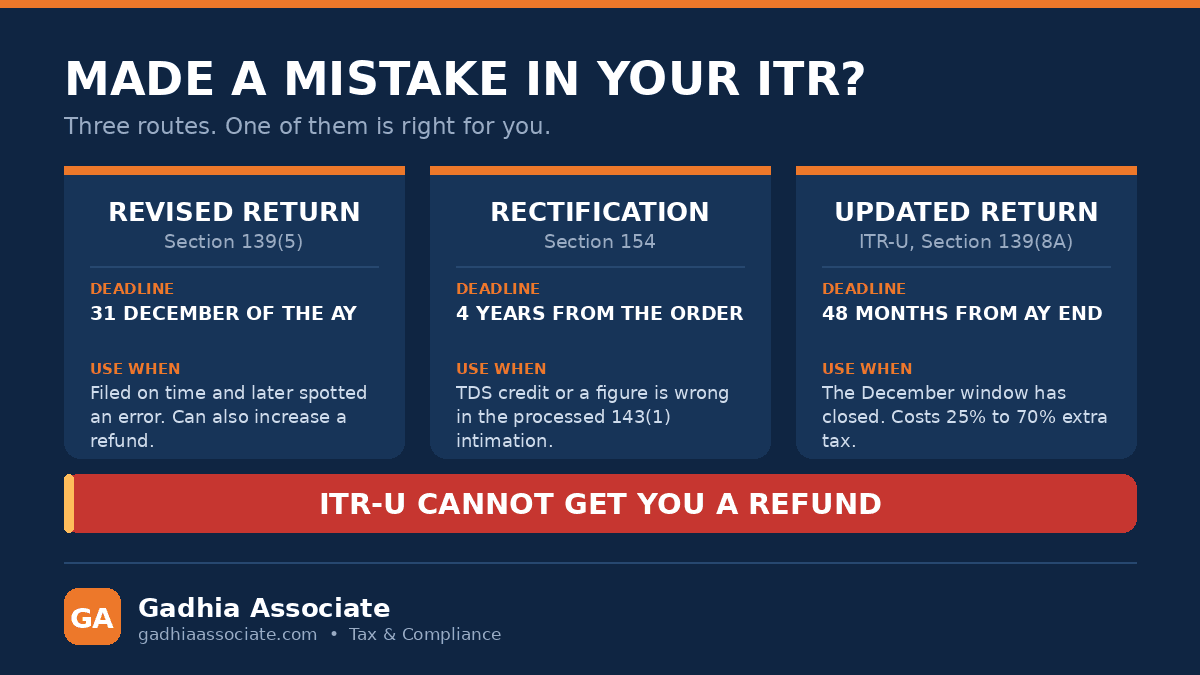
Short answer: Use a revised return under Section 139(5) if you filed on time and 31 December of the assessment year has not passed. Use a rectification under Section 154 if the mistake is in a processed intimation, such as TDS credit not given. Use ITR-U under Section 139(8A) if the December window is gone.
Which route applies to my situation?
Match your situation to the route before you touch the portal. Most wasted effort comes from filing the wrong one and waiting three months to find out.
- You forgot to report FD interest, savings interest or capital gains. Revised return under Section 139(5) if you are within the window. ITR-U if not.
- You claimed a deduction you were not entitled to. Revised return, and if the window has closed, ITR-U, because it increases your tax.
- Your TDS credit was not given in the Section 143(1) intimation although it shows in Form 26AS. Rectification under Section 154. A revised return is the wrong tool here.
- You filed but never verified. Discard the return on the portal and file fresh, if the conditions are met.
- You missed the filing due date entirely and nothing is on record. Belated return under Section 139(4), with a late fee under Section 234F.
- You want a bigger refund than you originally claimed. Revised return only. ITR-U cannot do this.
- You need to report a loss you did not declare. Revised return only, within the window.
What is a revised return under Section 139(5) and by when can I file it?
A revised return replaces your original return completely, and it is the most forgiving of the four routes. Section 139(5) allows it where you have already furnished a return and later discover an omission or a wrong statement. You can file it more than once. The deadline is 31 December of the relevant assessment year, or before completion of the assessment, whichever is earlier. For FY 2025-26, which is assessment year 2026-27, that date is 31 December 2026.
What makes it valuable is what it can do that nothing else can. A revised return can increase your refund, reduce your tax, declare a loss you missed, or correct a bank account. There is no additional tax loading, only the normal interest under Sections 234A, 234B and 234C where applicable. On the portal you file it the same way as a normal return, under e-File then Income Tax Returns then File Income Tax Return, selecting the revised return option under Section 139(5) and quoting the acknowledgement number and filing date of the original return. Get that acknowledgement number wrong and the return will not validate.
A belated return under Section 139(4) is a different animal. That is for people who filed nothing at all by the due date. Same 31 December deadline, but a late fee under Section 234F applies and certain loss carry-forwards are lost. A belated return can itself be revised.
When should I file a rectification under Section 154 instead?
File a rectification only when the error sits in a processed order or intimation, not in your return. Section 154 covers a mistake apparent from the record. In practice, that means TDS credit that appears in Form 26AS but was not allowed, an arithmetic error at CPC, a data-entry mismatch, or an advance tax challan not picked up.
You file it from the e-filing portal under Services, then Rectification, then select the request type and the specific assessment year and the intimation you are rectifying. The time limit is commonly four years from the end of the financial year in which the order or intimation was passed. The most frequent mistake we see is people filing a rectification to add income they forgot, which is not a mistake apparent from the record at all, and it comes back rejected months later with the revised return window long gone by then. If the underlying figure in your return was wrong, rectification is not your route.
What is ITR-U under Section 139(8A) and what does it cost?
ITR-U is the late-repentance route, and it is not cheap. Section 139(8A) allows an updated return where you need to report additional income. Following the Finance Act 2025, the window is widely reported as 48 months from the end of the relevant assessment year, extended from the earlier 24 months. The price is an additional tax on top of the tax and interest otherwise due, on a ladder that steepens the longer you wait: commonly 25 percent if filed within 12 months from the end of the assessment year, 50 percent within 24 months, 60 percent within 36 months and 70 percent within 48 months.
Illustrative example only, round numbers. You left out Rs 60,000 of FD interest. Tax on it works out to Rs 12,000 and interest to Rs 2,000, so Rs 14,000. Corrected through a revised return before 31 December, you pay that Rs 14,000. Corrected through ITR-U in the first 12-month band, you add 25 percent of Rs 14,000, so Rs 3,500 more, and Rs 17,500 in total. Wait until the fourth year and the additional tax alone approaches Rs 9,800. Same mistake, very different bill.
Can ITR-U get me a refund?
No, and this is the trap that catches most people. An updated return under Section 139(8A) cannot be used to claim a refund, to increase a refund already claimed, to reduce your tax liability, or to declare or increase a loss. It only works in one direction: more income, more tax. If your problem is that you forgot to claim a deduction, or that a TDS credit was never adjusted and money is owed to you, ITR-U will not help and the portal will not accept it. That is precisely why the 31 December revised return deadline matters so much more than people treat it. There has been discussion about relaxing some of these limits in later amendments, and that is not settled, so confirm the current position before you rely on it.
Not sure which one you need?
Gadhia Associate is a tax and compliance firm based in Junagadh, Gujarat, handling income tax filings, corrections and notice replies for individuals and businesses across India. Send us the acknowledgement number and the intimation PDF and we will tell you which route is open and what it will cost before you commit to anything.
First consultation is free. Call or WhatsApp +91 82005 28355.
I filed my ITR but never verified it. What happens now?
An unverified return is treated as never filed, which is worse than most people assume, but it also gives you the cleanest fix available. The e-filing portal offers a Discard option for returns that have been filed but not yet e-verified. You find it under e-File, then Income Tax Returns, then View Filed Returns, sitting beside the e-Verify link on the relevant return.
The conditions matter. The status must show as unverified or pending for verification. You must not have already posted the signed ITR-V to CPC. The option is available only within the time allowed for filing under Sections 139(1), 139(4) and 139(5), which as things stand means 31 December of the assessment year. A discard cannot be reversed, and if the discarded return was your original on-time filing and your fresh return goes in after the due date, it carries belated-return consequences including the Section 234F fee. There is no cap on how many times the option can be used within the window.
What happens if I do nothing about the mistake?
Nothing, for a while, and then quite a lot at once. Unreported income that appears in your AIS or Form 26AS is matched electronically, and the usual first contact is a communication asking you to confirm or revise, followed by a notice if you stay silent. Once the revised return window shuts, your only route is ITR-U with its additional tax, and if the department has already begun proceedings, even that door narrows.
Refunds are the quieter casualty. A mismatch on record will hold a refund at CPC indefinitely, and our article on why income tax refunds get stuck goes through the usual reasons. If you are unsure what the department already knows about you, read our comparison of AIS and Form 26AS first, because that is where nearly every correction we handle actually begins. We have also written on how to read and reply to income tax notices, and on the options for NRIs with several years of unfiled returns, which is a common situation in Saurashtra.
Fix it while the cheap door is still open
The difference between acting in September and acting in January is usually the difference between paying tax and paying tax plus 25 percent. Gadhia Associate has been in practice since 2007 with more than 7,000 clients across Saurashtra and Gujarat and a 5.0 Google rating from over 100 reviews. Same-day appointments at the Junagadh office, fully digital service across India and for NRIs, fixed-fee corrections and monthly plans.
Free first consultation. Call or WhatsApp +91 82005 28355.
Frequently asked questions
How many times can I file a revised return?
There is no limit under Section 139(5). You can revise as many times as needed until 31 December of the assessment year or until the assessment is completed, whichever comes first. Each revision replaces the previous one entirely. Repeated revisions do attract attention, so it is better to get the corrected figures right once rather than filing three times in a week.
Is there a penalty for filing a revised return?
No penalty applies for revising a return within the Section 139(5) window. You pay any additional tax that becomes due, along with interest under Sections 234B and 234C where applicable. This is the cheapest of all correction routes, which is why the 31 December deadline is the one date worth putting in your calendar the moment you spot an error.
My TDS shows in Form 26AS but the intimation did not give me credit. What do I file?
File a rectification under Section 154 from the portal, under Services then Rectification, against that specific intimation. This is a classic mistake apparent from the record. Do not file a revised return for it, and do not file ITR-U. Attach nothing extra; the department matches against its own records. Processing takes months in practice, not weeks.
Can I file ITR-U if I never filed an original return?
Yes. Section 139(8A) permits an updated return whether or not you filed an original, belated or revised return for that year, subject to the eligibility conditions and the additional tax. The same hard limits still apply: it cannot produce a refund, reduce liability, or declare a loss. For older unfiled years, this is often the only route left.
Have these section numbers changed under the Income-tax Act, 2025?
Yes. The Income-tax Act, 2025 came into force on 1 April 2026 and renumbered almost the entire Act. The substance of revised, belated, rectification and updated return provisions largely carries over, but the section numbers differ from the 1961 Act. Returns for FY 2025-26 are still governed by the earlier numbering, so quote whichever applies to your year.
This article reflects the position as of September 2026. Deadlines, additional-tax rates and section numbering change through CBDT circulars, notifications and Finance Act amendments, and outcomes depend on the specific facts of your case. Confirm the current position with a professional before acting on anything here.