Buying Property? The Form 26QB and TDS Mistakes That Come Back as a Notice Years Later
You bought a flat. You paid the builder or the seller, you registered the sale deed, you took the keys, and nobody in the room mentioned Form 26QB or TDS on property purchase. Or you did file Form 26QB, felt the job was done, and two or three years later an intimation landed in your income tax account showing interest, a late fee and a demand in your name as the buyer. Either way, you are in the right place. This is one of the most common compliance failures we see in Junagadh and across Saurashtra, and it is almost always fixable if you act on it properly.
Do I have to deduct TDS when buying a flat?
Yes, in most cases. Under Section 194-IA of the Income-tax Act, when you buy immovable property in India (other than agricultural land) and the consideration or the stamp duty value is Rs 50 lakh or more, you, the buyer, must deduct TDS at 1% and deposit it with the government. Not the seller. Not the broker. Not the bank. You.
Three features of this provision surprise people every single week:
- You do not need a TAN. You deduct and deposit using your PAN, through the challan-cum-statement in Form 26QB.
- Form 26QB must be filed within 30 days from the end of the month in which the deduction is made, and you must then download and issue Form 16B to the seller from the TRACES portal.
- If you are paying in instalments, TDS applies to each instalment, and a Form 26QB is required for each one. Under-construction flats bought from a builder are the classic case.
Please note that the Income-tax Act, 2025, which came into force on 1 April 2026, has renumbered the provisions of the old 1961 Act. The obligation and the mechanism are unchanged in substance, but the section numbers you see quoted in older articles and in the notice itself may differ. This is one more reason to have someone read your specific notice rather than a generic checklist.
What if the property is jointly owned? The Form 26QB trap that creates most notices
This is the single most common trap, and it caught thousands of honest buyers.
People assumed that if a property was bought by two buyers, or sold by two sellers, the Rs 50 lakh threshold applied to each person's share. So a flat of Rs 80 lakh bought jointly, where each buyer's share was Rs 40 lakh, was treated as below the limit and no TDS was deducted at all.
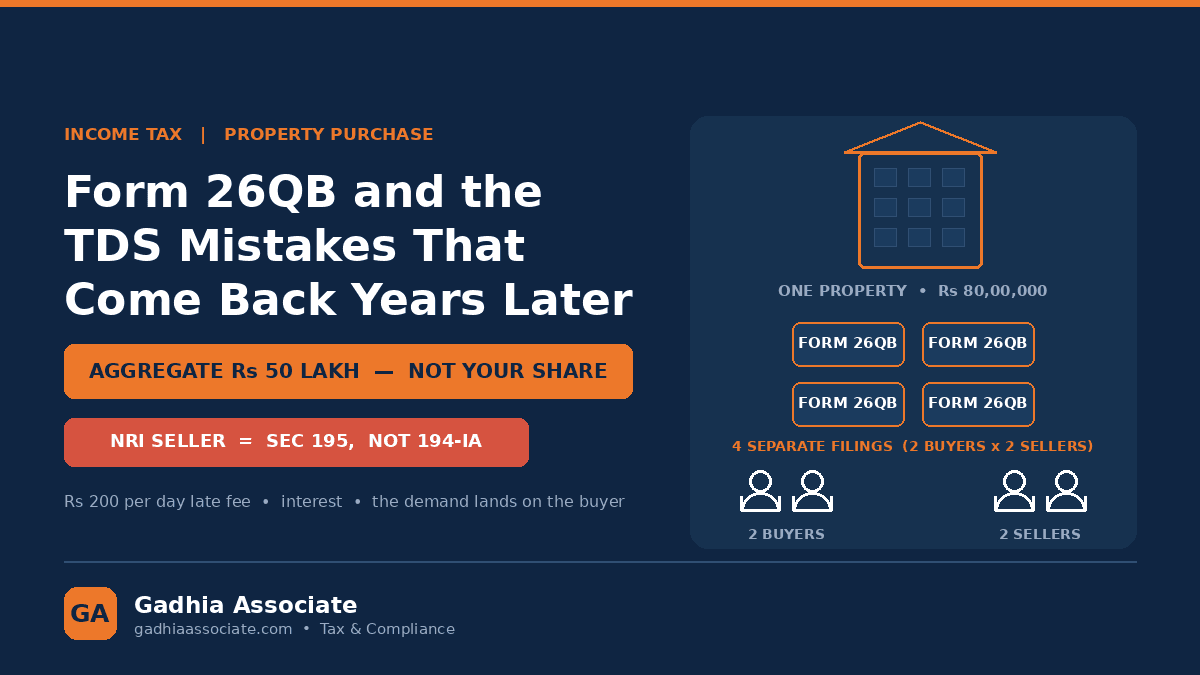
That reading was closed off. With effect from 1 October 2024, the law makes it explicit that where there is more than one buyer or more than one seller, the Rs 50 lakh threshold is tested against the aggregate consideration for the property as a whole, not against each person's share.
An illustrative example (round figures, for illustration only)
Suppose a flat is sold for Rs 80,00,000. There are two buyers, a husband and wife, each contributing Rs 40,00,000. There are two sellers, two brothers, each receiving Rs 40,00,000.
Each individual share is below Rs 50 lakh. But the aggregate consideration for the property is Rs 80,00,000, which crosses the threshold. So TDS at 1%, that is Rs 80,000, must be deducted. And because a separate Form 26QB is needed for each buyer-seller combination, this transaction requires four Form 26QBs (2 buyers x 2 sellers), of Rs 20,000 each, with the corresponding consideration reported in each form.
Buyers who filed one Form 26QB instead of four, or who filed none at all, are the people receiving notices today.
What is the penalty for not filing 26QB, and why does it land on you?
Be clear about who pays. The default is raised against the buyer, because the buyer is the deductor. The seller has your money; you have the notice.
The costs stack up in three layers:
- Interest for failure to deduct, charged at 1% per month (or part of a month) from the date the tax was deductible until the date it is actually deducted.
- Interest for failure to deposit, charged at 1.5% per month (or part of a month) from the date of deduction until the date of payment.
- Late fee under Section 234E of Rs 200 per day for every day the statement remains unfiled, subject to a cap of the TDS amount itself. On a small deduction the cap is reached quickly; on a large one, the fee runs a long way.
There is a fourth cost that is not money but is often worse. If you filed with the wrong PAN, or filed only one form where four were required, the TDS credit will not appear correctly in the seller's Form 26AS and AIS. The seller cannot claim credit against their capital gains liability, and they will chase you, sometimes through a lawyer, sometimes by refusing to sign a document you need. We have seen possession and society transfer held up over exactly this.
None of this is a disaster. It is a mess with a defined cleanup path. But the meter runs daily, and every month you leave it alone is another 1.5% and another Rs 6,000 of late fee exposure.
If a notice has already reached you, or you suspect the 26QB on your purchase was never filed, talk to us before the interest grows further. Gadhia Associate offers a free first consultation. Call or WhatsApp +91 82005 28355, send us the sale deed and the notice, and we will tell you exactly what happened and what it will cost to fix. We have been practising since 2007, and property TDS defaults are among the most frequent matters we clean up.
How do I file Form 26QB, and how do I correct it if it is wrong?
Filing is done online through the income tax portal as a challan-cum-statement. You will need the PAN of every buyer and every seller, the full property address, the date of the agreement, the date of payment, the total consideration, the stamp duty value, and the amount being paid in that particular instalment. Pay the tax, save the acknowledgement, then wait a few days and download Form 16B from TRACES for the seller.
The errors that generate defaults are boringly consistent:
- Wrong assessment year selected (the most frequent single error).
- Wrong PAN of the buyer or the seller, usually a typing error or a PAN taken from the wrong family member.
- Wrong total value of consideration, especially where the aggregate value of the property was entered as the individual share, or vice versa.
- Wrong date of payment or date of deduction, which triggers interest even though the money reached the government on time.
- Ticking the wrong option for instalment versus lump sum payment.
I entered the wrong PAN in 26QB, how do I correct it?
Corrections are made through the 26QB correction facility on TRACES, logged in as a taxpayer. Broadly, the fields fall into three groups:
Fields you can generally correct yourself after e-verification: total value of consideration, amount paid or credited, date of payment or credit, date of deduction, the address of the property and the buyer's or seller's address details.
Fields that require the seller to approve: where you are changing the PAN of the seller, the request is routed to the existing seller's PAN for approval before it can move forward. If that seller is uncooperative or unreachable, the correction stalls, which is why we insist on verifying PANs before payment rather than after.
Fields that additionally require the Assessing Officer to approve: a PAN change submitted without a digital signature goes to the seller first and then to the TDS Assessing Officer for approval. If the correction is submitted using a valid digital signature certificate, the Assessing Officer approval step is generally not required and only the seller's approval is needed. This is precisely where having a professional file the correction saves weeks.
Correction requests do fail. They fail because the wrong request type was chosen, because both PANs were changed at once, or because the challan was already consumed. Getting it right the first time matters.
What if the seller is an NRI? This is the expensive one
Read this paragraph twice. If the seller is a non-resident, Section 194-IA does not apply at all. Filing Form 26QB for an NRI seller is not a small procedural slip; it is the wrong law, the wrong form and, almost always, the wrong amount.
Where the seller is an NRI, the deduction falls under Section 195. The rate is not 1%. It is based on the capital gains character of the transaction, at the rates applicable to long-term or short-term capital gains, plus surcharge and cess, and it is applied on the sale consideration unless the seller obtains a lower or nil deduction certificate from the Assessing Officer. There is also no Rs 50 lakh threshold. A buyer who deducted 1% on a Rs 1 crore purchase from an NRI, where the correct deduction was several times that, faces a demand for the shortfall plus interest, and the money has already left India.
Historically, a buyer purchasing from an NRI needed a TAN and had to file a quarterly TDS statement rather than Form 26QB. A welcome change allows resident individual and HUF buyers to deduct and deposit under Section 195 using their PAN, through a challan-cum-statement route, with effect from 1 October 2026. Company and firm buyers are expected to continue with TAN. Because this is a very recent change and the procedural notifications are still settling, please confirm the position applicable to your transaction date before relying on it. The rates and the obligation to deduct correctly are unchanged either way; only the mechanism is simplified.
If you are dealing with a non-resident seller, our detailed article on NRI property sale TDS walks through Form 13 lower deduction certificates and repatriation, and is worth reading alongside this one.
What to verify before you release the payment
- The residential status of every seller in writing, supported by passport or visa pages where there is any doubt. Do not rely on an Indian address in the sale deed.
- The aggregate consideration and the stamp duty value of the whole property, and whether either crosses Rs 50 lakh.
- The number of buyers and sellers named in the deed, and therefore how many Form 26QBs are required.
- The PAN of every buyer and every seller, verified against the PAN database, not just copied from a photocopy.
- The payment schedule, so TDS is deducted on each instalment rather than at the end.
- Whether the seller holds a lower or nil deduction certificate, and whether it covers your transaction and your PAN.
- That the 1% is deducted from the payment and not paid out of your own pocket after the seller has been paid in full.
- A diary note for the 30-day filing deadline and the Form 16B download.
Sellers reading this should also look at our articles on capital gains exemptions under Sections 54, 54F and 54EC, and use our Capital Gain Tax Calculator to see what the deduction actually offsets. If you are also a landlord, our article on TDS on rent covers a related obligation that catches the same people.
Whether you are about to buy, are mid-way through instalments, or already holding a notice, we can take this off your desk. Gadhia Associate has served over 7,000 clients across Saurashtra and Gujarat since 2007, holds a 5.0 Google rating from more than 100 reviews, and works on fixed-fee and monthly plans with a dedicated client manager, so you always know the cost and who to call. Our Junagadh office offers same-day appointments, and our service is fully digital across India and for NRIs. Your first consultation is free. Call or WhatsApp +91 82005 28355.
Frequently asked questions
The seller told me to skip TDS and settle it in their return. Is that safe?
No. The obligation is on you as the buyer, and the default is raised against you regardless of what the seller does in their own return. A written assurance from the seller has no effect on the department. If the seller has already declared the income and paid the tax, there is a route to argue that the tax itself should not be collected twice, but interest and the late fee generally still apply and the argument has to be properly documented.
I bought the flat three years ago and never filed. Is it too late?
It is not too late to comply, and voluntarily regularising is always better than waiting for the department to find it. You can still deduct and deposit, file the belated Form 26QB and issue Form 16B. Interest and the Section 234E late fee will apply, with the fee capped at the TDS amount. In most cases the total is far smaller than clients fear, and the peace of mind is worth it.
Do I need to be in Junagadh to use your services?
No. We work fully digitally across India and for NRIs in the Gulf, the UK, the US and elsewhere. You send scans of the sale deed, PANs and the notice, and we handle the portal work, the TRACES correction and the follow-up. If you are in or near Junagadh and prefer to sit across a table, we usually offer a same-day appointment.
What will it cost to fix?
We quote a fixed fee once we have seen the documents, so there is no open-ended billing. The tax, interest and late fee payable to the government are separate and depend entirely on the amounts and dates in your case. We tell you both numbers up front, in the free first consultation, before you commit to anything.
This article reflects the position as of September 2026. Tax law changes through amendments and CBDT notifications, and the Income-tax Act, 2025 has renumbered many provisions. Outcomes depend entirely on the specific facts, documents and dates of your transaction. Please confirm the current position with a qualified professional before acting on anything stated here.