NRI Who Has Not Filed an Income Tax Return in India? Notices, ITR-U and How to Fix Past Years Before the Department Finds You
You are an NRI who has not filed an income tax return in India — and you are wondering how much trouble that is
You moved abroad years ago. You still have a flat in Rajkot or Junagadh, an NRO account collecting rent or interest, some mutual funds your father opened for you, and perhaps a property you sold last year on which the buyer deducted a very large amount of TDS. Nobody told you to file, so you did not. If you are an NRI who has not filed an income tax return in India, the honest position is this: the Income Tax Department almost certainly already has your transaction data, the returns for some years can still be fixed, and for the older years the refunds you were entitled to are quietly expiring.
That last point is the one that costs the most. Money you overpaid as TDS does not wait for you forever.
Do NRIs have to file ITR in India?
A non-resident must file a return in India where total income — computed before Chapter VI-A deductions and before the exemptions claimed for reinvestment of capital gains — exceeds the basic exemption limit applicable to you for that year. Income that is earned or received in India, or that accrues or arises in India, counts: rent from Indian property, interest on NRO deposits, capital gains on Indian shares, mutual funds and property. Your salary abroad, generally, does not.
Two things people get wrong. First, the extra filing triggers that catch residents — large current account deposits, big electricity bills, foreign travel spend — are framed for residents, so an NRI should not assume they apply, but should also not assume they never matter; your residential status for each year has to be worked out before anything else. Second, and more important: not being required to file is not the same as it being sensible not to file. You should usually file if:
- TDS was deducted at high non-resident rates on a property sale, NRO interest or rent, and your actual tax is lower — a return is the only way to get the excess back;
- you made a capital loss you want to carry forward against future gains;
- you have made high-value purchases or investments in India that will show up in reporting and are better explained by a filed return than by a reply to a notice.
Will I get a notice for buying property in India?
Possibly, and the mechanism is not mysterious. Banks, registrars, mutual funds, depositories and companies file Statement of Financial Transactions (SFT) reports. Those feed your Annual Information Statement (AIS) and Form 26AS, which already show, year by year: purchase and sale of immovable property, mutual fund and securities transactions, large deposits in your NRO and NRE accounts, dividend and interest credits, and every rupee of TDS deducted — including TDS deducted by a buyer under Section 195 when a non-resident sells property.
The department runs those entries against filed returns. Where a large transaction appears and no return exists, the file is flagged. What arrives is typically a compliance message on the portal, then a notice under Section 142(1) calling for a return or information, and in more serious cases reassessment under Section 148 preceded by the Section 148A procedure — a show-cause with material, your reply, and an order deciding whether reassessment is warranted. Our articles on AIS versus Form 26AS and on responding to income tax notices explain those documents in more detail.
One structural note: the Income-tax Act, 2025 came into force on 1 April 2026 and renumbers essentially the whole statute, along with many forms. The concepts described here — updated returns, reassessment, TDS credit — continue, but the section numbers you see on a notice may differ from the familiar 1961 Act numbers. Check the numbering on your actual notice rather than assuming.
What happens if an NRI never filed a return? The real cost
The cost is rarely one dramatic penalty. It is an accumulation:
- Interest runs for default in furnishing the return and for shortfall in advance tax — month after month, on the unpaid tax, from the original due date.
- Penalty and late fee exposure for the non-filing itself, in addition to the tax.
- Reassessment reaching back several years once a case is opened, with you asked to prove the source of transactions from a decade ago, from abroad, with bank records you may no longer hold.
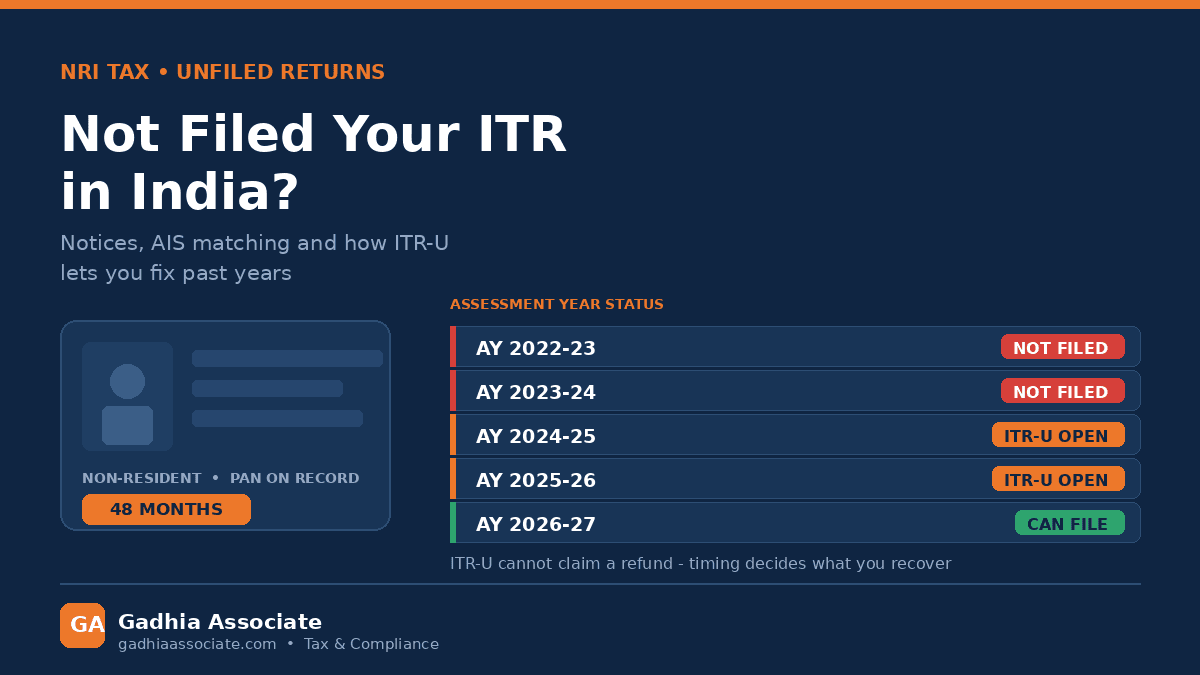
- Refunds lost permanently. This is the cruellest one. An updated return (ITR-U) cannot be filed to claim a refund, to increase a refund, or to declare a loss. So for a year where TDS was over-deducted and the belated window has closed, the updated return route does not bring your money back.
An illustrative example, round numbers only: suppose you sold a Gujarat flat as a non-resident and the buyer deducted TDS of Rs 12,00,000 on the gross sale consideration, while your actual long-term capital gains tax on the transaction worked out to about Rs 3,50,000. You were owed roughly Rs 8,50,000 back. If you file within the window available for that year, you claim it. If you let the year go cold and are left only with the ITR-U route, that Rs 8,50,000 is simply gone — and you may still owe tax and interest on other income for the same year. The timing, not the arithmetic, is what decides this.
Talk to our NRI Desk — the first consultation is free
Before you decide anything, someone needs to look at Form 26AS and the AIS for each open year and tell you which years are still refundable, which are ITR-U years, and which are closed. That is a two-day exercise, not a two-month one. Gadhia Associate has been practising since 2007 and has served over 7,000 clients across Saurashtra and Gujarat, and our NRI Desk works fully digitally — documents by email or WhatsApp, calls scheduled to your time zone, nothing requiring you to fly to India. The first consultation is free. Call or WhatsApp +91 82005 28355.
Can I file returns for previous years now?
Usually yes, but the route depends on the year. Work through them in this order.
1. Years where the belated or revised return window is still open
For the most recent assessment years the belated return route (or a revision, if you did file something) may still be available. This is the only route that can produce a refund, so if any year is still inside this window and you have excess TDS sitting there, treat it as urgent and deal with it before anything else.
2. Years covered by ITR-U under Section 139(8A)
The updated return lets you come forward voluntarily for past years. The Finance Act, 2025 extended the window to 48 months from the end of the relevant assessment year (previously 24 months), and the additional tax payable over and above tax and interest rises the longer you wait:
- filed within 12 months from the end of the assessment year — 25% additional tax;
- after 12 and up to 24 months — 50%;
- after 24 and up to 36 months — 60%;
- after 36 and up to 48 months — 70%.
Each slab you cross is a real, avoidable cost. And remember the limitation: ITR-U is for declaring additional income and paying tax on it. It cannot claim or increase a refund and cannot report a loss.
3. Years beyond the limit
For years outside every filing window, you cannot file voluntarily. What you can do is prepare — assemble the computation, bank records and property papers so that if a notice or reassessment ever comes for that year, you answer it with documents rather than guesswork. Where reassessment is initiated, the Section 148A stage is your opportunity to show that no income has escaped assessment, and it is far better used with representation than alone.
How do I claim back the TDS deducted on my property sale?
Only through a filed return for the correct year, in which the capital gain is computed properly (indexation and cost of improvement where applicable, exemptions where you have reinvested), the tax is worked out, and the TDS appearing in Form 26AS is claimed against it, with the refund routed to a bank account validated on the portal. Two things commonly go wrong: the TDS was deducted under a wrong section or against a wrong PAN and does not appear in your 26AS, and the return is filed for the wrong assessment year. Both are fixable, but only before the window shuts. Our articles on TDS on NRI property sales and on what to do when an ITR refund is stuck cover the follow-through.
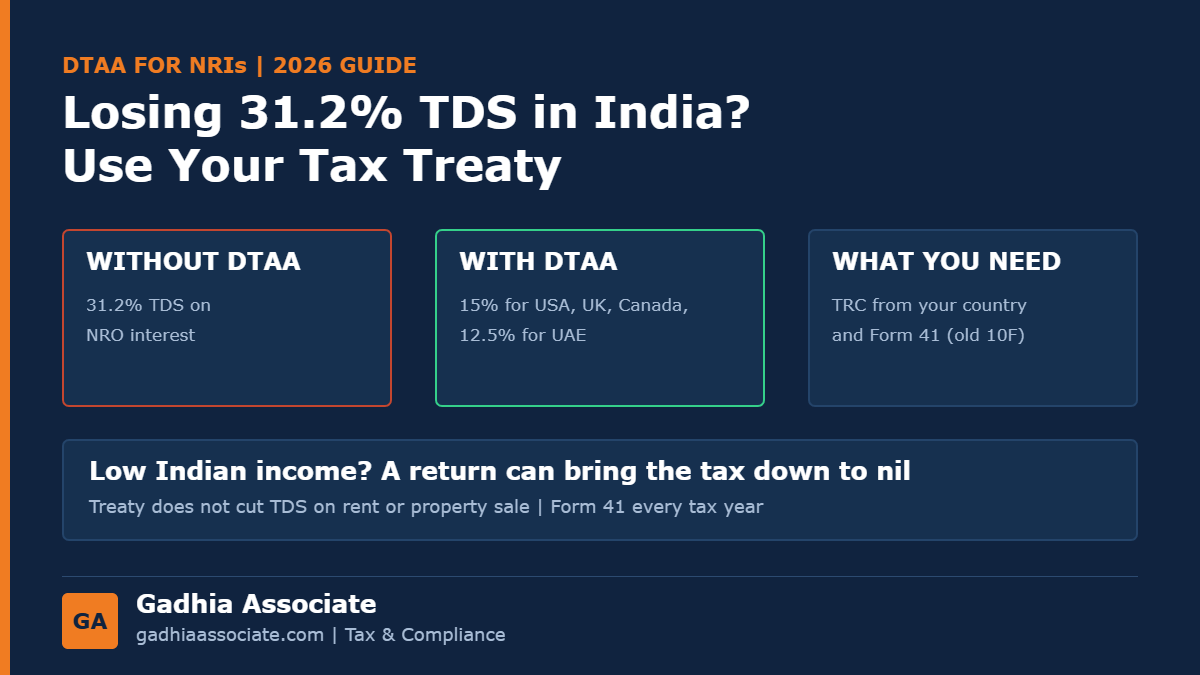
Where the same income is also taxed in your country of residence, the applicable DTAA can reduce or eliminate double taxation — but to claim treaty benefit you generally need a Tax Residency Certificate from your country of residence together with Form 10F, and these must be in place for the relevant year, not created afterwards.
Documents to keep ready
- Passport, visa and residence proof, plus travel dates to establish residential status for each year
- Tax Residency Certificate for the relevant years and Form 10F, if treaty benefit is to be claimed
- Form 26AS and the AIS/TIS download for each year in question
- NRO and NRE bank statements for each financial year
- Property documents — purchase deed, sale deed, improvement bills, brokerage
- TDS certificates (Form 16A / 16B / 16C, or their renumbered equivalents)
- Demat, mutual fund and capital gains statements
- PAN, and details of the bank account you want any refund credited to
Fix the open years before they close — speak to us
Gadhia Associate has been practising since 2007 — more than 18 years — with a 5.0 Google rating from over 100 reviews and 7,000+ clients. Our Junagadh office offers same-day appointments if you are visiting Gujarat, and our NRI Desk runs entirely online for clients across India and time zones, with a dedicated client manager and fixed-fee options quoted upfront for each year filed. The first consultation is free: send us your Form 26AS and AIS and we will map out exactly which years to file and in what order. Call or WhatsApp +91 82005 28355.
Frequently asked questions
Can this really be fixed after so many years?
For most people, yes. Recent years can usually be filed belated or revised, and the updated return covers up to 48 months from the end of the assessment year. Coming forward voluntarily is almost always treated better than being found through AIS matching.
How long does it take and do I need to come to India?
No travel is needed. A typical multi-year clean-up takes two to four weeks once documents are with us — the review of 26AS and AIS takes a few days, and each year's return follows. Everything is done digitally, with calls in your time zone.
What will it cost?
We quote fixed fees per year filed once we have seen your 26AS and AIS, so you know the total before we begin. The separate cost you cannot control is the ITR-U additional tax ladder — which is exactly why acting now is cheaper than acting next year.
What if I do not have documents from ten years ago?
Form 26AS, the AIS and bank statements can usually be reconstructed from the portal and from your bank, and property records from the registrar. Missing paperwork is a common starting position, not a reason to stay unfiled.
This article reflects the position as of September 2026 and is general information, not advice on your particular case. The Income-tax Act, 2025 in force from 1 April 2026 has renumbered provisions and forms, and rules continue to change through CBDT notifications and circulars. Time limits, additional-tax slabs and treaty relief depend on your residential status and the facts of each year, and notice, reassessment and appeal matters may require professional representation. Please take advice before filing or replying.