FAST-DS 2026 Foreign Asset Disclosure Scheme: Last Date 31 December, Who Qualifies, 60% Tax or Rs 1 Lakh Fee and Immunity
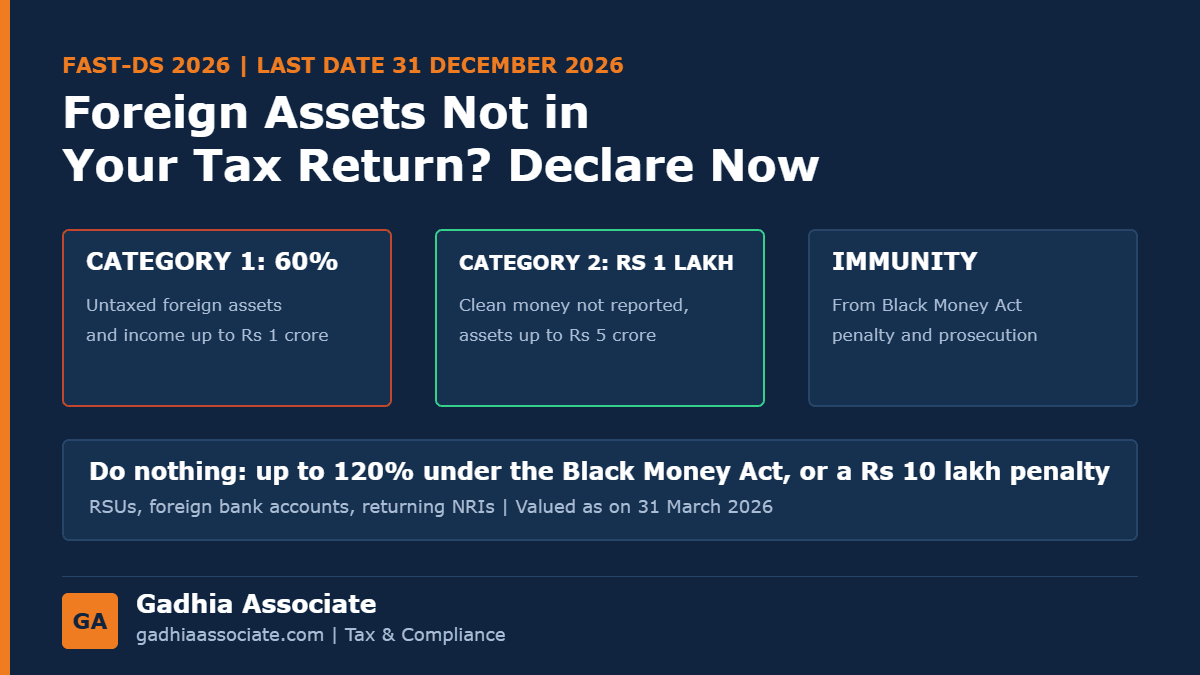
FAST-DS 2026 lets residents declare foreign assets they never reported, by 31 December 2026, for 60% of the value or a Rs 1 lakh fee.
A software engineer from Rajkot worked in California for five years and moved back in 2022. Her old US brokerage account, holding shares from her former employer's stock plan, and a small savings account are still there. She never showed them in her Indian tax return, because she believed that assets bought while she lived abroad had nothing to do with India. Last month an email from the income tax department asked her to look at her "overseas financial interests".
She is exactly the kind of taxpayer the government had in mind when it announced the Foreign Assets of Small Taxpayers Disclosure Scheme, 2026. Here is how the scheme works, what it costs, and why the window that closes on 31 December 2026 matters.
In short: FAST-DS is a one-time scheme under the Finance Act, 2026, open from 16 August to 31 December 2026. It lets you declare foreign assets and foreign income that were not reported in your Indian tax return, in two categories. Category 1 covers undisclosed foreign assets and income up to Rs 1 crore in total, at 30% tax plus an equal additional amount, so 60% of the value. Category 2 covers assets bought from foreign income you earned while you were a non-resident, or from income already taxed in India, that you simply did not report, up to Rs 5 crore, for a flat fee of Rs 1 lakh. In return you get immunity from further tax, penalty and prosecution under the Black Money Act for the financial year 2025-26 and earlier years. If you do nothing, the Black Money Act can take 120% of the value, and a penalty of Rs 10 lakh can apply for not reporting the asset in your return.
We prepare FAST-DS declarations end to end, from choosing the category and valuing the assets to filing Form 1 and getting the certificate, for residents and returning NRIs. The details are at the end of this guide.
What is FAST-DS 2026?
- Full name: the Foreign Assets of Small Taxpayers Disclosure Scheme, 2026, in Chapter IV of the Finance Act, 2026.
- Window: 16 August 2026 to 31 December 2026. No declaration can be filed after 31 December.
- The idea: the Budget described it as a one-time scheme for small taxpayers such as students, young professionals, tech employees and relocated NRIs who hold foreign assets they did not report.
- Rules and FAQs: the rules and forms were notified on 14 August 2026, and the tax department has issued official FAQs.
Who can use it?
- Residents: if you are resident in India, you can use it, even for assets you bought while you were a non-resident. A person who is a non-resident, or not ordinarily resident, today can use it only for income of a year in which they were resident, or for an asset bought in such a year.
- The condition: you did not file a return, or the asset or income was not shown in a return filed before the scheme began, or it has escaped assessment.
- Who cannot: apart from the value limits, only two cases are excluded. Proceeds of crime where money-laundering proceedings have started, and any year for which an assessment under the Black Money Act is already complete.
- A notice does not shut the door: an email or a notice from the department does not by itself make you ineligible. Where an assessment is pending, the officer must take the declaration into account.
If you are not sure whether you were resident in a particular year, our guide to residential status explains the day-count tests.
Category 1 or Category 2: which one fits you?
Category 1: foreign income or assets never taxed in India
- Covers: an asset outside India, held in your name or as beneficial owner, including a financial interest in an entity, whose source you cannot explain, and foreign income that was taxable in India but never offered to tax.
- Limit: the value of the asset and the income together must not exceed Rs 1 crore.
- Cost: 30% tax on the value of the asset and 30% on the income, plus an additional amount equal to that tax. In effect, 60%.
- The official example: a foreign bank account worth Rs 60 lakh and undisclosed income of Rs 20 lakh cost Rs 24 lakh of tax plus an additional Rs 24 lakh, or Rs 48 lakh in all.
Category 2: clean money that was never reported
- Covers: an asset bought from foreign income you earned while you were a non-resident, which you did not show in the foreign assets schedule of your return after you became resident. It also covers an asset bought from income already taxed in India but not shown in that schedule.
- Limit: Rs 5 crore.
- Cost: a flat fee of Rs 1 lakh, with immunity from penalty and prosecution.
For the Rajkot engineer, the shares and savings that came from salary she earned while she was a non-resident fit Category 2, and Rs 1 lakh can close the matter. But shares that vested after she returned, and dividends or gains earned after she became resident, can be income taxable in India, depending on her residential status in each year, and if that income was never taxed they may fall under Category 1. If the income was taxed in India and only the shares were not reported, the shares fit Category 2. Sorting each asset into the right category is where most of the work lies.
How are the assets valued?
- Date: 31 March 2026. The general rule is the higher of cost and market value on that date, but bank accounts and listed shares have their own rules.
- Foreign bank accounts: the total of all deposits made into the account from the day it was opened to 31 March 2026, not the balance on that date. Money moved back in from the same account is left out. This rule can make an old account worth far more than its balance, so work it out carefully.
- Listed shares, including stock from a foreign employer: the average of the highest and lowest price on 31 March 2026.
- Currency: converted at the RBI reference rate on 31 March 2026.
- Some room for error: for assets other than bank accounts, a difference of up to 20% from the fair market value declared does not by itself make the declaration invalid.
What do you get in return?
- Immunity: no further tax, penalty or prosecution under the Black Money Act for the assets and income declared, for the financial year 2025-26 and earlier years.
- Income tax: the income declared is not added to your total income under the Income-tax Act or the Black Money Act.
- A limit on past assessments: you cannot use the declaration to get a completed assessment revised or rectified, or to claim any set-off or relief in it.
- What it does not cover: FEMA. Holding assets abroad has its own exchange control rules, and regularising them is a separate exercise.
What if you do nothing?
- Black Money Act: tax of 30% of the value of an undisclosed foreign asset, plus a penalty of three times that tax. That is 120% of the value.
- Not reporting it in the return: a penalty of Rs 10 lakh for a resident and ordinarily resident who files a return but leaves out a foreign asset or foreign income. Since 1 October 2024 it does not apply where the foreign assets, other than immovable property, add up to no more than Rs 20 lakh.
- Prosecution: possible in serious cases.
The department already has much of the data. Under international information exchange, foreign banks and brokers report accounts held by Indian residents, and since July 2026 a "Foreign Assets Information" report built from this data can be seen under Reports on the compliance portal. In the department's first NUDGE campaign, launched on 17 November 2024, 24,678 taxpayers went back to their returns and disclosed foreign assets of Rs 29,208 crore and foreign income of Rs 1,089.88 crore. A second campaign followed in November 2025. Check what is already reported against your PAN; our guide to AIS and Form 26AS shows how.
How do you file a declaration?
- Form 1: the declaration, filed online on the income tax portal under Income Tax Forms, in the forms under other Acts, with valuation reports and documents. One form can cover several assets and both categories. It is verified by Aadhaar OTP, digital signature or EVC.
- Form 2: the department's order of the amount payable, issued within a month after the end of the month in which you declare.
- Payment: within two months after the end of the month in which you receive Form 2, or within a further two months with simple interest of 1% a month. Miss that, and the benefit of the scheme is lost.
- Form 3: your intimation of payment, with proof.
- Form 4: the certificate, issued within a month after the end of the month in which Form 3 is filed.
Filing a fresh Form 1 makes the earlier one non-actionable, so get it right the first time. File well before 31 December, because the portal gets crowded in the last weeks of every deadline.
Who should look at this now?
- Employees of multinational companies who hold shares or stock options of a foreign parent in an overseas brokerage account
- Students and young professionals who studied or worked abroad and left a bank account open
- Returning NRIs who kept foreign accounts, pensions, insurance or property and did not show them in the return after becoming resident. See our guide on returning to India after years abroad.
- Families who bought a flat or an insurance policy abroad years ago
- Anyone who has received an email or SMS from the department about overseas financial interests
If a notice has already arrived, read our note on income tax notices before you reply, and take advice on whether to file under the scheme first.
How we help
- Review your foreign holdings and past returns, and tell you whether you need FAST-DS at all
- Decide the category, asset by asset
- Work out the value under the scheme's rules, including the deposit-based value of bank accounts
- Prepare and file Form 1, follow up on Form 2, guide the payment and file Form 3
- Get the Form 4 certificate, and set your future returns right, including the foreign assets schedule
- Coordinate the FEMA side with your bank where an asset needs to be regularised
Gadhia Associate has been in practice since 2007 and has handled work for over 7,000 clients, with a 5.0 Google rating from more than 100 reviews. Professionals, business families and returning NRIs from Junagadh, Rajkot and across Gujarat come to our Junagadh office, and the work can be done fully online from anywhere in India or abroad. Our NRI Desk also handles Indian tax work for families living abroad.
Hold anything abroad that is not in your tax return? Talk to us before 31 December 2026. Call or WhatsApp +91 82005 28355, or message us on WhatsApp. The first consultation is free.
Frequently asked questions
What is the last date for FAST-DS 2026?
31 December 2026. No declaration can be filed after that date. The amount is paid after the department's order in Form 2, within the time limits of the scheme.
How much do you pay under FAST-DS?
In Category 1, 30% tax plus an equal additional amount, so 60% of the value of the asset and income, up to Rs 1 crore. In Category 2, a flat fee of Rs 1 lakh, for assets up to Rs 5 crore.
Can a returning NRI use FAST-DS?
Yes. Assets bought from income earned abroad while you were a non-resident, but not reported in your return after you became resident, fall in Category 2, for a fee of Rs 1 lakh, if they are worth no more than Rs 5 crore.
How is a foreign bank account valued under FAST-DS?
At the total of all deposits made into it from the date it was opened to 31 March 2026, not at the balance, converted at the RBI reference rate on 31 March 2026.
Does FAST-DS give immunity from prosecution?
Yes, under the Black Money Act, for the assets and income declared, for the financial year 2025-26 and earlier years, once the amount is paid in time. It does not cover FEMA.
What happens if I do not declare a foreign asset?
Under the Black Money Act, tax of 30% and a penalty of three times the tax can apply, 120% of the value, along with a penalty of Rs 10 lakh for not reporting it in your return, unless the relief for small assets applies.
Position as of 10 October 2026. The scheme is new, and the department's FAQs may be updated. The category and the value depend on your own facts. Take advice before you file.