NRI Buying Property in India 2026: FEMA Rules, Paying from NRE or NRO, Home Loan, TDS, Stamp Duty in Gujarat and Repatriation
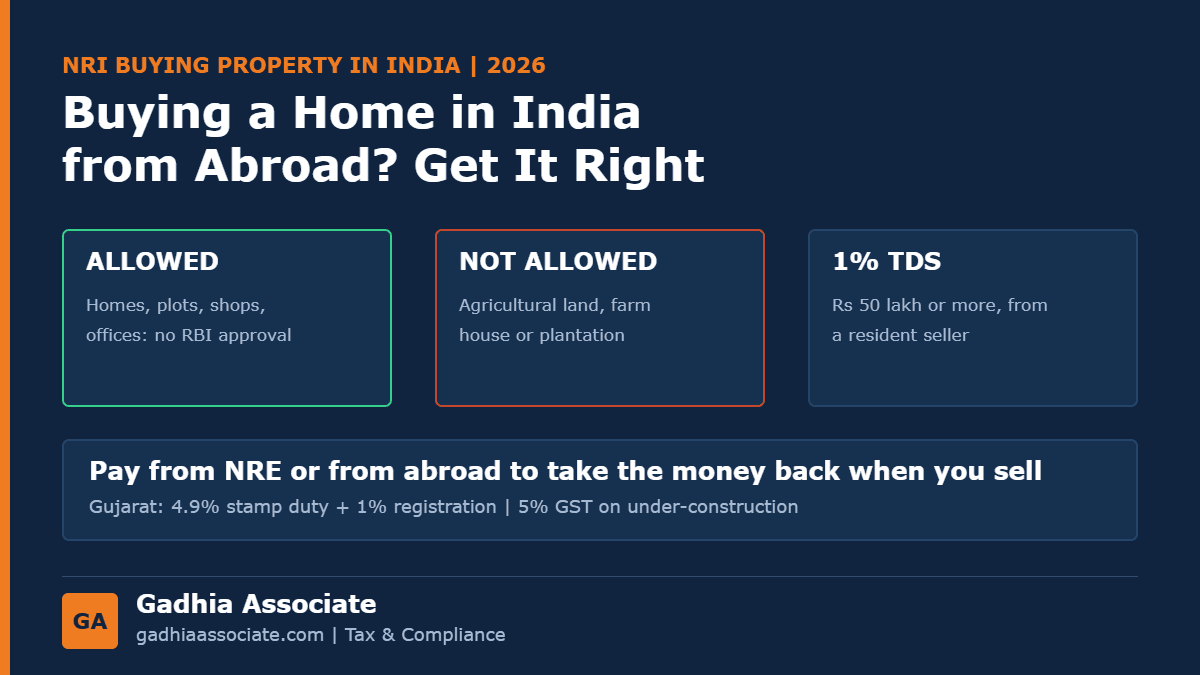
NRIs buying property in India need no RBI approval for a home, plot, shop or office, but cannot buy agricultural land, a farmhouse or plantation.
Hetal is a nurse in Perth. She has booked a three-bedroom flat in an under-construction project in Rajkot for Rs 72 lakh, payable in instalments as the building goes up. She plans to pay the first instalment from her NRO account, where the rent from her old flat collects, and her brother will sign the papers here. Nobody has mentioned TDS, and nobody has asked which account the money should come from.
Those two questions decide what she pays now and what she can take back to Australia when she sells. Here is how buying property in India works for an NRI in 2026, from the rules to the payments and the paperwork.
In short: Under FEMA, an NRI or OCI can buy any number of homes, plots, shops or offices in India, with no RBI approval and no reporting, but not agricultural land, a farmhouse or plantation property. Pay through the bank, from abroad or from an NRE, FCNR or NRO account, and never in cash. Money paid from abroad or from an NRE or FCNR account can be taken back when you sell, for up to two homes. If the price or the stamp duty value is Rs 50 lakh or more and the seller is a resident, you deduct 1% TDS and pay it with Form 141, using your PAN. If the seller is an NRI, the TDS is far higher and you need a TAN. In Gujarat, stamp duty is 4.9% and the registration fee 1%, and an under-construction flat also carries 5% GST.
Our NRI Desk handles the TDS, the tax paperwork and the planning for the day you sell, for NRIs buying from any country. The details are at the end of this guide.
What can an NRI or OCI buy in India?
- Allowed: a house, flat, plot, shop or office, ready or under construction, alone or jointly.
- No limit and no approval: there is no cap on the number of properties, and nothing to file with the RBI.
- Not allowed: agricultural land, a farmhouse or plantation property. These can come to an NRI only by inheritance. See NRI inherited property.
- OCI cardholders: the same rules as NRIs.
- Foreign citizens without an OCI card: if they live abroad, they generally cannot buy. The exception is one property bought jointly with an NRI or OCI spouse, where the marriage is registered and has lasted at least two years, the money comes through the bank, and the spouse is not a citizen of a country such as Pakistan or China.
Which account should you pay from?
This is the choice that matters most later, when you sell.
- From abroad, or from an NRE or FCNR account: when you sell, you can take back what you paid this way, for up to two residential properties. Home loan instalments paid from these sources count too.
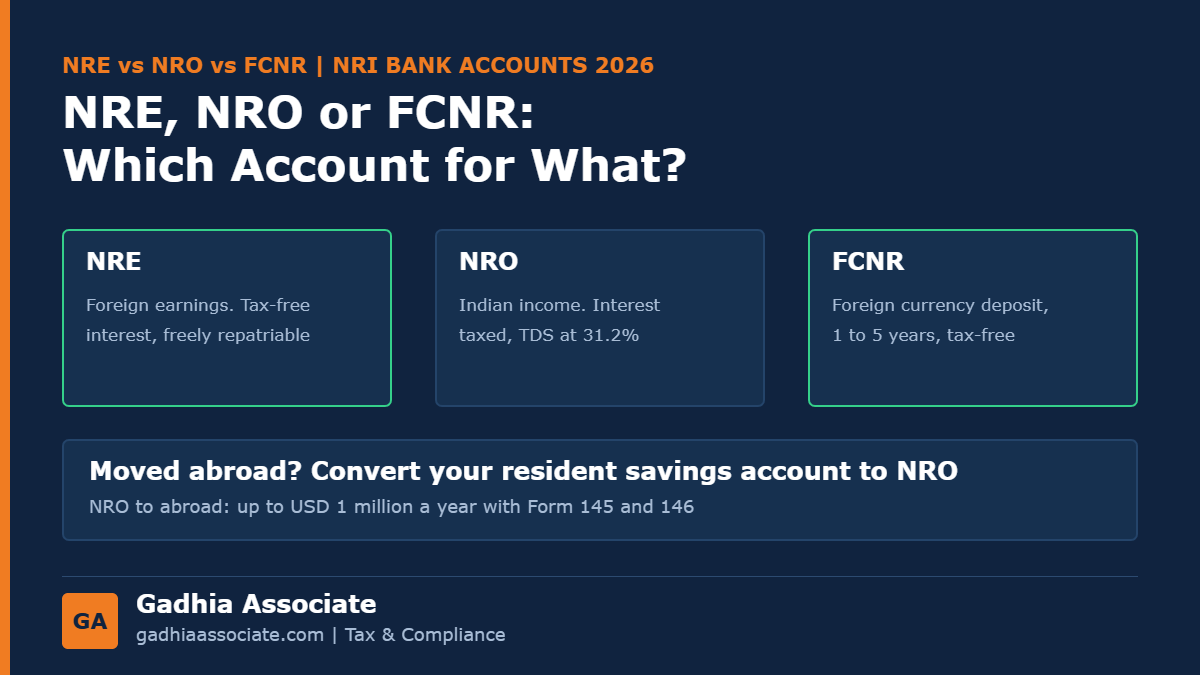
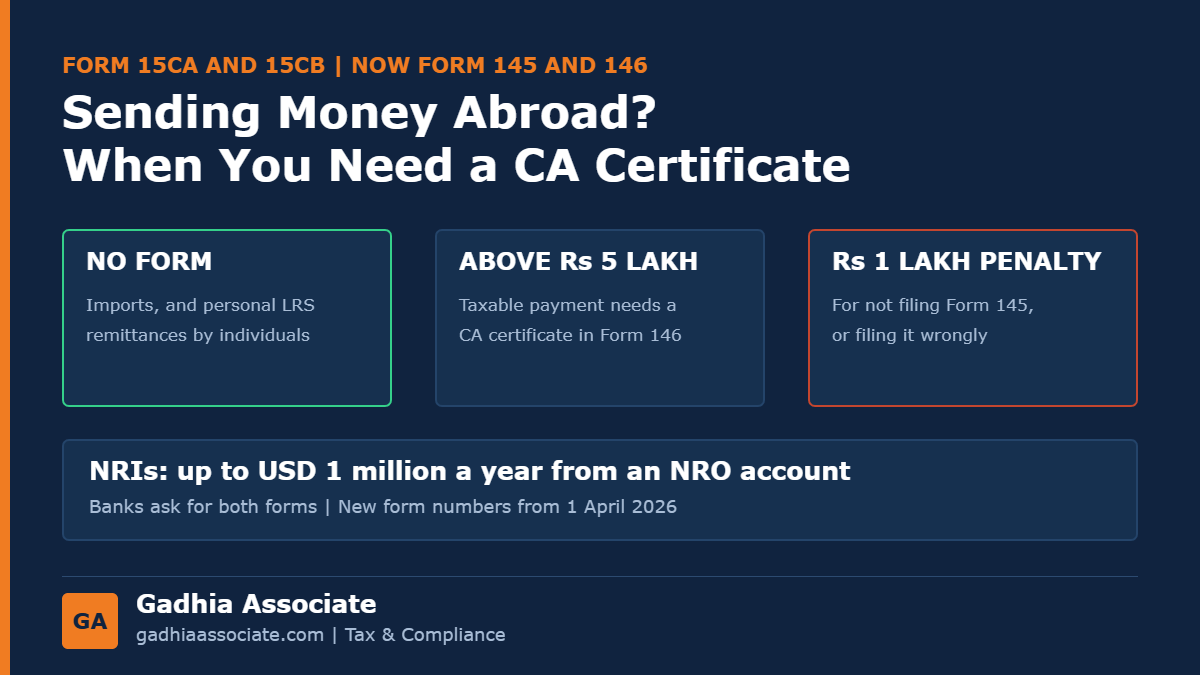
- From an NRO account: allowed, but the sale money can then go abroad only within the USD 1 million a year limit for NRO funds, after tax, with Form 145 and Form 146.
- Not allowed: cash, foreign currency notes and traveller's cheques.
- Keep the proof: the bank's certificate for every remittance and the account statements, because the bank will ask for them when the money goes back.
Hetal's NRO payment is legal. But if she pays from her NRE account, or sends the money straight from Australia, she can take that amount back when she sells without using up the NRO limit. Our guide to NRE, NRO and FCNR accounts explains the difference.
Can an NRI get a home loan in India?
- Yes: banks and housing finance companies lend to NRIs and OCIs to buy a home in India. The loan is usually paid straight to the builder or seller, and it cannot be credited to your NRE or FCNR account.
- Repayment: from abroad, from your NRE, FCNR or NRO account, from the rent of that property, or by a relative in India paying into the loan account.
- When you sell: instalments paid from abroad or from NRE or FCNR count as money paid in foreign exchange, so they can be taken back.
- Tax benefit: under the old regime, interest of up to Rs 2 lakh a year on a home you keep for yourself, even if it stays locked while you live abroad. The home must be completed within five years from the end of the year of the loan, and interest paid during construction is claimed in five equal parts from the year it is ready, within the same Rs 2 lakh. Principal, stamp duty and registration count towards the overall Rs 1.5 lakh limit of section 123, the old 80C. On a let-out home, the interest is deducted from the rent under either regime, but a loss cannot reduce your other income under the new regime, and only up to Rs 2 lakh of it can under the old regime. See home loan tax benefit in the new regime.
Do you have to deduct TDS when you buy?
In most cases, yes. The buyer deducts it, and the buyer is the one the tax department comes after if it goes wrong.
Buying from a builder or a resident seller:
- When: if the price or the stamp duty value is Rs 50 lakh or more, counting all buyers and sellers together.
- How much: 1% of every payment, including the booking amount. If the stamp duty value is higher than the price, TDS is worked out on that value.
- How: online, with Form 141, which replaced Form 26QB, using your PAN. You do not need a TAN. Joint buyers each file their own form.
- By when: within 30 days from the end of the month of payment. Then download Form 132, the old Form 16B, from TRACES and give it to the seller within 15 days of that due date.
On Hetal's Rs 72 lakh flat, the TDS is Rs 72,000 in all, 1% of each instalment as she pays it. Our guides to TDS on buying property and to the TDS mistakes that bring notices later cover the details, which are the same for an NRI buyer.
Buying from an NRI seller:
- No minimum: TDS applies whatever the price.
- How much: 12.5% plus surcharge and cess on the full price if the seller has held the property for more than 24 months, and 30% plus surcharge and cess if not, unless the seller gives you a lower deduction certificate.
- TAN: the PAN-only route that began on 1 October 2026 is only for resident individuals and HUFs. An NRI buyer still needs a TAN, deposits the TDS by the 7th of the next month, or by 30 April for March, files Form 144 every quarter and gives the seller Form 131.
- An example: on a resale flat bought for Rs 80 lakh from an NRI who has owned it for more than 24 months, the TDS without a certificate is 14.3% (12.5% plus 10% surcharge and 4% cess), or Rs 11.44 lakh. If the seller has owned it for 24 months or less, it is 34.32%, or about Rs 27.46 lakh.
A buyer who does not deduct is treated as being in default, and the tax, interest and fees can be recovered from the buyer. The seller's side is in our guide for an NRI selling property in India.
What does it cost in Gujarat?
- Stamp duty: 4.9% of the price or the jantri value, whichever is higher.
- Registration fee: 1%, which is waived when the property is registered only in the names of women.
- GST: 5% on an under-construction flat, or 1% on an affordable home, which outside the metros means up to 90 square metres of carpet area and a price of up to Rs 45 lakh. There is no GST on a ready flat where the whole price is paid after the completion certificate.
- Buying below the jantri value: if the jantri value is higher than the price by more than 10% of the price, the difference is taxed as your income. If you paid part of the price through the bank by the date of the agreement, the jantri value on that date is used.
- Under-construction projects: check the project's RERA registration and the builder's promised dates. See RERA 2.0 in 2026.
Can you buy without coming to India?
- Power of attorney: give one to a family member, signed at the Indian consulate, or before a local notary and then apostilled. In countries that do not use the apostille, such as the UAE, sign it at the Indian consulate or have the notarised copy attested by the Indian mission. In Gujarat, it must be stamped within three months of reaching the state.
- PAN: needed for the TDS form, and to be quoted for any purchase above Rs 20 lakh. You can apply from abroad.
- KYC: the builder and the bank will ask for your passport, your visa or OCI card, and proof of your address abroad.
With these in place, your attorney can sign the agreement and register the sale deed for you, and you can make every payment from abroad.
What happens when you let it out or sell it?
- Rent: your tenant must deduct 31.2% TDS from the rent. See NRI rental income.
- Tax where you live: many countries tax the rent and the gain on sale too, with credit for the Indian tax. See DTAA for NRIs.
- Selling: after 24 months, the gain is taxed at 12.5% plus surcharge and cess, with no indexation for an NRI. The buyer deducts TDS on the full price at that rate, or at the lower rate in your certificate if you get one in Form 128 before the sale. Keep the receipts for stamp duty, registration and brokerage, because they add to your cost. See NRI selling property in India and our capital gains tax calculator.
- Taking the money abroad: what you paid in foreign exchange, for up to two homes, and the rest within USD 1 million a year from your NRO account, with Form 145 and Form 146. See Form 145 and Form 146.
How our NRI Desk helps
- Check the FEMA position and the right account to pay from, before you pay the booking amount
- Deduct and deposit TDS on every instalment with Form 141, and issue Form 132 to the seller
- Get a TAN and handle Form 144 and Form 131 when you buy from an NRI
- Check the price against the jantri value, and the agreement for the tax points
- Apply for your PAN, and keep the payment record you will need when you sell
- File your Indian return once the property earns rent
Title checks, the agreement and the sale deed are legal work. We handle the tax, FEMA and banking side, and work with your advocate on the rest.
How it works from abroad: a first call at a time that suits your time zone, a clear fixed fee before we start, documents shared on WhatsApp or email, and one person who handles your file from start to finish. No visit to India is needed for the tax work. See everything our NRI Desk does.
Gadhia Associate has been in practice since 2007 and has handled work for over 7,000 clients, with a 5.0 Google rating from more than 100 reviews. From our office in Junagadh, Gujarat, the NRI Desk works with NRIs in the UK, the USA, Canada, the UAE and the Gulf, Australia, Singapore and Africa.
Buying property in India from abroad? Talk to us before you pay the booking amount. Call or WhatsApp +91 82005 28355, or message us on WhatsApp. The first consultation is free.
Frequently asked questions
Can an NRI buy property in India?
Yes. An NRI or OCI can buy any number of houses, flats, plots, shops or offices in India without RBI approval. Agricultural land, farmhouses and plantation property are not allowed.
Does an NRI have to deduct TDS when buying property?
Yes. From a resident seller, 1% if the price or stamp duty value is Rs 50 lakh or more, paid with Form 141 using a PAN. From an NRI seller, 12.5% plus surcharge and cess on the whole price if the seller has owned it for more than 24 months, or 30% plus surcharge and cess if not, with a TAN, unless the seller has a lower deduction certificate.
Can an NRI pay for property from an NRO account?
Yes. But money paid from NRO can go abroad after a sale only within the USD 1 million a year limit. Money paid from abroad or from NRE or FCNR can be taken back, for up to two homes.
Can an NRI get a home loan in India?
Yes, from Indian banks and housing finance companies, repaid from abroad, from an NRE, NRO or FCNR account, or from the rent of the property.
Can an OCI cardholder buy property in India?
Yes, on the same terms as an NRI. Agricultural land, farmhouses and plantation property are not allowed.
Does an NRI need to come to India to buy property?
No. A power of attorney to a family member, signed at the Indian consulate or before a notary abroad and then apostilled or attested, and stamped in Gujarat within three months of arriving here, lets them sign and register the purchase.
Position as of 8 October 2026. FEMA rules, stamp duty and GST depend on the property and the state, and TDS depends on whether the seller is a resident. Take advice on your own facts before you pay.