NRI Gift Tax in India 2026: Gifts to and from NRIs, Money, Property and Shares, the Relatives List, FEMA Limits and Paperwork
NRI gift tax in India is simple at the core: gifts between close relatives are tax-free, and gifts from others above Rs 50,000 are taxed.
A retired teacher in Junagadh wants to send Rs 30 lakh to his son in London for a house deposit. In the same week, his daughter in Sydney wants to gift her share in the family flat to her brother, and a family friend in Dubai wants to send Rs 2 lakh for a wedding. Three gifts, and three different answers on tax, bank limits and paperwork.
Two laws apply to every gift that crosses the border. Income tax decides whether the gift is taxed. FEMA decides whether, and how, the money or property can move. Here is how both work in 2026.
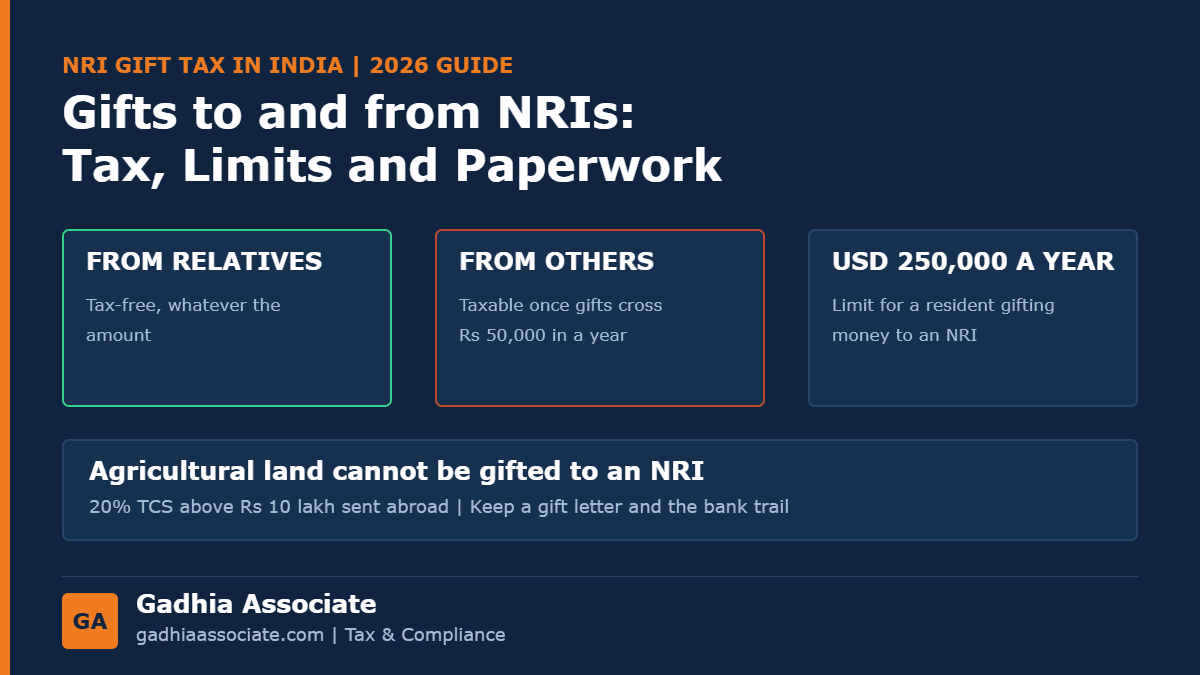
In short: For income tax, a gift from a relative, such as a parent, spouse, child, brother or sister, is fully exempt, whatever the amount and wherever the two of you live. A gift from anyone else is taxed in the hands of the person receiving it once such gifts cross Rs 50,000 in the year, and that includes an NRI who receives money from a resident. For the bank, FEMA decides. A resident can gift up to USD 250,000 a year to an NRI relative, with TCS at 20% on amounts above Rs 10 lakh sent abroad, while an NRI can gift money to family in India without limit. Property and shares have their own rules, and agricultural land cannot be gifted to an NRI at all.
Our NRI Desk checks the tax and FEMA position before a gift is made, and handles the paperwork, for families with members in any country. The details are at the end of this guide.
When is a gift taxable in India?
- From a relative: exempt, without any limit. Relatives are your spouse; your brothers and sisters and your spouse's; your parents' brothers and sisters; your parents, grandparents, children and grandchildren, and your spouse's; and the spouses of all of these.
- Who is not a relative: cousins, friends, and a nephew or niece giving to an uncle or aunt.
- From anyone else: if such gifts add up to more than Rs 50,000 in a year, the whole amount is taxed as the receiver's income.
- Always exempt: gifts on your own marriage, and anything received under a will or by inheritance. See NRI inherited property.
- NRIs receiving gifts: since 5 July 2019, money gifted by a resident to a non-resident who is not a relative, above Rs 50,000 in a year, is taxed in India in the NRI's hands.
Our guide on whether a gift is taxable in India has the full list and the rules for property.
How do the rules work in common cases?
- Father in Junagadh gifts Rs 30 lakh to his son in London. Tax-free, because a parent is a relative. It is within the USD 250,000 limit. The bank collects TCS of 20% on the Rs 20 lakh above the Rs 10 lakh threshold, which is Rs 4 lakh, and the father gets that back as a credit in his own tax return. See TCS on foreign remittance.
- Daughter in Sydney gifts her share in the family flat to her brother. Tax-free for him, and allowed under FEMA because a brother is a close relative. It needs a registered gift deed, and stamp duty is payable.
- A friend in Dubai sends Rs 2 lakh for a wedding. Tax-free for the bride or groom, as a gift on marriage. For anyone else in the family, it is taxable, because it is above Rs 50,000 and a friend is not a relative.
- Son in London sends Rs 10 lakh to his mother in India. Tax-free. There is no FEMA limit. It should come through the bank, from abroad or from his NRE or NRO account.
- A resident gifts Rs 5 lakh to an NRI friend. Taxable in India in the NRI's hands at the slab rates, unless the tax treaty with his country says otherwise. The giver has to deduct TDS before sending it, and file Form 145.
What does FEMA allow for gifts of money?
- Resident to NRI: up to USD 250,000 in a financial year under the Liberalised Remittance Scheme, counted together with everything else that person sends abroad that year. It can be remitted abroad, or transferred in rupees to the NRO account of an NRI who is a close relative.
- NRI to resident: no limit. Use the bank, and keep the remittance advice.
- If the giver holds a foreign passport: this includes OCI cardholders. A relative in India who receives more than Rs 10 lakh from such a person in a financial year must report it to the Home Ministry in Form FC-1 within three months.
- Cash: avoid it. Receiving Rs 2 lakh or more in cash, even as a gift, attracts a penalty equal to the amount.
- Forms: a gift sent abroad by a resident individual under the scheme does not need Form 145 where it is not taxable. See Form 15CA and 15CB, now Form 145 and 146.
A narrower list of relatives: for rupee gifts into an NRO account, and for gifts of property and shares, FEMA counts only your spouse, parents, children and their spouses, and brothers and sisters. A grandparent, uncle or aunt is a relative for income tax but not for FEMA. Check before such a gift is made to an NRI.
Money received by an NRI in India goes into the NRO account. Our guide to NRE, NRO and FCNR accounts explains how it can be taken abroad later.
Can property be gifted to or by an NRI?
- To an NRI or OCI: a house, flat, shop or plot can be gifted by a relative on that narrower list, whether resident or NRI. Agricultural land, a farmhouse or plantation property cannot be gifted to an NRI or OCI.
- By an NRI: a house, flat, shop or plot can be gifted to a resident, or to an NRI or OCI. Agricultural land can be gifted only to a person resident in India, who in Gujarat must generally be an agriculturist.
- Gift deed and stamp duty: a gift of property needs a registered gift deed, with stamp duty on the market value. Our note on gift deed or will covers the position in Gujarat.
- When it is sold later: the receiver takes over the giver's cost and holding period, and capital gains tax is worked out on that basis.
What about gifts of shares?
- NRI to resident: allowed.
- Resident to an NRI relative: needs prior approval from the RBI, and is limited to USD 50,000 in a year and 5% of the company's capital.
- Tax: exempt between relatives, with the giver's cost and holding period carried over.
Clubbing: when the income is taxed in someone else's hands
- The rule: if you gift to your spouse or your son's wife, the income earned on that gift is added to your income. A minor child's income, whoever made the gift, is added to the income of the parent who earns more.
- A common case: an NRI gifts money to his wife in India and she puts it in fixed deposits. The interest is taxed in his hands in India.
- Where it does not apply: gifts to parents, adult children, brothers and sisters.
What paperwork should you keep?
- A signed gift letter or deed, with the names, relationship, amount, date and mode of transfer, accepted by the receiver.
- The bank trail on both sides, and proof of the giver's source, such as a bank statement or tax return.
- For property, the registered gift deed.
- An entry in the receiver's tax return where one is filed.
- The rules of the other country. The USA, for example, asks for Form 3520 when gifts from abroad cross USD 100,000 in a year.
How our NRI Desk helps
- Check whether a planned gift is taxable in India, for the giver and for the receiver
- Check the FEMA route and limit before the money or property moves
- Prepare the gift letter and the record the bank will ask for
- Handle the TCS credit, and Form 145 and Form 146 where they are needed
- Plan gifts so that clubbing does not undo the tax saving
- Report the gift correctly in the tax returns of both sides
How it works from abroad: a first call at a time that suits your time zone, a clear fixed fee before we start, documents shared on WhatsApp or email, and one person who handles your file from start to finish. No visit to India is needed. See everything our NRI Desk does.
Gadhia Associate has been in practice since 2007 and has handled work for over 7,000 clients, with a 5.0 Google rating from more than 100 reviews. From our office in Junagadh, Gujarat, the NRI Desk works with NRIs in the UK, the USA, Canada, the UAE and the Gulf, Australia, Singapore and Africa.
Planning a gift between India and abroad? Check before the money moves. Call or WhatsApp +91 82005 28355, or message us on WhatsApp. The first consultation is free.
Frequently asked questions
Is a gift from an NRI to a resident Indian taxable?
Not if the NRI is a relative. From a non-relative, it is taxable once such gifts cross Rs 50,000 in a year.
Is a gift from parents in India to an NRI child taxable?
No. Parents are relatives, so the gift is exempt in India, whatever the amount.
How much money can be gifted to an NRI?
A resident can gift up to USD 250,000 in a financial year under the Liberalised Remittance Scheme. TCS at 20% applies on amounts above Rs 10 lakh a year sent abroad.
Can an NRI gift property to a relative in India?
Yes. A house, flat, shop or plot can be gifted. Agricultural land can be gifted only to a person resident in India.
Can agricultural land be gifted to an NRI?
No. An NRI can inherit agricultural land, but cannot receive it as a gift or buy it.
Is a gift deed necessary for a gift of money?
Not by law. But a signed gift letter and a clear bank trail are what the tax officer and the bank will ask for.
Position as of 6 October 2026. Gift tax, FEMA limits and stamp duty depend on the relationship, the asset and the countries involved. Take advice on your own facts before you make a large gift.