Form 15CA and 15CB Are Now Form 145 and 146: When You Need a CA Certificate to Send Money Abroad, NRO Repatriation and TDS in 2026
Form 15CA and 15CB, now Form 145 and Form 146, are the declaration and CA certificate a bank needs before it sends money to a non-resident.
An engineer from Junagadh, settled in Toronto, sells his late father's flat in Rajkot for Rs 85 lakh. The buyer deducts TDS and the balance lands in his NRO account. He asks the bank to send it to Canada, and the bank asks for two things he has never heard of: Form 145 and Form 146. A Morbi tile exporter hears the same words that week, when he tries to pay a 4% commission to his agent in Kenya.
Until March 2026 these were Form 15CA and Form 15CB. The numbers have changed and the idea has not: before money leaves India for a non-resident, the tax department wants to know what it is for, and whether Indian tax on it has been paid. Here is when the forms apply, when a chartered accountant's certificate is needed, and what a mistake costs.
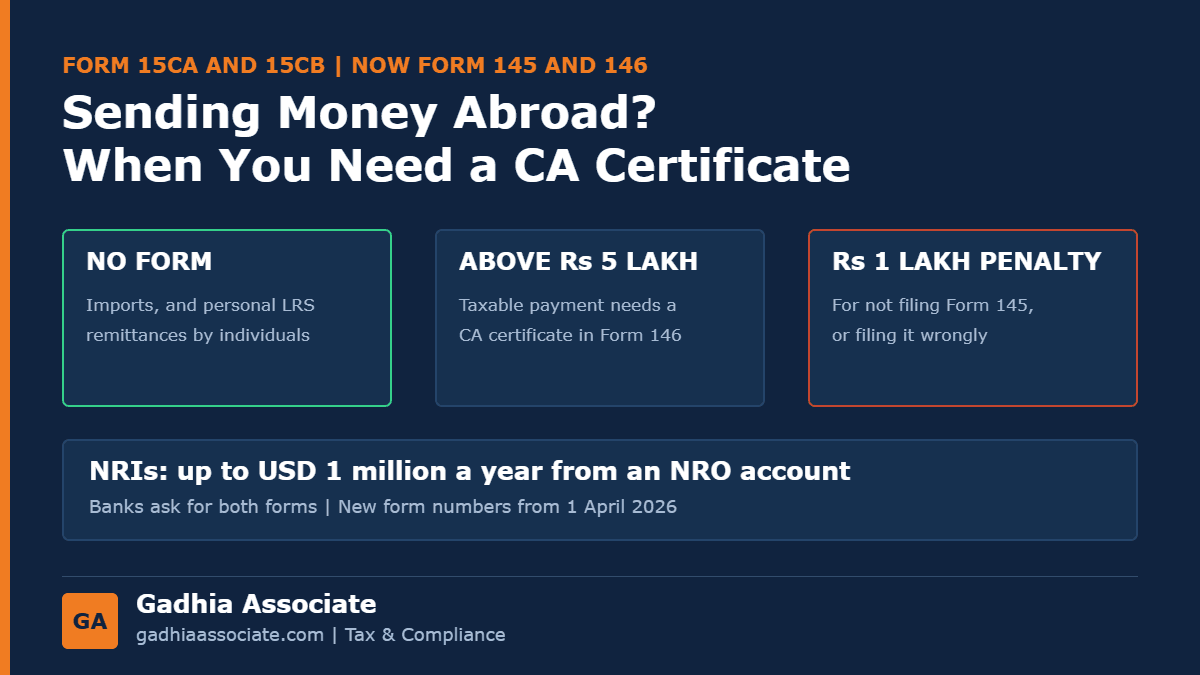
In short: From 1 April 2026, under Section 397(3)(d) of the Income-tax Act, 2025 and Rule 220, a person making a payment to a non-resident files Form 145 online before the remittance. If the payment is taxable in India and such payments cross Rs 5 lakh in the tax year, a chartered accountant must first certify the nature of the payment, the tax treaty position and the TDS in Form 146, unless the Assessing Officer has issued a certificate. Payments that are not taxable go in Part D of Form 145. Most personal remittances by resident individuals under the LRS, and a list of 33 purposes such as imports, need no form at all. An NRI can take up to USD 1 million a year out of an NRO account, and banks ask for both forms. Not filing, or filing wrongly, carries a penalty of Rs 1 lakh.
What changed on 1 April 2026?
- Form 15CA is now Form 145, the payer's online declaration.
- Form 15CB is now Form 146, the chartered accountant's certificate. It now carries the CA's UDIN, which the portal checks.
- Section 195 is now Section 393, and Rule 37BB is now Rule 220.
- Form 10F is now Form 41, which the foreign party files to claim the benefit of a tax treaty.
- Form 27Q is now Form 144, the quarterly TDS return for payments to non-residents. Our note on the new TDS return forms covers the rest.
Banks, accountants and most websites still say 15CA and 15CB. They mean the same thing.
Which part of Form 145 applies to you?
- Part A: the payment is taxable, and such payments do not exceed Rs 5 lakh in the tax year. A self-declaration, with no CA certificate.
- Part B: taxable and above Rs 5 lakh, where you hold a certificate or order from the Assessing Officer fixing the tax to be deducted.
- Part C: taxable and above Rs 5 lakh, with no such certificate. This needs Form 146 from a chartered accountant first.
- Part D: the payment is not taxable in India. A self-declaration.
The Rs 5 lakh limit is for the whole tax year, not for each payment. A fourth payment of Rs 1.5 lakh crosses it just as a single payment of Rs 6 lakh does.
When is no form needed?
- Personal remittances under the LRS: money sent abroad by a resident individual for education, travel, medical treatment, gifts or maintenance of relatives. TCS can still apply, as our guide to TCS on foreign remittance explains.
- The list of 33 purposes: the most common is payment for import of goods.
Both exemptions are for money that is not taxable in India. A payment for services does not escape the form only because an individual is making it.
What does the chartered accountant certify in Form 146?
- The nature of the payment: business income, royalty, fees for technical services, interest, dividend, capital gains, or the return of a person's own money.
- Whether it is taxable in India under the Act.
- Whether a tax treaty gives a lower rate or an exemption. For this, the foreign party must give a tax residency certificate and file Form 41.
- The rate and amount of TDS, and that it has been deducted and paid.
The order matters: Form 146 first, then Form 145 quoting its acknowledgment number, then the bank's own Form A2. Each remittance needs its own forms.
NRIs: taking money out of an NRO account
- NRE and FCNR balances can be sent abroad freely. NRO balances are different.
- The limit: an NRI can repatriate up to USD 1 million in a financial year from an NRO account, including sale proceeds of property, inherited money and savings, after Indian tax is paid.
- The forms: banks ask for Form 145 and Form 146 for these transfers, because the certificate is their proof that tax on the money has been dealt with.
- The papers behind the money: the sale deed, TDS certificates and capital gains working for a property sale; the will or succession papers for an inheritance; bank statements and tax returns for savings.
- Excess TDS: if the buyer deducted tax on the full sale price, the excess comes back only through the income tax return. Planning before the sale avoids this, as our guide for an NRI selling property in India explains.
For the engineer in Toronto, that means the sale deed, the buyer's TDS certificate, a capital gains computation and Form 146, before the bank moves a rupee. Those moving the other way will find our guide on returning to India after years abroad more useful.
Businesses: the common payments to foreign parties
- Import of goods: on the exempt list. No form.
- Commission to a foreign agent for orders procured abroad: usually not taxable in India, where the agent works outside India and has no base here. It goes in Part D, though many banks still ask for a CA's certificate.
- Fees to a foreign consultant, designer or technical expert: usually taxable. TDS is 20% plus surcharge and cess under the Act, or the lower treaty rate where the papers are in order.
- Software, subscriptions and cloud services: the answer depends on the contract and the treaty, and is often different from what the vendor's invoice assumes.
- Interest on a foreign loan, or dividend to a foreign or NRI shareholder: taxable, at the Act rate or the treaty rate.
- Rent paid to an NRI landlord: tax is deducted at non-resident rates on the whole rent, with no threshold.
For the Morbi exporter, the commission to his agent in Kenya will normally go in Part D, supported by the agency agreement and proof that the agent works abroad.
What does a mistake cost?
- A penalty of Rs 1 lakh under Section 462 for not filing Form 145, or for filing wrong information.
- The bank will not send the money without the forms.
- If tax was not deducted where it should have been, the payer is treated as in default: the tax, interest of 1% to 1.5% a month, a possible penalty equal to the tax, and the loss of the deduction for the expense.
The costly mistakes are the quiet ones: using Part D for a payment that was taxable, or not noticing that the year's payments had crossed Rs 5 lakh.
What we do for you
- Examine the payment and tell you whether it is taxable, and at what rate under the Act and the treaty
- Issue the certificate in Form 146 and file Form 145
- Collect and check the tax residency certificate and Form 41 from the foreign party
- Apply for a lower or nil deduction certificate where the tax would otherwise be excessive
- Deposit the TDS and file the quarterly return in Form 144
- Handle NRO repatriation for NRIs: capital gains working, certificate, return filing and refund
Gadhia Associate has been in practice since 2007 and has handled work for over 7,000 clients across Saurashtra and Gujarat, with a 5.0 Google rating from more than 100 reviews. NRIs with family in Junagadh, Rajkot, Porbandar, Keshod and Veraval, and exporters and businesses across Saurashtra, come to our Junagadh office, where same-day appointments are available. Both forms are filed online, so the work can be done from anywhere in the world. Fixed-fee plans are available.
Is your bank asking for Form 15CA and 15CB? Call +91 82005 28355 or message us on WhatsApp. The first consultation is free.
Frequently asked questions
What are Form 145 and Form 146?
The new names of Form 15CA and Form 15CB from 1 April 2026: the payer's online declaration and the chartered accountant's certificate for a payment to a non-resident.
When is a CA certificate in Form 15CB or Form 146 required?
When the payment is taxable in India and such payments exceed Rs 5 lakh in the tax year, unless the Assessing Officer has issued a certificate for it.
Is Form 15CA needed to send money to a child studying abroad?
No. A resident individual's remittance under the LRS for education, maintenance or gifts needs no Form 145, though TCS can apply above Rs 10 lakh.
How much can an NRI transfer from an NRO account?
Up to USD 1 million in a financial year, after tax, with Form 145 and Form 146.
Is Form 15CA required for import payments?
No. Payment for import of goods is on the list of 33 purposes that need no form.
What is the penalty for not filing Form 15CA or Form 145?
Rs 1 lakh under Section 462 of the Income-tax Act, 2025, apart from the consequences of not deducting tax.
Position as of 6 October 2026. Whether a payment is taxable depends on the contract, the facts and the tax treaty with the other country, and banks differ in what they ask for. Take advice on your own remittance before you pay.