TDS Return for Q2 2026-27: Form 138 and Form 140 Replace 24Q and 26Q, New Payment Codes and the 31 October Deadline
Your TDS return for July to September 2026 is due on 31 October, and it is only the second one most businesses will file in new Forms 138 and 140.
The first one, in July, was a lesson. Accountants who had filed 24Q and 26Q for fifteen years opened the utility, typed 194C against the contractor and 194J against the engineer out of habit, and watched the return fail validation. Challans paid in April with the old section selected refused to match. Digital signatures that worked perfectly last year had to be registered again. Some deductors who filed on time are now looking at late fee intimations because the return was rejected weeks later.
None of this is difficult once you know what changed. This article explains the new forms, the new payment codes, the dates, and a checklist for getting the Q2 return right the first time.
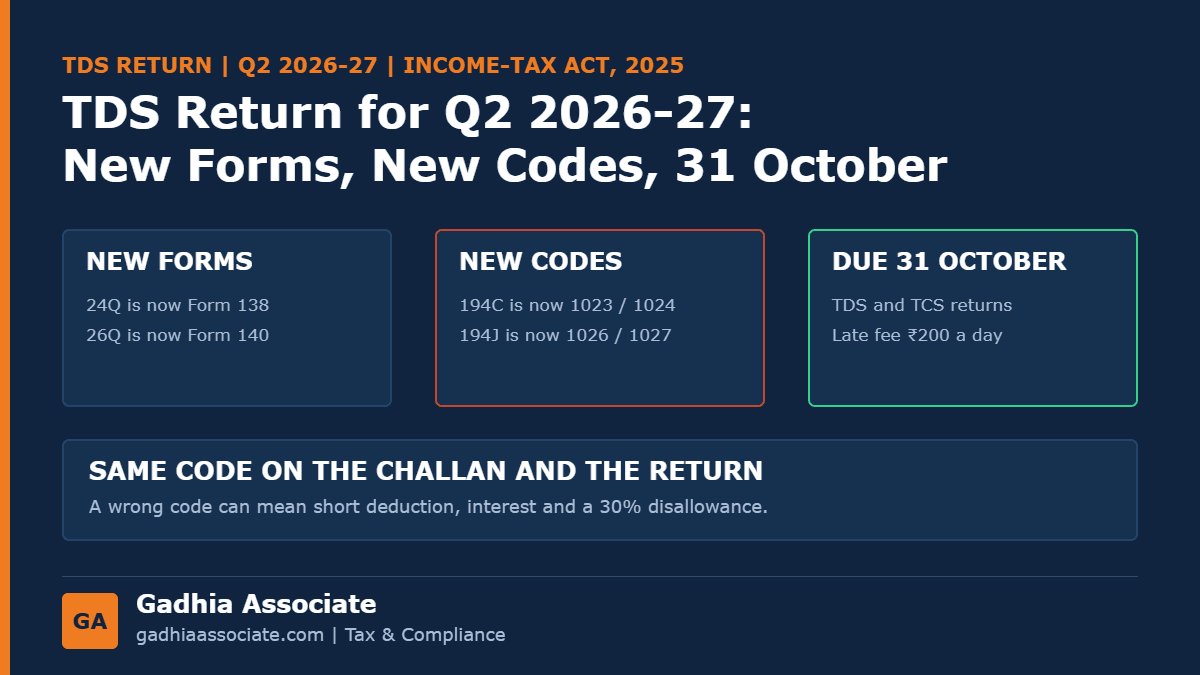
Short answer: From 1 April 2026, TDS and TCS are governed by the Income-tax Act, 2025. The quarterly returns now use new forms: Form 138 for salary (earlier 24Q), Form 140 for other payments to residents (earlier 26Q), Form 144 for payments to non-residents (earlier 27Q) and Form 143 for TCS (earlier 27EQ). Section numbers such as 194C and 194J have been replaced by four-digit payment codes, for example 1023 and 1024 for contractors and 1027 for professional fees, and the code must be the same on the challan and in the return. The Q2 return for July to September 2026 is due on 31 October 2026, and the TCS return now has the same date. The late fee is still Rs 200 a day.
What exactly changed from 1 April 2026?
The Income-tax Act, 1961 was replaced by the Income-tax Act, 2025 from 1 April 2026. TDS on salary now sits in Section 392, and almost every other TDS provision has been folded into one section, Section 393, which lists payments in tables instead of the old chain of sections from 194A to 194T. The words "previous year" and "assessment year" have also gone. April 2026 to March 2027 is simply Tax Year 2026-27.
The forms were renumbered along with the law:
- Form 24Q is now Form 138: TDS on salary
- Form 26Q is now Form 140: TDS on other payments to residents, such as contractors, professionals, rent, commission and interest
- Form 27Q is now Form 144: TDS on payments to non-residents
- Form 27EQ is now Form 143: TCS
- Form 16 is now Form 130, and Form 16A is now Form 131: the TDS certificates you give employees and vendors
- Forms 26QB, 26QC, 26QD and 26QE are now one Form 141: the challan-cum-statement for property purchases, rent paid by individuals, payments to contractors and professionals by individuals, and crypto transfers
- Form 12BB is now Form 124: the investment declaration employees give you
One point that confuses people: anything that belongs to FY 2025-26 still follows the old law. The return for January to March 2026 was filed in the old Form 24Q and 26Q, and a correction to any return of FY 2025-26 or earlier is also made in the old forms.
What are the new TDS payment codes?
Earlier, you told the department what a payment was by quoting its section. Now you quote a four-digit payment code. You select it on the challan when you pay the tax, and the same code must appear against each deductee in your quarterly return. These are the codes most businesses will use every month:
- 1023: payments to a contractor who is an individual or HUF, 1% (earlier 194C)
- 1024: payments to any other contractor, such as a firm or company, 2% (earlier 194C)
- 1006: commission or brokerage, 2% (earlier 194H)
- 1008: rent for plant, machinery or equipment, 2% (earlier 194-I)
- 1009: rent for land, building or furniture, 10% (earlier 194-I)
- 1026: fees for technical services, 2% (earlier 194J)
- 1027: fees for professional services, 10% (earlier 194J)
- 1031: purchase of goods above Rs 50 lakh from one seller in a year, 0.1% (earlier 194Q)
- 1067: salary, remuneration, interest and commission paid by a firm to its partners, 10% (earlier 194T)
Treat the code as seriously as you treated the section. The old 194J has been split: technical fees at 2% and professional fees at 10% now have separate codes, and director remuneration has its own code too. Picking 1026 instead of 1027 for your CA or architect is not a typing slip. It means you deducted 2% where 10% was due, and the shortfall can attract interest and a disallowance of 30% of the expense under Section 35(b) of the new Act, the successor to the old Section 40(a)(ia). Whether a "wrong code" gets the same relief that courts gave for a "wrong section" under the old law is not yet settled, so it is safer not to test it.
Always check each code against the list in the current return utility before you file. Payments to partners are a common miss; we covered them in detail in our guide to TDS on partners' remuneration and interest.
Did the TDS limits change as well?
Not on 1 April 2026. But several thresholds were raised from April 2025 and many accounting setups still carry the old figures. The limits that apply now:
- Professional and technical fees: Rs 50,000 a year per payee (was Rs 30,000)
- Commission and brokerage: Rs 20,000 a year (was Rs 15,000)
- Rent: Rs 50,000 per month or part of a month (was Rs 2.4 lakh a year)
- Interest paid by banks: Rs 50,000 a year, and Rs 1 lakh for senior citizens
- Dividend: Rs 10,000 a year (was Rs 5,000)
- Contractors: unchanged at Rs 30,000 for a single payment or Rs 1 lakh in the year
The higher TDS rate for people who had not filed returns (the old Section 206AB) was removed from April 2025, so you no longer need to run that check. The 20% rate for a payee whose PAN is missing or inoperative still applies. If a vendor's PAN is not linked with Aadhaar, read our note on why an inoperative PAN means 20% TDS.
What are the due dates for 2026-27?
Tax deducted in a month must be deposited by the 7th of the following month. Tax deducted in March can be deposited by 30 April. So TDS deducted in September 2026 is due by 7 October 2026.
The quarterly returns in Forms 138, 140, 143 and 144 are due on:
- Q1, April to June: 31 July 2026
- Q2, July to September: 31 October 2026
- Q3, October to December: 31 January 2027
- Q4, January to March: 31 May 2027
Note the TCS return. Form 27EQ used to be due on the 15th of the month after the quarter. Form 143 now follows the TDS dates, so if your office calendar still says 15 October, update it.
Certificates follow the return. Form 131 goes to vendors within 15 days of the return due date, which means mid-November for Q2. Form 130 goes to employees after the year ends, by 15 June 2027.
Remember what else falls in the last week of October. It is also the due date for income tax returns of businesses under tax audit, so your CA's office will be at its busiest exactly when your TDS return is due. File early.
What went wrong in Q1, and how do you avoid it in Q2?
The problems deductors and practitioners reported in July and August fall into a few groups:
- Old sections on new challans. Challans paid in April, May and June with the old section selected, or with the wrong year, did not sit well in a return that expects a payment code and Tax Year 2026-27. Get a wrong challan corrected before you file, not after a demand arrives.
- Digital signatures. Many DSCs had to be registered again on the e-filing portal, and some had quietly expired. Check yours this week, not on 30 October.
- Corrections and late challans. In the first months, the facility to correct a filed return or add a challan to it was not available for the new forms. If your Q1 return has an error, keep the working and the evidence ready and file the correction when the facility opens. Do not push a July challan into the October return to make the numbers work. That creates a second mismatch.
- Interest not picked up. Some returns were processed with interest demands even though the interest had been paid. Match every intimation against your challans before you pay anything twice.
- PAN errors. A wrong or inoperative PAN is still the most common reason for a short deduction demand.
If a demand has already come, our guide to TDS default notices from TRACES explains how to read it and clear it.
What does a late or wrong return cost?
- Late fee: Rs 200 for every day of delay until the return is filed, capped at the total TDS in that return. This was Section 234E and is now Section 427 of the new Act.
- Interest: 1% a month if you did not deduct when you should have, and 1.5% a month if you deducted but paid late. Part of a month counts as a full month.
- Penalty: Rs 10,000 to Rs 1 lakh where the return is not filed within a year of the due date or is filed with incorrect information.
- Disallowance: 30% of the expense, where TDS was not deducted or not paid in time, which increases your income tax.
There is also a cost you will not see on any notice. Your vendors and employees get credit for the TDS only when your return is processed. A late or wrong return means phone calls from vendors who cannot see their credit, and employees whose refunds are stuck.
A simple example
A construction company in Junagadh pays a civil contractor, which is a partnership firm, Rs 8 lakh in August 2026. In September it pays a structural engineer Rs 60,000 for drawings.
- Contractor: TDS at 2%, Rs 16,000, under code 1024, due by 7 September.
- Engineer: the fee crosses Rs 50,000, so TDS at 10%, Rs 6,000, under code 1027, due by 7 October.
- Return: both go into Form 140 for Q2, due by 31 October.
Now suppose the August TDS was actually paid on 20 September. Interest at 1.5% a month for August and September is Rs 480. If the Q2 return is filed on 30 November instead of 31 October, the late fee is 30 days at Rs 200, or Rs 6,000. And if the engineer's fee had been coded as 1026 at 2%, the company would have deducted Rs 1,200 instead of Rs 6,000, leaving a shortfall of Rs 4,800 plus interest and the risk of losing 30% of the expense.
Your Q2 checklist before 31 October
- Deposit September's TDS by 7 October, selecting the correct payment code and Tax Year 2026-27.
- Match every challan with the deductee entries: amount, code and period.
- Verify every PAN and check that it is operative. Deduct at 20% where it is not.
- Check lower or nil deduction certificates given by vendors, including their limits and validity dates.
- Recheck the professional versus technical fee split, and payments to partners and directors.
- Confirm that your DSC is registered on the e-filing portal and valid.
- Use the latest version of the return preparation and validation utility. New versions were released during Q1.
- File well before 31 October, and issue Form 131 to vendors once the return is processed.
What we do for you
- Map your regular vendors and payments to the correct new payment codes once, so every challan is right
- Calculate and deposit monthly TDS and TCS, including interest where a payment was late
- Prepare and file Forms 138, 140, 143 and 144, and Form 141 for property and rent payments
- Issue Form 130 to employees and Form 131 to vendors
- Correct Q1 returns and challans, and reply to TRACES demands for short deduction, interest and late fee
- Handle lower deduction certificates and cases where a payee's PAN is inoperative
- Review TDS before your tax audit so that no expense is disallowed
Gadhia Associate has been in practice since 2007 and has handled work for over 7,000 clients across Saurashtra and Gujarat, with a 5.0 Google rating from more than 100 reviews. Builders, traders, schools, hospitals and manufacturers from Junagadh, Rajkot, Veraval, Keshod, Porbandar and Amreli come to our Junagadh office, where same-day appointments are available. TDS work can equally be handled online for businesses anywhere in India. Fixed-fee and monthly plans are available.
The Q2 TDS return is due on 31 October. Send us your July to September ledger and we will check every payment against the right code before we file. Call or WhatsApp +91 82005 28355. The first consultation is free.
Frequently asked questions
What is the due date for the Q2 TDS return for 2026-27?
31 October 2026, for the July to September quarter. The same date applies to Form 138, Form 140, Form 144 and the TCS return in Form 143.
Which form has replaced Form 26Q?
Form 140, for TDS on payments other than salary to residents. Form 24Q has been replaced by Form 138, and Form 27Q by Form 144.
What is the new payment code for 194C and 194J?
For contractors, 1023 applies to individuals and HUFs at 1% and 1024 to others at 2%. For the old 194J, 1026 is for technical fees at 2% and 1027 is for professional fees at 10%. Check the codes in the current utility before filing.
Can I still file Form 26Q or 24Q?
Only for periods up to March 2026, which includes corrections of FY 2025-26 and earlier returns. From April 2026, the new forms apply.
Is the TCS return still due on the 15th?
No. Form 143 follows the same dates as the TDS returns, so the Q2 TCS return is due on 31 October 2026.
What is the late fee for filing a TDS return late?
Rs 200 per day until the return is filed, but not more than the total TDS in that return. Interest on late payment of the tax itself is separate.
What is Form 130?
It is the new name for Form 16, the annual salary TDS certificate. Form 131 replaces Form 16A for other payments.
Position as of 24 September 2026. The Income-tax Act, 2025 and the Income-tax Rules, 2026 apply from 1 April 2026, and the return utilities, payment codes and portal facilities are still being updated. The older section numbers (194C, 194J and so on) are used alongside the new codes because that is how people still search for them. Confirm the current codes and due dates, and take advice on your own facts, before you file.