Tax Audit Due 30 September 2026: Who Is Covered, the Last-Week Checklist, Section 271B Penalty and Where the Extension Demand Stands
Every year in the last week of September, the same phone call comes. A trader who has been meaning to "give the books next week" since July calls on the 27th, asking whether the date will be extended. This year the question is louder than usual, because several professional associations have asked the government to push the tax audit date from 30 September to 31 October, and the request has been doing the rounds on WhatsApp as though it has already happened.
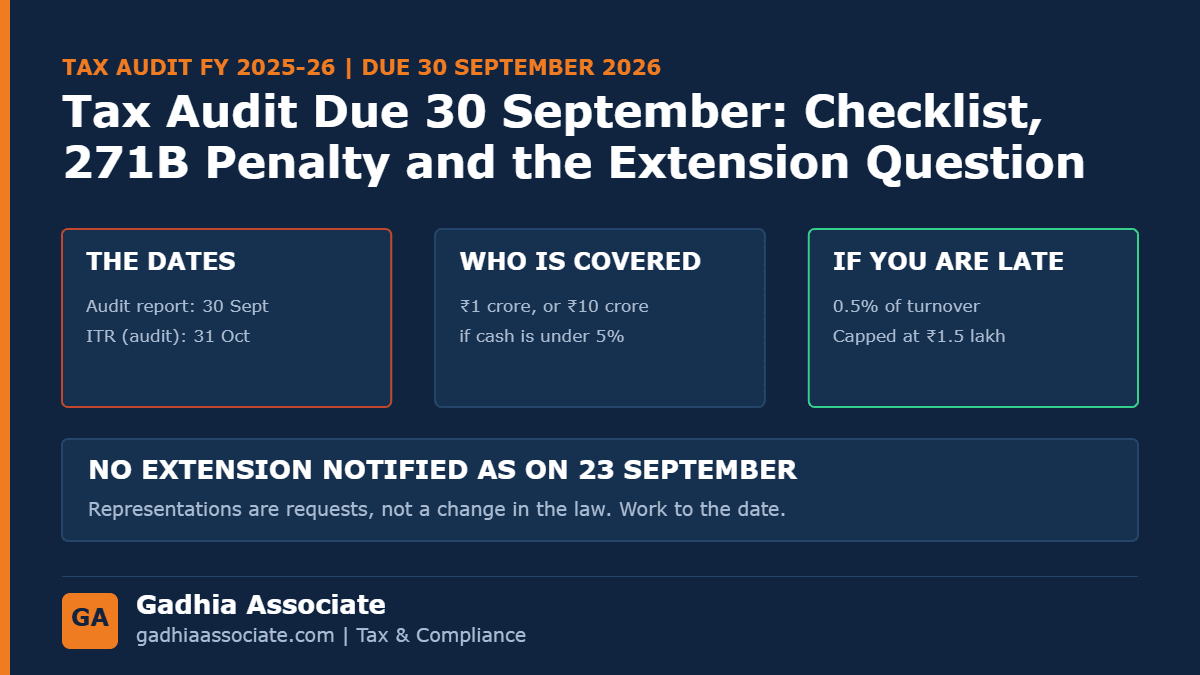
It has not. As things stand today, the tax audit report for FY 2025-26 is due on 30 September 2026, and the income tax return for audit cases is due on 31 October 2026.
Short answer: Plan on 30 September. If an extension is notified, you lose nothing by being ready early. If it is not, a late audit report costs 0.5% of turnover as penalty under Section 271B, up to Rs 1.5 lakh, and it delays your return, your refund and your loss carry-forward. What follows is who needs an audit, what to hand over, and what to do if you are already out of time.
Who actually needs a tax audit for FY 2025-26?
- Business: turnover above Rs 1 crore. The limit rises to Rs 10 crore where cash receipts and cash payments are each not more than 5% of the total. For most businesses that bank everything and pay by bank or UPI, the higher limit applies.
- Profession: gross receipts above Rs 50 lakh.
- Presumptive cases: if you were declaring income under the presumptive scheme and now declare less than the deemed profit, and your total income crosses the basic exemption limit, an audit is required.
- Other cases: certain specific situations, including some entities claiming exemptions or deductions that come with their own audit reports.
Note the direction of travel: more digital receipts means a higher audit threshold, not a lower one. Businesses that moved to UPI and bank transfers often find they are below the audit requirement entirely.
What your CA needs from you, and why it takes time
A tax audit is not a form that can be filled in an evening. The reporting in Form 3CD requires figures to be cross-checked against several other records. To finish in the remaining days, send these now:
- Final trial balance, ledgers, and the cash book, with the bank reconciliation done
- All bank statements for the year, including any account used occasionally
- GST returns for the year and the annual reconciliation, so turnover in the books matches GSTR-1 and GSTR-3B
- Stock statement at the year end, with valuation basis, and the stock statements given to your bank
- Purchase and sales registers, with the GST input credit register
- TDS challans and returns, and a list of payments where TDS was not deducted
- Details of cash payments above the limits, loans taken or repaid in cash, and cash sales
- Payments to MSME suppliers and how many days each took, for the 45-day rule
- Fixed asset additions with invoices, and loan statements showing interest
- Related-party transactions: rent, interest, salary or purchases involving family members and their concerns
The three that hold up most audits are the GST reconciliation, the year-end stock figure, and MSME payment days. Start with those.
What does a late tax audit actually cost?
- Penalty under Section 271B: 0.5% of turnover or gross receipts, subject to a maximum of Rs 1.5 lakh. On a turnover of Rs 5 crore, that is the full Rs 1.5 lakh.
- The return becomes late too, which brings a late filing fee and interest under Sections 234A, 234B and 234F, depending on the tax outstanding.
- Business losses cannot be carried forward if the return is filed after the due date. For a year with a loss, this is usually far more expensive than the penalty.
- Refunds are delayed, and interest on a refund can be reduced for the delay attributable to you.
- Bank and tender problems. Limits get reviewed on audited figures, and a missing audit report can hold up a renewal.
The penalty is not automatic. Section 273B allows it to be dropped where there is a reasonable cause, such as serious illness, a natural calamity, seizure of records, or the death of the person handling accounts. A busy schedule is not a reasonable cause.
Will the date be extended this year?
Several associations have made representations asking for the tax audit report date to move to 31 October and the audit-case return date to 30 November, pointing to the compressed window after the 31 August deadline for non-audit returns. As of today, no circular or notification extending 30 September 2026 has been issued.
Two practical points. First, a representation is a request, not a change in law. Second, even when an extension has come in past years, it has often come in the last few days, by which time the files that were left to the end were already late. Work to the notified date.
I will not make it. What now?
- File the audit report as soon as it is ready, even after the date. The penalty is capped, and it does not grow with further delay, but the return-related costs do.
- File the return by 31 October if you possibly can, because the loss carry-forward and some deductions depend on filing by the due date.
- Pay the self-assessment tax early, even if the return will be late. Interest under Section 234B keeps running on unpaid tax.
- Document the reason for the delay contemporaneously if it is genuine, such as a hospital record or a fire report. It supports a request to drop the penalty later.
- Do not file an unaudited return for an audit case just to beat the date. It creates a defective return and a bigger problem.
How to make next year easier
- Close your books monthly, not in September. A monthly closing takes two hours and saves two weeks.
- Reconcile GST with your books every month, and fix mismatches while suppliers still respond.
- Keep cash receipts and payments below 5% of the total so the Rs 10 crore threshold applies to you.
- Track MSME supplier payment days in your accounting software from April, not in September.
- Take a physical stock count at 31 March, with a signed sheet, instead of working backwards later.
- Move to a monthly bookkeeping arrangement if your turnover has crossed a crore. The audit then becomes a review, not a reconstruction.
What we do for you
- Tell you within a day whether you are covered by tax audit this year, and under which limit
- Complete the tax audit and file Form 3CA or 3CB with 3CD
- Reconcile your books with GST returns, AIS and Form 26AS before filing
- File the income tax return for audit cases and compute advance tax for the current year
- Handle Section 271B penalty proceedings and draft the reasonable cause submission
- Rebuild incomplete books where records are missing or scattered
- Set up monthly bookkeeping, GST filing and MSME payment tracking so next September is quiet
- Prepare the audited statements your bank needs for limit renewal
Gadhia Associate has been in practice since 2007 and has handled work for over 7,000 clients across Saurashtra and Gujarat, with a 5.0 Google rating from more than 100 reviews. Traders, manufacturers and professionals from Junagadh, Rajkot, Veraval, Gir Somnath, Amreli and Porbandar come to our Junagadh office, where same-day appointments are available. Audit work can equally be handled digitally for businesses anywhere in India. Fixed-fee and monthly plans are available.
The date is 30 September. If your books are not ready, call or WhatsApp +91 82005 28355 today, or come to our Junagadh office with whatever you have. The first consultation is free.
Frequently asked questions
What is the tax audit due date for FY 2025-26?
30 September 2026 for the audit report, and 31 October 2026 for the income tax return in audit cases. No extension has been notified as of 23 September 2026.
What is the penalty for not getting a tax audit done?
Under Section 271B, 0.5% of turnover or gross receipts, up to a maximum of Rs 1.5 lakh. The penalty can be dropped where there is a reasonable cause.
Is tax audit required if turnover is Rs 2 crore?
Not necessarily. If cash receipts and cash payments are each within 5% of the total, the threshold is Rs 10 crore, so a business at Rs 2 crore banking everything is usually outside audit.
Can I file my return before the audit report?
No. In an audit case the report must be filed first, and its details are quoted in the return. Filing without it makes the return defective.
Can the audit report be revised?
Yes, in specified circumstances, such as a recomputation of income or a change after the accounts were finalised. It should not be treated as a routine second chance.
Does a loss-making business need to file on time?
Yes, and it matters more. Business losses can be carried forward only if the return is filed by the due date.
Position as of 23 September 2026. Due dates change through CBDT circulars, sometimes at short notice, and the Income-tax Act, 2025 has renumbered the income tax provisions from 1 April 2026; the older section numbers are used here because that is how people still search for them. Confirm the current position before acting.