Influencer Earning Rs 40 Lakh or More? Proprietor, LLP or Private Limited Company: Real Tax Comparison, GST and When a Company Actually Saves Money
A food creator from Rajkot came to us last month with a simple question. Her Instagram page had crossed three lakh followers, brand deals were coming in every week, and a friend in Mumbai had told her, "Once you cross Rs 50 lakh, open a company. It saves tax." She wanted to know if she should register a private limited company before Diwali, when the big campaigns land.
We asked her three things: how much she earns, how much she spends on the business, and how much of the profit she actually takes home each year. Her answers changed the recommendation completely. That is the point of this article. A company is not automatically cheaper for a creator. For some it saves lakhs. For others it only adds cost and paperwork.
Short answer: If you spend most of what you earn on yourself and your family, staying a proprietor, with GST registration and proper books, is usually the simplest and cheapest option. A private limited company starts making sense when your profit is large, you want to leave a good part of it in the business (for equipment, a team, an office, or a reserve), and brands or agencies prefer to contract with a company. An LLP rarely saves tax for a single creator. The right answer depends on your numbers, not on your follower count.
What structures can a creator choose from?
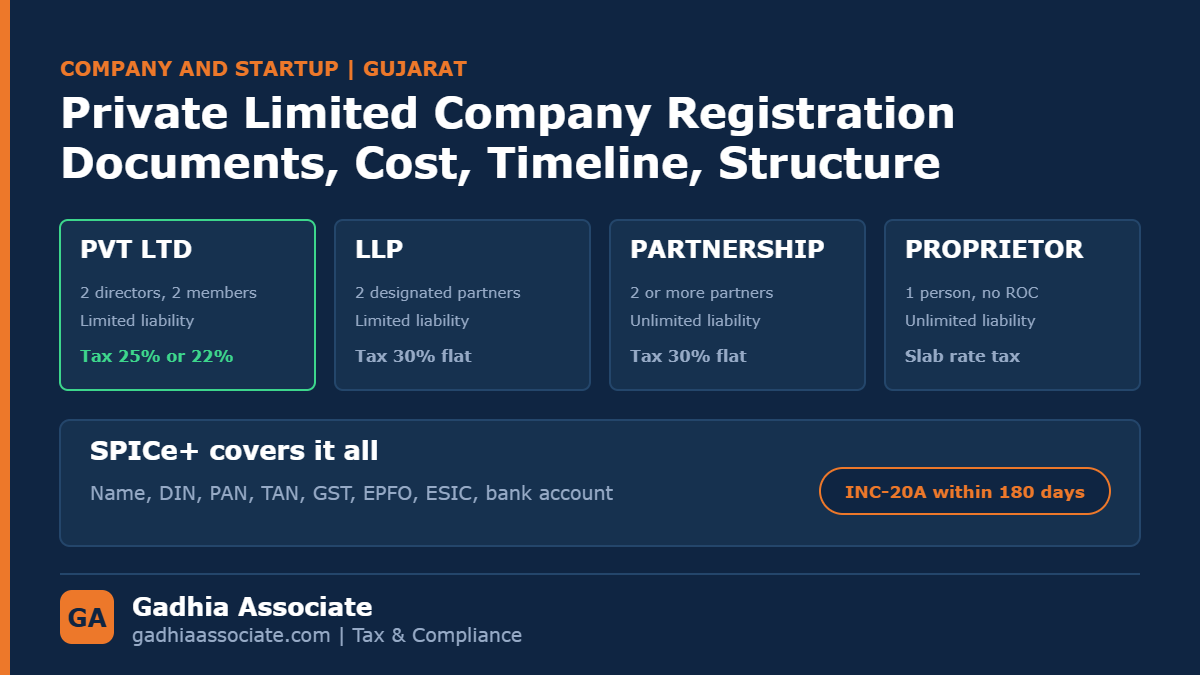
- Proprietorship: You and the business are the same person. No registration is needed to start. Income is taxed at your personal slab rates. You can register for GST and open a current account in your name or a trade name.
- LLP: A separate entity with at least two partners. Profit is taxed at 30% plus cess, but remuneration paid to working partners is deductible within limits. Annual filings with the MCA are compulsory.
- Private limited company: A separate legal entity with at least two directors and shareholders (a One Person Company is possible for a single founder). Profit can be taxed at a concessional 22% plus surcharge and cess. You take money out as salary or dividend. Audit and annual ROC filings are compulsory.
How is a creator taxed as a proprietor today?
Your brand deals, YouTube AdSense, affiliate commissions, paid collaborations and the fair value of products you keep all count as business or professional income. You can deduct genuine expenses: cameras, lights, editing software, a video editor's fees, travel for shoots, part of your phone and internet bills, and so on.
For FY 2026-27, the new tax regime slabs remain unchanged: nil up to Rs 4 lakh, then 5%, 10%, 15%, 20% and 25% in steps of Rs 4 lakh, and 30% above Rs 24 lakh. Income up to Rs 12 lakh is effectively tax-free because of the rebate, but once you cross it, the slabs apply in full.
Many creators ask about presumptive taxation, where profit is taken at a flat percentage and no books are needed. It is not automatic for influencers. The 50% scheme for professionals (earlier Section 44ADA, now part of Section 58 of the Income-tax Act, 2025) applies only to specified professions, and whether content creation fits depends on what exactly you do. The 6% or 8% scheme for businesses has its own exclusions. We decide this case by case, because getting it wrong means your return can be treated as defective.
Let's run the numbers: Rs 40 lakh of profit
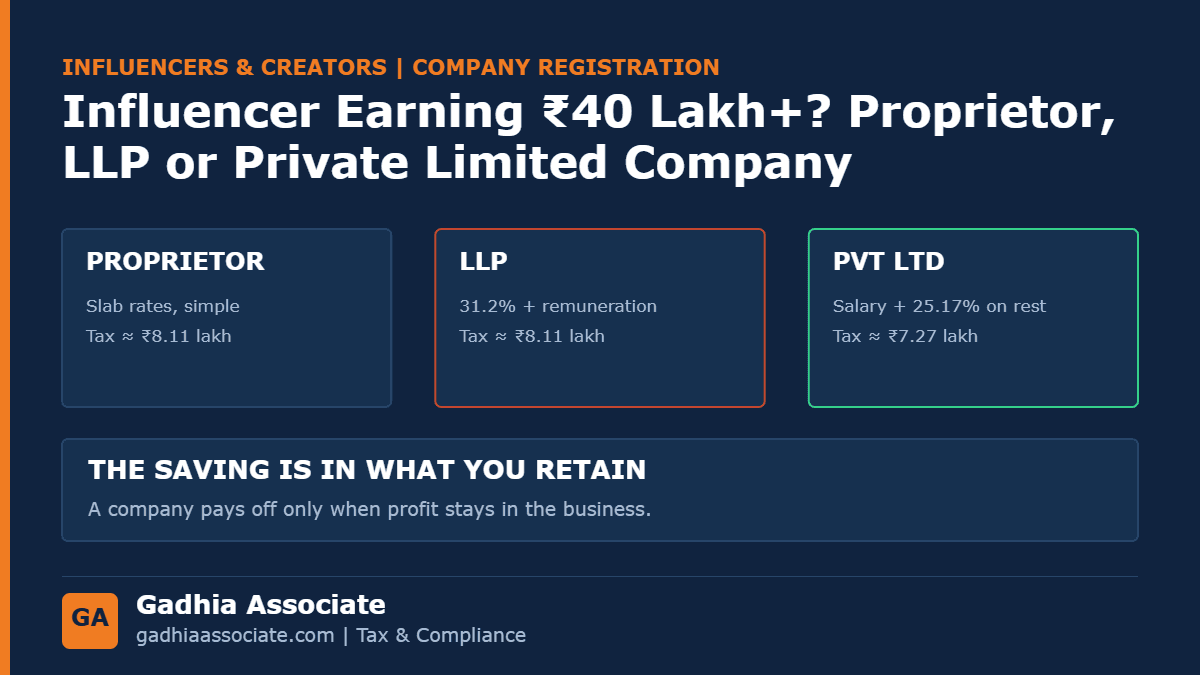
Assume a creator earns Rs 60 lakh in a year from brand deals and AdSense, spends Rs 20 lakh on the business, and is left with Rs 40 lakh of profit. Here is what each structure roughly looks like under the new regime.
As a proprietor
Tax on Rs 40 lakh at slab rates, plus 4% cess, comes to about Rs 8.11 lakh. The entire remaining Rs 31.9 lakh is yours to spend, invest or save, with no further tax.
As a private limited company, taking Rs 15 lakh salary
The company pays you a salary of Rs 15 lakh, which is a deductible expense for the company. After the standard deduction, your personal tax on the salary is about Rs 97,500. The company pays tax on the remaining Rs 25 lakh at about 25.17% (22% plus 10% surcharge plus cess), which is roughly Rs 6.29 lakh. Total tax: about Rs 7.27 lakh.
That is around Rs 84,000 less than the proprietorship. But look at the catch. Roughly Rs 18.7 lakh now sits inside the company. The moment you take it out as a dividend, it is taxed again in your hands at your slab rate. And the company has its own running costs: statutory audit, ROC filings, accounting and a professional fee that together can easily run to Rs 40,000 to Rs 60,000 a year.
So in this example, a company saves money only if you genuinely plan to keep that Rs 18.7 lakh in the business, for example to buy equipment, hire editors, rent a studio, or build a reserve for slow months. If you would take it all out anyway, the saving disappears.
As an LLP with you as the only working partner
The LLP can pay you remuneration within the limits of Section 40(b): 90% of the first Rs 6 lakh of book profit (or Rs 3 lakh, whichever is higher) and 60% of the balance. On Rs 40 lakh, that is Rs 25.8 lakh. The LLP pays 31.2% on the remaining Rs 14.2 lakh, about Rs 4.43 lakh. You pay about Rs 3.68 lakh on the remuneration. Total: about Rs 8.11 lakh, almost exactly the same as a proprietorship, with more compliance on top. An LLP helps only when two partners genuinely work in the business and share the remuneration, or for reasons other than tax.
So when does a private limited company actually make sense?
In our experience, it is worth serious thought when most of these are true:
- Your annual profit is comfortably above Rs 50 lakh and growing
- You want to reinvest a meaningful part of it, not spend it all
- You are hiring a team: editors, managers, shoot assistants, a social media executive
- You are building something beyond yourself, such as a product line, a course, a D2C brand or a second channel
- Larger brands or agencies ask for a company for vendor registration and contracts
- You want limited liability because your contracts carry penalty or indemnity clauses
- You may bring in an investor or a co-founder later
If only one or two of these apply, a well-run proprietorship with GST registration, a current account and clean books usually serves you better for now. You can move to a company later without losing anything.
What about GST?
This does not change with the structure. A creator, whether proprietor or company, must register for GST once aggregate turnover crosses Rs 20 lakh in a financial year for services. Brand deals from Indian companies attract 18% GST, which you charge on your invoice. Many brands actually prefer a GST-registered creator because they can claim input tax credit.
Income from Google AdSense or foreign brands paid in foreign currency can qualify as an export of services. That is zero-rated, which means no GST if you file a Letter of Undertaking (LUT), but it still counts towards the Rs 20 lakh threshold. Creators who earn mostly from YouTube often cross the limit without realising they needed to register.
And TDS on your brand payments?
Indian brands and agencies usually deduct TDS before paying you, often at 10% as professional fees, sometimes at a lower rate under the contracts provision. Products and trips you receive free and keep are covered by TDS on benefits (earlier Section 194R) once the value crosses Rs 20,000 in a year. All of this shows up in your AIS. If your return does not match it, the department notices quickly. Whatever structure you choose, reconcile your AIS before filing.
If you register a company, what does it involve?
- Choose a name, ideally close to your brand, and check it against existing companies and trademarks
- Get digital signatures for the directors
- File SPICe+ with the MCA, which also gives the company its PAN and TAN
- Open a current account in the company's name
- Register for GST in the company's name, and file an LUT if you have foreign income
- Move brand contracts, payment gateways and platform payouts (like AdSense) to the company
- File a trademark for your channel or page name, so the brand you built is protected
The last two steps are where most creators slip. If AdSense keeps paying into your personal account after the company is formed, you end up with income split across two taxpayers and a messy year-end.
Common mistakes we see with creators
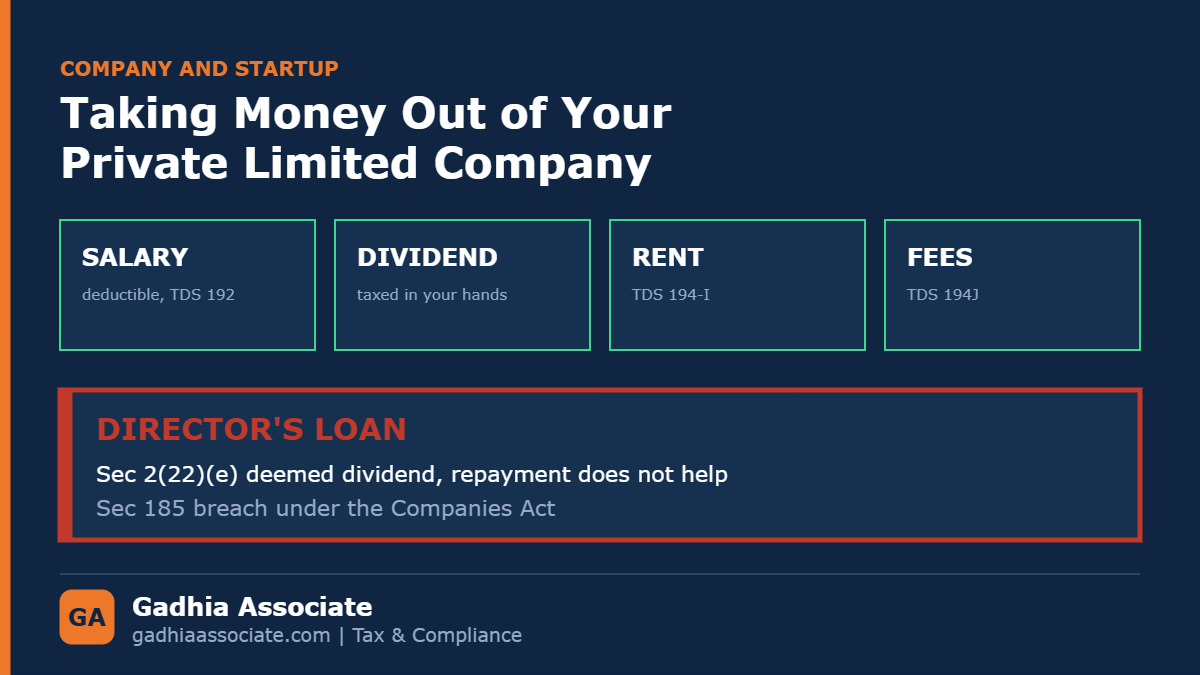
- Forming a company on a friend's advice, then taking all the money out as "loan from company," which creates its own tax problems
- Not registering for GST because "YouTube money is foreign," then getting a demand for the period after crossing Rs 20 lakh
- Ignoring barter products while filing the return, even though the brand has reported them
- Mixing personal spending and business spending in one account, which makes expenses hard to defend
- Signing brand contracts without reading the indemnity, exclusivity and usage-rights clauses
What we do for you
- Review your last year's income, expenses and AIS, and tell you honestly which structure suits you
- Prepare a side-by-side tax comparison on your own numbers, not an example
- Register your private limited company, OPC or LLP, including DSC, SPICe+, PAN, TAN and bank documentation
- Handle GST registration, LUT for export income and monthly GST returns
- Draft your invoicing format for Indian and foreign brands
- Review brand deal contracts for tax, TDS and payment terms
- File your trademark application for your channel or brand name
- Keep your books, file your income tax return, and manage company ROC compliance every year
Gadhia Associate has been in practice since 2007 and has handled work for over 7,000 clients across Saurashtra and Gujarat, with a 5.0 Google rating from more than 100 reviews. We work with creators, freelancers and digital businesses across Gujarat and the rest of India, and most of the work is done online, so you do not need to visit our Junagadh office unless you want to. Fixed-fee and monthly plans are available.
Send us your last year's numbers and we will tell you, in one call, whether a company is worth it for you. Call or WhatsApp +91 82005 28355. The first consultation is free.
Frequently asked questions
At what income should an influencer register a company?
There is no fixed figure. As a rough guide, a company starts making sense when profit is well above Rs 50 lakh and you plan to keep a large part of it in the business. Below that, a proprietorship with proper books is usually cheaper.
Can a single influencer form an LLP?
No. An LLP needs at least two designated partners. Many creators add a spouse or parent, but for tax purposes an LLP gives meaningful benefit only when both partners genuinely work in the business.
Can one person register a private limited company?
A private limited company needs at least two directors and two shareholders. A single founder can form a One Person Company (OPC) instead, which can later be converted.
Is GST applicable on YouTube AdSense income?
AdSense paid from abroad in foreign currency can qualify as an export of services, which is zero-rated. You still need GST registration once your total turnover crosses Rs 20 lakh, and should file an LUT to export without paying GST.
Are free products from brands taxable?
Yes. Products you keep are income at their fair value, and brands deduct TDS on them once the value crosses Rs 20,000 in a year. Products you return to the brand are not income.
Will a company reduce my tax if I take out all the profit?
Usually not by much. Salary is taxed at your slab rate, and dividends are taxed twice in effect, first in the company and then in your hands. The saving comes mainly from profit you leave in the company.
Position as of 21 September 2026. Figures are illustrative, use the new tax regime for FY 2026-27, and ignore cess-rounding and individual deductions. The Income-tax Act, 2025 has renumbered income tax provisions from 1 April 2026; older section numbers are mentioned because that is how people still search for them. Confirm the current position for your own case before acting.