Private Limited Company Registration in Gujarat: Documents, Cost, Timeline and Whether You Should Pick Pvt Ltd, LLP or Proprietorship
A customer has asked for your company name on the invoice. Or a bank wants a certificate of incorporation before it will look at your loan file. Or a tender form has a box marked "constitution of firm" and none of the options fit what you are. You have run fine as a proprietor for years. Now somebody wants paper. That is usually the week people ring us.
Short answer: A private limited company needs two directors, two shareholders and at least one resident director. You register it through the SPICe+ form on the MCA portal. The MCA filing fee is nil where authorised capital is up to Rs 15,00,000. You still pay Gujarat stamp duty and digital signature charges. A clean file usually finishes in 10 to 15 working days.
Should I pick Pvt Ltd, LLP or proprietorship?
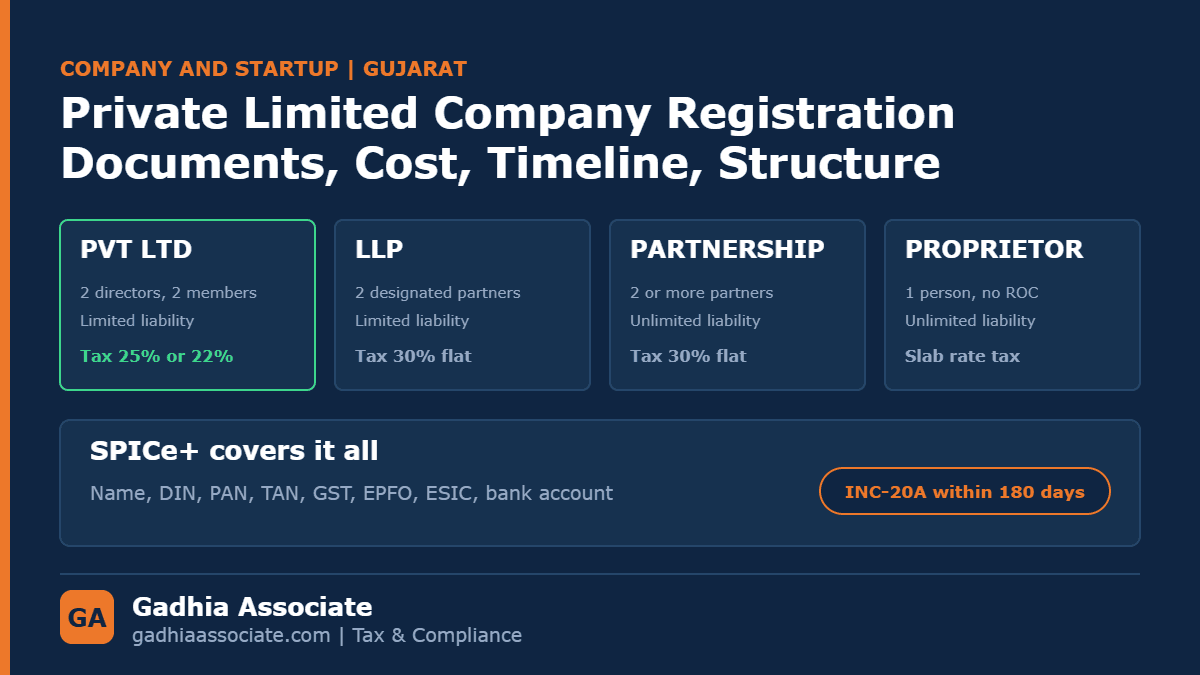
Pick the structure that matches who you sell to, not the one that sounds biggest. Here is the plain version of Pvt Ltd vs LLP vs proprietorship.
Pick a private limited company if...
You want outside investment, a bank facility in the business name, or you are bidding for tenders and corporate supply contracts. Banks and large buyers trust it. Your personal assets are separate from business debts. You need two people, two shareholders, and one director who has stayed in India long enough to count as resident. It costs more to keep alive every year, and there is a real audit and filing calendar.
Pick a one person company if...
You are alone and you still want limited liability. An OPC needs one member and one nominee. It gives you a company structure without hunting for a second shareholder. The catch is that you cannot raise equity from investors, and the annual work is close to that of a private limited company.
Pick an LLP if...
You are two or more professionals or a services business with no plan to raise equity. An LLP needs two designated partners. Liability is limited. The yearly filing load is lighter than a company. Audit only kicks in above the prescribed turnover and contribution limits, which keeps costs down for small firms. Investors generally will not put money into an LLP, so do not choose it if funding is the goal.
Pick a proprietorship or a partnership firm if...
You sell locally, your customers are individuals, and nobody has asked for incorporation papers. A proprietorship needs no registration at all beyond GST where applicable and a shops and establishment registration. A registered partnership firm sits in between, and the deed matters more than people think because partner salary and interest deductions run through Section 40(b). We have a separate article on partnership deeds and Section 40(b) if that is your situation.
An honest note. If you are one person selling in Junagadh or Veraval with turnover under about Rs 40 lakh and no tender or investor in sight, a private limited company is usually not worth the annual cost. Stay a proprietor. Come back when a buyer or a bank asks.
How much tax does each structure pay?
Companies are usually taxed lower than LLPs and firms, but the gap narrows once you take money out. A domestic company with turnover within the prescribed limit pays 25 per cent. A company that opts into Section 115BAA pays 22 per cent, plus surcharge and cess, and gives up most deductions and MAT. Section 115BAB, the 15 per cent rate for new manufacturers, carried a sunset date of 31 March 2024 for commencing production and has not been extended, so a company formed today cannot use it. Confirm this before you plan around it.
An LLP and a partnership firm are taxed at a flat 30 per cent with no slab benefit. A proprietor is taxed on the individual slab, which is often the cheapest at low income and the worst once profits climb.
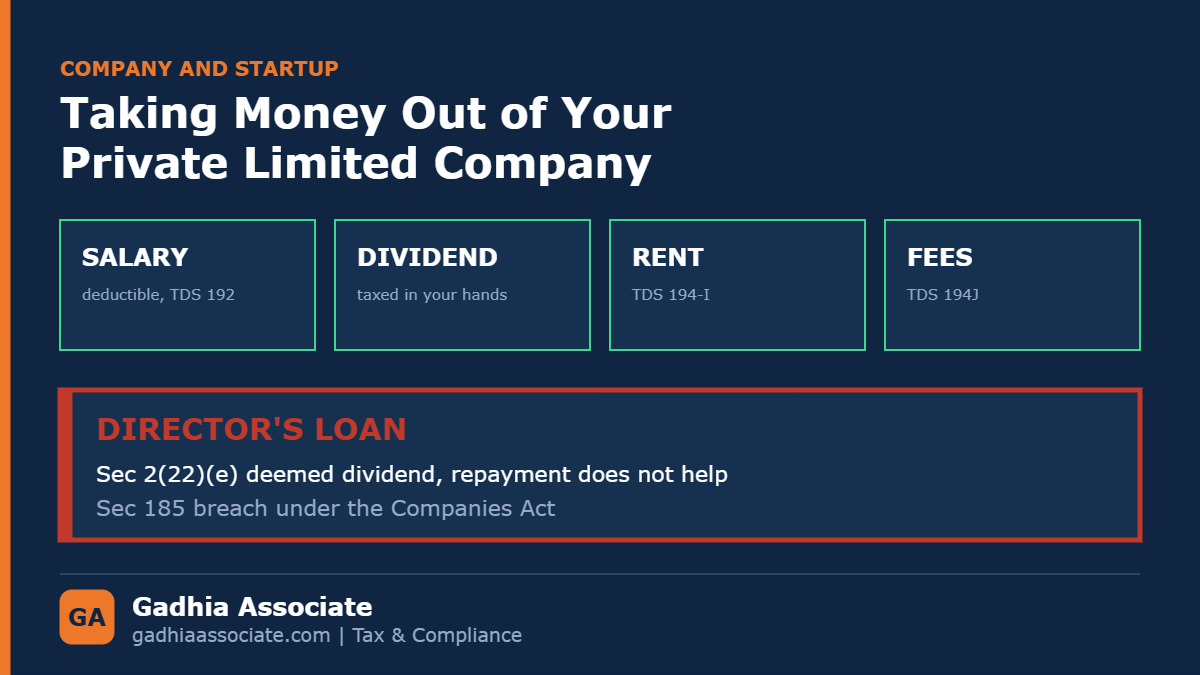
The part people forget: company profit is taxed once in the company, and again in your hands when you take it out as salary or dividend. Plan the withdrawal before you incorporate, not after. Our article on how to take money out of your private limited company legally covers the three legal routes.
Not sure which one fits you? Call or WhatsApp +91 82005 28355 for a free first consultation. Tell us who your buyer is and what your turnover looks like. We will tell you plainly which structure to register, in one call.
What documents are required for company registration?
Start collecting these today. Every director and subscriber needs the same set.
- PAN card of each director and shareholder
- Aadhaar card of each director and shareholder
- Passport, if any director or subscriber is a foreign national
- One recent passport size photograph each, plain background
- Identity proof: voter ID, passport or driving licence
- Address proof: bank statement, electricity bill, telephone bill or mobile bill, not older than two months
- Email ID and mobile number linked to the Aadhaar, because OTP verification uses them
- Registered office proof, explained below
The mistake that costs three weeks is a name mismatch. If the PAN says "Rakeshbhai M Patel" and the Aadhaar says "Rakesh Manubhai Patel", the form will go into resubmission. Fix the spelling on one of them before you file, not after.
What proof does the registered office need?
This is where most applications stall, so read this part twice. You need a utility bill for the office address that is not older than two months. It must be an electricity, gas, telephone or mobile bill in the name of the owner of the premises.
Then, depending on how you hold the place:
- Owned by a director or family member: a no objection certificate from the owner, signed, allowing the company to use the address
- Rented: the rent agreement, plus the owner's NOC
The two documents must agree. If the electricity bill is in your late father's name and the NOC is signed by you, the officer will query it. Get the bill transferred, or attach the succession proof, before filing. We see this every month in Junagadh and Amreli, where the shop or godown has been in the family for two generations and the meter was never changed.
What is the step-by-step process with SPICe+?
SPICe+ is one integrated form that does the whole job. Here is what actually happens.
- Digital signature certificates. Every director and subscriber needs a class 3 DSC with video verification. Budget a day or two for this.
- SPICe+ Part A: name reservation. You propose up to two names with their meaning. You can also reserve a name separately through the RUN facility for a fee of Rs 1,000. Check the name against existing companies and against the trademark register. A name that clashes with a registered trademark gets rejected even if no company holds it.
- SPICe+ Part B: incorporation. Company details, capital, registered office, directors and subscribers. DIN is allotted through this form itself for up to three directors, at no separate cost, so first-time directors do not apply separately.
- eMoA (INC-33) and eAoA (INC-34). The memorandum and articles, filed electronically and signed with the subscribers' DSCs. The object clause in the MoA should cover what you actually plan to do, including what you might do in two years.
- AGILE-PRO-S (INC-35). This one form applies for GSTIN, EPFO, ESIC, professional tax, the bank account and shops and establishment registration together with the incorporation.
- Form INC-9. A declaration by each subscriber and first director. It auto-generates from Part B in most cases; foreign nationals usually have to sign it manually.
- Certificate of incorporation. Issued with the CIN, and PAN and TAN printed on it.
How long does company registration in Gujarat really take?
A clean file takes about 10 to 15 working days from DSC to certificate. Name approval is often the fastest part, around one to three working days. The incorporation forms take longer because the Central Registration Centre reviews them.
What makes it slower: a rejected name, a blurred or expired utility bill, a PAN and Aadhaar name mismatch, a director whose mobile number is not linked to Aadhaar, and resubmission. Each resubmission adds roughly a week. Two resubmissions and your fifteen days have become a month.
What is the company registration cost?
Separate the three government-side items from professional fees. The government side is small; people are often surprised.
Illustrative cost example, private limited company in Gujarat, authorised capital Rs 1,00,000, two directors:
- MCA filing fee on SPICe+, authorised capital up to Rs 15,00,000: Nil
- Digital signature certificates, two directors: roughly Rs 1,500 to Rs 2,500 in total, depending on the certifying agency
- Gujarat stamp duty on the memorandum: Rs 100
- Gujarat stamp duty on the articles: charged on authorised capital, commonly cited at 0.5 per cent
- Stamp on the incorporation eForm: Rs 20
- Name reservation through RUN, only if you reserve separately: Rs 1,000
- PAN and TAN: issued with the certificate, no separate fee
- Professional fee: quoted separately after we see your file
Stamp duty is a state subject and it changes by notification, so treat the figures above as indicative and confirm the current Gujarat rate before you fix your authorised capital. One planning point that is genuinely useful: stamp duty on the articles is charged on authorised capital, not on what you actually issue. Declaring Rs 10,00,000 of authorised capital when you only need Rs 1,00,000 of shares just costs you money.
Ready to start? Send your PAN, Aadhaar and the office electricity bill on WhatsApp to +91 82005 28355. We will check the file for mismatches the same day and tell you what is missing before anything is filed.
What must I do straight after incorporation?
The certificate is the start, not the finish. In the first six months:
- Open the current account in the company name and bring in the subscription money from each shareholder's own bank account. Cash will not do.
- File Form INC-20A within 180 days of incorporation, declaring that the subscription money is received. Miss it and the company faces a penalty of Rs 50,000, and every officer in default Rs 1,000 a day up to Rs 1,00,000. Worse, the company cannot file other forms and the Registrar can start striking it off.
- Activate GST if the AGILE-PRO-S application went through, or apply separately if your turnover or business type needs it.
- Appoint the first auditor within 30 days of incorporation.
- Put up the company name board and print the CIN on letterheads and invoices.
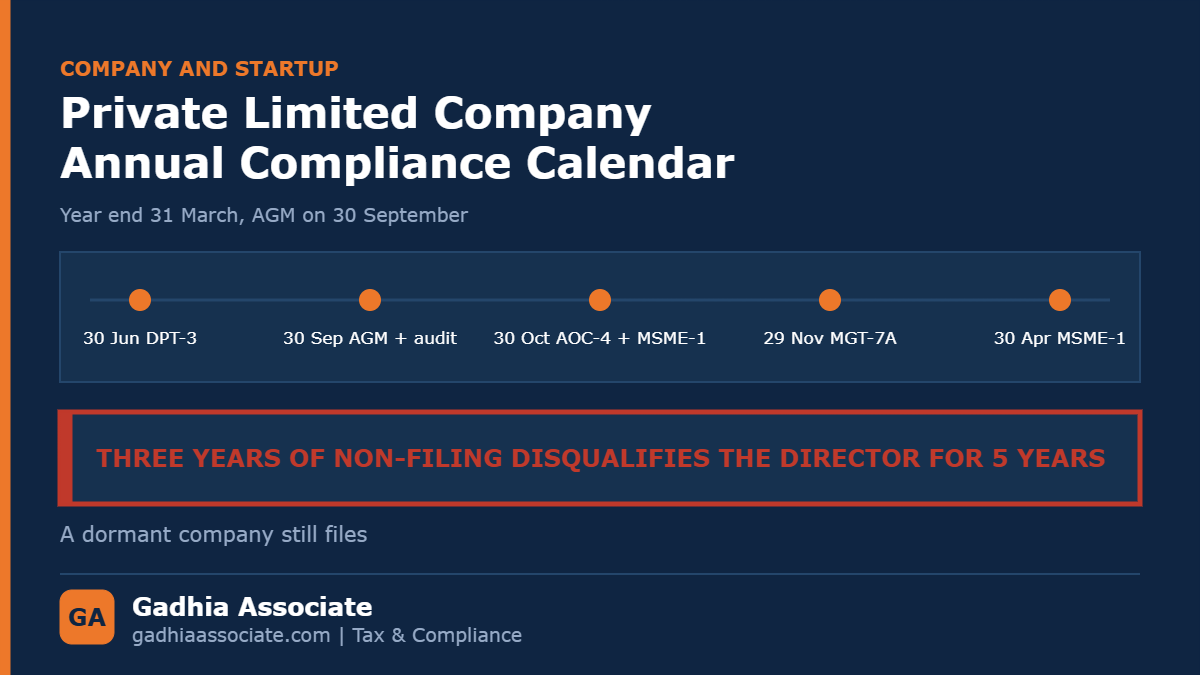
After that the annual calendar starts. We have a separate article on AOC-4, MGT-7A and DIR-3 KYC that walks through the yearly filings, so we will not repeat them here. If you are planning a collateral-free bank facility once the company is a year old, our article on CGTMSE business loans for a private limited company explains what banks ask for.
What we do for you
- Free first call to decide Pvt Ltd, OPC, LLP or proprietorship for your actual situation
- Name search against the MCA database and the trademark register before we file
- Class 3 digital signature certificates for every director and subscriber
- SPICe+ Part A and Part B, eMoA, eAoA, AGILE-PRO-S and INC-9, drafted and filed
- Object clause drafted to cover what you plan to do next year, not just today
- Registered office document check, including the NOC and the utility bill match
- DIN and PAN and TAN through the same filing
- Bank account opening papers and the board resolution
- Form INC-20A and first auditor appointment inside the deadline
- GST registration where you need it, and the monthly compliance after that
- Reply and resubmission handling if the Registrar raises a query
- Fixed-fee and monthly plans so you know the cost before we begin
Gadhia Associate has been practising since 2007 and works with more than 7,000 clients across Saurashtra and Gujarat. We hold a 5.0 Google rating from over 100 reviews. Our Junagadh office takes same-day appointments, and we handle clients in Rajkot, Veraval, Gir Somnath, Porbandar and Amreli, along with clients elsewhere in India entirely online.
Book your free first consultation. Call or WhatsApp +91 82005 28355, or walk into the Junagadh office. Bring your PAN and Aadhaar and we can start the name search while you sit there.
Frequently asked questions
Can I register a private limited company alone?
No. A private limited company needs at least two directors and two shareholders, and at least one director must be resident in India. If you are alone, register a one person company instead. An OPC needs one member and one nominee, and it gives you limited liability. You can convert an OPC into a private limited company later when a second shareholder joins.
Can I use my home address as the registered office?
Yes. A residential address is allowed as a registered office. You need a utility bill for that address not older than two months, in the owner's name, plus a signed no objection certificate from the owner. If the house is in a parent's name, the parent signs the NOC. The bill name and the NOC signature must match.
What is the company registration cost in Gujarat?
The MCA filing fee on SPICe+ is nil where authorised capital is up to Rs 15,00,000. You still pay digital signature charges for each director, Rs 100 stamp duty on the memorandum, stamp duty on the articles based on authorised capital, and Rs 20 on the eForm. Name reservation through RUN costs Rs 1,000 if you use it separately. Stamp duty changes by state notification, so confirm the current rate.
Is an LLP cheaper to run than a private limited company?
Usually yes. An LLP files fewer annual forms, and a statutory audit only applies above the prescribed turnover and contribution limits. A private limited company needs an audit every year regardless of turnover, plus AOC-4, MGT-7A and director KYC. But an LLP is taxed at 30 per cent and investors rarely fund one, so the saving costs you options.
What happens if I miss Form INC-20A?
The company faces a penalty of Rs 50,000, and every officer in default Rs 1,000 for each day of delay, capped at Rs 1,00,000. Until INC-20A is filed the company cannot file other forms, cannot legally start business, and cannot borrow. The Registrar may also start action to strike the company off the register. File it within 180 days of incorporation.
This article states the position as of September 2026. Fees, forms, day limits and stamp duty change through MCA notifications, CBIC circulars and state notifications, and the Income-tax Act, 2025 has renumbered the income tax provisions with effect from 1 April 2026. Confirm the current position before acting.