Cash Transaction Limits That Trigger Penalties: Section 269ST, 269SS, 269T and 40A(3) Explained for Traders
A trader in the Junagadh market sells groundnut oil worth Rs 2,50,000 against one bill and takes the money in cash, because that is how the buyer has paid him for eleven years. The same week, a family friend hands over Rs 50,000 in cash to help with a wedding, to be returned after Diwali. Both feel completely ordinary. Both carry a penalty equal to the entire amount.
If you deal in agricultural produce, run a wholesale or retail counter, take deposits from customers, or lend and borrow within the family without paperwork, this is your problem and not somebody else's. The penalties here are not a percentage of tax. They are the transaction. Take Rs 3,00,000 in cash against one invoice and Section 271DA allows a penalty of Rs 3,00,000 on top of the tax you already owe on that sale.
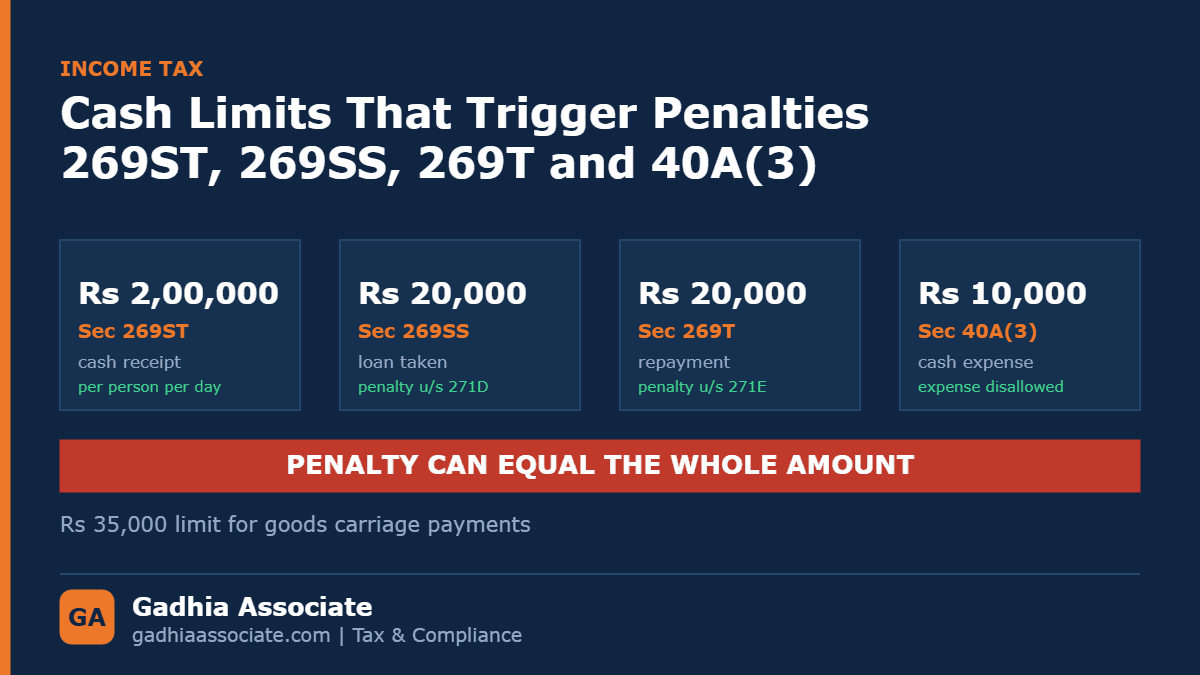
Direct answer: Section 269ST bars receiving Rs 2,00,000 or more in cash from one person in a day, against a single transaction, or for one event, with penalty under Section 271DA equal to the amount and payable by the receiver. Section 269SS and 269T cap cash loans and repayments at Rs 20,000. Section 40A(3) disallows cash business expenses above Rs 10,000.
What is the Rs 2,00,000 cash limit under Section 269ST?
Section 269ST says no person shall receive Rs 2,00,000 or more in cash, and it applies three separate ways. From one person in a single day, aggregated. Against a single transaction, even if collected in instalments over months. Or in respect of transactions relating to one event or occasion, such as a wedding or a single order.
Two details catch people out. First, the penalty under Section 271DA equals 100 per cent of the amount received, and it falls on the receiver, not the payer. The customer who handed over the cash walks away clean. Second, splitting doesn't help. Rs 90,000 today and Rs 90,000 tomorrow against one bill of Rs 1,80,000 is fine; Rs 90,000 on three days against one bill of Rs 2,70,000 is a single transaction over the limit, and the fact that no single receipt crossed Rs 2,00,000 is not a defence.
The exceptions are narrow. Receipts from the Government, a banking company, a co-operative bank or a post office savings bank are outside the section, along with entities the Central Government notifies. Section 271DA also lets the officer drop the penalty where there was good and sufficient reason, but that is a mercy provision, not a plan.
What we see in practice: the trader whose sales register shows several receipts of Rs 1,99,000 and Rs 1,95,000 from the same party in the same month. Nothing individually crosses the line, which is precisely what makes an assessing officer start reading the ledger properly.
What are the cash limits on loans and repayments under Sections 269SS and 269T?
Rs 20,000. Section 269SS says you cannot take or accept a loan, deposit or specified sum of Rs 20,000 or more otherwise than by account payee cheque, account payee draft or a prescribed electronic mode. Penalty under Section 271D equals the amount taken. Section 269T covers the other direction, repayment of a loan or deposit of Rs 20,000 or more, with penalty under Section 271E equal to the amount repaid.
"Specified sum" is the part that surprises people. It brings in advances received against transfer of immovable property, so the Rs 1,00,000 cash token money for a plot sale is a Section 269SS violation for the seller even if the deal falls through. Land deals in and around Junagadh still start this way far too often.
Two exceptions matter locally. Where both the person giving and the person taking the money have only agricultural income and no income chargeable to tax, Section 269SS does not apply. And relief for loans between relatives is not automatic. It rests on Section 273B, which lets the officer waive penalty where there was reasonable cause, and the officer decides what counts as reasonable. Genuine, urgent, documented, promptly repaid, and reported on both sides gives you an argument. "He is my brother-in-law" does not.
What is the Rs 10,000 cash expense limit under Section 40A(3)?
Section 40A(3) disallows the expense outright where you pay more than Rs 10,000 in cash to one person in a single day. You do not get penalised, you simply lose the deduction, which means you pay tax on money you have genuinely spent. Section 40A(3A) does the same job for a liability booked in an earlier year and settled later in cash, by treating the payment as income of the year of payment.
The limit rises to Rs 35,000 for payments made for plying, hiring or leasing goods carriages, which is the one exception most transport operators and traders in Saurashtra actually use. Rule 6DD lists the other exceptions, including payments to the Government, payments to a cultivator or producer of agricultural produce, and payments made where the village or town has no bank. Read Rule 6DD before you rely on it. The agricultural producer exception is narrower than market talk suggests.
Capital spending is not exempt from this thinking. Under the second proviso to Section 43(1), cash paid above the limit for acquiring an asset is not treated as part of its actual cost, so you lose depreciation on that portion permanently. A similar cash bar applies to capital expenditure claims for specified businesses, but the exact provision is worth confirming before you build a position on it.
In passing: Section 80G denies deduction for cash donations above Rs 2,000, and Section 13A restricts cash donations to political parties. Both come up every March and both are settled law.
An illustrative example on round numbers
Illustrative only. Figures are rounded and simplified to show how the sections stack.
A proprietor makes one sale of Rs 3,00,000 and receives the whole amount in cash on a single day from one buyer. Separately, he pays Rs 40,000 in cash to a labour contractor on one day, and accepts Rs 60,000 in cash as a temporary loan from a friend.
- The Rs 3,00,000 cash receipt breaches Section 269ST. Penalty under Section 271DA: Rs 3,00,000.
- The Rs 40,000 cash payment breaches Section 40A(3). The whole Rs 40,000 is disallowed, so at a 30 per cent slab the extra tax is roughly Rs 12,000.
- The Rs 60,000 cash loan breaches Section 269SS. Penalty under Section 271D: Rs 60,000.
Total hit: around Rs 3,72,000, before interest, on a set of transactions that felt like a normal week. The sale itself was genuine and fully recorded. The only thing wrong was the mode of payment.
Worried about receipts you have already taken this year?
Come in with the cash book and we will go through it. Breaches from earlier months cannot be undone, but they can often be explained, and the rest of the year can be fixed.
Gadhia Associate is based in Junagadh, Gujarat and serves clients across India. Practising since 2007, more than 7,000 clients across Saurashtra and Gujarat, and a 5.0 Google rating from over 100 reviews. Same-day appointments at the Junagadh office, fully digital service if you are elsewhere, and fixed-fee or monthly plans quoted up front.
First consultation is free. Call or WhatsApp +91 82005 28355.
Does staying out of cash actually save me tax?
Yes, and this is the part nobody mentions at the mandi. Keeping cash receipts low buys you higher thresholds.
- Section 44AD. The presumptive turnover limit is Rs 2 crore, raised to Rs 3 crore where aggregate cash receipts during the year do not exceed 5 per cent of total turnover. On top of that, turnover received through banking channels is taxed at 6 per cent presumptive profit instead of 8 per cent.
- Section 44ADA. For professionals, Rs 50 lakh, raised to Rs 75 lakh on the same 5 per cent cash receipts condition.
- Section 44AB. The tax audit threshold is Rs 1 crore of turnover, and Rs 10 crore where both cash receipts and cash payments stay within 5 per cent. Note the difference: 44AD and 44ADA test receipts only, while the Rs 10 crore audit relief tests receipts and payments together.
These limits and the percentage have moved more than once in recent years, so confirm the figure applicable to your year before you plan around it.
What are Sections 269SU and 194N about?
Section 269SU requires a business with sales, turnover or gross receipts above Rs 50 crore in the immediately preceding year to provide the prescribed electronic payment modes, in addition to whatever else it offers. Rule 119AA prescribes RuPay debit card, UPI and UPI QR code. Failure attracts penalty under Section 271DB of Rs 5,000 for each day the failure continues, which compounds quietly.
Section 194N deals with the other end, TDS on cash withdrawals from your own bank account. Where you have filed returns for the relevant preceding years, TDS applies above Rs 1,00,00,000 at 2 per cent. Where you have not, the threshold drops to Rs 20,00,000, with 2 per cent above that and 5 per cent above Rs 1,00,00,000. The section number is sometimes quoted differently in older material, and under the Income-tax Act, 2025 this provision has been recast with effect from 1 April 2026, so check which numbering your bank or software is using.
How does the department find out about cash?
Through reporting you never see. Under Section 285BA read with Rule 114E, banks and other specified entities file a Statement of Financial Transactions. Cash deposits aggregating Rs 10 lakh or more in savings accounts, and much larger current account activity, get reported against your PAN, aggregated across branches. Those entries surface in your Annual Information Statement, which you can read yourself on the income tax portal.
So the pattern that draws attention is not one large receipt. It is a cash book showing Rs 8 lakh of cash sales a month against a bank account that only ever sees Rs 1 lakh deposited. The gap is the question. If you have already filed and spotted a problem, our article on mistakes in a filed ITR sets out the correction routes.
What housekeeping prevents all of this?
- Print a cash limit rule and stick it at the counter. No single receipt or related set of receipts from one party reaching Rs 2,00,000, in any form, ever.
- Put UPI and a card machine at the counter, whatever your turnover. It costs almost nothing and removes the temptation entirely.
- Never take or repay a loan or deposit of Rs 20,000 or more in cash, including from family. Bank transfer, always, and confirm both sides report it.
- Cap cash expense vouchers at Rs 10,000 per party per day, with Rs 35,000 allowed only for goods carriage payments, and keep the vehicle details on the voucher.
- Deposit cash sales into the bank promptly and in a pattern that matches the sales register. Officers compare the two.
- Download your Annual Information Statement before you file, not after. Our piece on GST registration thresholds and the one on the composition scheme are worth a read if your turnover is growing, since cash-heavy trade and GST thresholds tend to collide at the same point.
Get one hour of review now instead of a penalty order later
We review cash books, fix the counter process, and handle penalty proceedings under Sections 271D, 271DA and 271E when they have already started.
First consultation is free. Call or WhatsApp +91 82005 28355.
Frequently asked questions
Who pays the penalty under Section 269ST, the buyer or the seller?
The receiver. Section 271DA imposes a penalty equal to the amount received, on the person who accepted the cash. A buyer paying Rs 3,00,000 in cash faces nothing under this section; the shop that took it faces Rs 3,00,000. This is why the cash limit has to be enforced at your counter and cannot be left to the customer.
Can I take Rs 1,90,000 in cash twice from the same customer?
Only if they are genuinely separate transactions on separate days. Section 269ST aggregates cash received from one person in a single day, and separately aggregates all cash against one transaction regardless of dates. Two receipts of Rs 1,90,000 against one invoice of Rs 3,80,000 breach the section, because the test looks at the transaction and not the receipt.
Is a cash loan from a relative allowed?
There is no blanket relative exemption in Section 269SS. Any loan, deposit or specified sum of Rs 20,000 or more taken in cash attracts penalty under Section 271D equal to the amount. Relief depends on Section 273B, where the officer accepts reasonable cause. Urgency, genuineness, documentation and disclosure on both sides help; the relationship alone does not.
What happens if I pay a supplier Rs 50,000 in cash?
Under Section 40A(3) the whole Rs 50,000 is disallowed as a business expense, because the payment to one person in one day exceeds Rs 10,000. There is no penalty, but you pay tax on money already spent. The limit is Rs 35,000 for payments for plying, hiring or leasing goods carriages, and Rule 6DD lists the remaining exceptions.
Do cash deposits into my own bank account get reported?
Yes. Under Section 285BA read with Rule 114E, banks report cash deposits aggregating Rs 10 lakh or more in savings accounts in a financial year, aggregated across branches against your PAN. The entry appears in your Annual Information Statement. Depositing your own recorded sales is not an offence, but an unexplained gap between deposits and declared turnover invites questions.
Position as of September 2026. Sections, limits and time limits change through CBIC and CBDT notifications, and the Income-tax Act, 2025 has renumbered the income tax provisions with effect from 1 April 2026. Confirm the current position before acting on anything here.