Business Loan for a Private Limited Company: CGTMSE Collateral-Free Credit, GST Turnover Based Lending and How the File Actually Gets Sanctioned
You have orders on hand. A machinery quotation is sitting on your desk with a validity date on it. Your buyer pays in 75 days and your supplier wants payment in 30, so the gap has to come from somewhere. You walk into your bank branch in Junagadh or Rajkot, and within ten minutes the manager is talking about drawing power, margin money, CGTMSE cover, hypothecation and a stock statement, and nobody has explained a single one of those words to you. If you are the director of a private limited company with GST returns filed, a few years of audited accounts and some plant lying on the shop floor, this article is written for you.
Getting this wrong is expensive in a way that does not show up on any invoice. A file that goes in half-prepared usually comes back in six to ten weeks with a rejection, and that rejection sits on the record. The next banker sees a company that was turned down. Your season passes. When you do finally get sanctioned, it is often at a rate 100 to 200 basis points higher than what a clean file would have fetched, and you pay that gap every month for five years.
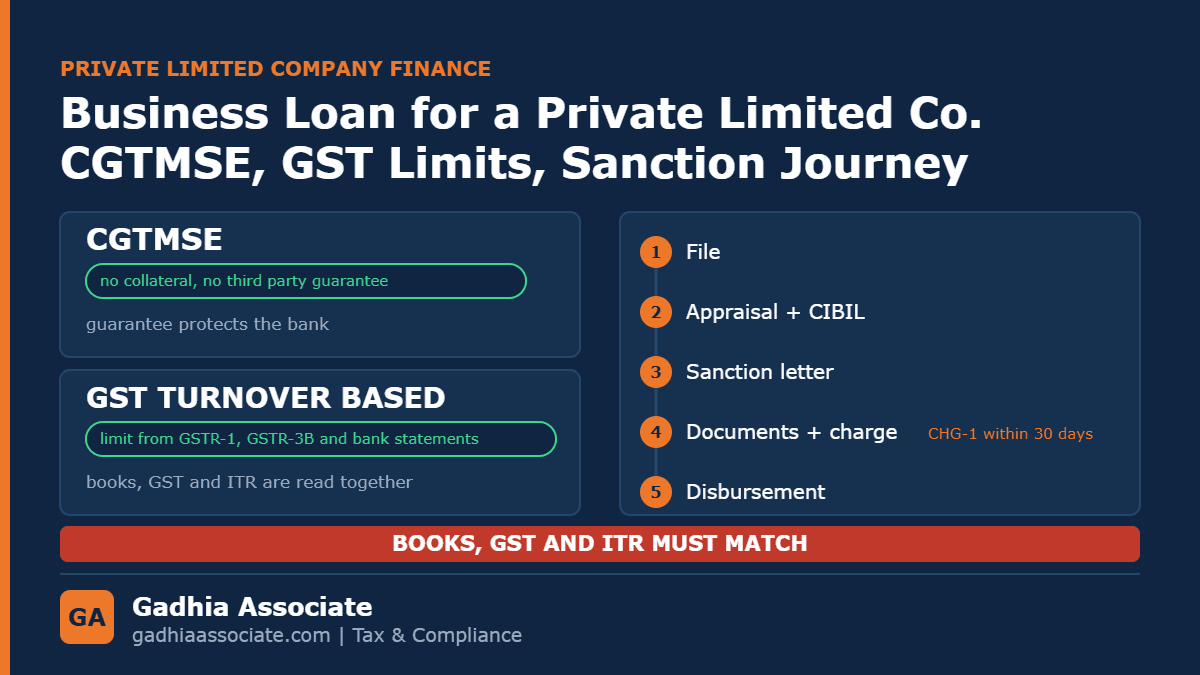
Short answer: A private limited company can borrow with or without collateral. CGTMSE gives the lender a guarantee so a micro or small enterprise can get credit without collateral security and without a third-party guarantee, with cover now available up to Rs 10 crore. Separately, many lenders now fix limits by reading GSTR-1, GSTR-3B and bank statement credits rather than relying only on a balance sheet.
Which facility actually fits what you need?
Match the loan to the life of the asset you are funding, because that single decision drives everything else. A term loan pays for something that stays with you for years: a CNC machine, a shed, a solar rooftop, a second-hand imported press. You repay it in monthly instalments over three to seven years, usually with a moratorium of three to twelve months while the machine is being installed.
A cash credit limit, which everyone shortens to CC limit, is a revolving facility for working capital. The bank fixes a ceiling, say Rs 1 crore, and you draw and repay within it as often as you like. You pay interest only on the daily outstanding, not on the sanctioned limit. An overdraft works similarly and is often given against property or deposits instead of stock.
Here is where the jargon bites. Inside a CC limit, the bank does not let you draw the full sanctioned amount automatically. It calculates drawing power every month from the stock and debtor statement you submit. Take your closing stock, subtract the creditors for that stock, apply a margin of usually 25 percent, then add your book debts under 90 days after a margin of about 40 percent. That figure is your drawing power. If it comes to Rs 68 lakh in a month, you can draw Rs 68 lakh even though your limit says Rs 1 crore. Founders are genuinely surprised by this the first time it happens, usually on the day they need the money most.
Bill discounting and invoice discounting give you cash against a specific accepted invoice instead of a general limit. Letters of credit and bank guarantees are not loans at all in the cash sense; they are the bank lending you its name to a supplier or a tender authority, and they carry a commission rather than interest. Equipment finance from an NBFC is quicker and lighter on documents but usually dearer. Loan against property is the fallback when the business numbers alone will not carry the limit you want, and it should honestly be the last option, because you are pledging a family asset for a business risk.
One route most small companies ignore is TReDS, the Trade Receivables Discounting System regulated by the RBI. If you supply to a large corporate or a PSU, your invoice can be uploaded and financiers bid to discount it, usually without recourse to you. Since the Ministry of MSME notification of November 2024, companies with turnover above Rs 250 crore must be onboarded on TReDS, so your large buyer is probably already registered even if nobody told you.
What is CGTMSE really, and what does it not do?
CGTMSE protects the bank, not you. This is the single most misunderstood thing in MSME lending. The Credit Guarantee Fund Trust for Micro and Small Enterprises was set up by the Ministry of MSME and SIDBI, and what it does is stand behind the lender. If your account goes bad, the trust reimburses the member lending institution a percentage of its loss. Your liability to repay does not reduce by one rupee. What you get out of it is the ability to borrow at all, because the guarantee lets the bank drop the demand for collateral security and for a third-party guarantee.
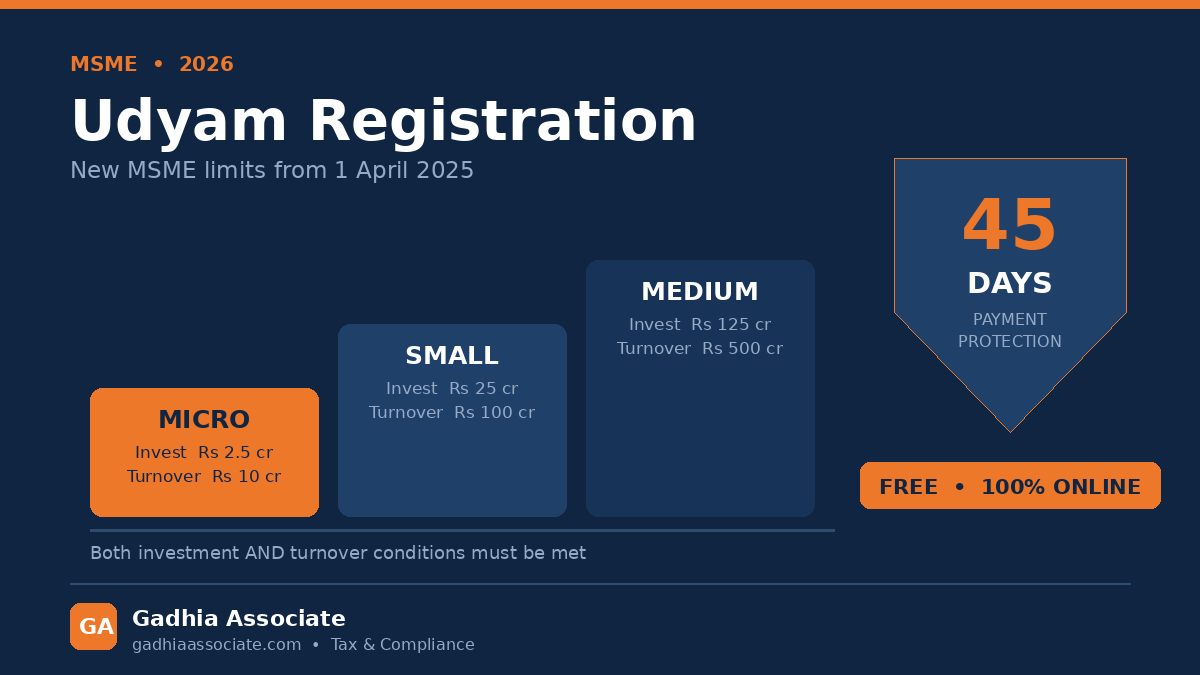
To be eligible you have to be a micro or small enterprise as classified under the MSMED Act, and you need a live Udyam registration. Since 1 April 2025 the classification limits went up: micro is now investment up to Rs 2.5 crore and turnover up to Rs 10 crore, small is up to Rs 25 crore and Rs 100 crore, under Ministry of MSME notification S.O. 1364(E) dated 21 March 2025. Plenty of companies that thought they had outgrown MSME status are back inside the bracket.
The guarantee ceiling was doubled from Rs 5 crore to Rs 10 crore per borrower following the Budget 2025 announcement, operative from 1 April 2025 through CGTMSE circular no. 250/2024-25. The extent of cover is slab-based: broadly 85 percent for micro enterprise credit up to Rs 5 lakh, 80 percent above Rs 5 lakh up to Rs 50 lakh, and 75 percent above that up to the ceiling, with higher cover for women-owned units, units in the North East and certain priority categories. I will be straight with you here, because the slabs have been revised more than once and different bank circulars quote them differently. Do not plan around a percentage you read anywhere, including here. Ask your branch to pull up the current CGTMSE circular before you commit.
The Annual Guarantee Fee is the cost of the cover. Under the revised structure effective 1 April 2025, the standard rate starts at 0.37 percent for facilities up to Rs 10 lakh and rises through the slabs, roughly 0.55 percent up to Rs 50 lakh, 0.60 percent up to Rs 1 crore, 0.85 percent up to Rs 2 crore and around 1 percent up to Rs 5 crore. The rate is adjusted for the lending institution's own risk rating, so two banks can quote you different fees on the same loan. The fee is charged annually, and in practice the bank recovers it from you. Nobody tells you this at the sanction stage. It shows up as a debit in your account and you call the branch asking what it is.
There is also a hybrid security model, which is useful and underused. You give collateral for part of the facility and CGTMSE covers the uncovered balance. So if you can mortgage a plot worth Rs 40 lakh against a Rs 1 crore requirement, the remaining Rs 60 lakh can sit under the guarantee. CGTMSE takes a pari passu charge on the security in that arrangement.
Now the part that upsets people. Even under CGTMSE, almost every bank still takes the personal guarantee of the directors. The scheme bars a third-party guarantee, not a promoter or director guarantee. Your signature on that form puts your house and your personal deposits behind the company's borrowing. It is legal, it is standard, and you should read it before you sign rather than after.
Not sure whether your file qualifies for CGTMSE cover, or whether the bank is quietly asking for security it does not need? Send us your last two years of financials and your Udyam certificate and we will tell you where you stand. First consultation is free. Call or WhatsApp +91 82005 28355.
How does a lender read your GST returns to fix a limit?
Your GST returns are now a credit assessment document, whether you meant them to be or not. Lenders pull GSTR-1 to see declared outward supplies month by month, cross-check GSTR-3B for what was actually paid, and lay both against the credits in your bank statement and the turnover in your income tax return. If those four numbers tell the same story, the file moves. If they do not, the file stops, and the credit officer does not always tell you which number bothered him.
Cash flow lending works off that data directly. Instead of computing a limit from your balance sheet ratios alone, the lender takes average monthly GST turnover, applies a multiple, sanity-checks it against bank credits, and offers a limit. It is faster. It is also unforgiving about inconsistency.
The PSB Loans in 59 Minutes platform runs on the same logic. You upload GST data, ITR and bank statements, and the system returns an in-principle approval letter, for business loans broadly in the range of Rs 1 lakh to Rs 5 crore. Understand what that letter is: it is a computer saying your numbers fit a policy grid. It is not a sanction. The branch still does its own appraisal, and disbursement typically takes another week or more after physical documentation. People walk into the branch waving the in-principle letter expecting a cheque, and that conversation never goes well.
The Account Aggregator framework is the newer piece. With your consent, given digitally and revocable, your bank statement and GST data flow straight to the lender without you emailing PDFs. It shortens the file by days. It also means the lender sees exactly what is there, including the cheque returns.
What does a banker infer from your turnover pattern? Steady growth reads as a business with repeat customers. Lumpy turnover, three flat months then one enormous month, reads as either seasonal or as a single dependent buyer, and he will ask which. Falling turnover with a rising limit request reads as stress. Say it before he finds it, with a reason he can write into his note.
Which other routes are worth checking before you sign anything?
Several schemes are cheaper than a plain commercial loan, and most companies never check them. PMEGP offers margin money subsidy of 15 to 35 percent depending on category and whether the unit is rural or urban, but it is for new units set up by individual entrepreneurs, so an existing private limited company generally will not qualify. Stand-Up India funds greenfield projects between Rs 10 lakh and Rs 1 crore for SC, ST and women entrepreneurs; a company can apply if at least 51 percent of the shareholding and controlling stake is held by an eligible promoter. Mudra is designed for micro units and is typically extended to proprietors and small firms rather than to companies of any size; ask the branch rather than assuming.
For DPIIT-recognised startups, the Credit Guarantee Scheme for Startups was expanded in May 2025 and the maximum guarantee cover per borrower went from Rs 10 crore to Rs 20 crore, with cover of 85 percent for loans up to Rs 10 crore and 75 percent above that. The Mutual Credit Guarantee Scheme for MSMEs, run by NCGTC and launched in 2025, gives lenders a 60 percent guarantee on credit facilities up to Rs 100 crore for purchase of plant and machinery, with a Udyam number as a precondition and a minimum share of the project cost required to be equipment. SIDBI runs its own machinery and green finance lines worth a look.
In Gujarat, the Aatmanirbhar Gujarat Scheme for assistance to MSMEs, operative from October 2022, offers interest subsidy on term loans and a capital investment subsidy for micro manufacturing units, with the quantum varying by taluka category. The figures move with each amendment and the taluka classification matters a great deal in Saurashtra, so treat the scheme document from the Industries Commissionerate as the only reliable source. Most of these need a live Udyam registration before anything else.
What actually happens between your first enquiry and money in the account?
The sanction letter is not the finish line, and that misunderstanding costs more time than any other single thing. Here is the real sequence.
You start with an enquiry and an eligibility check, a day or two. Then an in-principle discussion where the manager tells you roughly what he can do. File submission comes next, and this is on you: financials, CMA data, projections, KYC, GST and ITR, sanction letters of existing lenders, property papers. Credit appraisal follows, typically one to three weeks at a branch, longer if the proposal goes to a regional or zonal office because it exceeds branch powers. Ask early which office will sanction it, because a file travelling to Ahmedabad takes two weeks longer than one cleared at the branch.
CIBIL is pulled for the company and for every single director, including the quiet one who holds two percent and has a credit card he forgot about. Then verification and a site visit. What does the manager check first when he walks in? Not your projections. He looks at whether the machines are running, whether there are workers present, and whether the stock you claimed in the statement is physically there. Everything else he reads later.
Then the sanction letter with its conditions, your written acceptance, documentation and stamping, creation of security, and disbursement. Total realistic time for a clean, complete file: three to six weeks. For a file with gaps: three months or more.
The gap between sanction and disbursement is where most files sit for weeks. Stamping on loan documents in Gujarat, valuation and legal opinion on the mortgaged property, the CERSAI registration, the CGTMSE cover being lodged, insurance of the hypothecated assets with the bank named as loss payee. The document that delays sanction most often, in our experience, is the property title chain: an old plot with a missing link deed or a revenue entry that was never regularised can add a month on its own. Start that search on day one, not after sanction.
If your file has been "under process" for more than three weeks, something specific is stuck. We will read the sanction conditions with you and identify what is actually holding the disbursement. First consultation is free. +91 82005 28355, Junagadh office, same-day appointments.
What security will the bank take, and what does this loan really cost?
Two kinds of security exist and banks use both words loosely. Primary security is the asset being funded: the machine under the term loan, the stock and receivables under the CC limit. Collateral security is everything extra, usually immovable property. Hypothecation means the bank has a charge over movable assets that stay in your possession and you use them normally; a mortgage means immovable property and involves stamp duty and registration.
Margin money, or promoter contribution, is your share of the cost. Banks commonly expect 25 to 35 percent on a machinery term loan, so a Rs 1 crore machine may need Rs 25 to 35 lakh from you before a rupee is released. That money has to be visibly brought in and traceable, not adjusted through a book entry at year end.
DSCR, debt service coverage ratio, is the number the credit officer defends internally. It is your annual cash profit plus depreciation plus interest, divided by the annual instalments plus interest. Most banks want around 1.5 times or better, and a projection that shows 1.05 gets sent back without discussion.
Costs that are real but rarely quoted upfront: processing fee, usually 0.5 to 1 percent of the limit, annually on working capital; the CGTMSE annual guarantee fee; valuation and legal opinion charges; stamp duty on the loan and mortgage documents under the Gujarat Stamp Act; insurance premium on hypothecated stock and machinery; and the ROC filing cost for the charge. Interest on MSME loans is usually linked to the repo rate plus a spread that depends on your internal credit rating, so improving that rating is worth real money. Add the fees up before you compare two offers. The cheaper headline rate is not always the cheaper loan.
What must the company do after the sanction letter arrives?
- File Form CHG-1 with the Registrar of Companies within 30 days of creation of the charge under Section 77 of the Companies Act, 2013. Late filing is permitted up to 60 days with additional fees and beyond that only with Central Government condonation. An unregistered charge is not enforceable against the liquidator and other creditors, and every future lender and due diligence team will see the gap on the MCA portal. This is the compliance founders forget most often.
- Pass a board resolution to borrow under Section 179(3)(d) before drawing. Where total borrowings will exceed paid-up capital plus free reserves plus securities premium, a special resolution of members under Section 180(1)(c) is required as well.
- Submit stock and debtor statements monthly or quarterly as the sanction specifies. Miss them and the bank can reduce drawing power or charge a penal rate.
- Renew working capital limits every year with fresh financials and CMA data. Start 60 days before expiry, not after.
- Insure hypothecated stock and machinery for full value with the bank recorded as loss payee, and send the policy copy to the branch.
- Provide end-use certification for term loans, usually a chartered accountant certificate with UDIN confirming the money went into the asset it was sanctioned for.
- Keep GST returns and income tax returns filed and current. Lenders re-check them at renewal, and a lapsed GSTR-3B is enough to stall a routine renewal.
- Update Udyam registration details when investment or turnover changes, since scheme eligibility follows the Udyam record.
Why do files get rejected or repriced at the last minute?
Almost always because of something in the numbers the promoter knew about and hoped nobody would open. A mismatch between books, GST returns and ITR is the biggest one. Thin or negative net worth after years of drawings. Heavy unsecured loans from directors that the bank may ask to be subordinated. Overdue EMIs or a poor CIBIL score on any director. Cheque returns in the bank statement, which are visible for the full twelve months you submitted. Statutory dues outstanding, GST or TDS or PF. Unexplained cash deposits, which look worse now that Section 269ST restricts cash receipts of Rs 2 lakh or more. Projections nobody can defend internally, showing 40 percent growth with no order book attached.
Two quieter ones: Section 43B(h) of the Income Tax Act, which disallows deduction for payments to micro and small suppliers beyond the 45-day limit, can move your year-end profit and therefore your DSCR. And if a chunk of your sales are in cash, the file reads as risky regardless of how honest the business is.
How is a working capital limit actually arrived at? (illustrative)
The following figures are illustrative and rounded, used only to show the method. Assume Saurashtra Engineering Private Limited reports turnover of Rs 6 crore, expects Rs 7.5 crore next year, and holds average stock of Rs 90 lakh, debtors of Rs 1.1 crore and creditors of Rs 70 lakh.
Under the traditional turnover method used for smaller limits, working capital requirement is taken at 25 percent of projected turnover, so Rs 1.87 crore. The promoter is expected to fund at least 5 percent of turnover as margin, about Rs 37.5 lakh. The bank's share works out to roughly Rs 1.5 crore, and the sanctioned limit is often set a little below that after looking at actual utilisation.
Now check it against drawing power. Stock of Rs 90 lakh less creditors of Rs 70 lakh gives Rs 20 lakh; after 25 percent margin, Rs 15 lakh. Debtors under 90 days of, say, Rs 80 lakh after 40 percent margin gives Rs 48 lakh. Drawing power is Rs 63 lakh. So even with a Rs 1.5 crore limit on paper, this company can draw about Rs 63 lakh this month. That gap is the conversation to have with your banker before you accept the sanction, not after your supplier's cheque bounces.
What do we do on a loan file, and what do we not do?
Gadhia Associate is based in Junagadh, Gujarat, and works with clients across India. We have been in practice since 2007, serve 7000-plus clients across Saurashtra and Gujarat, and hold a 5.0 Google rating from over 100 reviews. The Junagadh office takes same-day appointments, we work digitally with clients anywhere in the country, and we offer fixed-fee engagements and monthly plans instead of open-ended billing.
What we prepare: audited and provisional financials, CMA data, projections with assumptions a credit officer can actually defend, net worth and turnover certificates carrying UDIN, reconciliation between books, GST returns and the income tax return, ROC charge filings including CHG-1, board and shareholder resolutions, and post-sanction compliance through the life of the loan. We coordinate with your banker and answer the queries that come back from the credit department.
What we do not do, stated plainly: we do not guarantee sanction. We are not a loan agent and not a DSA. We have no commission arrangement with any lender and we do not take a cut of your loan amount. The credit decision belongs to the bank. Our job is to make sure the file you submit is accurate, complete and internally consistent, so that the decision is taken on the merits of your business rather than on a gap in the paperwork.
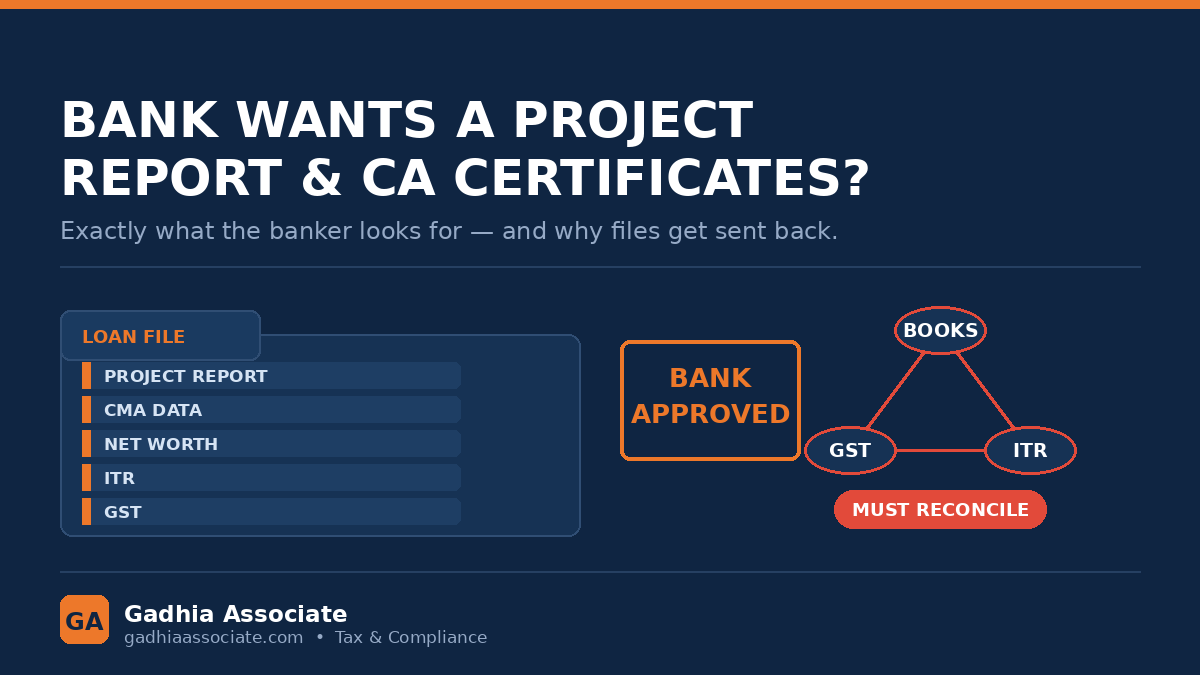
If your banker has already asked for a project report and CA certificates, read our separate article, Bank Asking for a Project Report and CA Certificates for Your Business Loan? Here Is Exactly What They Want and Why Files Get Rejected, which covers the documentation in detail. Our guides on Udyam registration, MSME benefits and government grants, the MSME 45-day payment rule under Section 43B(h), private limited versus LLP versus proprietorship, and cash transaction limits are all relevant here too. If you are still deciding on your structure, the Business Structure Advisor tool on our site is a reasonable starting point.
Bring us your file before the bank sees it. We will tell you honestly whether it will clear as it stands, what needs fixing, and how long it will take. First consultation is free. Call or WhatsApp +91 82005 28355.
Frequently asked questions
Can a private limited company get a loan without any collateral?
Yes, if it qualifies as a micro or small enterprise under the MSMED Act with a valid Udyam registration and the lender is registered with CGTMSE. The guarantee allows credit without collateral security and without a third-party guarantee, with cover available up to Rs 10 crore per borrower. Most banks will still take the personal guarantee of directors, which the scheme permits.
Who pays the CGTMSE guarantee fee, the bank or the borrower?
The scheme is between CGTMSE and the lending institution, but in practice banks recover the Annual Guarantee Fee from the borrower every year. Rates start around 0.37 percent for small facilities and rise through the slabs, adjusted for the lender's risk rating. Ask for the exact rate in writing before accepting the sanction, because it varies between banks.
Why can I only draw part of my sanctioned cash credit limit?
Because drawing power, not the sanctioned limit, controls the actual withdrawal. The bank computes it monthly from your stock and debtor statement: paid stock after a margin, plus eligible book debts under 90 days after a margin. If drawing power falls below the limit, you can only draw the lower figure. Filing accurate statements on time directly protects your available cash.
What happens if we miss the 30-day deadline for filing Form CHG-1?
The charge can still be registered within 60 days of creation on payment of additional fees, and beyond that only with Central Government condonation under Section 77 of the Companies Act, 2013. An unregistered charge is not enforceable against the liquidator or other creditors in winding up, and the gap is visible to every future lender and investor on the MCA portal.
How long does a business loan really take from application to disbursement?
A complete, consistent file usually takes three to six weeks. Credit appraisal is one to three weeks, longer if the proposal exceeds branch powers and goes to a regional office. The stretch between sanction and disbursement, covering stamping, valuation, legal opinion, charge creation and insurance, is where most delays sit. Files with document gaps commonly run past three months.
Will a director's personal CIBIL score affect the company's loan?
Yes. Lenders pull the credit report of the company and of every director individually. A defaulted personal loan, a settled credit card or overdue EMIs on any director can hold up or reprice the entire proposal. Check all director reports before applying, correct any wrong entries with the bureau first, and disclose genuine issues upfront rather than letting the banker discover them.
This article states the position as of September 2026. Scheme ceilings, the extent of guarantee cover and fee rates change through CGTMSE circulars and government notifications, and every lender applies its own credit policy on top of them. Confirm the current terms with your bank before committing to anything.