MSME 45-Day Payment Rule (Section 43B(h)) in 2026: Disallowance Trap, New Classification Limits & Solutions for Every Buyer
If your business buys goods or services from small suppliers, Section 43B(h) of the Income-tax Act is the single most expensive clause you can afford to ignore. It does not levy a penalty. It quietly takes away your expense deduction for a whole year, pushes your taxable profit up, and leaves you paying tax on money you have already spent. In 2026, with the revised MSME classification limits and the new Income-tax Act, 2025 now in force, the rule bites a much wider set of vendors than most buyers realise.
What Section 43B(h) Actually Says
Section 43B(h) provides that any sum payable by an assessee to a micro or small enterprise is allowed as a deduction only in the previous year in which the payment is actually made, unless the payment is made within the time limit specified under Section 15 of the MSMED Act, 2006.
The time limit under Section 15 is simple:
- 45 days from the date of acceptance or deemed acceptance of goods or services, where there is a written agreement.
- 15 days where there is no written agreement between the buyer and the supplier.
Miss that window and the expense is disallowed in the year of purchase. It is allowed only in the year you actually pay. There is no proviso that rescues you by paying before the ITR due date, unlike other clauses of Section 43B. That is what makes 43B(h) different, and dangerous.
Who Is Covered and Who Is Not
This is where most errors happen. Section 43B(h) applies only to Micro and Small enterprises. It does not apply to Medium enterprises. It also applies only where the supplier is Udyam-registered as a micro or small enterprise. A supplier who is small in size but has never taken Udyam registration is outside the clause.
Two further points that are regularly missed:
- Traders registered on Udyam are eligible for MSME benefits only for priority sector lending purposes. They are generally not covered for the purpose of delayed payment protection under Section 15, so 43B(h) does not attach to pure trading suppliers.
- The clause covers revenue expenditure claimed as a deduction. Capital purchases and amounts not routed through the profit and loss account follow their own treatment.
The New MSME Classification Limits (w.e.f. 1 April 2025)
The investment and turnover thresholds were revised upward with effect from 1 April 2025. An enterprise must satisfy both the investment and the turnover condition to fall in a category. Breach either one and it moves up.
- Micro: investment up to Rs 2.5 crore and turnover up to Rs 10 crore.
- Small: investment up to Rs 25 crore and turnover up to Rs 100 crore.
- Medium: investment up to Rs 125 crore and turnover up to Rs 500 crore.
Because the limits went up, many enterprises that were earlier Medium have slipped back into the Small bracket. If they are Udyam-registered, your payments to them are now inside the 45-day net. Buyers who prepared a vendor list in 2023 and never revisited it are the most exposed.
Classification is no longer a one-time declaration either. It updates automatically every year based on ITR and GST data linked to the Udyam portal. A vendor can change category between two purchase orders without telling you. Also note that Udyog Aadhaar and EM-I / EM-II registrations are no longer valid — only a live Udyam Registration Number counts.
Income-tax Act, 2025: Does 43B(h) Survive?
Yes. The Income-tax Act, 2025, which came into force on 1 April 2026, carries forward the substance of Section 43B(h) in its corresponding provision on deductions allowed only on actual payment. The section number changes; the discipline does not. Businesses that built a 45-day payment process under the old Act do not need to rebuild it, but they do need to update section references in their internal policies, audit checklists and vendor contracts.
What the Disallowance Costs You
Take a simple case. You buy Rs 40 lakh of job-work services from a Udyam-registered small enterprise in February and pay in June, 120 days later. The Rs 40 lakh is disallowed in the year of purchase. At a 25 per cent effective rate you fund roughly Rs 10 lakh of extra tax, plus interest under Sections 234B and 234C, and you get the deduction only in the following year. Your cash flow, not your accountant, absorbs the damage. Add to that the supplier's statutory right to interest at three times the RBI bank rate under Section 16 of the MSMED Act, and the true cost climbs further.
Practical Checklist for Every Buyer
- Collect Udyam certificates from every vendor and refresh them annually. Store the Udyam Registration Number, category and date in your vendor file.
- Flag Micro and Small vendors in your accounting master so that the system itself tells your payables team which invoices are on the clock.
- Print the MSME status on the vendor ledger and the invoice booking screen. A tag nobody sees is a tag nobody follows.
- Run a 45-day payment calendar. Schedule MSME payments by due date, not by convenience, and review the queue weekly.
- Execute written agreements or accepted purchase orders with every MSME supplier. Without one, your window shrinks from 45 days to 15.
- Fix the acceptance date. The clock starts from delivery or deemed acceptance, and objections to goods must be raised in writing within 15 days.
- Do a vendor ageing review before 31 March. Pull every open MSME balance, identify what has crossed the limit, and clear what can still be cleared.
- Reconcile the disclosure. MSME dues are separately disclosed in the financial statements and in the half-yearly MSME Form 1 filing with the MCA. Keep the tax computation, the notes to accounts and the MCA filing consistent.
- Brief your auditor early. Disallowance under 43B(h) is reported in the tax audit report, so surprises at the last minute are avoidable.
Common Mistakes We See
- Treating every MSME-labelled vendor as covered, including Medium enterprises and traders.
- Relying on a vendor's verbal claim of MSME status instead of a certificate.
- Assuming payment before the ITR filing date saves the deduction. It does not.
- Holding back payment as leverage in a quality dispute without documenting the objection in writing.
- Ignoring retention money and part-payments, which are judged invoice by invoice.
How Gadhia Associate Can Help
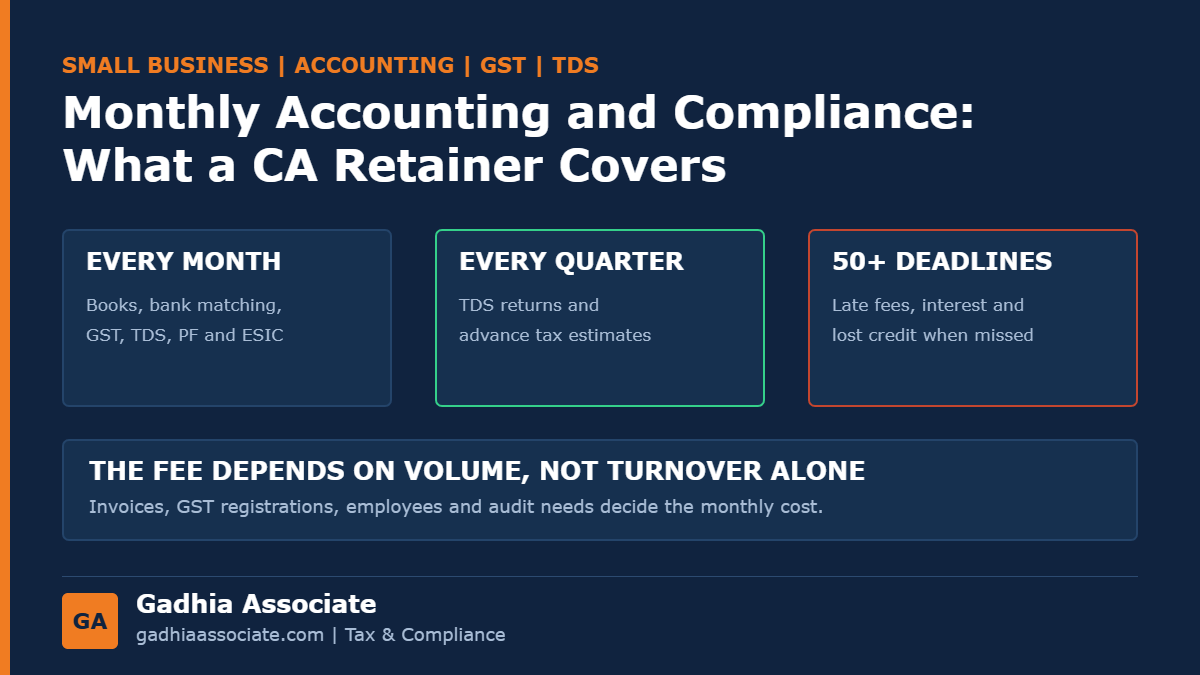
At Gadhia Associate, Junagadh, we help businesses across Gujarat convert Section 43B(h) from a year-end shock into a routine control. We audit your vendor master against live Udyam data, classify suppliers under the revised 2025 limits, design a 45-day payment calendar that your accounts team can actually run, draft or review MSME vendor agreements, quantify the exposure sitting in your current payables, and align your tax computation, tax audit report, financial statement disclosure and MSME Form 1 filing. If a disallowance has already been triggered, we help you plan the year of allowance so the deduction is not lost. Write to us or call the office to arrange a vendor ledger review before your next year-end.
Disclaimer: This article is for general information only and reflects the position of law as of August 2026. Statutory limits, section references under the Income-tax Act, 2025 and MSME classification criteria are subject to change, and the application of Section 43B(h) depends on the facts of each case. Please obtain professional advice before acting on anything stated here.