CA Turnover Certificate and Net Worth Certificate for Tenders in 2026: Bid Capacity, UDIN, Documents and Why Bids Get Rejected on Financial Papers
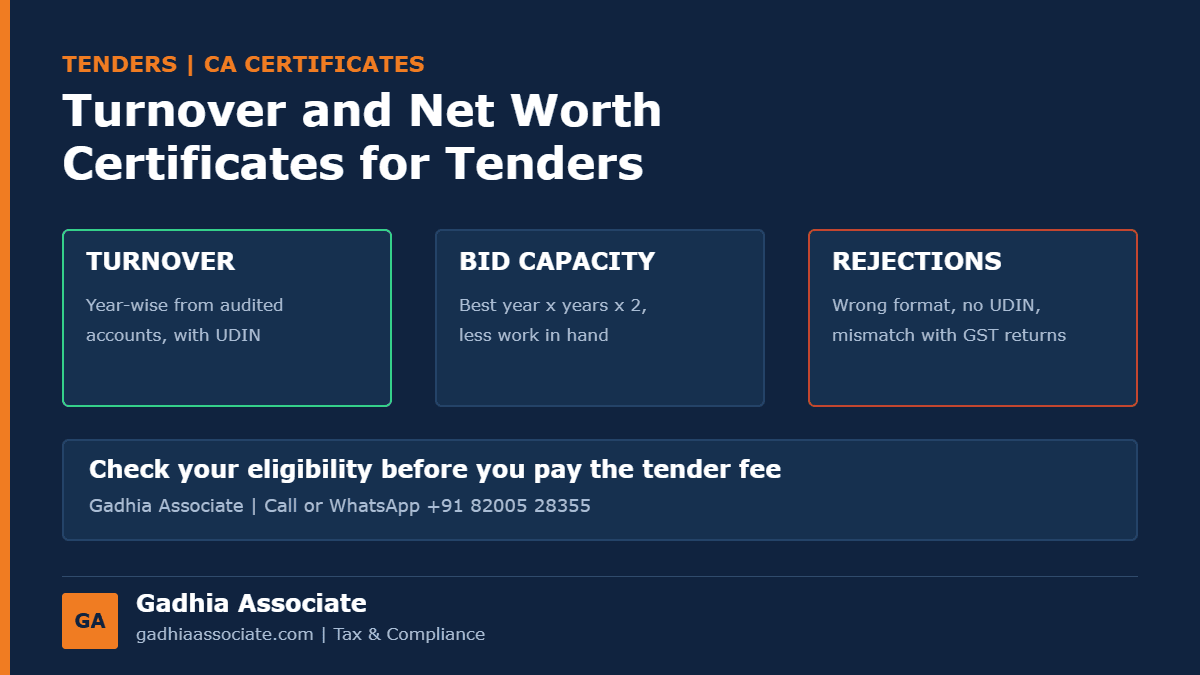
A CA turnover certificate for tender gives your year-wise turnover from audited accounts with a UDIN, and it must agree with your tax and GST returns.
Rameshbhai is a civil contractor from Junagadh with turnover of Rs 2.1 crore, Rs 3.4 crore and Rs 2.8 crore in the last three years. A Rs 6 crore road work has been tendered, with five days left to bid. The tender asks for a CA turnover certificate, a net worth certificate and a bid capacity statement, and he has work worth Rs 2.2 crore in hand. He has paid tender fees before, only to be rejected on the financial papers.
Contractors and suppliers across Saurashtra lose bids not on price but on paperwork. The financial certificates are the part a CA signs, and the part buyers now verify online. Here is what they contain and how to get them right.
Short Answer: Government and large private tenders ask bidders to prove financial strength with certificates from a chartered accountant: a turnover certificate for the last three to five years, a net worth certificate, and often a bid capacity statement, each with a UDIN the buyer can verify online. The figures come from audited accounts and must agree with income tax and GST returns. A common norm in government works is average annual turnover of at least 30% of the estimated cost, and bid capacity is usually two or more times the best year's work, less work in hand. A solvency certificate comes from the bank, not the CA. Wrong or unsupported figures lead to rejection and blacklisting.
Our team issues turnover, net worth and bid capacity certificates with UDIN, and checks your eligibility before you bid. Call or WhatsApp +91 82005 28355, or see the details at the end of this guide.
Which financial papers tenders ask for
- Turnover certificate: year-wise turnover for the last three to five years.
- Net worth certificate: usually to show that net worth is positive.
- Bid capacity statement: mainly in works contracts.
- Audited accounts and returns: balance sheets, tax audit reports and income tax returns for the same years.
- Solvency certificate: from the bank, not from the CA.
- Not from the CA either: work completion certificates come from your past clients.
Turnover certificate
- Source: the audited profit and loss account of each year. See tax audit.
- Which years: the tender names them, usually the last three financial years ending on the previous 31 March.
- What counts: turnover from operations, without GST, unless the tender defines it differently.
- Similar work: some tenders ask for turnover from a particular kind of work or product, shown separately.
- Latest year not audited: provisional figures work only if the tender allows them.
- Must match: buyers compare it with GST returns and the tax statement, so reconcile first. See GST and income tax for contractors.
Net worth certificate
- Company: paid-up capital plus free reserves, less accumulated losses. Revaluation reserves do not count.
- Proprietor or firm: the capital account balances in the audited balance sheet.
- Typical condition: positive net worth, or net worth above a stated amount.
- Different from a visa certificate: that one lists personal assets at market value. See net worth certificate for visa.
Bid capacity
- Usual formula: A x N x 2, less B. Some tenders use 2.5 or 3 in place of 2.
- A: the highest value of work done in any one of the last five years, updated to current prices if the tender allows.
- N: the number of years given to complete the work.
- B: the value of existing work still to be done during that period.
- The CA's part: certifying A from the accounts and B from work orders and bills.
- Check first: if the result is below the estimated cost, the bid fails, however good the price.
Turnover norms and MSE relaxations
- Common norm: in government works, average annual turnover of at least 30% of the estimated cost, though each tender sets its own figure.
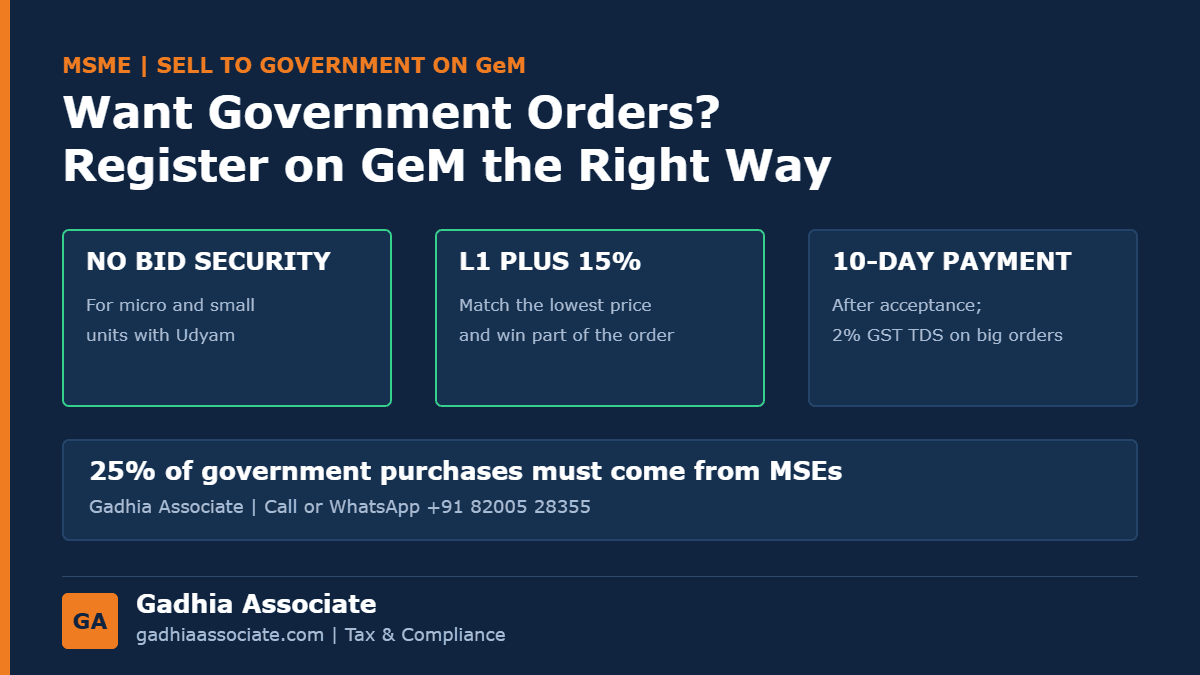
- MSEs and startups: many tenders relax prior turnover and experience for them, subject to quality. See selling to the government on GeM.
- Udyam: the relaxation needs a valid Udyam certificate. See Udyam registration.
- Not automatic: the relaxation applies only where the tender says so.
What to give your CA
- The tender document, with the required format
- Audited accounts, tax audit reports and income tax returns for each year
- GST annual returns and the tax statement for the same years
- List of work in hand, with work orders and bills raised
- PAN, GST and Udyam certificates
Why bids are rejected on financial papers
- Certificate not in the tender's format, or covering the wrong years.
- No UDIN, or a UDIN that does not verify on the ICAI portal.
- Turnover that does not match the audited accounts or GST returns.
- Signed by another CA where the tender asks for the statutory auditor.
- Provisional figures where audited figures were required.
- Work in hand left out of the bid capacity statement.
- False figures, which can mean rejection, loss of the bid security and blacklisting.
Back to Rameshbhai. His average turnover of about Rs 2.77 crore clears the 30% norm of Rs 1.8 crore, and his net worth is positive. But his bid capacity is Rs 3.4 crore x 1 x 2, less Rs 2.2 crore of work in hand, which is Rs 4.6 crore, short of the Rs 6 crore estimate. He does not bid for this work, and bids instead for a Rs 4 crore package in the same notice. His turnover and net worth certificates are issued in the tender's format with UDIN, matching his audited accounts and GST returns.
How we help
- Turnover and net worth certificates with UDIN, in the tender's format
- Bid capacity working and eligibility check before you bid
- Reconciling turnover with GST returns and tax statements
- Audit, tax audit and returns kept ready for tender season
- Udyam and MSE documents for relaxations
- GST, TDS and accounting for contractors and suppliers
Gadhia Associate has been in practice since 2007 and has handled work for over 7,000 clients, with a 5.0 Google rating from more than 100 reviews. Contractors and suppliers from Junagadh, Rajkot, Porbandar, Veraval and Amreli come to our Junagadh office, where same-day appointments are available. Clients elsewhere in Gujarat are handled online.
Bidding for a tender? Get your certificates and eligibility checked before you pay the fee. Call or WhatsApp +91 82005 28355, or message us on WhatsApp. The first consultation is free.
Frequently asked questions
What is a turnover certificate for tender?
A CA's certificate of your year-wise turnover, taken from audited accounts, with a UDIN.
Who can issue a turnover certificate?
A practising chartered accountant. Some tenders insist on the statutory auditor.
How is bid capacity calculated?
Usually as the best year's work multiplied by the completion period in years and by 2, less the work in hand.
Is a solvency certificate issued by a CA?
No. It comes from the bank.
How is net worth calculated for a tender?
For a company, paid-up capital plus free reserves less accumulated losses. For a proprietor or firm, the capital account in the audited balance sheet.
Do MSEs get relaxation in turnover criteria?
In many government tenders, yes, with a valid Udyam certificate, where the tender provides for it.
Position as of 15 November 2026. Every tender sets its own eligibility terms, formats and formulas, so the tender document prevails. A certificate reflects the audited accounts and records produced.