Mudra Loan in 2026: Shishu, Kishor, Tarun and Tarun Plus up to Rs 20 Lakh Without Collateral, Documents and Why Files Get Rejected
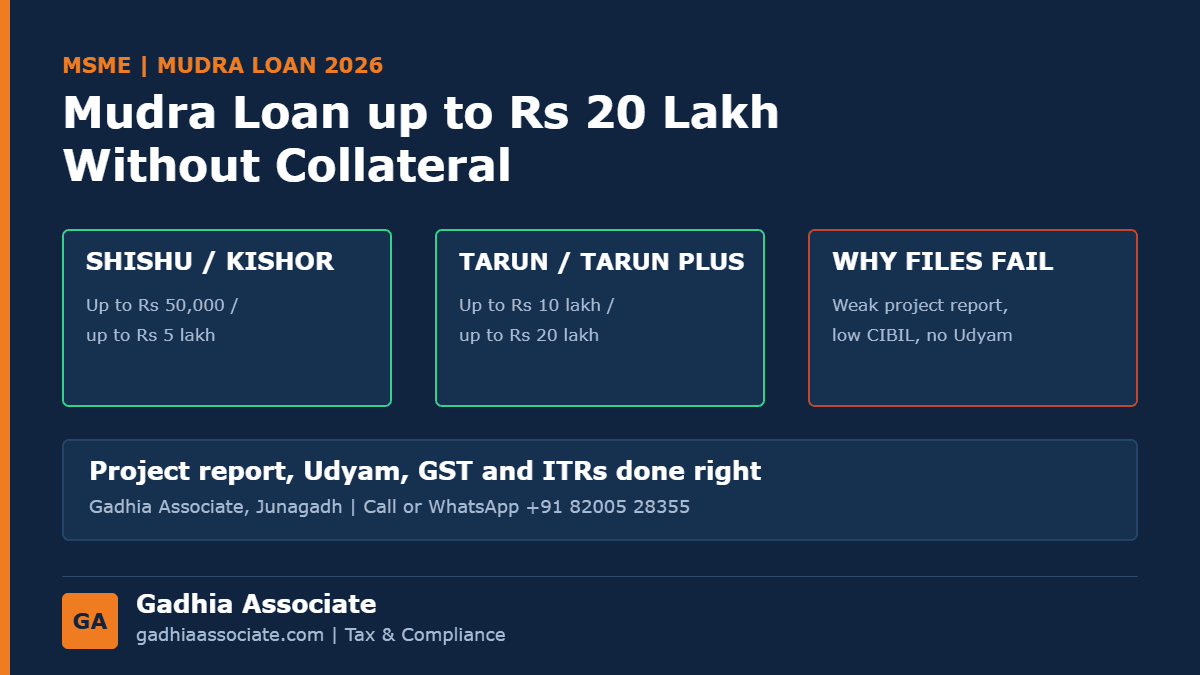
A Mudra loan gives small businesses up to Rs 20 lakh without collateral, but banks still want a sound project report, Udyam or GST and clean records.
Nileshbhai wants to start a groundnut oil unit in Keshod with an Rs 8 lakh expeller and filter press. He applied for a Mudra loan at his bank, but the file came back with a list: a project report with projections, machinery quotations, Udyam registration, two years of returns and an explanation for two late EMIs on his bike loan. An agent has since offered to get the loan approved for a fee.
Mudra loans are one of the most common ways small businesses in Saurashtra start or expand, but many files are returned or rejected for avoidable reasons. Here is how the scheme works in 2026 and how to prepare a file that gets sanctioned.
Our team prepares project reports, CMA data, Udyam and GST registrations and the returns banks ask for. Call or WhatsApp +91 82005 28355, or see the details at the end of this guide.
The four Mudra categories
- Shishu: up to Rs 50,000, for very small or new businesses.
- Kishor: above Rs 50,000 and up to Rs 5 lakh.
- Tarun: above Rs 5 lakh and up to Rs 10 lakh.
- Tarun Plus: above Rs 10 lakh and up to Rs 20 lakh, only for borrowers who have taken and repaid a Tarun loan.
The loan can be a term loan for machinery, equipment or a commercial vehicle, a working capital limit, or both. A working capital limit can be drawn through a Mudra card.
Who can apply
- Eligible: proprietors, partnership firms and other small business units, including shopkeepers, traders, small manufacturers, service providers, artisans and transport operators.
- Activities: income-generating manufacturing, trading and services, plus activities allied to agriculture such as dairy, poultry, fisheries and beekeeping.
- Not covered: crop loans and personal or consumption needs.
- Record: no default with any bank, and a credit score the bank is comfortable with.
Interest, collateral and fees
- No collateral: the loans are covered by the Credit Guarantee Fund for Micro Units instead of security.
- Interest: fixed by each bank under its own policy, usually linked to its benchmark rate, so compare banks.
- Fees: usually no processing fee on Shishu loans; for larger loans it depends on the bank, and many waive it.
- Own contribution: for Kishor and Tarun loans, banks often expect the owner to bring in a part of the project cost.
Documents banks ask for
- KYC: PAN, Aadhaar and photographs of the owners.
- Business proof: Udyam registration, GST registration where needed, shop licence and address proof. See Udyam registration.
- Project report: the cost of the project, means of finance, projected sales, profit and cash flow, and repayment ability. See what banks want in a project report.
- Quotations: for machinery, equipment or vehicles, from the suppliers.
- Bank statements: usually for the last 6 to 12 months.
- Returns and financial statements: for a running business, usually two or three years of income tax returns with balance sheets.
Why Mudra files get rejected
- Weak project report: projections that do not match the business, or a repayment plan the cash flow cannot support.
- Credit history: late EMIs, credit card defaults, or a guarantee given for someone else's bad loan.
- Low income on record: a return showing very little profit makes a large loan hard to justify. The presumptive scheme keeps tax low, but the declared profit also caps what the bank will lend. See presumptive taxation.
- Mismatched papers: different names or addresses across PAN, Aadhaar, Udyam, GST and the bank account.
- Branch area: banks prefer applicants whose business is in the branch's service area.
- Agents and fake offers: there is no agent or fee for a Mudra sanction. Letters or calls promising approval for a payment are frauds.
When another route is better
- Above Rs 20 lakh: a regular MSME loan with the CGTMSE guarantee can go much higher without collateral. See business loans with CGTMSE.
- Subsidy schemes: government schemes for new units can add a capital subsidy where you qualify. See MSME benefits and grants.
- Working capital: a cash credit limit against stock and debtors may suit a trading business better than a term loan.
Back to Nileshbhai. His project report is rebuilt with realistic oil and oilcake prices from the Keshod market, working capital for the groundnut season, and a repayment schedule his margins can carry. He registers on Udyam, gets two supplier quotations, writes a short note explaining the late EMIs, which were cleared long ago, and ignores the agent. The bank sanctions a Tarun loan of Rs 8.5 lakh: Rs 6.5 lakh as a term loan for the machinery, with Rs 1.5 lakh of his own money, and Rs 2 lakh as working capital on a Mudra card. Repaying it on time also opens the door to Tarun Plus when he expands.
How we help
- Project reports and CMA data for Mudra and other business loans
- Udyam, GST and shop registrations before you apply
- Income tax returns and financial statements banks accept
- Choosing between Mudra, CGTMSE and subsidy schemes
- Replies to bank queries, and stock statements after sanction
- Accounting and GST filings that keep the loan account healthy
Gadhia Associate has been in practice since 2007 and has handled work for over 7,000 clients, with a 5.0 Google rating from more than 100 reviews. Small businesses from Junagadh, Keshod, Mangrol, Veraval and Manavadar come to our Junagadh office, where same-day appointments are available. Work for clients elsewhere is handled online.
Planning a Mudra loan, or got your file back from the bank? Get the project report and papers right the first time. Call or WhatsApp +91 82005 28355, or message us on WhatsApp. The first consultation is free.
Frequently asked questions
What is the maximum Mudra loan amount?
Rs 20 lakh under Tarun Plus, for borrowers who have taken and repaid a Tarun loan. Others can get up to Rs 10 lakh.
Is collateral needed for a Mudra loan?
No. The loans are covered by a government-backed guarantee fund instead of security.
What is the interest rate on a Mudra loan?
Each bank sets its own rate, usually linked to its benchmark lending rate.
Is a project report needed for a Mudra loan?
For Kishor and Tarun loans, almost always. It shows the project cost, the projected profit and how the loan will be repaid.
Can a new business get a Mudra loan?
Yes. New units mostly start under Shishu or Kishor, with a project report and some money of their own.
Do I need to pay an agent for a Mudra loan?
No. There is no agent or fee for a sanction. Apply directly to a bank or other lender.
Position as of 25 October 2026, with loan limits as revised in October 2024. Lenders apply their own credit policies, so take advice on your own case.