Selling a Running Business in 2026: Slump Sale Tax at 12.5%, the Fair Value Rule, Form 3CEA, GST Exemption and Better Alternatives
Selling a running business as a slump sale means capital gains tax on the price minus the net worth, with a CA report and a fair value floor.
Rajeshbhai, 64, built an agro-chemicals distribution business in Gondal over 25 years. A larger distributor from Ahmedabad has offered Rs 6 crore for the whole business, with its godowns, vehicles, stock, debtors and staff, but not the cash in the bank. His sons are abroad, and he wants to know how much of the Rs 6 crore he will actually keep, and whether selling it in one piece is the best way.
As family businesses in Gujarat change hands, more owners face the question of how to sell. The way the deal is structured decides the tax, the GST and the paperwork. Here is how it works in 2026.
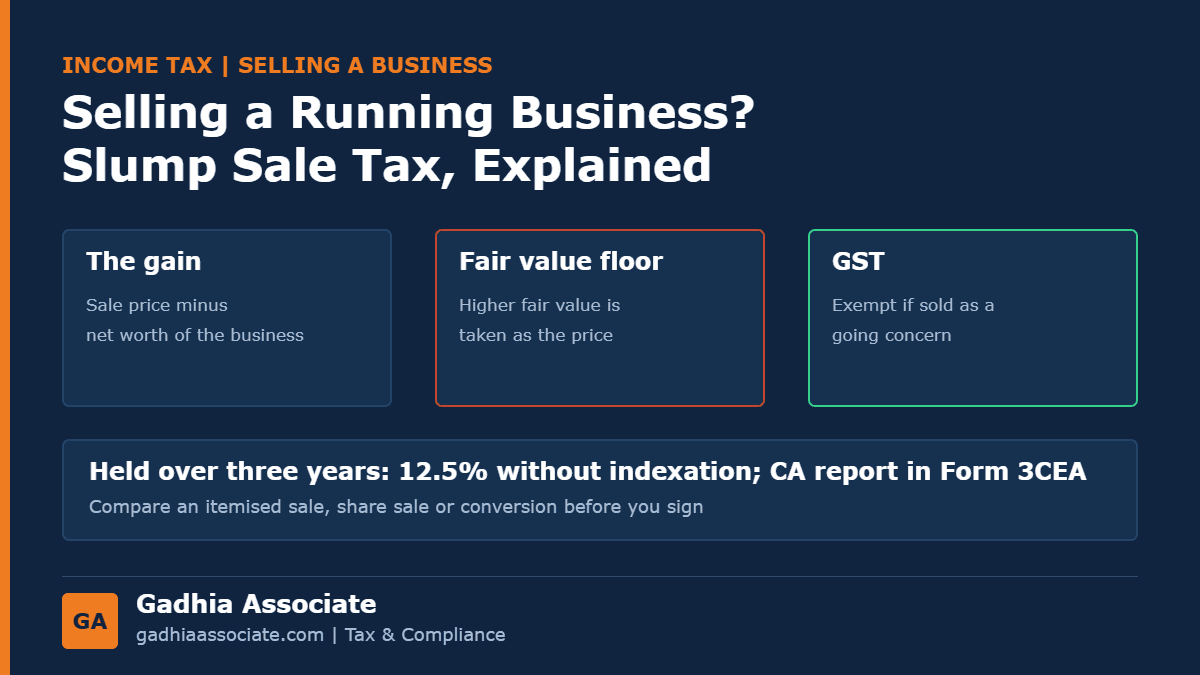
In short: A slump sale is the transfer of a whole business, or an undertaking, for a lump sum without values given to individual assets. The gain is the sale price minus the net worth of the undertaking, worked out under the tax rules and certified by a CA in Form 3CEA. If the undertaking was held for more than three years, the gain is long-term and taxed at 12.5% without indexation. The sale price is taken as the fair market value of the undertaking if that is higher than the agreed price. Transfer of a business as a going concern is exempt from GST. Alternatives such as selling assets one by one, or converting to a company first and selling shares, can give a better result, so compare them before signing.
Our team works out the tax on each route, prepares the Form 3CEA report and handles GST, agreements and the filings. The details are at the end of this guide.
What counts as a slump sale
- A whole undertaking: the business, or an independent division, transferred as a going concern.
- A lump sum: one price for the whole, without separate values for each asset and liability.
- Any form of transfer: sale or exchange both count.
- Not a slump sale: selling assets one by one with separate prices, which is taxed asset by asset instead.
How the tax is worked out
- The gain: sale price minus the net worth of the undertaking.
- Net worth: total assets minus liabilities, with depreciable assets at their written-down value for tax and other assets at book value. Revaluations are ignored.
- Fair value floor: if the fair market value of the undertaking under the tax rules is higher than the agreed price, that value is treated as the sale price.
- Holding period: an undertaking held for more than three years gives long-term gains, taxed at 12.5% without indexation, plus surcharge and cess. Otherwise the gain is short-term and taxed at normal rates.
- CA report: the net worth working is certified by a chartered accountant in Form 3CEA and filed before the return.
An example
Price agreed: Rs 6 crore. Net worth of the undertaking: Rs 2.4 crore. Long-term gain: Rs 3.6 crore, taxed at 12.5%, which is Rs 45 lakh before surcharge and cess. If the fair value worked out under the rules were Rs 6.5 crore, the gain would be computed on Rs 6.5 crore even though only Rs 6 crore was received.
GST on selling a business
- Exempt as a going concern: transfer of a business as a whole, or an independent part of it, as a going concern is exempt from GST.
- Credit transfer: unused input tax credit can be moved to the buyer through Form ITC-02.
- Asset sales are different: selling assets one by one attracts GST on each asset at its rate.
- Registration: the seller's GST registration is cancelled or amended after the transfer. See GST registration cancellation.
The buyer's side
- No depreciation on goodwill: goodwill paid for in the deal cannot be depreciated for tax, which affects how buyers price it.
- Stamp duty: land and buildings in the deal need a registered conveyance with stamp duty, while movables pass by delivery.
- Staff and contracts: employees, PF and ESIC, leases and supplier contracts need to be transferred or renewed.
Alternatives to compare
- Itemised sale: selling assets separately; depreciable assets give short-term gains, stock gives business income, and land held long gives long-term gains.
- Selling shares: if the business is in a company, the owners can sell their shares instead. See share transfer in a private limited company.
- Convert first: a proprietorship can be converted into a company, tax-free if the conditions are met, and shares sold later. See converting a proprietorship into a company.
- Saving the gain: investing long-term gains in a residential house can reduce the tax, within limits. See saving capital gains tax.
Back to Rajeshbhai. A slump sale at Rs 6 crore, against a net worth of Rs 2.4 crore, gives a long-term gain of Rs 3.6 crore, after the fair value floor is checked. Before signing, the sale is compared with selling the land and godowns separately and leasing them to the buyer, which could keep a rental income for the family. The business transfer agreement records the going concern so that GST does not apply, the unused credit moves to the buyer, the Form 3CEA report is prepared, and part of the gain goes into a house for the sons when they return.
How we help
- Compare slump sale, itemised sale, share sale and conversion routes
- Net worth and fair value working, and the Form 3CEA report
- Business transfer agreements, with the lawyer, and GST treatment
- ITC transfer, GST cancellation or amendment
- Capital gains planning and advance tax for the seller
- Due diligence for buyers
Gadhia Associate has been in practice since 2007 and has handled work for over 7,000 clients, with a 5.0 Google rating from more than 100 reviews. Business owners from Junagadh, Rajkot, Gondal, Jamnagar and Morbi come to our Junagadh office, where same-day appointments are available. Deal work for clients elsewhere is handled online.
Planning to sell your business, or received an offer? Work out what you will keep before you sign. Call or WhatsApp +91 82005 28355, or message us on WhatsApp. The first consultation is free.
Frequently asked questions
What is a slump sale?
The transfer of a whole business or undertaking for a lump sum, without separate values for individual assets and liabilities.
How is capital gain on a slump sale calculated?
Sale price minus the net worth of the undertaking, with the fair market value used as the price if it is higher.
What is the tax rate on a slump sale?
12.5% without indexation, plus surcharge and cess, if the undertaking was held for more than three years. Otherwise normal rates apply.
Is a CA report required for a slump sale?
Yes. The net worth computation is certified by a chartered accountant in Form 3CEA.
Is GST payable on the sale of a business?
No, if the business is transferred as a going concern, whole or as an independent part.
Can the buyer claim depreciation on goodwill?
No. Goodwill is not depreciable for tax.
Position as of 23 October 2026. The slump sale provisions are described as carried into the Income-tax Act, 2025, where section and form numbers may have changed. Deal structures depend on your facts, so take advice before you sign.