Share Transfer in a Private Limited Company in 2026: Form SH-4, Stamp Duty, Valuation, Tax for Buyer and Seller, and the Demat Rule
Share transfer in a private limited company needs a stamped Form SH-4, board approval and a fair price, or both buyer and seller can face tax.
Jayeshbhai and two cousins set up a private limited company in Junagadh twelve years ago to make agricultural sprayers. One cousin now wants to exit and sell his 30% to Jayeshbhai's son, who has joined the business, at the original Rs 10 a share. The company owns the factory land it bought in 2014, and on paper each share is now worth about Rs 140. The family wants it done in one board meeting, without realising that a Rs 10 price for a Rs 140 share brings tax for both the cousin and the son.
A share transfer in a family company looks like paperwork, but three laws apply at once: the Companies Act sets the procedure, the Stamp Act the duty, and the Income-tax Act the price, with FEMA added when one side lives abroad. Here is how it works in 2026.
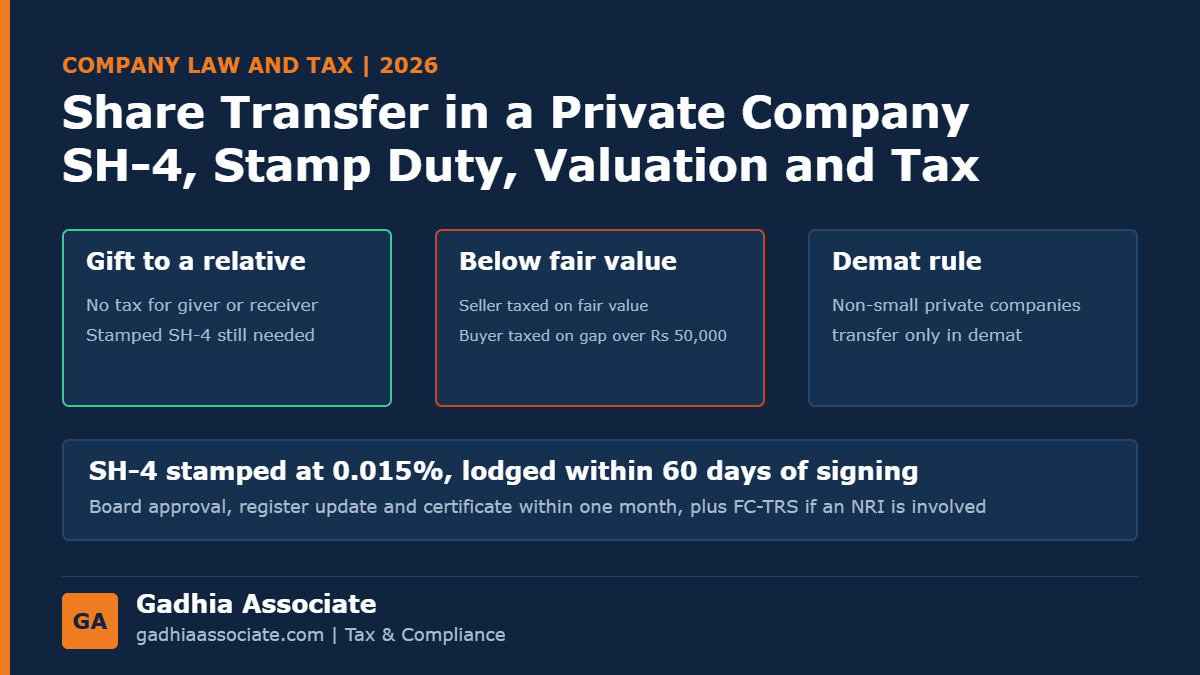
In short: Shares in a private limited company are transferred on Form SH-4, stamped at 0.015% of the price, signed by both sides and lodged with the company within 60 days, with the share certificate. The board approves it as the Articles require, the register of members is updated and the certificate is issued within a month. Price matters: if unlisted shares are sold below fair market value, the seller is taxed as if he received fair value, and the buyer is taxed on the shortfall if it exceeds Rs 50,000, unless the buyer is a relative. A gift to a relative is tax-free for both. A private company that is not a small company must keep its shares in demat form, so its shareholders must dematerialise before they transfer. Where one side is a non-resident, FEMA pricing rules and Form FC-TRS apply.
Our company law and tax team handles share transfers, valuations, demat conversion and the filings that follow. The details are at the end of this guide.
How does a share transfer work, step by step?
- Read the Articles: a private company's Articles must restrict the transfer of shares. Most require board approval, and many give existing shareholders the first right to buy. Check any shareholders' agreement too.
- Fix the price: agree a price backed by a fair market value working (see the tax sections below), and pay it through a bank.
- Execute Form SH-4: the transferor and transferee sign the form, with a witness, and it must be stamped.
- Lodge it within 60 days: deliver the SH-4 to the company within 60 days of signing, with the original share certificate. After that, the board can still register it against an indemnity, but a fresh SH-4 is the cleaner route.
- Board approval: the board approves the transfer, the register of members is updated, and the certificate is endorsed or a new one issued within one month of lodging. A delay exposes the company and its officers in default to a penalty of Rs 50,000 each.
- Later filings: the transfer is reported in the company's annual return. Where shares move to or from another company, LLP or trust, check the significant beneficial owner filings (BEN-2) as well.
- If the company refuses: a private company that refuses to register a transfer must send a notice within 30 days of lodging. The buyer can appeal to the NCLT within 30 days of that notice, or within 60 days of lodging if no notice is sent.
- On a shareholder's death: shares pass by transmission to the nominee or legal heirs, with the death certificate and succession papers. No SH-4 is needed.
- Bringing in an investor: if the money should go to the company rather than to an existing shareholder, it is a fresh allotment, not a transfer. See rights issue vs private placement.
Stamp duty on share transfer
- Rate: 0.015% of the consideration since 1 July 2020, the same across India. On Rs 10 lakh, that is Rs 150.
- Physical shares: the SH-4 itself must be stamped, by e-stamp or share transfer stamps. A company cannot register a transfer on an unstamped or under-stamped form.
- Demat shares: on an off-market transfer, the depository collects the duty.
- Gifts: a gift of shares also needs a duly stamped SH-4.
Which private companies must transfer shares only in demat?
- Who is covered: under Rule 9B of the Companies (Prospectus and Allotment of Securities) Rules, every private company other than a small company must issue securities only in demat form and help its shareholders dematerialise. The first deadline, extended once, ran to 30 June 2025.
- Small companies are outside: since December 2025, a small company is one with paid-up capital up to Rs 10 crore and turnover up to Rs 100 crore. A holding or subsidiary company cannot be a small company, whatever its size.
- What it means for a transfer: in a covered company, a shareholder must get his shares dematerialised before transferring them, and new allotments, rights and bonus shares are issued only in demat.
- What the company needs: an ISIN through a registrar and transfer agent, and a half-yearly reconciliation in Form PAS-6.
Tax for the seller
- Rates: unlisted shares held for more than 24 months give long-term capital gains taxed at 12.5% without indexation, plus surcharge and cess. Held for 24 months or less, the gain is added to your income and taxed at slab rates.
- Selling below fair value: if unquoted shares are sold for less than their fair market value under the Income-tax Rules, that value is taken as the sale price. This was section 50CA of the old Act and has been carried into the Income-tax Act, 2025, which applies from 1 April 2026.
- Saving the tax: long-term gains on shares can be exempt if the full sale price is invested in a residential house within the time limits, subject to a Rs 10 crore cap. See saving capital gains tax.
- Gifts: an individual who gifts shares pays no capital gains tax, because a gift is not a transfer for capital gains.
Tax for the buyer
- Below fair value: if you receive shares free or for less than their fair market value, the shortfall is taxed as your income if it exceeds Rs 50,000. This was section 56(2)(x) of the old Act. See is a gift taxable.
- Exempt receipts: shares received from a relative, on marriage, under a will or by inheritance are not taxed. Relatives include your spouse, brothers and sisters, your parents' and your spouse's brothers and sisters, lineal ascendants and descendants of you and your spouse, and the spouses of these. A cousin is not a relative.
- How fair value is worked out: for unquoted equity shares, it is broadly the book value of assets less liabilities, per share, with jewellery and art at market value, shares and securities at their value under the rules, and land and buildings at stamp duty value. That is why a company holding land bought years ago can be worth far more per share than its books suggest.
- Your cost later: the amount taxed in your hands becomes part of your cost when you sell the shares.
Does the company lose its carried-forward losses?
In a closely held company, business losses can be carried forward only if the shareholders who held at least 51% of the voting power on the last day of the loss year still hold it on the last day of the year in which the loss is set off. A large transfer can wipe out years of losses. Changes caused by a shareholder's death, or by a gift to a relative, do not count, and unabsorbed depreciation is not affected.
When the buyer or seller is an NRI
- Pricing: a resident selling to a non-resident cannot sell below fair value, and a non-resident selling to a resident cannot sell above it. Fair value is certified by a CA, a SEBI-registered merchant banker or a practising cost accountant using an internationally accepted method.
- Form FC-TRS: the resident party reports the transfer through its bank on the RBI's FIRMS portal within 60 days of the transfer or of the money moving, whichever is earlier. Late reporting attracts a late submission fee.
- TDS: a buyer paying a non-resident seller must deduct TDS on the capital gain under section 393 of the new Act (old section 195), and the money goes abroad with Form 145 and 146 (old 15CA and 15CB). See our guide to Form 145 and 146.
- Gifts to NRI relatives: need prior RBI approval and are capped, including at 5% of the company's capital and USD 50,000 a year.
- Sector rules: foreign holding must be allowed in the company's line of business. Our guide on NRIs starting a company in India explains the FEMA route.
Mistakes we see in family companies
- Transfers at face value in companies whose land or reserves have grown
- Paying in cash: receiving Rs 2 lakh or more in cash for one transaction attracts a penalty equal to the amount. See cash transaction limits.
- An unstamped SH-4, or one lodged after 60 days
- Ignoring the first-right-to-buy clause in the Articles
- A physical transfer in a company covered by the demat rule
- No FC-TRS when an NRI relative buys or sells
- Losing carried-forward losses through one large transfer
- Not updating the register of members, so the annual return does not match
Back to Jayeshbhai. A fair value working, with the factory land at its stamp duty value, puts each share at about Rs 140, so the cousin sells at that price and pays long-term capital gains tax on Rs 130 a share, which he can reduce by buying a house. Jayeshbhai gifts the money to his son, which is tax-free between father and son, and the son pays the cousin through the bank. The company is a small company, so a physical SH-4 stamped at 0.015% works. The board approves the transfer, and with only 30% changing hands, any carried-forward losses stay with the company.
How we help
- Read your Articles and any shareholders' agreement, and plan the route: sale, gift, transmission or fresh allotment
- Work out fair market value under the Income-tax Rules, and arrange a merchant banker or registered valuer report where FEMA or an investor needs one
- Prepare the SH-4, board resolutions, registers and new share certificates
- Demat conversion: ISIN through a registrar and transfer agent, and PAS-6 filings
- Capital gains planning for the seller and a tax review for the buyer
- FC-TRS, TDS and Form 145 and 146 when an NRI is involved
Gadhia Associate has been in practice since 2007 and has handled work for over 7,000 clients, with a 5.0 Google rating from more than 100 reviews. Family companies from Junagadh, Rajkot, Jamnagar, Gondal and Morbi come to our Junagadh office, where same-day appointments are available. Company work can equally be handled online for companies anywhere in India. Our guide to private limited company annual compliance covers the yearly filings.
Planning to bring in, buy out or gift shares in your company? Get the price and paperwork right before anyone signs. Call or WhatsApp +91 82005 28355, or message us on WhatsApp. The first consultation is free.
Frequently asked questions
What is the stamp duty on share transfer in a private limited company?
0.015% of the consideration, since 1 July 2020. For physical shares it is paid on the SH-4; for an off-market demat transfer the depository collects it.
What is the time limit to submit Form SH-4 to the company?
60 days from the date it is signed. It must be lodged with the original share certificate, and the company must issue the certificate within one month.
Can shares be transferred at face value in a private company?
The Companies Act allows any price the Articles permit, but if fair market value is higher, the seller is taxed on fair value, and the buyer is taxed on the difference if it exceeds Rs 50,000, unless the buyer is a relative.
Is a gift of shares from father to son taxable?
No. The father pays no capital gains tax on a gift, and the son is exempt because a father is a relative. A stamped SH-4 and board approval are still needed.
Do private company shares have to be in demat form?
Only in private companies that are not small companies. Since December 2025, a small company has paid-up capital up to Rs 10 crore and turnover up to Rs 100 crore, and is outside the rule.
Is a valuation report required for share transfer?
The Companies Act does not require one for a simple transfer, but the tax rules work on fair market value, so a fair value working is advisable. For transfers involving a non-resident, FEMA requires a valuation certificate.
Position as of 12 October 2026. The income-tax rules described were carried into the Income-tax Act, 2025 from 1 April 2026, with new section numbers. The demat rule and FEMA conditions have exceptions not covered here, so take advice on your own facts.