Private Limited Company Annual Compliance: AOC-4, MGT-7A, DIR-3 KYC and What Late Filing Actually Costs You
You incorporated the company two years ago. It has barely traded - a couple of invoices, maybe none at all - and somebody told you there is nothing to file until there is income. That advice is wrong, and the bill for it grows at a fixed rate every single day. If you are the director of a company sitting quietly with no turnover, this article is about what has been accumulating in your name while you were not looking.
Short answer: A dormant private limited company still files. Even with zero turnover it must hold an AGM, get accounts audited, and file Form AOC-4 and Form MGT-7A with the Registrar, plus Form DPT-3 and director KYC. Late annual filings attract an additional fee of Rs 100 per day per form with no ceiling, and three years of non-filing disqualifies every director for five years.
Does a company with no business really have to file anything?
Yes, and the obligation comes from the Companies Act, 2013, not from whether money moved.
A company is a registered person with a register entry, a DIN behind it and a statutory year. Section 92 requires an annual return. Section 137 requires the financial statements to be filed. Section 96 requires an annual general meeting. None of those provisions say "if the company had turnover". A company with a nil balance sheet still needs the audit, the AGM, the two annual forms and the registers.
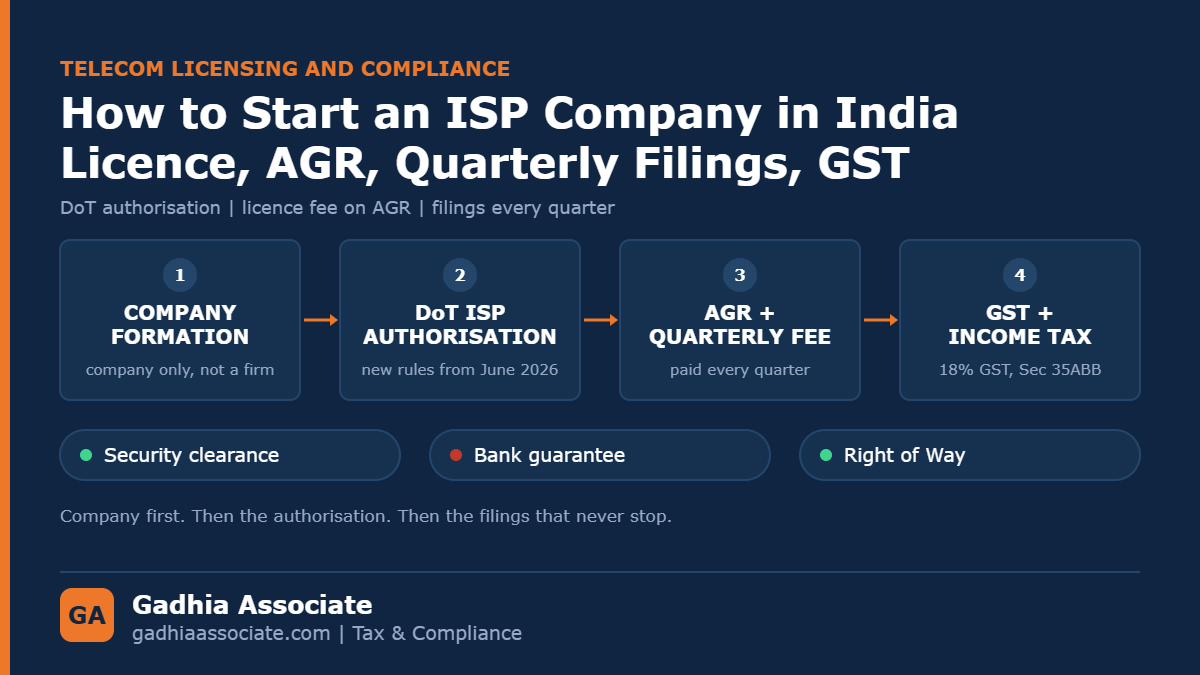
We see this constantly across Saurashtra. A family business incorporates a private limited company because a tender demanded a company, or because a bank said the limit would be easier in a company's name. The tender was lost, or the loan came through in the proprietorship anyway, and the company was never touched again. Two years later nobody remembers the auditor's name. If your company was formed to hold a licence or to qualify for something specific, the same thing happens - our article on starting an ISP company describes exactly that kind of company, and the filing clock runs on it identically.
What is the annual compliance calendar for a private limited company?
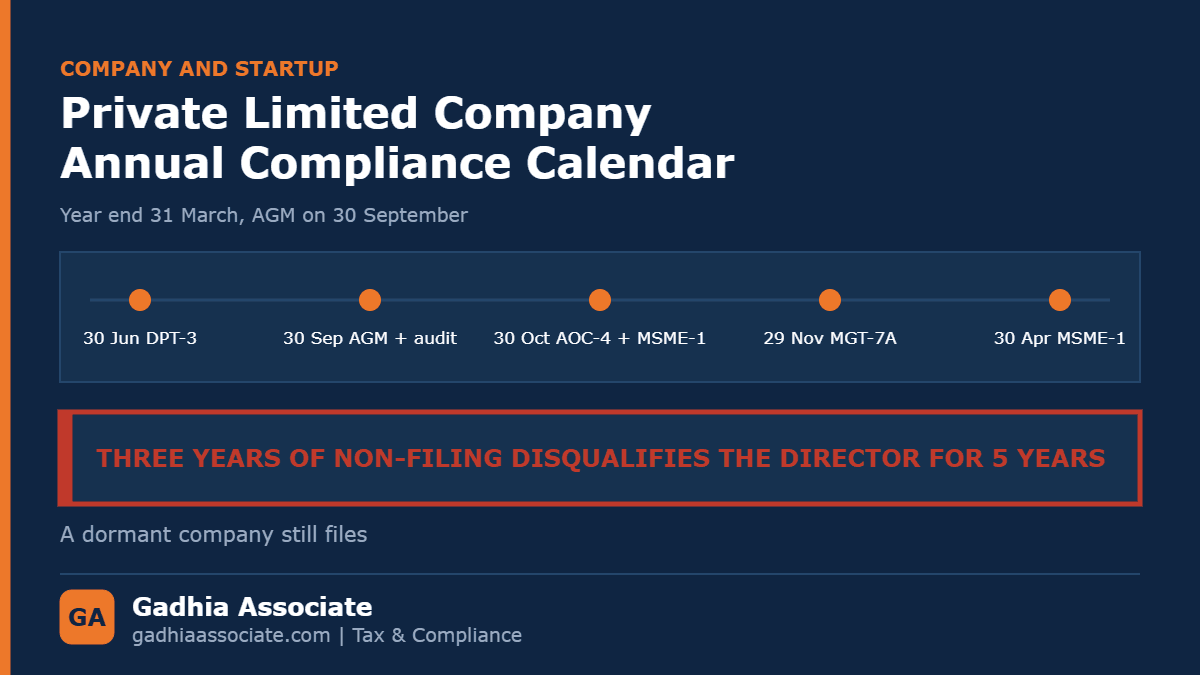
For a 31 March year end, here is the year in date order. Dates assume the AGM is held on the last permitted day, 30 September.
- First board meeting of the year (April, usually). Each director gives Form MBP-1, the disclosure of interest under Section 184, and Form DIR-8, the declaration of non-disqualification under Section 164. These stay in the company's records; they are not filed with the Registrar.
- 30 April - Form MSME-1 for the half year October to March, reporting amounts outstanding to micro and small enterprise suppliers beyond 45 days.
- 30 June - Form DPT-3, the annual return of deposits and of amounts not considered as deposits, for the year ended 31 March. Loans from directors are reported here as amounts not considered deposits.
- Before the AGM. The board approves the accounts, the auditor signs the audit report, and the notice of the AGM goes out with at least twenty-one clear days.
- 30 September - the AGM. Section 96 requires the AGM within six months of the year end, so 30 September for a March closing. A first AGM gets nine months from the first financial year end.
- 30 September - tax audit report where Section 44AB applies, for AY 2026-27.
- 30 September - director KYC. See the caution in the next section, because this requirement has changed.
- Within 15 days of the AGM - Form ADT-1, where an auditor is appointed or reappointed at that meeting.
- 30 October - Form AOC-4, the financial statements, due within 30 days of the AGM.
- 31 October - Form MSME-1 for the half year April to September, and the company's income tax return for AY 2026-27 in audit cases.
- 29 November - Form MGT-7A, the abridged annual return, due within 60 days of the AGM. MGT-7A is for a small company and a one person company; every other company files Form MGT-7.
Running alongside all of that: at least four board meetings in the year with no gap of more than 120 days between two consecutive meetings, relaxed to two meetings for a small company or a one person company; statutory registers and the minutes book kept up to date; and the significant beneficial ownership forms, BEN-1 and BEN-2, where an indirect holding exists. And if the company was incorporated recently, Form INC-20A, the declaration for commencement of business, is due within 180 days of incorporation - Rs 50,000 on the company and Rs 1,000 per day on each officer in default, capped at Rs 1,00,000, if it is missed.
Has the DIR-3 KYC due date changed?
Possibly, and this one needs checking before you rely on it. For years, every director holding a DIN had to complete DIR-3 KYC annually by 30 September, with the DIN deactivated from 1 October and a Rs 5,000 fee to reactivate it. Reports of the Companies (Appointment and Qualification of Directors) Amendment Rules, 2025 indicate the requirement has moved to once in three consecutive financial years, with a 30 June deadline in the third year, and the e-form and web-form merged. Sources are not consistent on how this applies in the transition year. Check your own DIN status on the MCA portal rather than assuming either position - the consequence of getting it wrong is the same as it always was, which is a dead digital signature and a company that cannot file anything. Our earlier article on DIR-3 KYC and ROC filings covers the mechanics of the form itself.
Is your company two or three years behind?
Send us the CIN. We will pull the master data and the filing history and tell you exactly which forms are open, what the additional fee stands at today, and whether any director is close to the three-year line. The first consultation is free.
Call or WhatsApp +91 82005 28355. Gadhia Associate is based in Junagadh, Gujarat, and handles ROC compliance for companies across India.
What does late filing of AOC-4 and MGT-7A actually cost?
Rs 100 per day, per form, with no upper limit. That is the part that surprises people.
The annual forms have carried a flat additional fee of Rs 100 for every day of delay since 1 July 2018. There is no cap and no tapering. Several other MCA forms still follow the older slab table of multiples of the normal filing fee - two times, four times, six times and so on up to twelve times - so do not assume the slab logic applies to AOC-4 and MGT-7A. Where you see conflicting figures online, treat the MCA fee calculator on the portal as the position for your own CIN.
Illustrative example. Round numbers, one company, one year late.
- Normal filing fee per form, on authorised capital of Rs 5,00,000: about Rs 300.
- AOC-4 filed 365 days after its due date: Rs 100 x 365 = Rs 36,500 additional fee, plus the Rs 300 normal fee.
- MGT-7A filed 365 days late: another Rs 36,500 plus Rs 300.
- Roughly Rs 73,600 for one year's two annual forms on a company that earned nothing.
That figure is only the additional fee. Section 137 and Section 92 carry their own penalties on the company and on the officers in default, adjudicated separately, and the ROC has been issuing those adjudication orders far more freely than it used to. A company three years behind is not looking at Rs 73,000. It is looking at a multiple of it.
On amnesty: the Companies Compliance Facilitation Scheme, 2026 opened on 15 April 2026 and, after an extension, closed at the end of August 2026. As of today there is no MCA amnesty or fee-waiver scheme open. If you were waiting for one, the wait cost you the discount. Verify on the MCA portal before concluding either way, because these schemes are announced with little notice.
What happens to me personally if the company does not file for three years?
You get disqualified as a director for five years, and there is no fee that undoes it.
Section 164(2) of the Companies Act, 2013 provides that a person who is or has been a director of a company which has not filed financial statements or annual returns for a continuous period of three financial years is not eligible for reappointment in that company, or for appointment in any other company, for five years from the date of the default. It operates automatically. No notice, no hearing, no order. Every director of the defaulting company is caught, whether or not they were the one handling compliance. The DIN goes inactive, and with it every other directorship that person holds.
That last point is what ruins people. A man who is a director in the family's working company and also in a shell company that a cousin left idle loses the ability to sign for both. We have sat with a client in exactly that position while a live company's AOC-4 could not be filed because his DIN was frozen by a company he had forgotten he was on.
One relief in the design: if even one of the three years is filed, late, the continuity breaks. Which is why the cheapest thing a three-years-behind company can do this month is file the oldest open year.
Can the Registrar strike off my company?
Yes. Under Section 248 the Registrar may remove a company's name from the register where it has not commenced business within one year of incorporation, or where it has not been carrying on any business or operation for two immediately preceding financial years without applying for dormant status. Non-filing is the evidence the Registrar reads for inactivity.
Getting it back means a petition to the National Company Law Tribunal under Section 252, and that is not a form-filling job. The Tribunal typically orders costs, requires every overdue return to be filed within a fixed window, and the whole exercise commonly runs several months and well over a lakh once professional fees, restoration costs and the accumulated additional fees are added. Compared with Rs 300 a year and an auditor's fee, it is a bad trade.
What else does non-filing quietly break?
The defaults show on public master data, and other people read it before they deal with you.
- Bank credit. A credit officer pulls the MCA master data and the last filed balance sheet as a matter of routine. No filings means no financials to appraise, and "under default" in the company's status. We had a client discover the company had filed nothing for three years only when a bank declined a working capital limit and the relationship manager read the reason out over the phone. Our article on business loans for a private limited company sets out what lenders look at, and the filing history sits right at the front of it.
- Tenders. Government and PSU tenders routinely ask for audited financials for the last three years and a company status check. A missing year disqualifies the bid at the technical stage, and there is no appeal against your own paperwork.
- Due diligence on a sale or an investment. A buyer's advisor finds the open forms in an afternoon. The deal does not usually collapse, but the price moves and an indemnity appears in the agreement.
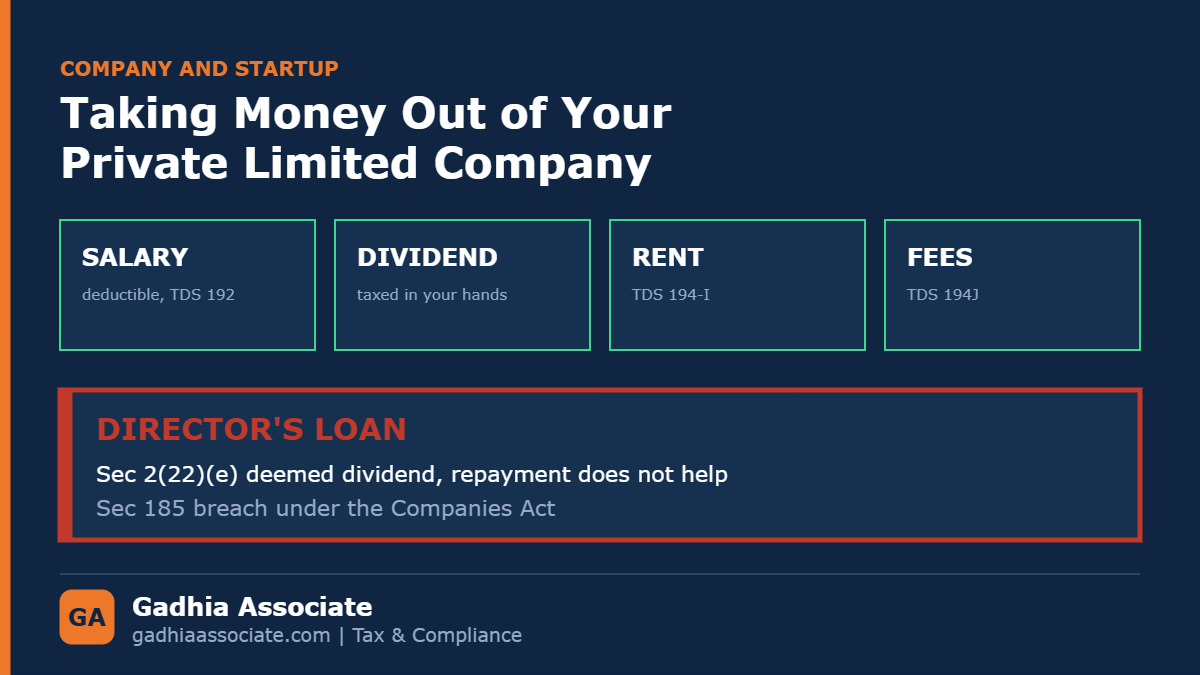
- GST and income tax. The company's registrations do not pause because the ROC filings did. Nil GST returns still fall due, and a company with no turnover still files an income tax return. Our article on GST registration covers where that obligation starts.
What does a clean compliance file look like, and who keeps it?
It looks boring, and someone other than you should be keeping it.
A clean file has the minutes book written up through the year rather than in one sitting - and the auditor can always tell, because four meetings typed on the same day in September read like four meetings typed on the same day in September. It has the registers of members, directors and charges current. It has MBP-1 and DIR-8 from each director on file, the ADT-1 acknowledgement, the audited accounts signed with the right dates, the AGM notice with proof of dispatch, and the challans for AOC-4, MGT-7A, DPT-3 and MSME-1 in one folder per financial year.
The reason a monthly or annual retainer works better than calling someone in September is that most of this is calendar work, not judgment work. Somebody has to know that MSME-1 falls on 30 April, watch the 120-day gap between board meetings, chase the auditor in July instead of the last week of September, and notice that a DIN is about to go inactive. Owners do not track that, and they should not have to. The audit itself is a few weeks' work; the compliance is twelve months of small deadlines, and it is the small deadlines that trigger the Rs 100 a day.
Put the whole calendar on someone else's desk
We keep the full annual cycle for private limited companies - board meetings, AGM, audit coordination, AOC-4, MGT-7A, DPT-3, MSME-1, ADT-1, KYC and the registers - on a monthly or annual retainer with the fee fixed in advance. If your company is behind, we clear the backlog first and quote the additional fee up front so there is no surprise.
Call or WhatsApp +91 82005 28355. Practising since 2007, more than 7,000 clients across Saurashtra and Gujarat, a 5.0 Google rating from over 100 reviews, same-day appointments at our Junagadh office, and digital service anywhere in India.
Frequently asked questions
Does a company with zero turnover have to file AOC-4 and MGT-7A?
Yes. The filing obligation under Section 137 and Section 92 of the Companies Act, 2013 does not depend on turnover. A nil company still needs audited financial statements, an AGM within six months of the year end, AOC-4 within 30 days of the AGM and MGT-7A within 60 days. Only formally obtaining dormant status under Section 455 reduces the requirement, and that itself is an application.
How much is the late fee for AOC-4 filed one year late?
The additional fee is Rs 100 for every day of delay, per form, with no ceiling, so around Rs 36,500 for a form filed 365 days late, on top of the normal fee based on authorised capital. MGT-7A carries the same daily charge separately. Penalties under Section 137 and Section 92 on the company and its officers are additional and adjudicated on their own.
Can a disqualified director be restored by paying a penalty?
No. Disqualification under Section 164(2) runs for five years from the date of default and is not cured by paying a fee. Filing the overdue returns can stop the three-year continuity from being reached in the first place, which is why filing the oldest open year matters more than filing the newest. Once triggered, relief generally means going to the Tribunal.
Is any MCA amnesty scheme open right now?
No. The Companies Compliance Facilitation Scheme, 2026 ran from 15 April 2026 and closed after an extension at the end of August 2026. There is no replacement window announced as of September 2026. Additional fees are payable in full on overdue forms today. Because such schemes appear at short notice, check the MCA portal circulars before you finalise a plan for a long-overdue company.
What is the difference between MGT-7 and MGT-7A?
MGT-7A is the abridged annual return, available to a small company and to a one person company. Every other company files the full Form MGT-7. Both are due within 60 days of the annual general meeting and both attract the same Rs 100 per day additional fee if late. Whether your company still meets the small company thresholds should be rechecked each year, since paid-up capital and turnover limits have been revised.
Position as of September 2026. Fees, thresholds, forms and due dates change through MCA and CBDT notifications, and the Income-tax Act, 2025 has renumbered the income tax provisions with effect from 1 April 2026. Confirm the current position before acting on anything here.