You Got a GST Notice: How to Read ASMT-10, DRC-01A and DRC-01, and What to Reply Before the Deadline
The email lands at 9.40 in the morning. The subject line is a reference number, the body says a notice has been issued against your GSTIN, and there is a link to the portal. Your accountant says it's routine. Someone at the shop says the department is tightening up this year. Nobody has actually opened the attachment and read the form number printed at the top of it.
That form number is the whole story. If you run a trading firm, a fabrication unit, a transport business or a professional practice with a GST registration, the gap between a Rs 30,000 problem and a Rs 3,00,000 problem is usually just whether somebody replied inside the time allowed. Let the date pass and the officer is entitled to decide the matter on the information he already has, which means your returns and his mismatch report, with nothing from your side to contradict either.
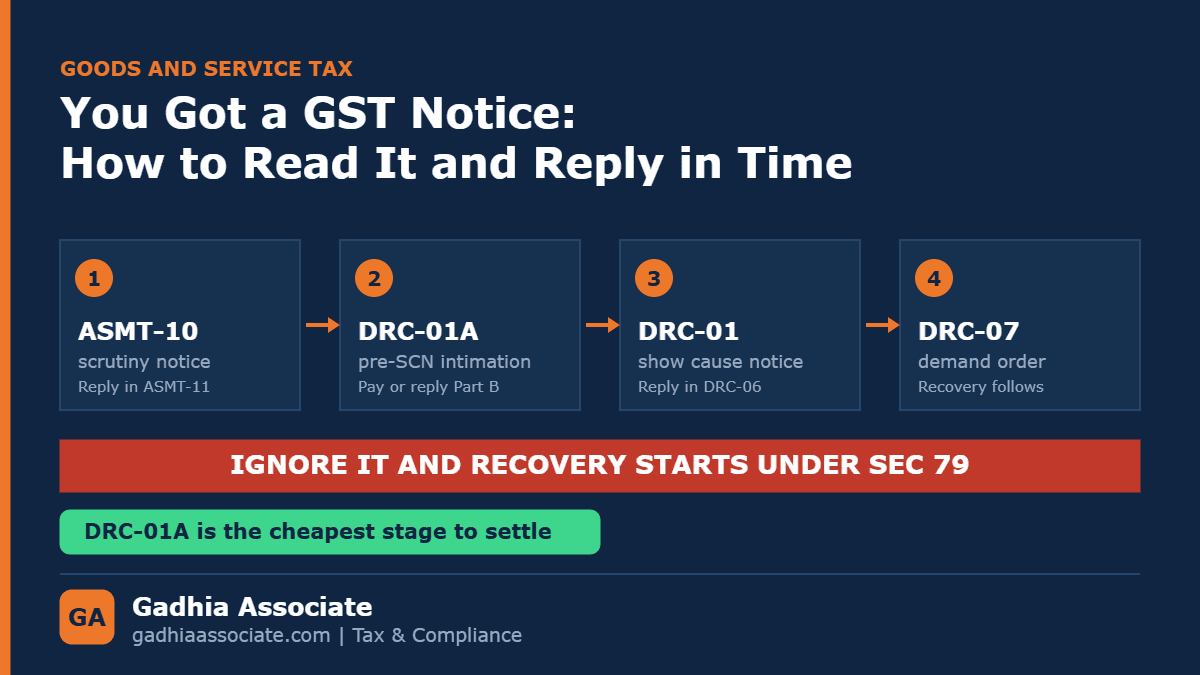
Direct answer: Form GST ASMT-10 is a scrutiny notice under Section 61 of the CGST Act, and you reply in Form GST ASMT-11, normally within 30 days. Form GST DRC-01A is a pre-show-cause intimation under Rule 142(1A) and the cheapest stage to settle. Form GST DRC-01 is the show cause notice itself, issued under Section 73, Section 74 or the newer Section 74A.
What does Form GST ASMT-10 actually mean?
ASMT-10 means an officer has compared your returns against other data and found a difference he wants explained. It is issued under Section 61 of the CGST Act read with Rule 99 of the CGST Rules. It is not a demand and it is not an allegation of fraud. The notice seeks an explanation within a period not exceeding 30 days from the date of service, and the officer may allow a longer period if you ask him in writing before the date expires.
You answer in Form GST ASMT-11. Two things can happen. If the explanation satisfies him, he closes the file with an order in Form GST ASMT-12 and you hear nothing more. If it doesn't, or if you say nothing at all, Section 61(3) lets him move on to assessment or to demand proceedings. That is how an ASMT-10 nobody opened in March turns into a show cause notice in October for the same rupees plus interest.
One thing worth knowing about this stage: the officer usually isn't looking for a legal argument. He wants a figure-to-figure reconciliation he can tick off against his own working, on one page, with the difference explained line by line. Send him three paragraphs of law and no numbers and he will simply record that the reply was unsatisfactory.
What is Form GST DRC-01A and why does it come before the notice?
DRC-01A is an intimation of tax ascertained as payable, issued under Rule 142(1A) before any formal show cause notice. Part A of the form carries the officer's own computation of tax, interest and penalty. You can either pay what is shown, or record your objection in Part B of the same form. If Part B satisfies him, the matter can end there. If it doesn't, DRC-01 follows.
Courts have treated this step as substantive rather than a courtesy. Several High Courts have set aside show cause notices issued without a prior DRC-01A, on the reasoning that skipping it cost the taxpayer a shot at a reduced penalty. So if a DRC-01 reaches you and no DRC-01A ever did, that is a point to raise.
What is Form GST DRC-01 and how serious is it?
DRC-01 is the show cause notice, and the section quoted in it decides what the case costs you. You reply in Form GST DRC-06.
- Section 73 covers tax short paid or credit wrongly taken for reasons other than fraud, suppression or wilful misstatement. The notice must be issued within three years of the due date for the annual return for that year. If you pay the tax with interest before the notice, no penalty. Pay within 30 days of the notice and, again, no penalty. Beyond that the penalty is 10 per cent of the tax or Rs 10,000, whichever is higher.
- Section 74 covers fraud, wilful misstatement or suppression of facts. The window stretches to five years. Penalty is 15 per cent of tax if you pay before the notice, 25 per cent within 30 days of the notice, 50 per cent within 30 days of the order, and 100 per cent after that.
Same rupees of tax, four very different outcomes, decided entirely by when you act. That is why the date on the covering letter matters more than the arguments in it.
Does Section 74A change this from 2024-25?
For periods from financial year 2024-25 onwards, Section 74A replaces the split between 73 and 74 with a single provision. Reported position: one common notice period of 42 months from the due date of the annual return whether fraud is alleged or not, with the order to follow within 12 months of the notice, extendable by six. Penalty stays graded, at 10 per cent of tax or Rs 10,000 in non-fraud cases and the full tax amount where fraud is established. Sources differ on the finer points of the transition and on exactly how the reduced-penalty timelines read inside 74A, so confirm the current wording before you rely on a specific number of days. Older years still go under 73 or 74.
Why is DRC-01A the cheapest stage to settle?
Because at DRC-01A you can often close the whole thing for tax plus interest and no penalty, or a small fraction of penalty. The same liability admitted after adjudication carries the full penalty, plus the cost of an appeal, plus a pre-deposit you cannot get back until the appeal is decided. Interest under Section 50 runs at 18 per cent a year the entire time, and at 24 per cent where credit was wrongly availed and utilised.
If the numbers in Part A are right, paying at DRC-01A is almost always the commercially sensible answer even when it stings. If they are wrong, Part B is where you say so, with documents, before positions harden.
Not sure which form you're holding?
Send us the PDF. We'll tell you what it is, how long you have, and what it will cost to close, before you decide anything.
Gadhia Associate is based in Junagadh, Gujarat and works with clients across India. We have been in practice since 2007 and now look after more than 7,000 clients across Saurashtra and Gujarat, with a 5.0 Google rating from over 100 reviews. Same-day appointments at the Junagadh office, digital service anywhere in India, and fixed-fee or monthly plans so you know the cost before we start.
First consultation is free. Call or WhatsApp +91 82005 28355.
What goes into a reply that actually works?
A reply that works is mostly attachments, not prose. Five things do the heavy lifting.
- A reconciliation statement. Your figure, the department's figure, the difference, and one line of reason for each difference. Put it first.
- The ledgers. Electronic credit ledger and cash ledger extracts for the period, plus the relevant GSTR-1, GSTR-3B and GSTR-2B downloads. Not summaries you typed out, the actual downloads.
- Supplier proof where credit is questioned. Tax invoice, e-way bill if applicable, bank payment proof, and evidence the supplier filed. Payment through the bank is the single strongest document you have.
- Contracts, debit or credit notes, and amendment details for anything that moved between months. Timing differences are the most common innocent explanation and the easiest to prove.
- A covering letter that answers the notice paragraph by paragraph, in the officer's own numbering.
The entry that gets queried almost every time is the year-end journal adjusting output tax to match the books. Officers see it, ask what it is, and the answer is usually a genuine reconciliation nobody documented. Keep the working for it.
What does a bad reply look like?
A bad reply says the difference is due to a clerical error and requests the notice be dropped. That reply makes things worse, because it concedes there is a difference and offers nothing to explain it. The other reply that backfires is the one that blames the accountant or the software. Neither is a defence, and both read as an admission with no supporting number attached.
What happens if you ignore a GST notice?
The officer proceeds on the information available and passes an order. The demand is then summarised in Form GST DRC-07, which is the entry that sits in your electronic liability register and behaves like a decree. From there:
- Recovery under Section 79 needs no fresh notice. The department can recover from money owed to you by others, attach and sell goods, or attach your bank account through a notice to the bank.
- If the trouble started with unfiled returns, Section 62 applies. After a notice in Form GSTR-3A, the officer can assess to the best of his judgment. Filing the valid return within 60 days of service of that order gets it deemed withdrawn, and a further 60 days is available on payment of an additional late fee of Rs 100 per day. Older material still quotes 30 days, which was the position before the Finance Act, 2023 change, so check the date of anything you read.
- Never registered though liable? Section 63 lets the officer assess an unregistered person, with a five-year outer limit.
- Collected GST and didn't deposit it? Section 76 applies whether or not the supply was taxable, and there is no soft landing in it.
- Where no specific penalty is prescribed, Section 125 allows a general penalty up to Rs 25,000, and Section 122 covers the listed offences separately.
The bank attachment is the part clients never expect. It arrives without warning, cheques bounce, and suppliers find out. Fixing it afterwards takes weeks.
Can you appeal, and what does filing cost?
Yes. An appeal to the Appellate Authority goes under Section 107 within three months of communication of the order, and the authority can condone a further one month for sufficient cause. It is not extendable beyond that, which is why the order date should go straight into a diary.
The pre-deposit is the admitted liability in full, plus 10 per cent of the tax in dispute. That 10 per cent is capped, and the cap was brought down from Rs 25 crore to Rs 20 crore each under CGST and SGST by the 2024 amendment following the 53rd GST Council meeting. A second appeal to the Tribunal carries a further 10 per cent. Penalty-only orders have their own rule and the position there has shifted recently, so confirm the applicable figure for your case rather than assuming.
Which mismatches generate most GST notices?
Nearly all of them come from seven places.
- Output tax in GSTR-1 higher than what was paid in GSTR-3B. This one also triggers an automated intimation in Form GST DRC-01B under Rule 88C, with only seven days to pay or explain, and your next GSTR-1 gets blocked if you do neither.
- Input tax credit claimed in GSTR-3B more than what appears in GSTR-2B.
- Credit taken on invoices where the supplier never filed, or filed and then amended.
- Turnover in the GST returns not matching turnover in the income tax return or the audited accounts.
- E-way bill data showing movement of goods that the returns don't account for.
- Credit that was never available in the first place. Our article on input tax credit and blocked credits covers what Section 17(5) shuts out, and a surprising share of notices are really just this.
- Invoices not accepted or wrongly rejected in the Invoice Management System, which now decides what lands in your GSTR-2B. Combined with the 30-day reporting limit for e-invoices, covered in our e-invoicing article, this has changed what the 2B looks like month to month.
Two housekeeping habits prevent most of it: reconcile 2B against your purchase register every month rather than every year, and check your GST annual return against the monthly filings before you submit it, not after. Our pieces on the GST annual return and the HSN/SAC Code Finder tool are useful when you are cleaning up classification differences.
Deadline this week?
Don't file a holding reply. A weak ASMT-11 is harder to recover from than a short extension request.
We handle GST notices end to end: reading the notice, building the reconciliation, drafting the reply, representation, and appeal where it comes to that. First consultation is free. Call or WhatsApp +91 82005 28355.
Frequently asked questions
How many days do I get to reply to ASMT-10?
The officer specifies a period not exceeding 30 days from service of the notice under Rule 99 of the CGST Rules, and he can allow more if you request it in writing before the date passes. Apply for the extension early. An unanswered ASMT-10 lets the officer move to proceedings under Section 73, 74 or 74A for the same period.
Is DRC-01A compulsory before a show cause notice?
Rule 142(1A) provides for the intimation in Form GST DRC-01A before a notice under Section 73 or 74. Multiple High Courts have quashed show cause notices issued without it, holding that the omission denied the taxpayer the reduced-penalty option. If you received DRC-01 with no DRC-01A, raise it in your DRC-06 reply.
Can I pay after DRC-01 and avoid penalty entirely?
Under Section 73, paying the tax with interest within 30 days of the show cause notice concludes the proceedings with no penalty. Under Section 74 the same 30-day payment reduces penalty to 25 per cent of tax, not nil. Section 74A applies to periods from 2024-25 and its timelines should be confirmed against the current provision.
What is DRC-07 and can it be reversed?
DRC-07 is the summary of the adjudication order and it creates an enforceable entry in your electronic liability register, after which recovery under Section 79 can start without further notice. It is not reversed by request. You either file an appeal under Section 107 within three months with the pre-deposit, or seek rectification where there is an apparent error on the face of the order.
Do I need to reply if the notice amount is small?
Reply anyway. An unanswered notice becomes an order, an order becomes a recovery entry, and interest under Section 50 at 18 per cent a year keeps running on a figure that never gets smaller. A Rs 20,000 demand left alone for three years, with penalty and a bank attachment on top, stops being a small matter.
Position as of September 2026. Sections, limits and time limits change through CBIC and CBDT notifications, and the Income-tax Act, 2025 has renumbered the income tax provisions with effect from 1 April 2026. Confirm the current position before acting on anything here.