How to Start an Internet Service Provider (ISP) Company in India: Licence, AGR, Quarterly Filings, GST and Income Tax
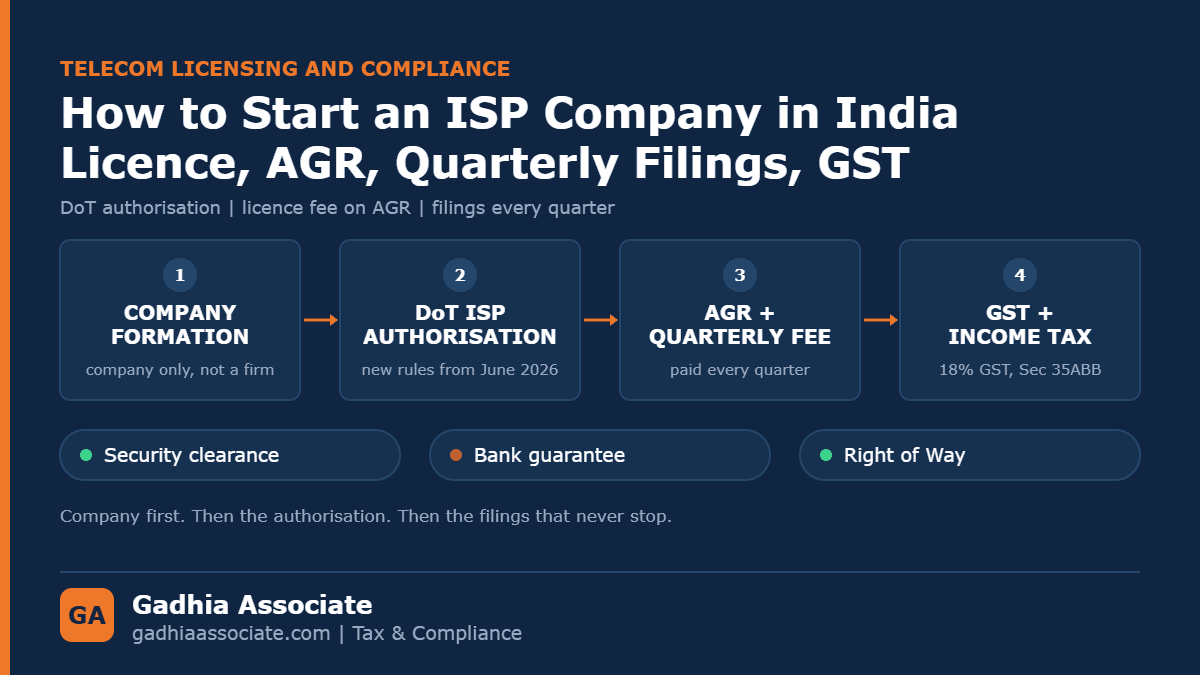
You have the fibre in the ground, or the route surveyed and the quotes from the cable vendor sitting on your desk. Maybe you already run a cable TV network in Junagadh or Rajkot and customers keep asking for broadband. The equipment part you understand. What nobody has explained properly is the licensing part, and that is where the money goes wrong. Apply in the wrong entity and the application is returned. Get the revenue share wrong and you face demands with compounded interest years later, plus encashment of the guarantee you gave the Department of Telecommunications.
The short answer: you need a company registered under the Companies Act, not a proprietorship, firm or LLP. That company applies to the Department of Telecommunications for an internet service authorisation through the DoT authorisation portal, pays a processing fee, an entry fee and a financial guarantee. After that you pay 8% of Adjusted Gross Revenue as authorisation fee, in quarterly instalments, and file an audited revenue statement annually. Company law, GST and income tax compliance run alongside.
Can I take this licence in my proprietorship or partnership firm?
No. The Department of Telecommunications grants internet authorisations only to a company, and a One Person Company is specifically excluded under the current eligibility rules. A proprietorship will not be looked at. Neither will a partnership firm or an LLP, however long it has been trading and however good its balance sheet is.
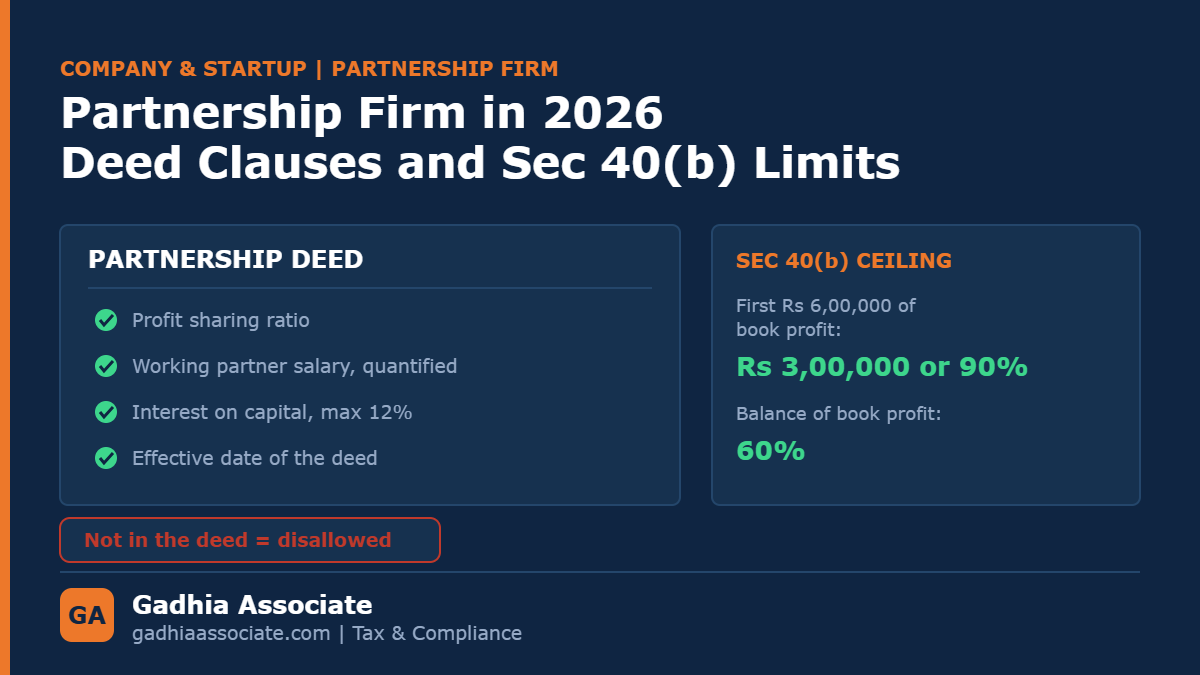
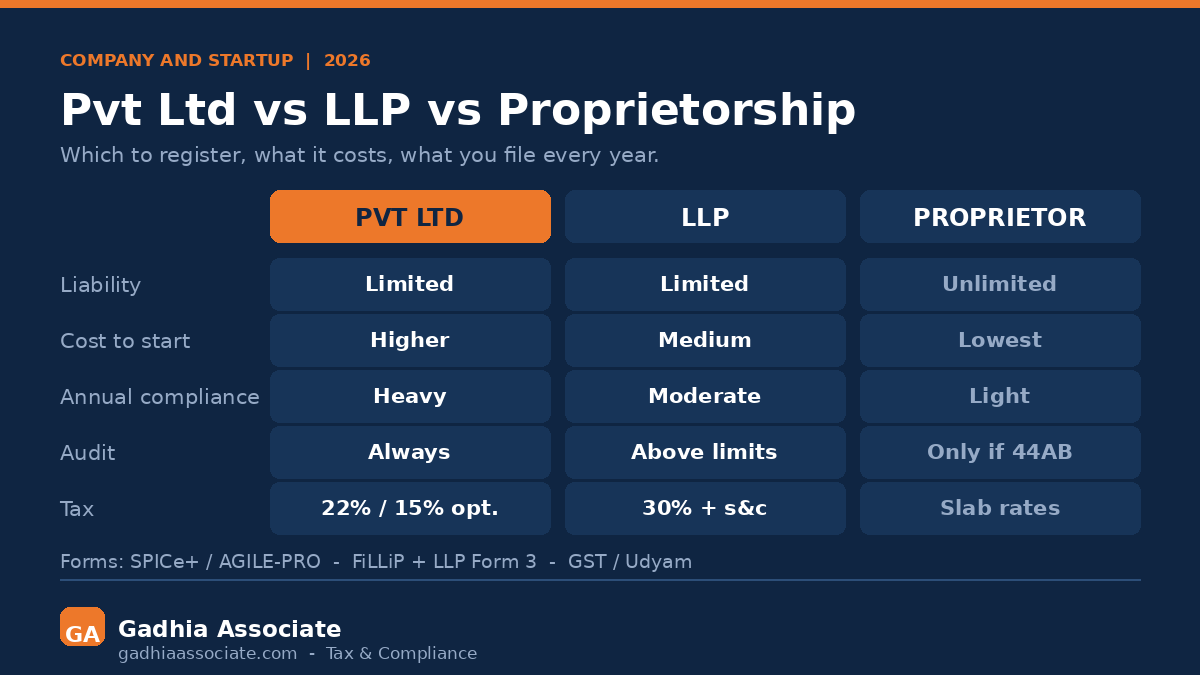
This catches a lot of people in Saurashtra. You have been running a cable or networking business as "XYZ Enterprise" for fifteen years, you have the customer base, the GST number and the bank limits, and now you are told all of it sits in the wrong vehicle. The practical route is to incorporate a private limited company and either build the ISP business inside it or transfer the existing undertaking into it. That transfer has its own tax and stamp duty consequences, so it is worth planning before you incorporate rather than after. Our articles comparing a private limited company with an LLP and a proprietorship, and the Business Structure Advisor tool on this site, are a sensible first stop.
One more thing that trips up applicants. The main object clause of the memorandum has to actually permit the provision of internet service. DoT checks this. If your MoA says "trading and general commerce", the application will sit in query until you pass a special resolution and file with the Registrar of Companies. Fix it at incorporation and you save six weeks.
Has the Unified Licence gone? What replaced it in June 2026?
Yes, for new applicants the Unified Licence route has closed. On 24 June 2026 the Department of Telecommunications notified the Telecommunications (Authorisation for Provision of Principal Telecommunication Services) Rules, 2026 (G.S.R. 513(E)), made under the Telecommunications Act, 2023. These replace the Unified Licence and UL-VNO agreements that were issued under the Indian Telegraph Act, 1885. The authorisation portal opened for fresh applications and migrations from 25 June 2026.
What changed in practice. You no longer sign a bilateral licence agreement with DoT; the government grants an authorisation unilaterally after a Letter of Intent, and the portal becomes the legal interface. The roughly thirteen old service categories collapse into five: unified service, access service, wireline access service, internet service and long distance service. Each can be held as a Network Service Operator, which owns and runs the network, or as a Virtual Network Operator, which rides on a parent operator's network.
The old ISP Category A, B and C split is gone. Internet service authorisation is now granted for a national service area or for a telecom circle or metro service area. Category C, the single secondary switching area or district-level ISP licence, has been dropped as a separate category. If you were told a year ago that a Rs 20,000 Category C licence was your cheapest entry, that advice is now out of date. Existing licence holders are not moved automatically. They continue under their old agreements until they choose to migrate under Section 3(6) of the Telecommunications Act, 2023, using the separate migration rules.
This is a regime in transition, and I would rather say that plainly than pretend otherwise. A lot of the operational detail is still being issued, and much of the published commentary still describes the old Category A/B/C structure. Check the gazette text and the DoT portal before you budget anything.
Which internet authorisation suits a local broadband or fibre business?
For a Junagadh or Saurashtra operator selling to homes and small businesses in one state, the circle or metro internet service authorisation as a Network Service Operator is the usual fit. Gujarat is one of the 22 telecom circles. That authorisation covers the whole circle, so it is wider than the old district-level Category C and priced accordingly, which is to say still modestly.
The national internet authorisation only makes sense if you genuinely intend to sell outside Gujarat. If you plan to buy capacity from an existing operator rather than build your own core, look at the Virtual Network Operator route instead. A VNO contracts with one or more parent network operators and carries a lighter build obligation. Wireline access service, a new category, sits with VNOs only and is aimed squarely at fixed broadband.
Eligibility thresholds published in Schedule C are light at circle level. Reported figures are minimum paid-up equity of around Rs 1 lakh with no separate net worth requirement for a circle internet authorisation, and around Rs 10 lakh equity for the national one. Where a company holds more than one authorisation, the equity and net worth thresholds stack. I could not read the gazette Schedule myself, so treat those numbers as indicative and confirm from the notified text.
What does it cost to apply, and how much money gets locked up?
Less than under the old regime, on every published comparison. Under Schedule A to the 2026 Rules, as reported by law firms and telecom advisers reading the gazette, an internet service authorisation for a Network Service Operator carries a processing fee of about Rs 10,000, an entry fee of about Rs 50,000 for a circle or metro service area and about Rs 10 lakh for a national area, with an initial guarantee of about Rs 20,000 and Rs 4 lakh respectively.
Compare that with the Unified Licence it replaces, where the ISP Category A entry fee was Rs 30 lakh, Category B Rs 2 lakh and Category C Rs 20,000, with a performance bank guarantee and a separate financial bank guarantee on top. The two guarantees have now collapsed into a single initial guarantee per authorisation, and you can give it as a bank guarantee, an insurance-company performance bond regulated by IRDAI, or a non-interest-bearing cash deposit with the government. That last option is genuinely useful if your bank limits are tight.
Two cautions. First, published figures for the old Category A, B and C bank guarantees vary wildly between consultants' websites, and I could not reconcile them against the licence annexure. Second, and this one bites: from the second year the authorisation fee is the higher of 8% of AGR or 30% of the applicable entry fee. The old floor was 10%. In a low-revenue circle, that floor is what you will actually pay.
How does the application work, and how long does it really take?
Everything runs on the portal. You register the company once, apply for the authorisation you want, and the department scrutinises the papers before issuing a Letter of Intent setting out the entry fee, guarantee amount and effective date. You then pay and the authorisation is granted, for a term of up to 20 years.
The documents are where applications die. From DoT's own published checklist for internet authorisations: the certificate of incorporation with every single page of the MoA and AoA certified by the company secretary or statutory auditor and countersigned by the authorised signatory; a board resolution appointing that CA or CS, dated after incorporation, with specimen signatures; an original power of attorney on Rs 100 non-judicial stamp paper, notarised, executed by someone other than the person receiving it; and CA or CS certificates on promoter details, equity details and foreign equity, each carrying a valid UDIN. If there is any foreign shareholding, you trace ownership all the way to the ultimate beneficial owner and give an undertaking of compliance with Press Note 3 dated 17 April 2020, which restricts investment from entities in land-bordering countries.
The step applicants always underestimate is the signature chain. The person named at serial number 4 of the application form, the person named in the power of attorney, and the person whose digital signature is affixed to the form must all be the same person. A mismatch there sends the file straight back into query, and each query round costs weeks.
Realistic timeline: two to four weeks to incorporate cleanly with the right object clause, two to three weeks to assemble the certificates, and then the department's scrutiny. Plan on three to six months from decision to grant if the papers are right, longer if security clearance of promoters takes time. The cable in the ground will be ready well before the paperwork is.
Thinking of applying and not sure the company structure is right? Call or WhatsApp us on +91 82005 28355. The first consultation is free, and it is far cheaper to fix an object clause before incorporation than after.
Which approvals do first-time applicants forget?
Several, and each one can stop a launch. Security conditions come first. A majority of directors must be Indian citizens, and the network security officer, core network officers, system administrators and nodal officers must be resident Indian citizens. Foreign nationals proposed as Chairman, Managing Director, CEO or CFO need Ministry of Home Affairs security clearance before appointment.
Lawful interception and monitoring, usually shortened to LIM, is the equipment that lets authorised agencies intercept traffic on lawful order. Internet service providers have to build it. You self-audit before launch and must be able to demonstrate the system within 15 days of commencing service, failing which the authorisation can be suspended until you fix it. Very few first-time operators put LIM in the project budget. Exemptions exist where the user base is below a notified threshold or where you take upstream bandwidth from a single authorised provider, but you have to ask.
Then the rest of the list. Subscriber KYC and the new Point of Sale regime, with document checks and address verification for anyone selling your connections. Data localisation, which under the 2026 Rules means network data, logs and information stay in India and cannot be routed, shared or copied abroad, including offshore backups. Domain name resolution hosted in India for network operators. CERT-In incident reporting and cyber security audit. Equipment certified under the TEC mandatory testing and certification regime. WPC and SACFA clearance from the wireless wing if you use any microwave link or licensed spectrum. Right of Way permission for every metre you dig, now governed by the Telecommunications (Right of Way) Rules, 2024, which came into force on 1 January 2025 and are applied for through the Gati Shakti Sanchar portal, read with Gujarat's own RoW policy and whatever the municipal corporation or GIDC insists on. Of everything in this article, municipal RoW is the stage that most often runs months past schedule.
If you intend to own fibre, ducts or towers and lease them out rather than sell internet, that was the IP-1 registration. On 20 July 2026 DoT notified the Telecommunications (Authorisation for Telecommunication Network) Rules, 2026, under which IP-1 has been subsumed into a network authorisation framework and a new Digital Connectivity Infrastructure Provider category introduced. Passive infrastructure authorisations are reported to carry no authorisation fee.
What is AGR, in plain language?
AGR stands for Adjusted Gross Revenue, and it is simply the revenue figure on which you pay the government its share. Start with gross revenue, everything the company earns. Strip out revenue that has nothing to do with telecom, and you get Applicable Gross Revenue. Then subtract the narrow list of permitted deductions, and what remains is AGR. The authorisation fee is 8% of that number, of which five-eighths is attributable to the Digital Bharat Nidhi, the successor to the Universal Service Obligation Fund. The rules allow the rate and that component to be varied later.
The list of permitted deductions is short: access or pass-through charges paid to other authorised operators, roaming revenue passed on, and GST actually paid to the government. Nothing else. Not your bandwidth cost from an unlicensed vendor, not bad debts, not discounts you forgot to net off in the books.
Why does this matter so much? Because in 2019 the Supreme Court upheld the department's wide reading of the definition, which meant non-telecom income like interest and rent had been sitting inside AGR all along, and the industry was hit with enormous arrears. DoT then notified a revised definition with effect from 1 October 2021 that excludes non-telecom revenue prospectively. The relief was forward-looking only. That history is the reason the department reads deductions narrowly and why you should too.
Can you show me an AGR computation?
Illustrative figures only, chosen for round numbers. Say the company bills Rs 4,00,00,000 in a year. It also earns Rs 5,00,000 interest on fixed deposits and Rs 2,00,000 on sale of an old vehicle. Those two are non-telecom, so Applicable Gross Revenue is Rs 3,93,00,000. Permitted deductions: Rs 60,00,000 of pass-through charges paid to another authorised operator and Rs 30,00,000 of GST actually paid to the government. AGR works out to Rs 3,03,00,000. Authorisation fee at 8% is Rs 24,24,000 for the year, roughly Rs 6,06,000 a quarter. Your own numbers will differ, and whether a particular bandwidth payment qualifies as a pass-through is exactly the sort of question that gets reopened at assessment.
What has to be filed every quarter and every year?
This is the part that decides whether your authorisation stays clean. The cadence, as published:
- Authorisation fee for the first three quarters is payable within 15 days of the end of each quarter, on a self-assessment basis.
- The fourth quarter is paid in advance by 25 March on an estimated basis, and reconciled by 15 April.
- A quarterly statement of revenue accompanies the payment.
- The annual audited statement of revenue and licence fee, certified by a chartered accountant and supported by the audited accounts, is due by 30 June.
- Interest on delayed payment is charged at the State Bank of India one-year MCLR as on 1 April of that financial year plus 2%, compounded annually, with part of a month counted as a full month.
- The guarantee amount is reviewed periodically against your assessed dues, so it grows as you grow.
- Separately: TRAI performance monitoring and subscriber reports, data retention, and net neutrality conditions.
Due dates are drawn from published summaries of the 2026 Rules and the older licence conditions. They have been consistent across sources, but confirm against the notified text before you set a calendar, because this is precisely the kind of detail the new rules may refine.
What happens if you get AGR wrong?
It compounds, quietly, for years. The department assesses your audited statement against what you paid. Where it disagrees with a deduction, the shortfall carries interest at MCLR plus 2%, compounded, from the original due date. Under the 2026 Rules the assessment window is normally four years from the end of the financial year, extendable to six where the unassessed amount is likely to be Rs 50 lakh or more. Dues are recoverable as arrears of land revenue, which means the government does not need to sue you to collect.
Then there is the guarantee. If you default, the bank guarantee or performance bond is encashed, and your bank will want it replaced immediately. Persistent default leads to suspension, curtailment or revocation of the authorisation under Section 32 of the Telecommunications Act, 2023, with orders published on the portal taking effect on the 61st day and a requirement to give subscribers at least 30 days' notice.
The honest practitioner point: almost nobody defaults deliberately. What happens is that the first-year deductions are claimed a little generously, nobody checks, the business grows, and four years later a demand arrives covering every one of those years with interest on top.
Want your AGR computation reviewed before it becomes a demand? We do AGR workings, quarterly statements and the annual audited revenue certification. Call or WhatsApp +91 82005 28355 for a free first discussion.
What company law compliance comes with running an ISP?
The ordinary private limited company set, plus a few telecom-specific overlays. Incorporate through SPICe+ on the MCA portal with an object clause covering internet and telecom services. Plan share capital with the Schedule C thresholds in mind and remember they stack if you add authorisations later. After that: statutory audit every year, AOC-4 for financial statements and MGT-7 or MGT-7A for the annual return, DIR-3 KYC for every director by 30 September, at least four board meetings a year, the annual general meeting, and the statutory registers.
The telecom overlay is what people miss. Changes in shareholding arising from an acquisition have to be reported to DoT, and for listed entities where SEBI takeover disclosure thresholds are crossed. Cross-holding limits apply, broadly barring a 10% or larger shareholder from holding a beneficial interest in a competing authorised entity in the same service and service area. If insolvency proceedings are admitted against the company under the Insolvency and Bankruptcy Code, the government must be informed within 48 hours with a copy of the NCLT order. Transfer of the authorisation itself needs government approval.
How does GST work for a broadband business?
Internet and broadband services attract GST at 18%. Registration is compulsory once you cross the threshold, and because telecom services have their own place of supply rule, presence in more than one state usually means registration in each. Our article on GST registration requirements covers the thresholds.
Place of supply sits in Section 12(11) of the IGST Act, 2017. For a fixed line, leased circuit, internet leased line, cable or dish connection, the place of supply is where the line or connection is installed. For post-paid connections it is the billing address of the customer on your records. For pre-paid recharge sold through a distributor or reseller, it is the address of that distributor or reseller on your records. For an operator serving only Gujarat this is straightforward; the moment you sell a leased line in another state, it is not.
Input tax credit is where a fibre business loses money if nobody is watching. Credit on routers, OLTs, switches and optical fibre cable is ordinarily available. Credit on civil work is the problem. Section 17(5) of the CGST Act blocks credit on goods and services used for construction of immovable property on your own account, and trenching, ducting and civil foundations often land on the wrong side of that line depending on how the contract is drawn and how you capitalise the cost. Get the contracts and the fixed asset schedule right at the start. Our article on input tax credit and blocked credits explains the mechanics.
Two more. GST on authorisation fee and spectrum charges paid to the government is payable by you under reverse charge at 18%, and the credit then has to be absorbed against your output liability. And e-invoicing applies once your aggregate turnover crosses the notified threshold, with monthly GSTR-1 and GSTR-3B either way.
What about income tax, and what exactly is Section 35ABB?
Start with rates. A domestic company can opt for the concessional regime under Section 115BAA at 22% plus surcharge and cess, giving up most deductions, or under Section 115BAB at 15% for a new manufacturing company, which will rarely fit an ISP. Network assets carry ordinary depreciation as plant and machinery.
Now the provision most people miss. The entry fee you pay for the licence is capital expenditure. You cannot claim it in one year, and you do not depreciate it either. Section 35ABB of the Income-tax Act, 1961 allows the capital expenditure incurred to obtain a licence to operate telecommunication services to be written off in equal instalments over the unexpired period of the licence, beginning in the year the payment is actually made and ending in the year the licence expires. Pay Rs 10 lakh for a 20-year authorisation in year one and you deduct roughly Rs 50,000 a year, not Rs 10 lakh. Section 35ABA does the same for spectrum. Section 35ABB also governs what happens if you sell or transfer the licence part-way.
One live change to flag. The Income-tax Act, 2025 has replaced the 1961 Act with effect from 1 April 2026, and the telecom licence and spectrum amortisation provisions have been consolidated into Section 52 of the new Act, with draft rules issued by CBDT in February 2026. The principle is the same; the section number and some mechanics are not. Ask your adviser which provision applies to your year.
Beyond that: TDS under Section 194C on contractors laying your cable, Section 194J on professional and technical fees, Section 194-I on rent for tower or duct space, quarterly TDS returns, advance tax in four instalments, and tax audit under Section 44AB once turnover crosses the threshold, which our article on Section 44AB sets out. If a foreign company holds shares in yours, transfer pricing documentation and Form 3CEB come with it.
What does year one realistically cost and how long does it take?
Indicative only, and every business differs. On the regulatory side for a circle-level internet authorisation, the government payments themselves are small under the new Schedule A, likely under Rs 1 lakh including entry fee, processing fee and the initial guarantee. Incorporation, certifications, notarisation and professional fees add to that. The real money is elsewhere: LIM equipment, network build, fibre, RoW charges payable to the municipality or the state, and working capital until subscriber revenue arrives.
Timeline, assuming nothing goes badly wrong: incorporation in two to four weeks, document preparation in two to three weeks, department scrutiny and Letter of Intent over the following months, then payment and grant. Three to six months to authorisation is a fair planning assumption. RoW and physical build often run in parallel and frequently take longer. Do not sign customer contracts against a date you have not been given.
Two registrations worth doing while you wait, because they cost little. Udyam registration for MSME benefits and the payment protection under the MSMED Act, and Startup India DPIIT recognition if the company is within the eligibility window. Both are covered in separate articles on this site. In Gujarat you will also need professional tax registration and shops and establishment registration for your office, and you should price adequate insurance on the network.
What do we handle, and what do we not?
Gadhia Associate is a chartered accountancy and compliance firm based in Junagadh, Gujarat, working with clients across India. We have been in practice since 2007 and have served more than 7,000 clients across Saurashtra and Gujarat, with a 5.0 Google rating from over 100 reviews. Same-day appointments are usually available at the Junagadh office, and everything can also be done digitally wherever you are.
What we do for an ISP business: company incorporation with the right object clause and capital structure, the CA certificates and UDIN-backed documentation the application requires, accounting and books designed so that AGR can actually be computed from them, AGR workings, quarterly revenue statements, the annual audited revenue statement, GST registration and returns with the input tax credit position mapped properly, income tax including the Section 35ABB and Section 52 amortisation, TDS, tax audit, and ROC compliance.
What we do not do, and will say so plainly: we are not a telecom law firm. The DoT application strategy, security clearance follow-up, LIM implementation, RoW litigation and drafting of NSO-VNO agreements sit with telecom consultants and legal counsel. We work alongside them and handle the financial and compliance side. If you do not have such a consultant, we will tell you what kind of help you need.
Ready to talk it through? A free first consultation, no obligation. Call or WhatsApp +91 82005 28355, or visit the Junagadh office.
Frequently asked questions
Can a partnership firm or LLP get an ISP licence in India?
No. The Department of Telecommunications grants internet service authorisations only to companies registered under the Companies Act, and a One Person Company is excluded under the current eligibility conditions. A proprietorship, partnership firm or LLP cannot hold the authorisation. If you already run the business in one of those forms, you will need to incorporate a private limited company and plan the transfer of the existing undertaking into it before applying.
Is the ISP Category C licence still available?
Not for new applicants. Under the Telecommunications (Authorisation for Provision of Principal Telecommunication Services) Rules, 2026, notified on 24 June 2026, the old ISP Category A, B and C structure has been replaced. Internet service authorisation is now granted for a national service area or a circle or metro service area, and the district-level Category C has been dropped. Existing Category C holders continue under their old licence until they migrate.
How much is the authorisation fee on AGR?
Eight per cent of Adjusted Gross Revenue, of which five-eighths is attributable to the Digital Bharat Nidhi, the successor to the Universal Service Obligation Fund. From the second year the fee is the higher of 8% of AGR or 30% of the applicable entry fee, so a low-revenue circle operation effectively pays the floor. The rules allow the government to vary the rate and the Digital Bharat Nidhi component during the authorisation period.
When is the licence fee payable and when is the audited statement due?
Payment is quarterly on self-assessment. The first three quarters are due within 15 days of the end of each quarter. The fourth quarter is paid in advance by 25 March on an estimated basis and reconciled by 15 April. The annual audited statement of revenue, certified by a chartered accountant, is due by 30 June. Delayed payment carries interest at the SBI one-year MCLR as on 1 April plus 2%, compounded annually.
What GST rate applies to broadband, and can I claim credit on fibre and civil work?
Internet and broadband services attract GST at 18%. Credit on network equipment and optical fibre cable is ordinarily available. Credit on civil work such as trenching and ducting is often blocked by Section 17(5) of the CGST Act, which denies credit on goods and services used for construction of immovable property on your own account. How the contract is drafted and how the cost is capitalised makes a real difference, so decide that before the work starts.
Why can't I claim the entry fee as an expense in the first year?
Because it is capital expenditure on obtaining a licence. Section 35ABB of the Income-tax Act, 1961 requires it to be written off in equal instalments over the unexpired period of the licence, starting in the year the payment is actually made. Section 35ABA does the same for spectrum. Under the Income-tax Act, 2025, effective from 1 April 2026, these provisions have been consolidated into Section 52. Check which applies to your assessment year.
Position as of September 2026. Telecom authorisation in India is governed by the Telecommunications Act, 2023 and rules and notifications issued by the Department of Telecommunications, and that framework is still settling after the June and July 2026 notifications. Entry fees, guarantee amounts, eligibility thresholds, AGR rules and due dates change, and several figures above are drawn from published summaries rather than the gazette text itself. Confirm the current position with the Department of Telecommunications and with your professional advisers before committing money.