How Influencers Should Invoice Brands in India 2026: Invoice Format, GST and TDS Clauses, and How to Get Paid Within 45 Days
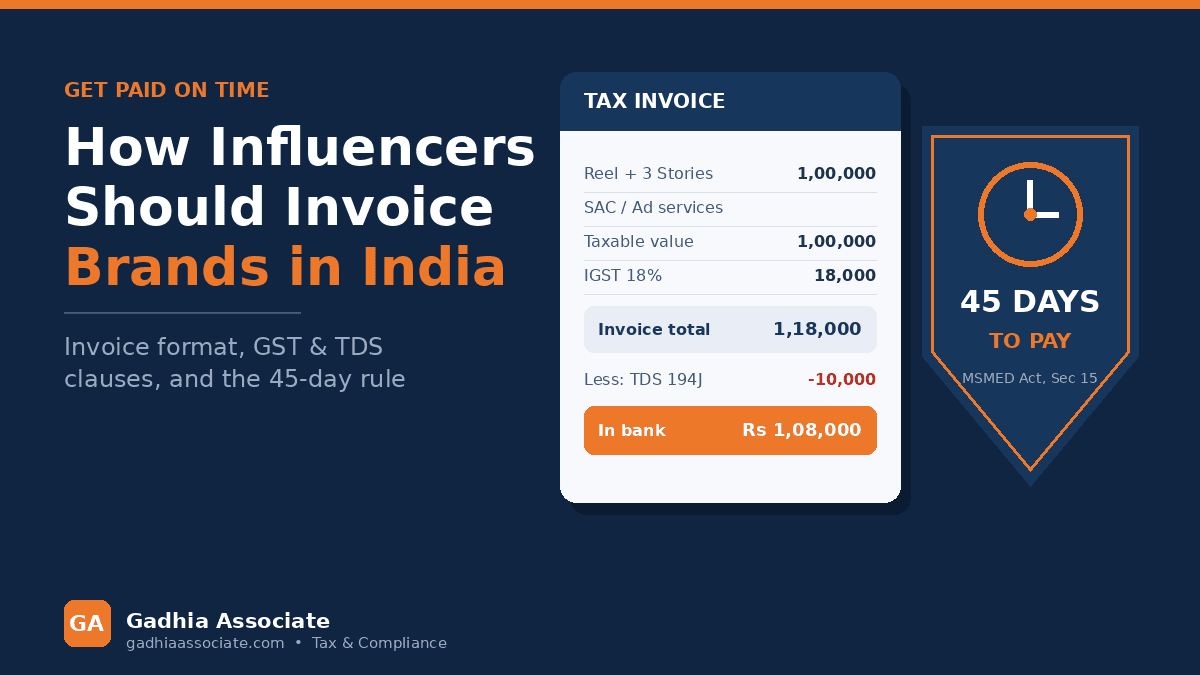
How influencers should invoice brands in India 2026: the short answer
To invoice brands in India, a creator raises a proper tax invoice carrying both parties' names, addresses and GSTINs, a serial invoice number and date, a clear description of the deliverables, the SAC code for advertising and marketing services, the taxable value, 18% GST split as CGST and SGST or charged as IGST, and the place of supply. If you are not GST registered, you issue a simple bill of supply instead. Then you chase payment using the one tool most creators never use: Udyam registration and the MSMED Act 45-day rule.
Getting paid is a process, not a hope. This guide covers the invoice format, the GST and TDS clauses that stop short payments, and the legal route when a brand simply goes quiet.
How do I make an invoice as an influencer?
Your invoice is a tax document, not a WhatsApp message with a number in it. A compliant invoice from an Indian creator should carry every one of the following, line by line.
- Your name or business name, full address, and GSTIN if you are registered
- The brand's registered legal name, address, state and GSTIN
- A unique serial invoice number and the invoice date
- Description of service, for example "Influencer marketing services: 1 Instagram reel and 3 stories, Campaign X, August 2026"
- SAC code for advertising and marketing services, along with the campaign or PO reference the brand's finance team needs
- Taxable value in rupees
- CGST and SGST where the brand is in your state, or IGST where it is in another state
- Place of supply, which is normally the brand's location for a registered recipient
- Total invoice value, in figures and words
- Your bank name, account number, IFSC and PAN
- Your signature or digital signature
Keep the numbering continuous across the financial year. Never restart the series mid-year and never skip numbers, because both are the first things a GST officer notices.
What does a sample influencer invoice look like?
Here is a plain-text walkthrough of a typical creator invoice with round numbers.
- Invoice No: GA/2026-27/014, Date: 20 August 2026
- From: Your Name, Junagadh, Gujarat. GSTIN: 24XXXXXXXXXXXZX. PAN: ABCDE1234F
- Billed to: Brand Private Limited, Mumbai, Maharashtra. GSTIN: 27XXXXXXXXXXXZX
- Place of supply: Maharashtra (27)
- Description: Influencer marketing services, 1 Instagram reel plus 3 stories, 30 days organic usage on brand handles
- SAC: advertising and marketing services
- Taxable value: Rs 1,00,000
- IGST at 18%: Rs 18,000
- Total invoice value: Rs 1,18,000
- Note on invoice: "TDS, if any, to be deducted on the taxable value of Rs 1,00,000 only, and not on the GST component."
- Payment terms: "Payable within 30 days. Supplier is registered on Udyam as a micro enterprise; MSMED Act 2006 payment timelines apply."
If the brand is in Gujarat, the same invoice would show CGST at 9% of Rs 9,000 and SGST at 9% of Rs 9,000 instead of IGST.
Do I charge GST on brand deals?
If you are registered under GST, yes, at 18% on your fee. If your turnover is below the registration threshold and you are not registered, you cannot charge GST at all and you issue a bill of supply rather than a tax invoice. A bill of supply looks like the invoice above minus the GSTIN, the tax lines and the place of supply, and it should say clearly that the supplier is not registered under GST and therefore not authorised to collect tax.
Two practical points. First, do not collect GST while unregistered, that is a serious problem. Second, agree upfront in the contract whether your quoted fee is inclusive or exclusive of GST. Our article on GST for influencers goes deeper into registration thresholds and return filing, and our GST Calculator tool on the site works out the tax and the gross value in seconds.
Why did the brand pay me less than my invoice?
Almost always, TDS. Brands deduct tax at source before paying you, usually under Section 194C for contractual work or Section 194J for professional or technical services, depending on how they classify your engagement. That deducted amount is not lost. It shows up against your PAN in Form 26AS and in the Annual Information Statement, and you claim it as a credit when you file your income tax return, which is covered in our article on income tax for influencers.
Here is the worked example every creator should memorise. You raise an invoice for a Rs 1,00,000 brand deal.
- Taxable value: Rs 1,00,000
- GST at 18%: Rs 18,000
- Invoice total: Rs 1,18,000
- TDS deducted by the brand, illustratively at 10% under Section 194J, on the taxable value of Rs 1,00,000: Rs 10,000
- Amount that should hit your bank account: Rs 1,08,000
- GST of Rs 18,000 that you must pay to the government in your return: Rs 18,000
- Net in your hands before expenses: Rs 90,000, plus a Rs 10,000 TDS credit to claim in your ITR
The classic dispute is a brand deducting TDS on the GST-inclusive Rs 1,18,000 instead of on Rs 1,00,000, which shorts you by the tax on the tax. Where the GST is shown separately on the invoice, TDS is generally to be deducted on the value excluding GST. Put that note on every invoice, and reconcile every receipt against Form 26AS and the AIS each quarter. If a brand deducted but never deposited, the credit will not appear, and you want to know that in month two, not at filing time.
How do I invoice a foreign brand?
If the recipient is outside India, the payment comes in convertible foreign exchange and the other conditions for export of services are met, your supply is zero-rated. In practice that means you can file a Letter of Undertaking with the GST department and then invoice the foreign brand without charging GST at all, rather than paying IGST and claiming a refund later. The invoice should state that it is a supply of services for export under LUT without payment of integrated tax, and should carry the foreign currency amount.
Indian TDS sections do not usually apply to a foreign payer, but the platform or the foreign country may apply its own withholding, so read the payout statement. Keep your bank's foreign inward remittance documentation, because that is your proof that the export conditions were satisfied.
What can I do if a brand delays payment?
This is where Udyam registration changes the game. A service provider, including a content creator, can register on the Udyam portal as a micro enterprise. It is free and online. Once registered, the MSMED Act 2006 protections apply to you.
- Section 15 requires the buyer to pay within the agreed period and in any event within 45 days of acceptance of the service
- Section 16 makes a delaying buyer liable to compound interest with monthly rests at three times the RBI bank rate, which is a genuinely painful number
- Section 43B(h) of the Income-tax Act disallows the buyer's expense deduction if the payment to a registered micro or small enterprise is not made within the prescribed time, which means their finance team has a tax reason to clear your bill
- The MSME Samadhaan portal lets you file a delayed payment complaint free of cost, which goes to the Micro and Small Enterprise Facilitation Council for conciliation and, if needed, arbitration
The practical sequence: put your Udyam number on every invoice, add a line stating that MSMED Act timelines apply, send a written reminder at day 30 and a formal notice at day 46 quoting Sections 15 and 16 and Section 43B(h), and file on Samadhaan if there is still silence. Our article on the MSME 45-day payment rule and Udyam registration walks through the filing itself.
What records should a creator keep?
Keep the contract or approved brief, the invoice, the delivery proof such as post links and screenshots, the bank credit entry, the TDS certificate, and a simple ledger reconciling invoice value to amount received to TDS deducted. Barter deals need the same file, with the agreed value of the product recorded in writing. This one habit is the difference between a five-minute return and a three-week scramble.
How Gadhia Associate Can Help
Gadhia Associate is a tax and compliance firm in Junagadh, Gujarat, working with creators and small businesses across India digitally. We set up compliant invoice templates and numbering, handle Udyam registration, LUT filing for foreign brand payments, GST returns, TDS reconciliation against Form 26AS and AIS, and ITR filing for creators. We also review brand contracts from a tax and compliance angle before you sign. Book a free consultation.
Position as of August 2026. This article is general information and not legal advice. Contract terms and tax positions should be reviewed by a qualified professional for your specific facts, and rules change through CBDT, CBIC and ASCI notifications.