Job Work Under GST in 2026: Sending Goods Without Tax, the 1-Year and 3-Year Rule, E-Way Bills and ITC-04 Due 25 October
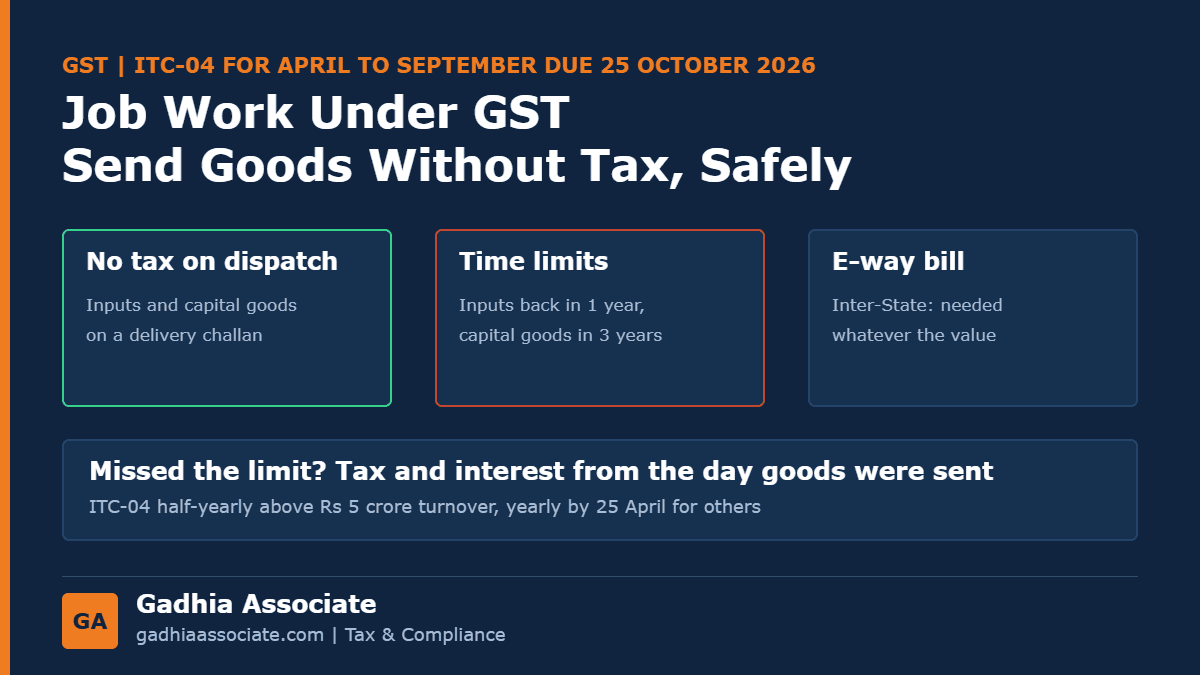
Job work under GST lets you send goods to a job worker without paying tax, but only if they come back within one year, or three for capital goods.
Mukeshbhai makes brass fittings in Jamnagar. He sends rods to three job workers for turning, plating and polishing, all on delivery challans. A lot sent to a plater in Rajkot in August 2025 is still lying there, the challans are filed in a drawer, and nobody has filed the job work return. His turnover crossed Rs 5 crore last year, so his first half-yearly ITC-04 is due on 25 October 2026.
Job work is how much of Saurashtra's engineering, brass, ceramic and textile work gets done, and GST gives it a special route that saves tax only when the paperwork is kept. Here is how it works in 2026.
In short: A registered principal can send inputs and capital goods to a job worker on a delivery challan without paying GST. Inputs must come back within one year and capital goods within three years; moulds, dies, jigs, fixtures and tools are exempt from the time limit. If they do not come back in time, the original dispatch is treated as a supply on the day the goods were sent, and the principal pays tax with interest. Goods sent to a job worker in another State need an e-way bill whatever their value. The principal reports these movements in Form ITC-04: half-yearly if aggregate turnover is above Rs 5 crore, with April to September due by 25 October, and yearly by 25 April for others. The job worker's charges are a taxable service, and waste and scrap can be sold by the job worker if registered, or otherwise by the principal.
Our GST team handles job work set-ups, challans, ITC-04 filing and the notices that follow. The details are at the end of this guide.
What counts as job work?
- The definition: any treatment or process carried out by a person on goods belonging to another registered person, such as machining, plating, polishing, dyeing, printing, cutting or assembly.
- The principal must be registered: the special route is available only to a registered principal.
- Ownership stays with you: the job worker processes your goods; it does not buy them.
Sending goods without tax: the time limits
- Inputs: must come back, or be supplied from the job worker's premises, within one year of being sent.
- Capital goods: within three years.
- No time limit: moulds, dies, jigs, fixtures and tools.
- Extension: the Commissioner can extend the period, by up to one year for inputs and two years for capital goods, on sufficient cause.
- Missed the limit: the goods are treated as supplied by you to the job worker on the day you sent them. You pay GST with interest from that day, and issue an invoice.
- Credit: you can take input tax credit on inputs and capital goods sent to a job worker, including those your supplier delivers straight to the job worker.
Challans and e-way bills
- Delivery challan: goods go to the job worker, and come back, on a serially numbered challan, not a tax invoice.
- E-way bill: needed for inter-State movement to a job worker whatever the value of the goods. Within Gujarat, the normal Rs 50,000 limit applies. See our guide on e-way bill detention.
- Keep a job work register: challan number, date, quantity sent, quantity received back, waste and scrap, for each job worker.
Form ITC-04: the job work return
- Who files: the principal, not the job worker.
- Aggregate turnover above Rs 5 crore: half-yearly. April to September by 25 October, and October to March by 25 April.
- Rs 5 crore or less: once a year, by 25 April.
- What it shows: goods sent to each job worker, goods received back, goods supplied from the job worker's premises, and waste and scrap.
- Why it matters: officers match ITC-04 with your challans, e-way bills and stock. Goods sent more than a year ago and never shown as received are the first thing questioned in a GST audit. See what to expect in a GST department audit.
Supplying directly from the job worker
- Finished goods: can be supplied straight from the job worker's premises on your tax invoice, or exported without tax.
- The condition: the job worker's premises must be declared as your additional place of business, unless the job worker is registered.
- Waste and scrap: can be sold by the job worker on payment of tax if registered; otherwise you sell it and pay the tax.
For the job worker
- Your charges are taxable: job work charges are a service, billed with GST. The rate depends on the goods processed, and many rates were revised from 22 September 2025, so check your invoices.
- Registration: needed once your turnover crosses the limit for services, Rs 20 lakh in Gujarat. A job worker below the limit generally does not have to register only because its principal is in another State. See do I need GST registration.
- Goods are not your stock: keep the principal's goods separately recorded, so they are not counted as your purchases or sales.
The notices we see
- Tax and interest on goods lying with job workers beyond one year
- ITC-04 not filed, or not matching the challans and e-way bills
- Credit questioned on inputs that never came back
- Waste and scrap sold without tax
Our guide to ITC mismatch notices explains how to reply when credit is questioned.
Back to Mukeshbhai. The lot sent to Rajkot in August 2025 has crossed one year, so it is treated as supplied on the day it left Jamnagar; he pays GST with interest from that date and raises an invoice, or applies for an extension if there is a genuine reason. The other challans are entered in a job work register, matched with the job workers' records and e-way bills, and his first half-yearly ITC-04 goes in by 25 October. From now on, every challan is tracked against its one-year limit.
How we help
- Set up challans, job work registers and e-way bill routines
- Track inputs and capital goods against the one-year and three-year limits
- File ITC-04, half-yearly or yearly
- Regularise goods lying beyond the time limit, with the right invoice and tax
- GST registration and billing for job workers
- Replies to audit queries and notices on job work
Gadhia Associate has been in practice since 2007 and has handled work for over 7,000 clients, with a 5.0 Google rating from more than 100 reviews. Manufacturers and job workers from Junagadh, Rajkot, Jamnagar, Morbi and Gondal come to our Junagadh office, where same-day appointments are available. GST work for businesses elsewhere in India is handled online.
Goods lying with job workers, or ITC-04 due on 25 October? Get your challans checked this week. Call or WhatsApp +91 82005 28355, or message us on WhatsApp. The first consultation is free.
Frequently asked questions
What is the due date of ITC-04 for April to September 2026?
25 October 2026, for principals with aggregate turnover above Rs 5 crore. Others file once a year, by 25 April.
What happens if goods are not returned by the job worker within one year?
The inputs are treated as supplied to the job worker on the day they were sent, and the principal pays GST with interest from that day. Capital goods have three years.
Is an e-way bill required for sending goods to a job worker?
Yes for inter-State movement, whatever the value. Within the State, the normal value limit applies.
Does a job worker need GST registration?
Only once its turnover crosses the registration limit for services. A smaller job worker generally need not register just because the principal is in another State.
Can goods be sold directly from the job worker's premises?
Yes, on the principal's tax invoice, if the premises are declared as the principal's additional place of business or the job worker is registered.
Who pays GST on waste and scrap at the job worker?
The job worker, if registered. Otherwise the principal supplies it and pays the tax.
Position as of 14 October 2026. Job work charges are taxed at rates that depend on the goods and were revised from 22 September 2025. Time limits and ITC-04 rules apply to your facts and records, so take advice on your own case.