57th GST Council Meeting Highlights (8 October 2026): No Arrest, Rs 10,000 Notice Limit, 90% Auto Refunds and Late Fee Relief
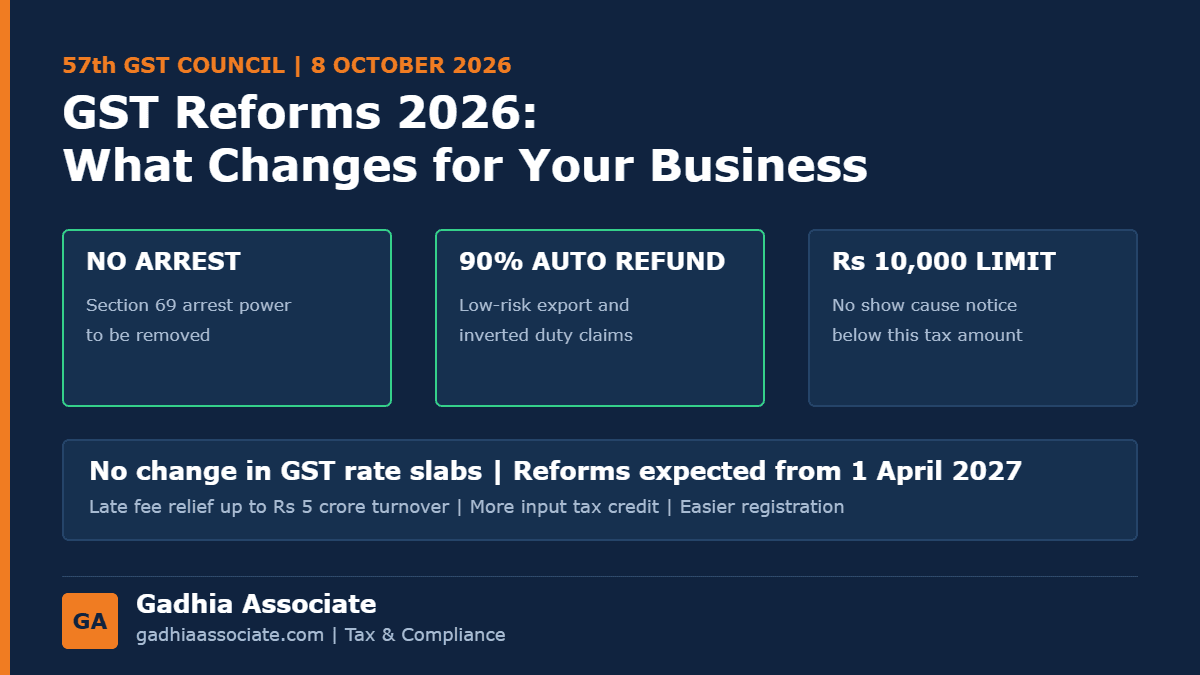
The 57th GST Council on 8 October 2026 recommended ending GST arrests, faster automatic refunds, lighter penalties and easier registration.
Ask any GST practitioner in Saurashtra what clients want to know this week, and you will hear the same three questions. Will export refunds now come in days instead of months? Will a notice for a few thousand rupees of tax simply go away? And, from isabgol traders, is the rate dispute that has held up trading at Unjha since late July finally over?
The answer to all three is mostly yes, but not yet. The Council's decisions are recommendations. They become law only when the GST Acts, Rules and notifications are changed, and the Finance Minister said the process reforms are aimed at 1 April 2027. Here is what was decided, what it means for your business, and what to do in the meantime.
In short: The 57th GST Council met on 8 October 2026 and did not change the GST rate slabs. It recommended a large set of process reforms instead: removing the power to arrest under GST, raising the prosecution limit from Rs 1 crore to Rs 5 crore, no show cause notice where the tax involved is below Rs 10,000, lower penalties in non-fraud cases, automatic provisional sanction of 90% of the amount claimed in low-risk export and inverted duty refund claims, automatic approval of most registration changes, no late fee for taxpayers with turnover up to Rs 5 crore who file a late GSTR-3B by the end of the month in which it was due, and input tax credit on items such as health and life insurance, outdoor catering and free samples. None of this is law yet. Most of it needs amendments to the GST Acts and Rules, and the process reforms are expected from 1 April 2027.
What did the 57th GST Council decide?
The Council met at Bharat Mandapam, New Delhi, chaired by Finance Minister Nirmala Sitharaman. The official press release lists dozens of changes. These are the ones that matter most to a business:
- No arrest under GST: section 69 of the CGST Act, which allows arrest, is to be removed completely.
- Prosecution only for large cases: the limit goes up from Rs 1 crore to Rs 5 crore of tax, and the offences in section 132 are narrowed.
- No notice for small amounts: no show cause notice where the tax involved (CGST, SGST, IGST and cess together) is below Rs 10,000, and pending notices and appeals below that amount are to be decided as if the limit had been in force when the notice was issued.
- Lower penalties: in non-fraud cases, a penalty of only 5% if the tax and interest are paid within 30 days of the order (60 days under section 74A), no minimum penalty of Rs 10,000, and the maximum general penalty under section 125 cut from Rs 25,000 to Rs 10,000.
- Faster refunds: for export and inverted duty claims that the system rates as low-risk, 90% of the amount claimed to be sanctioned provisionally and automatically, with the provisional order within three working days of acknowledgement; other claims go to an officer. A refund claim for excess cash in the electronic cash ledger to be sanctioned in full automatically, without an officer.
- Easier registration: a circular listing the documents that can be asked for, a simpler application form, automatic approval of changes other than the principal place of business, and automatic acceptance of cancellation applications once all returns are filed and dues paid, in two phases.
- Late fee relief: no late fee for taxpayers with turnover up to Rs 5 crore in the previous financial year if a late GSTR-3B is filed by the end of the month in which it was due.
- More input tax credit: the bar on credit to be lifted for items including outdoor catering, health and life insurance, telecom towers, pipelines outside the factory, free samples, and goods that must be destroyed when their shelf life ends.
- Goods in transit: vehicles to be stopped only on specific intelligence approved by an officer of at least Joint Commissioner rank, and not in transit states, unless the e-way bill or documents are missing.
- Rates: no change to the GST rate slabs. The Finance Minister said rate changes will be taken up only once a year, from 1 April.
When will these changes apply?
- Not law yet: the press release says the recommendations take effect only through circulars, notifications and amendments to the law. As of 10 October 2026, we had not seen any notification or circular giving effect to them.
- From 1 April 2027: the Finance Minister said the process reforms are targeted for implementation from 1 April 2027 and could take about a year to stabilise. Changes to the CGST Act also need matching changes to each state's GST Act, including Gujarat's.
- Rate items and clarifications: these come through notifications and circulars, which can be issued sooner. No dates have been announced.
- The new return-matching system: the mechanism to correct differences between GSTR-1, GSTR-3B and GSTR-2B is proposed from the return for April 2027.
Until then, the current law applies in full. The power to arrest, today's penalties, and every notice and return deadline still stand. Do not ignore a notice because the amount is small.
What it means for traders and small businesses
- Small notices: once the Rs 10,000 limit is law, show cause notices for tax below Rs 10,000 should stop. The press release says nothing about system mismatch intimations or scrutiny notices, so those may continue. Until then, reply on time. Our guide to replying to a GST notice explains how.
- Late returns: if your turnover was up to Rs 5 crore in the previous financial year, a late GSTR-3B filed by the end of the month in which it was due will carry no late fee once this is notified. Today the late fee still applies; see GST late fee and interest.
- Registration: fewer document queries and faster changes. If your application is stuck now, our note on GST registration rejected or stuck in Gujarat covers what to do.
- Quarterly payment for B2C sellers: the Council approved, in principle, a concept note for an optional Annual Return Quarterly Payment (ARQP) scheme, with an annual return and quarterly payment, for taxpayers with turnover up to Rs 5 crore in the previous financial year who sell only to unregistered buyers. The detailed scheme is still to be framed, and press reports say it is likely to come up at the next Council meeting.
- Small e-commerce sellers: a simpler way to register in another state where you have no premises, using the e-commerce operator's warehouse there as the principal place of business, if you sell goods only through e-commerce operators, pass on no more than Rs 2.5 lakh of input tax credit a month and have the operator's consent.
What it means for exporters
- Refunds: for export refund claims the system rates as low-risk, 90% of the amount claimed to be sanctioned provisionally by the system, and in a second phase the full amount automatically after adjusting any dues, with data checked against customs, RBI and SEZ records. Refund forms are to capture data directly, with no scanned uploads.
- Rule 96(10): to be omitted with effect from 23 October 2017, in line with the Supreme Court's decision. This helps exporters whose IGST refunds on exports were denied or recovered under rule 96(10) because they had used import or input tax concessions such as Advance Authorisation or EOU benefits. The Gujarat High Court had already struck the rule down in 2025.
- Services to your own branch abroad: the "distinct person" condition is to be removed from the definition of export of services, so services to your own foreign branch can count as exports.
- Capital goods: refund of input tax credit on capital goods, spread over 60 months, for credit taken from 1 April 2027, where you export under LUT or bond (not where IGST is paid on the export) or have an inverted duty structure.
- Input services in inverted duty refunds: credit on input services taken from 1 November 2026 is to count in inverted duty refunds once the law changes, so track it separately from that date.
Service exporters also have new FEMA reporting from 1 October 2026. See the new EDF rules for exporters, and our guide on GST refunds that get stuck.
Input tax credit: what opens up
- Blocked credits to be removed: outdoor catering, health and life insurance, telecom towers, pipelines laid outside the factory, free samples, and goods destroyed or written off on expiry where the law requires it.
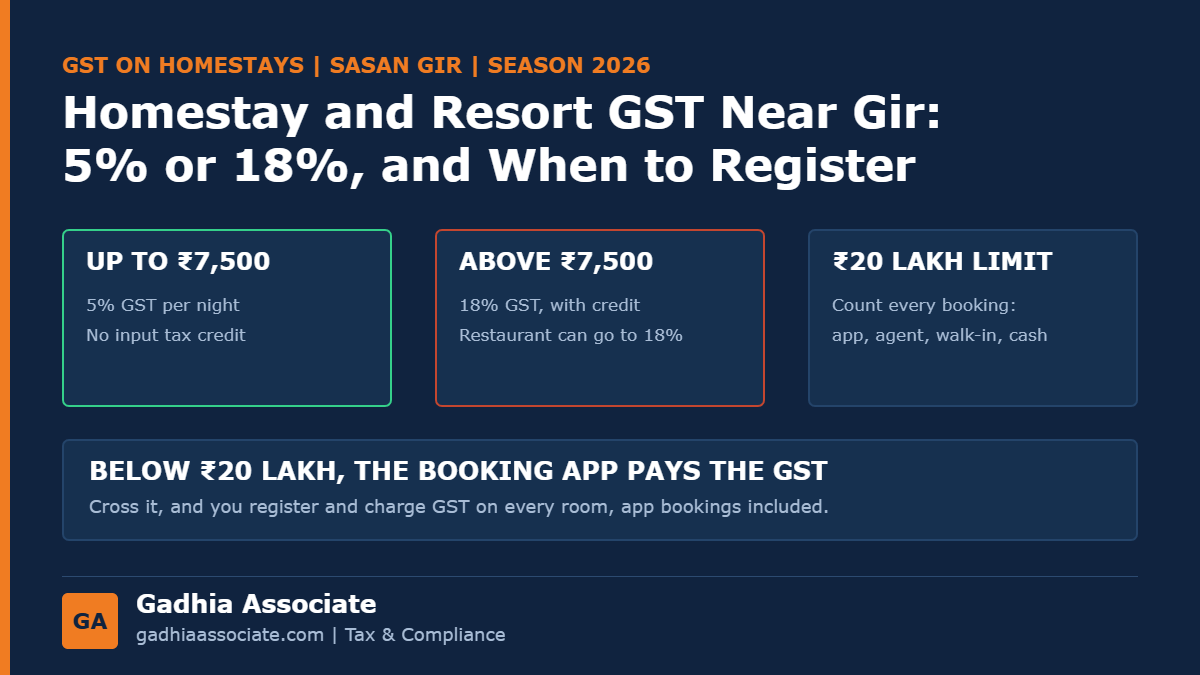
- Same line of business: restaurants, outdoor caterers, gyms and hotels with room rates up to Rs 7,500 per room per day, which pay 5% without credit, are to get credit only on the same kind of service bought in from another supplier, as already allowed for passenger transport and tour operators.
- Blocked credit ledger: a right to object and be heard when an officer blocks credit under rule 86A.
- Not decided yet: protection for buyers when a supplier fails to pay the tax (section 16(2)(c)) and credit on motor vehicles were sent to a committee of officers.
- Gifts: goods given as gifts are not among the items named in the press release, so treat that credit as blocked unless the final amendment says otherwise.
Notices, penalties and arrest
- Arrest: the power to arrest under section 69 is to be removed. The Finance Minister said criminal prosecution will remain available where there is criminality, and prosecution is to be limited to cases above Rs 5 crore.
- Penalties: 5% in non-fraud cases if you pay the tax and interest within 30 days of the order (60 days under section 74A), no minimum penalty of Rs 10,000, and a lower cap on the general penalty.
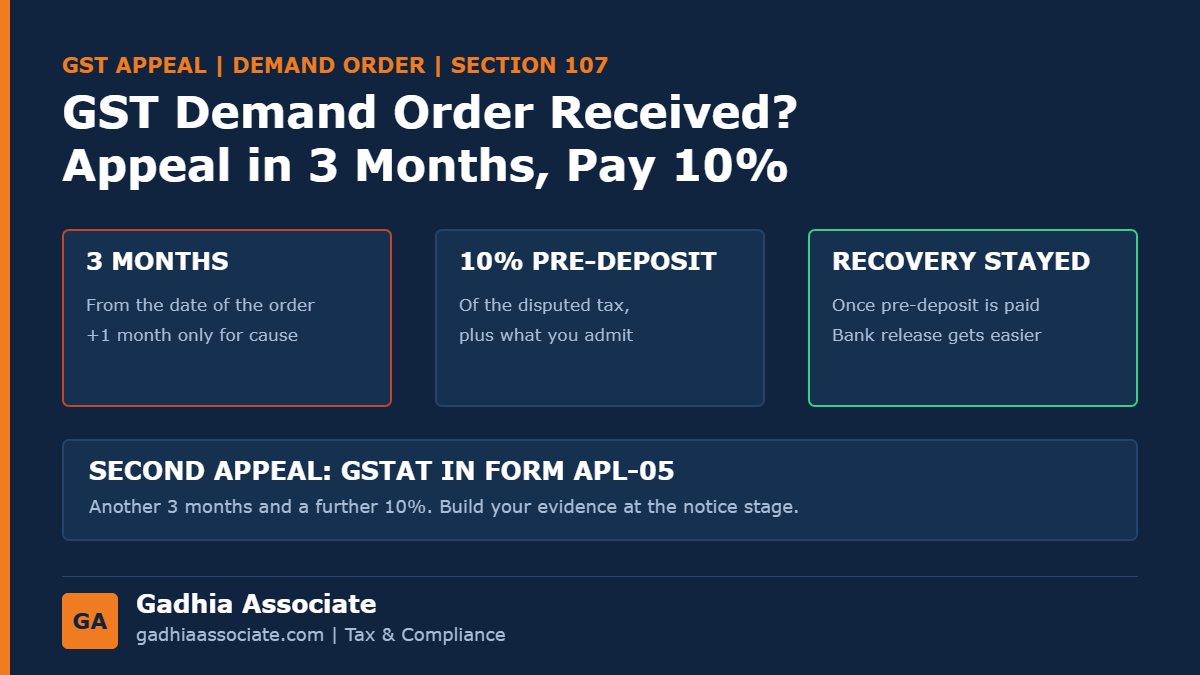
- Appeals: for appeals against orders that only levy a penalty, the pre-deposit is to be capped at Rs 40 crore. See our guide to GST appeals and pre-deposit.
- A change that goes against taxpayers: a validation clause is proposed to protect notices that courts set aside because they covered several financial years in one notice. If you won a case on that ground, take advice.
Goods in transit and e-way bills
Interception of vehicles is to need specific intelligence and approval from an officer of at least Joint Commissioner rank, and only the state of the supplier or the buyer can stop and inspect the goods. The exception matters: goods moving without an e-way bill or documents can still be stopped anywhere. Confiscation under section 130 is not to apply to goods or vehicles in transit. If a vehicle is detained today, our guide on e-way bill detention and release explains the steps.
Rate changes for specific items
- Isabgol (psyllium) seeds: to be nil whether fresh, chilled, frozen or dried. Once notified, this should settle the dispute over dried seeds that held up trade at Unjha.
- Waste and scrap: waste and scrap of plastics, electrical and electronic goods and tyres, and used cooking oil, sold by an unregistered person to a registered buyer to come under reverse charge, and sales between registered persons to carry 2% TDS deducted by the buyer.
- Delivery through e-commerce apps: delivery services, other than courier and postal, for goods ordered or supplied through e-commerce operators at 5% without credit, with the e-commerce operator paying where the delivery provider is not liable to register. The GST exemption for goods transport agencies carrying such goods to unregistered persons is to be withdrawn.
- Toys: the toy entries to cover all toys, including dolls and puzzles.
- Electric vehicles: an optional 5% rate, with restricted credit, for passenger transport and rental with operator using EVs, where charging is included in the price.
The main rate slabs set in September 2025 do not change. See GST 2.0 slabs for the current rates.
What should you do now?
- Keep complying under the current law. Nothing is notified yet, so reply to every notice on time, including small ones.
- If you have an inverted duty structure, track credit on input services separately from 1 November 2026. Businesses exporting under LUT or bond, and inverted duty businesses, should also track credit on capital goods taken from 1 April 2027, month by month.
- If you claim refunds, complete Aadhaar authentication and keep every return filed. Both are conditions for the automatic refunds.
- If your turnover is up to Rs 5 crore, file any late GSTR-3B within the same month it was due.
- Always generate the e-way bill and carry the documents. The new protections do not cover goods moving without them.
What we do for you
- Check which of the 57th Council changes help your business, and from when
- File export and inverted duty refunds, and follow up on stuck claims
- Reply to GST notices and handle appeals, including penalty-only orders
- Review your input tax credit under the proposed changes to blocked credits
- Handle GST registration, amendments, cancellation and revocation
- Get vehicles and goods released after an e-way bill detention
- File monthly GST returns and reconcile them, so a mismatch never becomes a notice
Gadhia Associate has been in practice since 2007 and has handled work for over 7,000 clients across Saurashtra and Gujarat, with a 5.0 Google rating from more than 100 reviews. Traders, manufacturers, exporters and service businesses from Junagadh, Rajkot, Jamnagar, Morbi, Porbandar and Veraval come to our Junagadh office, where same-day appointments are available. GST work can equally be handled online for businesses anywhere in India.
Want to know what the GST reforms mean for your business? Call or WhatsApp +91 82005 28355, or message us on WhatsApp. The first consultation is free.
Frequently asked questions
Has the power to arrest under GST been removed?
Not yet. On 8 October 2026 the GST Council recommended removing section 69 of the CGST Act, which allows arrest. It needs an amendment to the law, and until then the current provisions apply.
Did the 57th GST Council change GST rates?
There was no change to the rate slabs. A few item-level changes and clarifications were recommended, such as nil GST on isabgol seeds whether fresh, chilled, frozen or dried. The Finance Minister said rate changes will be taken up only once a year, from 1 April.
When will the GST reforms of October 2026 apply?
They are recommendations and apply only after notifications, circulars and amendments to the GST Acts. The process reforms are expected from 1 April 2027, and we had not seen any notification or circular on them as of 10 October 2026.
What is the 90% automatic GST refund?
For export and inverted duty refund claims that the system rates as low-risk, the system is to sanction 90% of the amount claimed provisionally, with the order within three working days of acknowledgement. The balance follows after an officer's scrutiny and final order, and other claims go to an officer first.
Will I still get a GST notice for a small amount?
The Council recommended that no show cause notice be issued where the tax involved is below Rs 10,000. Until the law is changed, notices can still be issued and must be answered on time.
Is there a late fee waiver for small taxpayers?
Yes, as a recommendation. Taxpayers with turnover up to Rs 5 crore in the previous financial year are to pay no late fee if a late GSTR-3B is filed by the end of the month in which it was due. It applies only once notified.
Position as of 10 October 2026. The decisions of the 57th GST Council are recommendations and take effect only through notifications, circulars and amendments to the GST laws. Dates and details may change when they are notified. Take advice before acting on them.