New FEMA Export Rules from 1 October 2026: Monthly EDF for Service Exporters, SOFTEX Ends, and Export Money Must Arrive in 9 Months
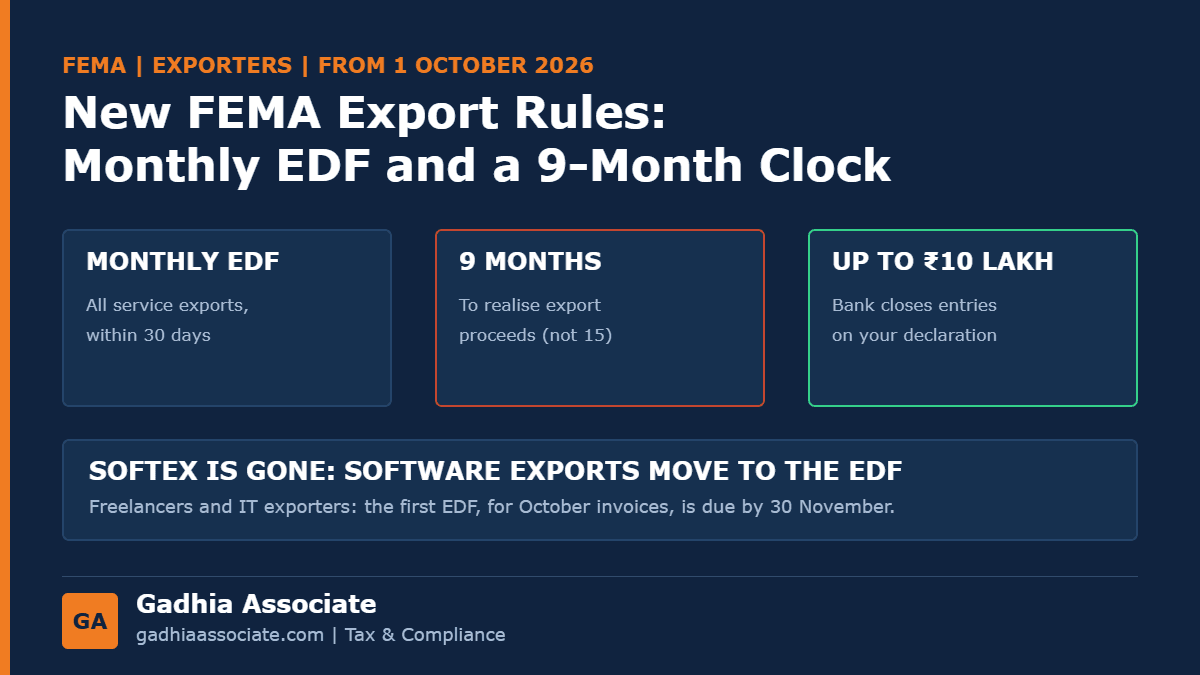
From 1 October 2026, every service exporter files a monthly EDF with the bank, and export proceeds must be realised within 9 months, not 15.
Take a Rajkot software developer who bills two clients in Canada every month. He has never filed a SOFTEX form, his money comes in through a payment platform, and so far his bank has never asked him for anything beyond a purpose code. From October, that changes. The same goes for a design studio working for a London agency, an engineer preparing drawings for a Dubai contractor, and a freelance video editor paid in dollars.
RBI's new Foreign Exchange Management (Export and Import of Goods and Services) Regulations, 2026 come into force on 1 October 2026. On 22 September, a week before the start date, RBI also cut the time allowed to bring export money home back to nine months. Here is what has changed, in plain terms, and what exporters should do this month.
In short: The 2026 regulations (Notification No. FEMA 23(R)/2026-RB dated 13 January 2026) replace the 2015 export regulations from 1 October 2026. Service exporters, including freelancers and software exporters, must file one Export Declaration Form (EDF) a month covering all their export invoices, within 30 days from the end of the month in which the invoices were raised. SOFTEX forms are gone. Goods exporters continue to furnish the EDF at the time of shipment. Under the amendment of 22 September 2026 (Notification No. FEMA 23(R)/(1)/2026-RB), export proceeds must be realised within nine months, or twelve months for exports invoiced or settled in rupees. Entries up to Rs 10 lakh can be closed on the exporter's own declaration.
Who has to file an EDF now?
For goods, not much changes. The EDF is furnished at the time of shipment, along with the shipping bill, as before. The real change is for services. Until now, only software exporters filed a declaration, through SOFTEX, and most other service exporters simply received the money and collected a FIRA. From October, every exporter of services declares exports to the bank through the EDF. That includes:
- IT, software and SaaS businesses, and global capability centres
- Freelancers and consultants: developers, designers, writers, editors and engineers
- Digital marketing agencies, KPOs and back-office service providers
- Professionals who bill foreign clients
How does the monthly EDF work?
- One form a month: all export invoices raised in a month go into a single EDF, even if they are for different clients.
- Deadline: within 30 days from the end of that month. Invoices raised in October 2026 must be declared by 30 November 2026.
- Where to file: with your authorised dealer bank, that is, the bank where the export money finally lands. Units in an STPI or SEZ file through those authorities.
- What goes in it: your details, the foreign buyer, a description of the service with its SAC code, invoice numbers, amounts and currency, and the expected mode of payment.
- What happens next: the bank opens an entry in EDPMS, RBI's export monitoring system. When the payment arrives, it is matched to that entry, the entry is closed, and the eBRC follows on the DGFT portal.
Payment platforms do not file the EDF for you. They give you the FIRA or payment advice, but the declaration is yours to make.
Nine months, not fifteen
The January 2026 regulations had allowed fifteen months to realise export proceeds. The 22 September amendment took it back to nine months before the new rules even started:
- Goods: nine months from the date of shipment.
- Services: nine months from the date of the invoice.
- Exports invoiced or settled in rupees: twelve months.
If a buyer is slow to pay, ask your bank for an extension before the period runs out, with the reason and your correspondence with the buyer. Banks can now grant extensions, allow a reduction in the export value, and permit set-off against import payments to the same overseas party, without going to RBI. Do not leave it too long: if proceeds stay unrealised for more than a year, further exports are allowed only against full advance payment or an irrevocable letter of credit.
The Rs 10 lakh relief for small exporters
Where an EDPMS entry is for Rs 10 lakh or less, the bank can close it on the exporter's own declaration, without the full set of documents, and a quarterly bulk declaration is allowed. Most freelancers and small agencies invoice well within this limit, so for them this is the most useful part of the new rules. It only helps if the EDF was filed in the first place.
Why this matters beyond FEMA
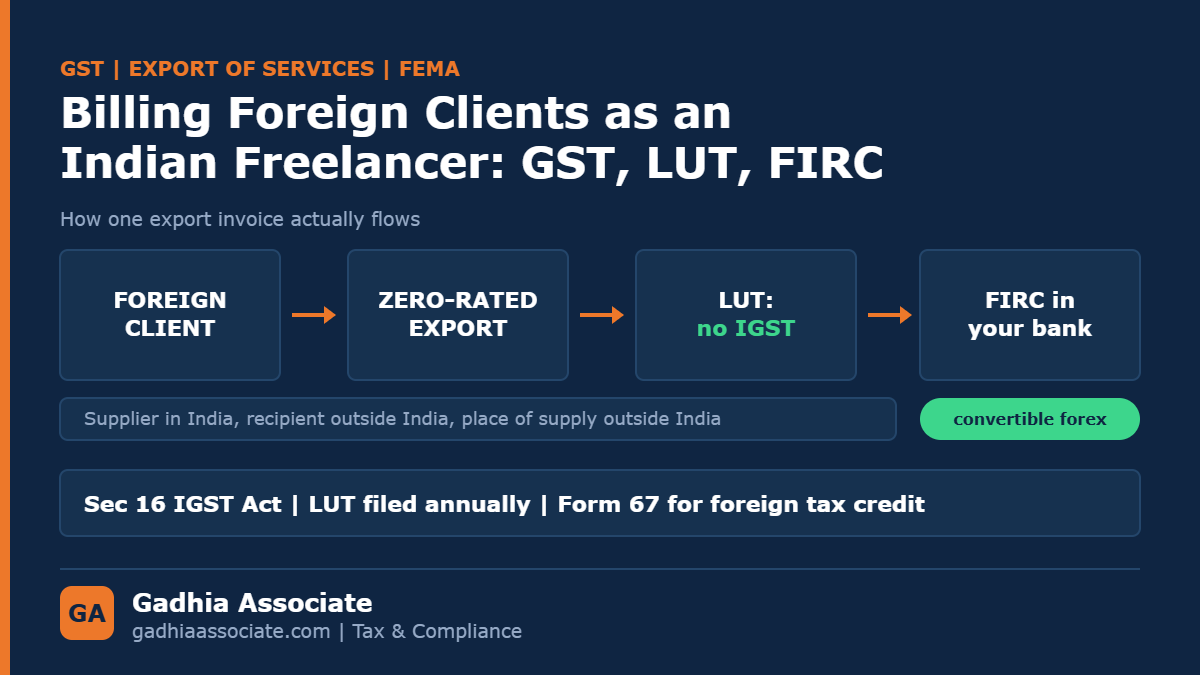
- GST: a service is a zero-rated export only if the payment comes in convertible foreign exchange, or in rupees where RBI permits. If the money does not arrive within the time allowed, the GST benefit can be lost and IGST with interest demanded. Our note on billing foreign clients as a freelancer explains the GST side and the LUT.
- Refunds and incentives: without a matched entry, no eBRC is generated, and GST refunds and export incentives that depend on it get stuck. See why export GST refunds get stuck.
- Penalty: a contravention of FEMA can attract a penalty of up to three times the amount involved, or up to Rs 2 lakh where the amount cannot be quantified, plus Rs 5,000 for every day it continues.
What to do this month
- Tell your bank that you export services, and ask how it wants the monthly EDF: on paper, by email or through its portal.
- List every export invoice from October onwards, with its SAC code, buyer and currency.
- File the October EDF by 30 November, and set a monthly reminder for the 30-day deadline.
- Match each payment to its invoice, and follow up on anything older than six months.
- For exports made before 1 October, check which realisation period applies to each shipment or invoice, because the older rules continue to govern them.
- If you also import from the same overseas party, ask the bank about setting off payables against receivables.
New to exporting? Our guide to starting exports from Gujarat covers IEC, the AD code and LUT in order.
What we do for you
- Tell you exactly what the new rules require for your kind of export
- Prepare the monthly EDF and coordinate with your bank
- Reconcile EDPMS entries with invoices, payments and FIRAs
- Apply for extensions, reductions or set-off through your bank
- Handle LUT, GST returns and export refunds
- Clean up old open entries before they turn into a problem
Gadhia Associate has been in practice since 2007 and has handled work for over 7,000 clients across Saurashtra and Gujarat, with a 5.0 Google rating from more than 100 reviews. Software exporters, freelancers, agencies and manufacturers from Junagadh, Rajkot, Jamnagar, Morbi, Porbandar and Veraval come to our Junagadh office, where same-day appointments are available. FEMA and GST work for exporters is handled online, so we also work with exporters anywhere in India. Fixed-fee and monthly plans are available.
Export services or goods? Get your first EDF right. Call or WhatsApp +91 82005 28355. The first consultation is free.
Frequently asked questions
What is EDF under FEMA?
EDF is the Export Declaration Form, the declaration an exporter makes about goods or services exported, so that the bank can track the export until the money is received.
Do freelancers have to file an EDF?
Yes. From 1 October 2026, every exporter of services, including freelancers and consultants, files a monthly EDF with the bank where the export money is received.
What is the due date for the EDF for services?
Within 30 days from the end of the month in which the invoices were raised. For October 2026 invoices, the due date is 30 November 2026.
Is the SOFTEX form still required?
No. Software exports are now declared through the same monthly EDF as other services.
What is the export realisation period from 1 October 2026?
Nine months from shipment for goods and from the invoice date for services, and twelve months for exports invoiced or settled in rupees.
What if my foreign client pays late?
Ask your bank for an extension before the nine months end, with the reason and supporting correspondence. Banks can now grant it without going to RBI.
Position as of 30 September 2026. Banks are still settling their procedures for the monthly EDF, so formats and filing channels may differ from bank to bank. Exports made before 1 October 2026 follow the earlier rules. Take advice on your own contracts and entries.