Cash Deposit Rules 2026: PAN Only Above Rs 10 Lakh a Year, When Your Bank Reports You, and How to Answer an Income Tax Query on Cash
Since April 2026, you quote PAN for cash deposits only above Rs 10 lakh a year, but banks still report large cash to the tax department.
A Keshod farmer sells his groundnut and cotton through the season and is often paid in cash. By March, he has deposited about Rs 14 lakh in his savings account. A few months later, a message on the income tax portal asks him to explain the deposits. He has never filed a return, because agricultural income is not taxed. He had nothing to hide, but he still had to prove it.
Cash is still a normal part of life in Saurashtra, in farming, in retail and at festival time. What changed in 2026 is the paperwork around it. What has not changed is how closely the department watches it. Here are the rules for cash deposits and withdrawals, when your bank reports you, and how to answer a query if one comes.
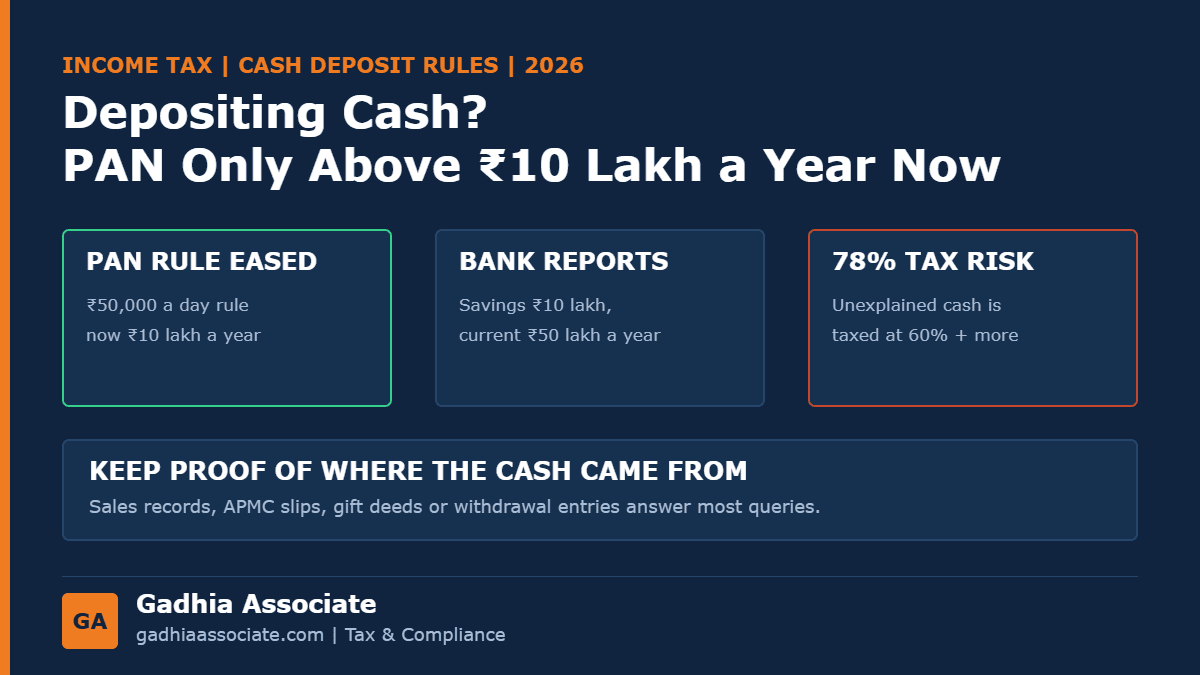
In short: Under the Income-tax Rules, 2026, which apply from 1 April 2026, PAN has to be quoted for cash deposits or withdrawals only when they add up to Rs 10 lakh or more in a financial year, in place of the old rule of PAN for any cash deposit above Rs 50,000 in a day. Separately, banks report cash deposits of Rs 10 lakh or more a year in savings accounts, and cash of Rs 50 lakh or more in current accounts, to the tax department, and these show up in your Annual Information Statement. There is no limit on how much cash you can deposit, but you must be able to explain where it came from. Cash that cannot be explained is taxed at about 78%.
What changed on 1 April 2026?
Under the old rule, PAN was needed for any cash deposit above Rs 50,000 in a single day. People without a PAN, or who did not want to give it, split their deposits into smaller amounts, which banks noticed anyway. The new rules look at the year instead of the day: PAN is needed once cash deposits or withdrawals in your accounts add up to Rs 10 lakh or more in a financial year. Fixed deposits follow a similar yearly limit.
This makes life easier for small depositors. It does not reduce reporting. Your bank already has your PAN through KYC, and the reporting limits below have not been relaxed.
When does your bank report cash to the tax department?
- Savings accounts: cash deposits adding up to Rs 10 lakh or more in a financial year.
- Current accounts: cash deposits or withdrawals adding up to Rs 50 lakh or more in a year.
- Fixed deposits: deposits adding up to Rs 10 lakh or more in a year, other than renewals.
- Credit cards: bills paid in cash of Rs 1 lakh or more, or Rs 10 lakh or more by any mode, in a year.
These figures go into the Statement of Financial Transactions filed by the bank and then into your AIS, where you can see them yourself. Our guide to AIS, Form 26AS and TIS shows how to check.
Is there a limit on how much cash you can deposit?
No. There is no legal cap on depositing your own money. Questions come only when the deposits do not match what you have declared. A shopkeeper who deposits Rs 40 lakh of sales that are recorded in the books and shown in GST returns has nothing to worry about. A salaried person earning Rs 8 lakh who deposits Rs 15 lakh in cash will be asked where it came from.
Two related rules sit alongside:
- Receiving cash: you cannot receive Rs 2 lakh or more in cash from one person in a day, for one transaction or for one event. The penalty equals the amount received. See our guide to cash transaction limits.
- Withdrawing cash: banks deduct 2% TDS on cash withdrawals above Rs 1 crore in a year, and lower limits apply to people who have not been filing returns.
What happens if the department asks about your deposits?
It usually starts with an SMS, an email or an entry on the compliance portal asking you to confirm or explain a high-value transaction. That is not yet a notice. If it is ignored, or the answer does not add up, it can lead to a notice for reassessment. So answer it, and back the answer with documents:
- Business sales: the cash book, sales bills and GST returns showing the same cash.
- Agricultural income: the 7/12 extract, APMC sale slips or bills from the trader.
- Earlier withdrawals: bank statements showing that the cash was withdrawn earlier and deposited back.
- Gifts from relatives: a gift deed, and the relative's own source of the money.
- Sale of an asset: the sale bill, for example for old gold or a vehicle.
If a notice has already arrived, our guide to reading and replying to income tax notices explains the next steps.
What if the cash cannot be explained?
Unexplained money is taxed at 60%, plus a 25% surcharge and cess, which works out to about 78% (old Section 115BBE), and a penalty can come on top. No expense or loss can be set off against it. That is why the explanation, and the documents behind it, matter more than the amount.
A few habits that prevent trouble
- Deposit business cash in the business account, not in a family member's savings account.
- Keep the cash book and sales records up to date, especially in the festival season.
- Farmers should keep sale slips for every season.
- File a return when deposits are large, even if the income is not taxable. It becomes compulsory once deposits in savings accounts reach Rs 50 lakh in a year, or deposits in current accounts cross Rs 1 crore.
- Check your AIS once a year, and reply to any query within the time given.
What we do for you
- Check your AIS and bank deposits against your income before the department does
- Reply to compliance portal queries about cash deposits
- Prepare the explanation and documents for cash from business, farming or gifts
- File returns for farmers, traders and families with large deposits
- Handle reassessment notices and appeals
- Set up cash books and records for shops and festival-season businesses
Gadhia Associate has been in practice since 2007 and has handled work for over 7,000 clients across Saurashtra and Gujarat, with a 5.0 Google rating from more than 100 reviews. Farmers, traders, shopkeepers and families from Junagadh, Keshod, Rajkot, Jamnagar, Veraval, Porbandar and Amreli come to our Junagadh office, where same-day appointments are available. Notice replies are filed online, so we also help taxpayers anywhere in India. Fixed-fee and monthly plans are available.
Got a message about cash deposits, or planning a large deposit? Call or WhatsApp +91 82005 28355. The first consultation is free.
Frequently asked questions
What is the cash deposit limit in a savings account in 2026?
There is no cap. But cash deposits of Rs 10 lakh or more in a financial year are reported to the tax department, and PAN is needed once deposits or withdrawals reach Rs 10 lakh in the year.
Is PAN required to deposit more than Rs 50,000 in cash now?
Not under the income tax rules from 1 April 2026, unless your cash deposits or withdrawals for the year reach Rs 10 lakh. Your bank may still ask for it under its own KYC policy.
Will I get an income tax notice for depositing cash?
Only if the deposits do not match your declared income or records. Large deposits are reported, so keep proof of the source.
How much cash can I deposit in a current account?
There is no cap. Cash deposits or withdrawals of Rs 50 lakh or more in a year are reported to the tax department.
What is the tax on unexplained cash deposits?
60% tax plus a 25% surcharge and cess, about 78% in all, and a penalty can also apply.
Can I deposit cash received as a gift?
Yes, with a gift deed. Gifts from specified relatives are not taxed. But receiving Rs 2 lakh or more in cash from one person in a day or for one occasion breaks the cash receipt rule, so larger gifts should come by bank transfer.
Position as of 30 September 2026. The thresholds are from the Income-tax Rules, 2026, and banks may ask for PAN under their own KYC policies. Reporting rules can change, so take advice before replying to any query.