Diwali Gifts and Bonus to Employees in 2026: The New Rs 15,000 Tax-Free Gift Limit, TDS on Cash Bonus and GST on Gifts
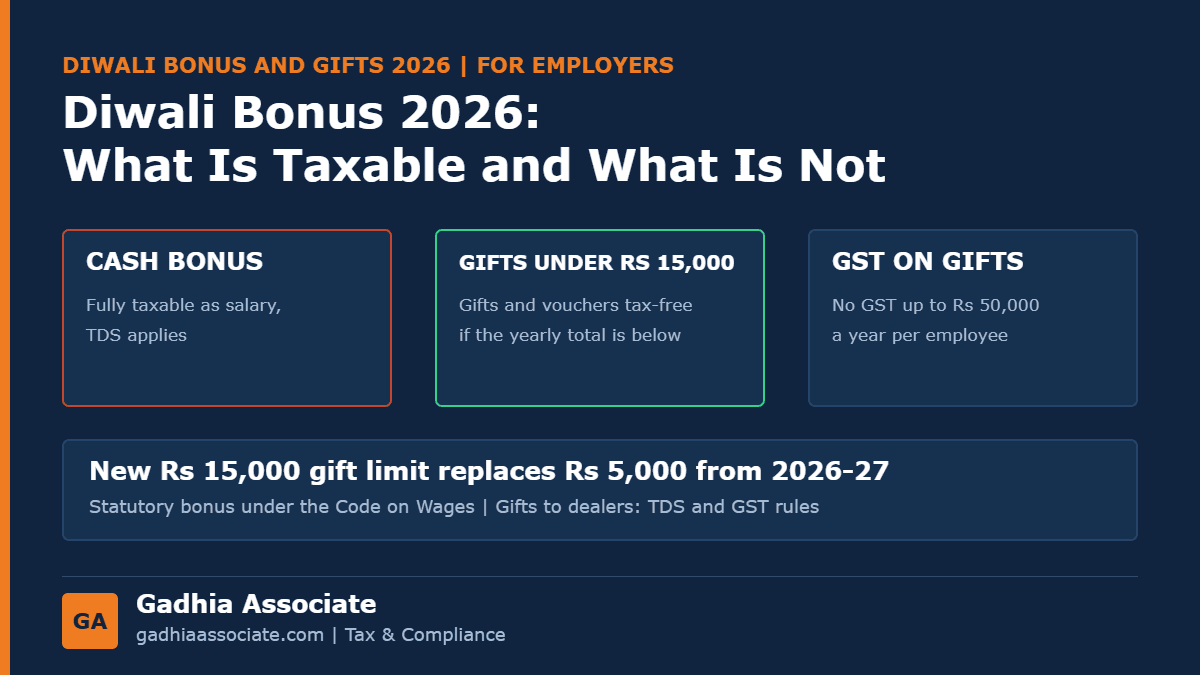
Diwali bonus 2026 is fully taxable as salary, while gifts and vouchers to employees are tax-free if their yearly total stays below Rs 15,000.
Every Diwali, a Rajkot manufacturer gives each of his 60 workers a cash bonus, a box of sweets and a silver coin, and his senior staff a gift voucher. The accountant usually treats it all as one expense and moves on. This year the rules around it have changed, and the difference between a voucher and cash now matters more than it used to. Diwali falls on Sunday, 8 November 2026, so most of these decisions are being made right now.
This guide explains how Diwali bonus and gifts to employees are taxed in 2026, who must get a statutory bonus under the Code on Wages, what the employer must do for TDS, how GST treats gifts, and the separate rules for gifts to dealers.
Short answer: Under rule 15 of the Income-tax Rules, 2026, gifts in kind and gift vouchers given by an employer to an employee, or to a member of the employee's household, are tax-free if their total value in the tax year is below Rs 15,000, up from Rs 5,000. If the total reaches Rs 15,000 or more, the whole value becomes a taxable perquisite. Cash gifts and bonus are always taxable as salary. The employer must add them to the employee's salary when working out TDS under section 392 of the Income-tax Act, 2025, and deduct tax if the employee's estimated tax for the year is more than nil. For GST, gifts to an employee up to Rs 50,000 a year are not treated as a supply, but input tax credit on goods bought as gifts is not available. Gifts and other benefits worth more than Rs 20,000 in a tax year to a dealer, professional or other business recipient attract TDS at 10%.
What changed for 2026-27?
- Limit raised: the tax-free limit for gifts and vouchers to employees is now a yearly total below Rs 15,000 per employee, three times the earlier limit of below Rs 5,000 (rule 15 of the Income-tax Rules, 2026).
- Non-cash only: it covers gifts in kind, gift vouchers, gift cards and similar tokens, whether given to the employee or to a member of the employee's household. Cash is not covered.
- Yearly total: the limit applies to all such gifts in the tax year together, not to each occasion. A Diwali voucher, a birthday gift and an award all count.
- All or nothing: if the yearly total reaches Rs 15,000 or more, the entire value becomes taxable, not just the excess.
Diwali bonus 2026: who must get a statutory bonus?
- The law: statutory bonus is now paid under the Code on Wages, 2019, which replaced the Payment of Bonus Act, 1965 from 21 November 2025.
- Which businesses: establishments that employed 20 or more persons on any day of the accounting year.
- Which employees: those drawing wages up to Rs 21,000 a month who worked at least 30 days in the year. Under the Code's new definition of wages, allowances above half of total pay are added back to wages, which can change who qualifies.
- How much: at least 8.33% of the wages or Rs 100, whichever is higher, and at most 20%.
- On what wage: in Gujarat, the state's notification of May 2026 provides that bonus is worked out on the minimum wage fixed for the job. For central-sphere establishments, such as banks, mines and ports, it is Rs 7,000 a month or the central minimum wage, whichever is higher.
- By when: within eight months of the close of the accounting year, by credit to the employee's bank account. For a year ending 31 March 2026, that is 30 November 2026.
- Diwali bonus counts: a customary Diwali bonus paid during the year can be adjusted against the statutory bonus.
An example: a worker earns Rs 18,000 a month. Suppose the minimum wage for her job is Rs 12,500. Her bonus is worked out on Rs 12,500: at least Rs 12,495 for the year at 8.33%, and at most Rs 30,000 at 20%.
Has the government announced Diwali bonus 2026 for its employees?
As of 9 October 2026, no official order had been issued for the 2026 bonus of railway or other central government employees. On 7 October, the Railway Board called a viral letter claiming a 78-day bonus fake. For reference, last year's ad-hoc bonus for central government employees was Rs 6,908, worked out as 30 days on a ceiling of Rs 7,000 a month. Rely only on an order from the ministry concerned.
Is Diwali bonus taxable?
Yes. A Diwali bonus or cash gift is part of salary under sections 15 and 16 of the Income-tax Act, 2025, taxed at the employee's slab rate under whichever tax regime they have chosen. When it is paid, the employer must add it to the estimate of the employee's salary for the year and work out TDS again under section 392 (the old section 192). If the employee's revised tax for the year is still nil, no tax needs to be deducted. Many employers forget this, and the shortfall appears as a demand on the employer and a surprise for the employee at the time of filing the return.
An example under the new regime: an employee with a salary of Rs 12,50,000 a year pays no tax, because after the standard deduction of Rs 75,000 her taxable income is Rs 11,75,000, within the Rs 12 lakh rebate limit. A Diwali bonus of Rs 50,000 takes her taxable income to Rs 12,25,000, and her tax becomes Rs 25,000 plus 4% cess, or Rs 26,000, after marginal relief. The employer's TDS must reflect this.
- Statutory bonus: also taxable salary. We explained the wider payroll changes in what the new labour codes mean for Gujarat employers.
- Advance bonus: taxed in the year it is received, and not taxed again when it falls due.
- Partners: a partner's bonus from the firm is not salary, and the gift limit does not apply. The firm deducts TDS at 10% where payments to a partner exceed Rs 20,000 in the year.
Some examples
- Worker A: sweets worth Rs 800 and a silver coin worth Rs 4,500 at Diwali, and a Rs 5,000 voucher on her work anniversary. Total Rs 10,300, below Rs 15,000, so nothing is taxable.
- Manager B: a Rs 12,000 voucher at Diwali and a gadget worth Rs 6,000 as an award. Total Rs 18,000, above the limit, so the full Rs 18,000 is a taxable perquisite.
- Worker C: Rs 5,000 in cash as a Diwali gift. Fully taxable as salary, whatever the amount, though the actual tax can still be nil if the worker's total income is within the rebate limit.
The lesson for employers who want the gift to reach employees tax-free: give it in kind or as a voucher, and keep the yearly total for each employee below Rs 15,000.
What must the employer do for TDS and reporting?
- Keep a register of gifts and vouchers given to each employee through the year, with values.
- Treat cash bonus and cash gifts as salary in the month of payment, and work out TDS again.
- Add the full value of non-cash gifts to the employee's salary as a perquisite once the yearly total reaches Rs 15,000.
- Show the salary, perquisites and TDS correctly in the quarterly TDS statement in Form 138 (which has replaced Form 24Q) and in Form 130 (which has replaced Form 16).
How does GST treat gifts to employees?
- Up to Rs 50,000 a year per employee: gifts by an employer to an employee are not treated as a supply, so no GST is payable on the gift itself.
- Input tax credit: credit on goods bought to be given as gifts is blocked under section 17(5)(h) of the CGST Act. Do not claim it on sweets, coins, gadgets or hampers bought for gifting, and reverse it if it was claimed. Gift vouchers are different: buying a voucher is neither a supply of goods nor of services, so no GST is charged when you buy it and there is no credit to claim.
- Above Rs 50,000: if gifts to one employee go above Rs 50,000 in a financial year, they are treated as a supply. GST is then payable on their value, and in that case the credit on those goods can be claimed.
- The GST Council on 8 October 2026: it recommended removing the credit block for free samples and some other items, but gifts were not mentioned, and the law has not been changed yet.
What about gifts to dealers, customers and professionals?
- TDS: a business that gives gifts or other benefits worth more than Rs 20,000 in total in a tax year to a resident, in connection with that person's business or profession (such as a dealer, distributor or doctor), must deduct TDS at 10% under section 393(1) of the Income-tax Act, 2025, which replaced section 194R. Where the gift is wholly in kind, the giver must make sure the tax is paid before handing it over. Individuals and HUFs whose turnover was up to Rs 1 crore (or Rs 50 lakh for professionals) in the previous year do not have to deduct. Diwali gifts to top dealers often cross this limit. See our detailed note on TDS on gifts and dealer incentives.
- GST: input tax credit on goods given as gifts to customers or dealers is also blocked.
- Income tax deduction: genuine business gifts are usually allowed as a business expense, but keep bills in the business name and a list of recipients.
A Diwali checklist for employers
- Work out the statutory bonus for every eligible employee and pay it by bank credit by 30 November 2026.
- Decide the gift policy: vouchers or gifts in kind for the tax-free benefit, and cash only where intended.
- Track each employee's gifts and vouchers for the full tax year and keep the total below Rs 15,000.
- Run cash bonus through payroll with TDS in the month of payment.
- Buy gifts on proper bills in the business name, and do not claim GST credit on them.
- List gifts to dealers, professionals and business customers, and deduct TDS where the total for any one of them goes above Rs 20,000 in the tax year.
- Keep the gift and bonus registers ready for the tax audit and a labour inspection.
What we do for you
- Work out statutory bonus under the Code on Wages, including the new wage definition
- Design a gift and bonus policy that keeps employee gifts tax-free where possible
- Handle payroll, TDS on salary and perquisites, and quarterly TDS statements
- Issue Form 130 to employees with perquisites shown correctly
- Review GST credit on festival purchases and reverse blocked credit
- Deduct and report TDS on gifts to dealers, customers and professionals
- Prepare the records your tax auditor will ask for
Gadhia Associate has been in practice since 2007 and has handled work for over 7,000 clients across Saurashtra and Gujarat, with a 5.0 Google rating from more than 100 reviews. Manufacturers, traders and service businesses from Junagadh, Rajkot, Jetpur, Veraval, Porbandar and Amreli come to our Junagadh office, where same-day appointments are available. Payroll and TDS work can equally be handled online for employers anywhere in India. Fixed-fee and monthly plans are available.
Planning Diwali gifts and bonus for your staff? Talk to us before you pay, not after. Call or WhatsApp +91 82005 28355, or message us on WhatsApp. The first consultation is free.
Frequently asked questions
Is Diwali bonus taxable?
Yes. A Diwali bonus is part of salary and is taxed at your slab rate under either regime, and the employer includes it when working out TDS. Gifts in kind and vouchers are different: they are tax-free if their yearly total is below Rs 15,000.
How much gift from an employer is tax-free in 2026?
Gifts in kind and vouchers are tax-free if their total value in the tax year is below Rs 15,000, from tax year 2026-27. The earlier limit was below Rs 5,000.
Is a cash Diwali gift from the employer taxable?
Yes. Cash gifts and bonus are fully taxable as salary. The employer must include them when working out TDS on salary, and deduct tax if the employee's estimated tax for the year is more than nil.
What happens if gifts reach Rs 15,000 in a year?
The whole value becomes a taxable perquisite, not just the amount above Rs 15,000. Gifts stay tax-free only while the yearly total is below Rs 15,000.
Who is eligible for statutory bonus in 2026?
Employees drawing wages up to Rs 21,000 a month who worked at least 30 days in the year, in establishments with 20 or more employees. The bonus is 8.33% to 20% of the wages used for the calculation.
What is the last date to pay statutory bonus?
Within eight months from the end of the accounting year, by credit to the employee's bank account. For a year ending 31 March 2026, that is 30 November 2026.
Can the employer claim GST credit on Diwali gifts?
No. Input tax credit on goods given as gifts is blocked under section 17(5)(h) of the CGST Act. On 8 October 2026 the GST Council recommended removing this block for free samples and some other items, but gifts were not mentioned, and the law has not been changed yet. Gifts to an employee up to Rs 50,000 a year are not treated as a supply.
Is TDS required on Diwali gifts to dealers?
Yes, at 10% under section 393(1) of the Income-tax Act, 2025 (the old section 194R), if the total value of gifts and benefits given to that dealer in the tax year is more than Rs 20,000. For a gift in kind, the giver must make sure the tax is paid before handing it over.
Does the Rs 15,000 limit apply under the new tax regime too?
Yes. The limit comes from the rules for valuing perquisites, which apply to salaried employees under both regimes.
Position as of 10 October 2026. The Income-tax Act, 2025 and the Income-tax Rules, 2026 apply from 1 April 2026, and older section numbers are mentioned because that is how people still search for them. Statutory bonus rules depend on the establishment and the state. Take advice on your own payroll and gifting plans.