FSSAI Registration and Licence in 2026: New Rs 1.5 Crore Limit, Perpetual Validity, Fees and Who Needs Which
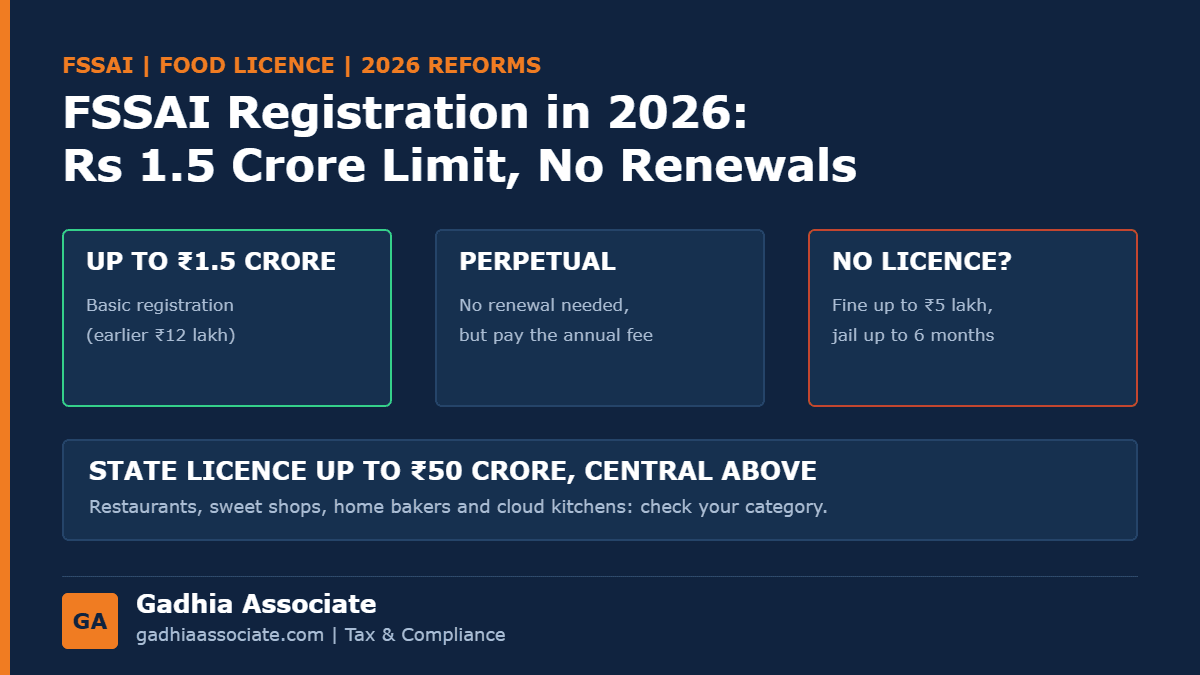
From April 2026, FSSAI basic registration covers food businesses with turnover up to Rs 1.5 crore, and registrations no longer need renewal.
A farsan and sweets shop in Junagadh with a turnover of around Rs 90 lakh has held a State licence for years, because the old limit for basic registration was only Rs 12 lakh. Every renewal meant documents, fees and a visit to the consultant. Home bakers selling on Instagram, cloud kitchens on delivery apps and small caterers were in the same position, often without any FSSAI number at all because the licence felt like too much work.
The 2026 reforms change that picture. This article explains who needs FSSAI registration or a licence now, what changed, the fees, and what a food business must still do every year.
Short answer: Every food business operator in India needs either FSSAI registration or an FSSAI licence under the Food Safety and Standards Act, 2006. From 1 April 2026, basic registration covers businesses with turnover up to Rs 1.5 crore (earlier Rs 12 lakh), a State licence covers turnover up to Rs 50 crore, and a Central licence applies above that and to certain categories. Registrations and licences now have perpetual validity, so there is no renewal, but the annual fee must still be paid or the licence is suspended. Applications are made online on the FoSCoS portal, and running a food business without a valid licence can attract a fine of up to Rs 5 lakh and imprisonment of up to six months.
Who needs FSSAI registration or a licence?
Anyone who manufactures, processes, packs, stores, transports, distributes, sells or serves food. That includes:
- Restaurants, dhabas, cafes, sweet and farsan shops, bakeries and caterers
- Cloud kitchens and home-based food businesses, including those selling on social media
- Grocery stores, wholesalers, distributors and food traders
- Manufacturers, including small units making pickles, snacks, spices, dairy products or packaged water
- Warehouses, cold storages and transporters of food
- Sellers on e-commerce and food delivery platforms, which will not list you without an FSSAI number
Registration or licence: which one do you need?
- Basic registration: turnover up to Rs 1.5 crore a year, subject to the capacity and category conditions in the regulations.
- State licence: turnover above Rs 1.5 crore and up to Rs 50 crore.
- Central licence: turnover above Rs 50 crore, and certain activities regardless of turnover, such as importing food.
Turnover is not the only test. Some manufacturing activities have capacity limits, and a business with units in several states may need a Central licence for its head office. Check the category before you apply, because a wrong category is the most common reason for rejection or later trouble.
What changed in 2026?
- Higher limit for registration: from Rs 12 lakh to Rs 1.5 crore, which moves a large number of small restaurants, shops and manufacturers from licence to simple registration.
- Perpetual validity: registrations and licences no longer expire after one to five years. Licences issued earlier also carry perpetual validity.
- Annual fee still applies: the fee must be paid every year. If it is not paid, the licence status changes to suspended, and operating while suspended is treated like operating without a licence.
- Simpler process for small businesses: reduced paperwork and instant registration, without a pre-registration inspection.
- Street food vendors: vendors registered with their municipal corporation or town vending committee are treated as registered under FSSAI.
- Risk-based inspections: inspections are planned according to the risk of the food, past compliance and audit results.
How much does FSSAI cost?
The annual government fee is modest:
- Basic registration: Rs 100 a year
- State licence: Rs 2,000 to Rs 5,000 a year, depending on the category
- Central licence: Rs 7,500 a year
Professional fees for preparing the application are separate. With perpetual validity, the recurring cost is now the annual fee and, for licence holders in certain categories such as manufacturers, the annual return.
How do you apply?
- Identify the right category of food business and the kind of registration or licence.
- Create a login on FoSCoS, the FSSAI's online portal.
- Fill the application with business details, premises address and the food products you deal in.
- Upload documents: photo identity of the proprietor or partners or directors, proof of the premises, and, for licences, documents such as the layout plan, list of equipment, constitution documents and water test report for manufacturers.
- Pay the fee online and track the application. Registration is now granted quickly for small businesses. Licences are processed after scrutiny.
What must you do after getting the number?
- Display the registration or licence certificate at the premises.
- Print the 14-digit FSSAI number and logo on food packaging.
- Mention the FSSAI number on bills and invoices, as FSSAI requires.
- Pay the annual fee on time, and file the annual return where your category requires it.
- Update the licence when you add products, premises or change the business constitution.
What if you run a food business without FSSAI?
Carrying on a food business that requires a licence without one can lead to imprisonment of up to six months and a fine of up to Rs 5 lakh. Delivery platforms delist sellers without a valid number, banks and large buyers ask for it, and food safety officers do inspect sweet shops and caterers, particularly in the festival season. The registration is cheap. Not having it is not.
FSSAI, GST and Udyam: the three registrations small food businesses need
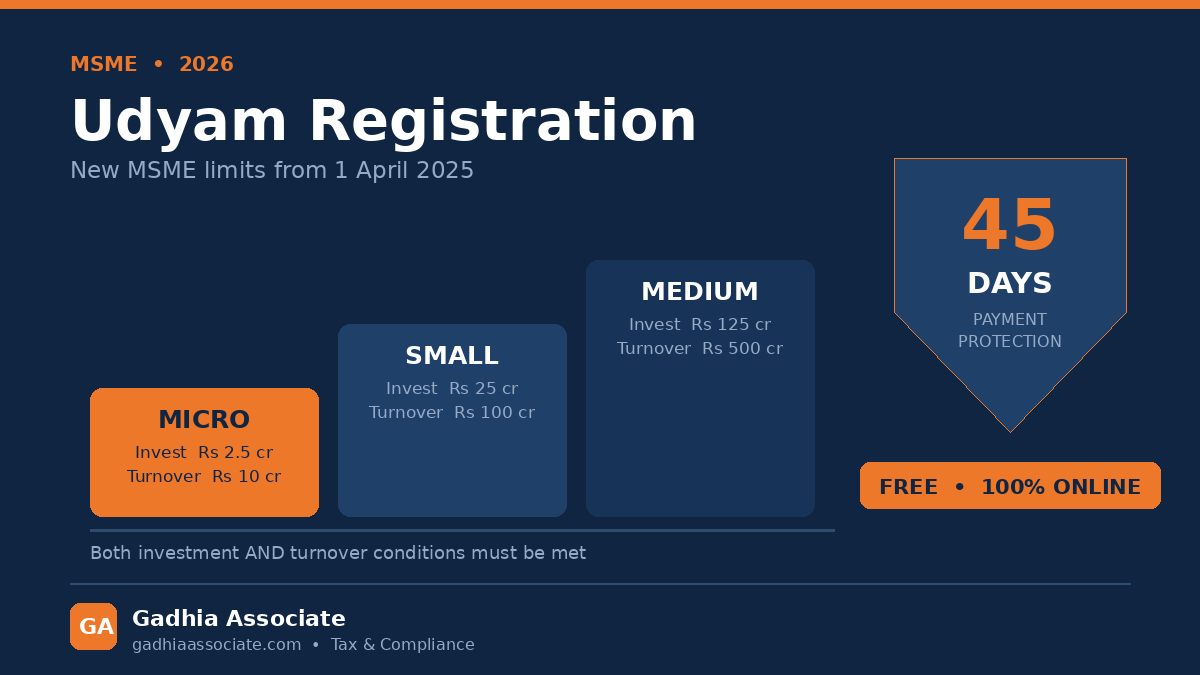
A food business usually also needs to look at GST registration and the rate that applies to its food, and Udyam registration to get MSME benefits. Restaurant GST has its own rules, which we covered in GST for restaurants, hotels and cloud kitchens, and our guide to Udyam registration explains the MSME side.
Common mistakes
- Assuming a home-based or online food business does not need FSSAI.
- Choosing the wrong food category, so the registration does not cover what you actually sell.
- Continuing with an expensive licence when basic registration now applies, or the reverse after turnover grows.
- Forgetting the annual fee now that renewals have gone, and ending up with a suspended licence.
- Not printing the FSSAI number on packaging and bills.
What we do for you
- Tell you whether you need registration, a State licence or a Central licence
- Prepare and file your application on FoSCoS, with the right food categories
- Move existing licence holders to the right category under the 2026 limits
- Track annual fees and annual returns so your licence never gets suspended
- Handle GST registration, the correct GST rate for your food, and Udyam registration
- Keep accounts and file income tax returns for food businesses of every size
Gadhia Associate has been in practice since 2007 and has handled work for over 7,000 clients across Saurashtra and Gujarat, with a 5.0 Google rating from more than 100 reviews. Restaurants, sweet shops, bakeries, caterers and food manufacturers from Junagadh, Rajkot, Veraval, Keshod, Porbandar and Amreli come to our Junagadh office, where same-day appointments are available. FSSAI applications are filed online, so we handle them for businesses anywhere in India. Fixed-fee and monthly plans are available.
Starting a food business, or not sure whether your FSSAI is still right? Call or WhatsApp +91 82005 28355. The first consultation is free.
Frequently asked questions
What is the turnover limit for FSSAI basic registration in 2026?
Rs 1.5 crore a year from 1 April 2026, raised from Rs 12 lakh, subject to the capacity and category conditions in the regulations.
Does an FSSAI licence need renewal now?
No. From April 2026, registrations and licences have perpetual validity. But the annual fee must be paid every year, or the licence is suspended.
Is FSSAI registration required for a home kitchen or home baker?
Yes. Any food business, including one run from home or selling online, needs at least basic registration.
What is the FSSAI fee for basic registration?
Rs 100 a year. State licences cost Rs 2,000 to Rs 5,000 a year and Central licences Rs 7,500 a year.
What is the penalty for running a food business without an FSSAI licence?
Imprisonment of up to six months and a fine of up to Rs 5 lakh, apart from delisting by delivery platforms.
Where do I apply for FSSAI registration?
Online on the FSSAI's FoSCoS portal, with identity proof, premises proof and details of the food products you deal in.
Position as of 26 September 2026. FSSAI regulations, fees, categories and capacity limits are revised from time to time. Confirm the current requirements for your category on the FSSAI portal before you apply.