Running a School or College Trust in Gujarat 2026: Income Tax Exemption, GST on Fees and Bus Services, Donations at Admission and Annual Filings
A school or college trust stays tax-free only if it is registered and spends on education, and most of its fees and support services carry no GST.
An education trust in Junagadh runs a Gujarati-medium and an English-medium school with about 1,800 students and fee receipts of around Rs 6 crore. Its bus contractor and lunch caterer both bill the school, an outside vendor runs a canteen selling snacks to students, and the trust sells uniforms, rents its hall for weddings on Sundays, and has taken a Rs 25,000 building fund from some parents at admission. The trustees have never been sure which of these are taxable.
Private schools and colleges are among the largest trusts in Saurashtra, with big receipts, many staff and many rules. Here is how income tax, GST and the other filings work for education trusts in 2026.
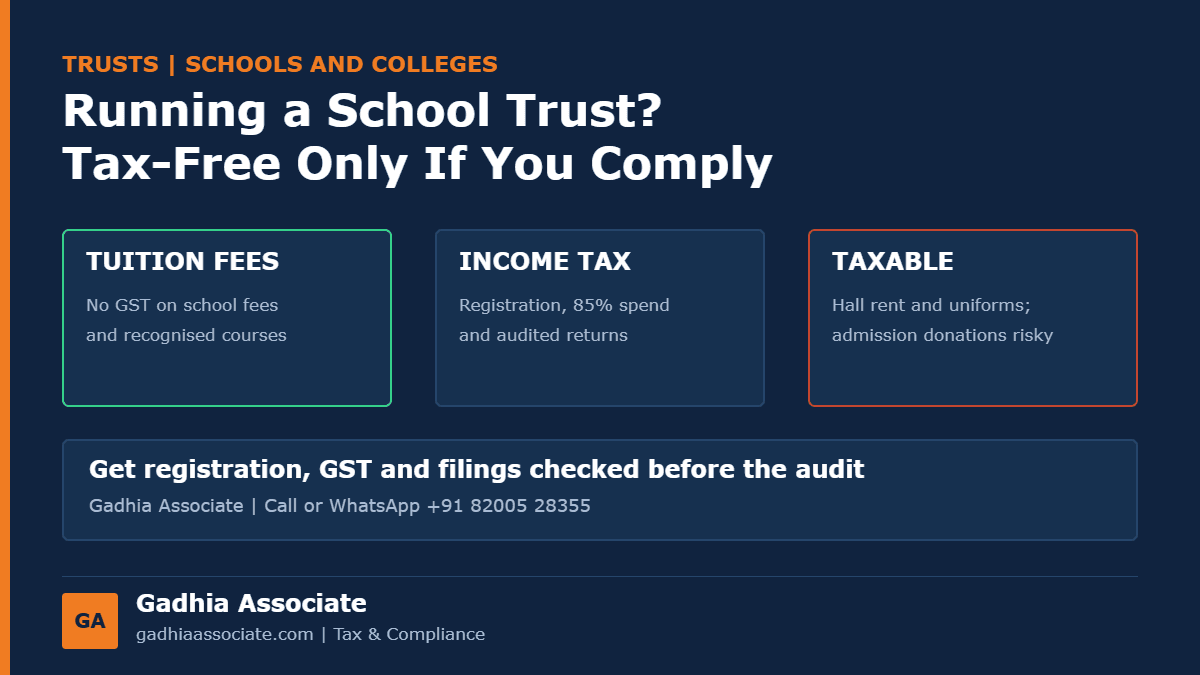
Short Answer: A school or college run by a trust pays no income tax if it is registered, spends at least 85% of its income on education and files audited returns on time; small institutions run solely for education may qualify without registration, up to a receipts limit. Tuition fees for school education and recognised courses carry no GST, and services a school up to higher secondary buys, such as student transport, catering, security and cleaning, are also exempt. Hall rent, uniforms and commercial coaching are taxable, and because exempt fees count towards the GST limit, such income usually means registration. Donations tied to admission are not voluntary and put the exemption at risk.
Our team handles registration, audits, returns, GST and payroll compliance for education trusts. Call or WhatsApp +91 82005 28355, or see the details at the end of this guide.
Income tax for education trusts
- Registration: with the income tax department, valid for five years, or ten years for trusts whose income stayed within Rs 5 crore in the two preceding years. See 12A and 80G registration and renewal.
- 85% rule: at least 85% of the year's income must be spent on education, including salaries, buildings and equipment, with accumulation allowed for specific projects.
- Small institutions: an institution run solely for education, with receipts within the specified limit, may be exempt without registration.
- No profit motive: surpluses are fine if they are used for education, but money taken out by trustees is not.
- Audit and return: audited accounts and the return every year, on time. See trust and NGO annual compliance.
Donations and fees
- Donations at admission: a payment demanded as a condition of admission is not a voluntary donation, and can be taxed or put the trust's exemption at risk.
- RTE ban: for classes 1 to 8, the Right to Education Act bars capitation fees, with a fine of up to ten times the amount collected.
- Anonymous donations: above the higher of Rs 1 lakh or 5% of total donations, they are taxed at 30%.
- Fee rules: fees of private schools in Gujarat are regulated by the state's fee regulation committee, so charge only approved fees.
- Receipts: issue a receipt for every payment and collect fees through the bank where possible.
GST on what a school charges
- Tuition fees: education by a school or by an institution giving a recognised qualification is exempt.
- Coaching and extra courses: commercial coaching or courses without a recognised qualification are taxable. See GST for coaching classes.
- Hall and ground rent: renting premises for weddings or events is taxable.
- Uniforms and stationery: sold by the school, these are taxable goods; printed books are exempt.
- Registration: exempt fees count towards the GST turnover limit, so a school with large fee receipts and any taxable income usually needs registration; only a school with wholly exempt income stays outside it.
GST on what a school buys
- Exempt for schools up to higher secondary: transport of students and staff, catering including mid-day meals, security, cleaning and housekeeping, and services for admissions and exams.
- Colleges: only services for admissions and exams, and online educational journals, are exempt; transport, catering, security and cleaning are taxable.
- Canteen sales to students: the exemption covers catering supplied to the school; a vendor selling food directly to students charges GST on those sales.
- Tell your contractors: bus and catering contractors who bill the school should not charge GST on these exempt services.
Staff, TDS and other filings
- TDS: on teachers' salaries, contractors and rent, with quarterly returns.
- PF and ESIC: once the staff thresholds are crossed. See PF and ESIC registration.
- Charity Commissioner: audited accounts and change reports for public trusts in Gujarat. See trust registration in Gujarat.
- CSR funds: education is an eligible CSR activity for company funding, with CSR-1 registration.
Back to the trust in Junagadh. Its income tax registration is renewed, and with receipts of Rs 6 crore it follows the 85% rule and files audited returns on time. The building fund taken at admission stops, and amounts already collected are reviewed for their tax effect. The bus contractor and the lunch caterer stop charging GST to the school, while the canteen vendor keeps charging GST on its sales to students. Because its exempt fees count towards the turnover limit, the trust registers for GST and pays tax on the Sunday hall rentals and uniform sales. TDS on salaries and contractors is in order, and the Charity Commissioner filings are brought up to date.
How we help
- Income tax registration, renewal and 85% planning
- Audits, returns and accumulation filings for education trusts
- GST registration and checks on fees, hall rent, uniforms and contractors
- TDS, PF and ESIC for teaching and other staff
- Charity Commissioner accounts and change reports
- CSR-1 registration and documents for CSR funding
Gadhia Associate has been in practice since 2007 and has handled work for over 7,000 clients, with a 5.0 Google rating from more than 100 reviews. Schools, colleges and education trusts from Junagadh, Rajkot, Keshod, Porbandar and Amreli come to our Junagadh office, where same-day appointments are available. Trusts elsewhere are handled online.
Running a school or college trust? Get your registration, GST and filings checked before the next audit. Call or WhatsApp +91 82005 28355, or message us on WhatsApp. The first consultation is free.
Frequently asked questions
Is a school run by a trust exempt from income tax?
Yes, if it is registered, spends 85% of its income on education and files audited returns on time.
Is GST payable on school fees?
No. Education by a school, and courses leading to a recognised qualification, are exempt.
Is GST charged on school bus services?
No. Transport of students and staff provided to a school up to higher secondary is exempt.
Can a school take a donation at admission?
A payment demanded for admission is not a voluntary donation and can put the trust's tax exemption at risk.
Is renting the school hall for weddings taxable?
Yes. Renting premises for events is taxable, and because exempt fees count towards the turnover limit, a school with such income usually needs GST registration.
Can a school get CSR funds?
Yes. Education is an eligible CSR activity, if the trust has CSR-1 registration.
Position as of 9 November 2026, under the trust provisions as carried into the Income-tax Act, 2025, the GST exemptions in force and Gujarat law. Every trust is different, so take advice on your own institution.