12A and 80G Registration and Renewal in 2026: Form 10AB, Provisional to Final Approval, Deadlines and Cancellation Risks for NGOs and Trusts
12A and 80G Registration and Renewal in 2026: The Short Answer
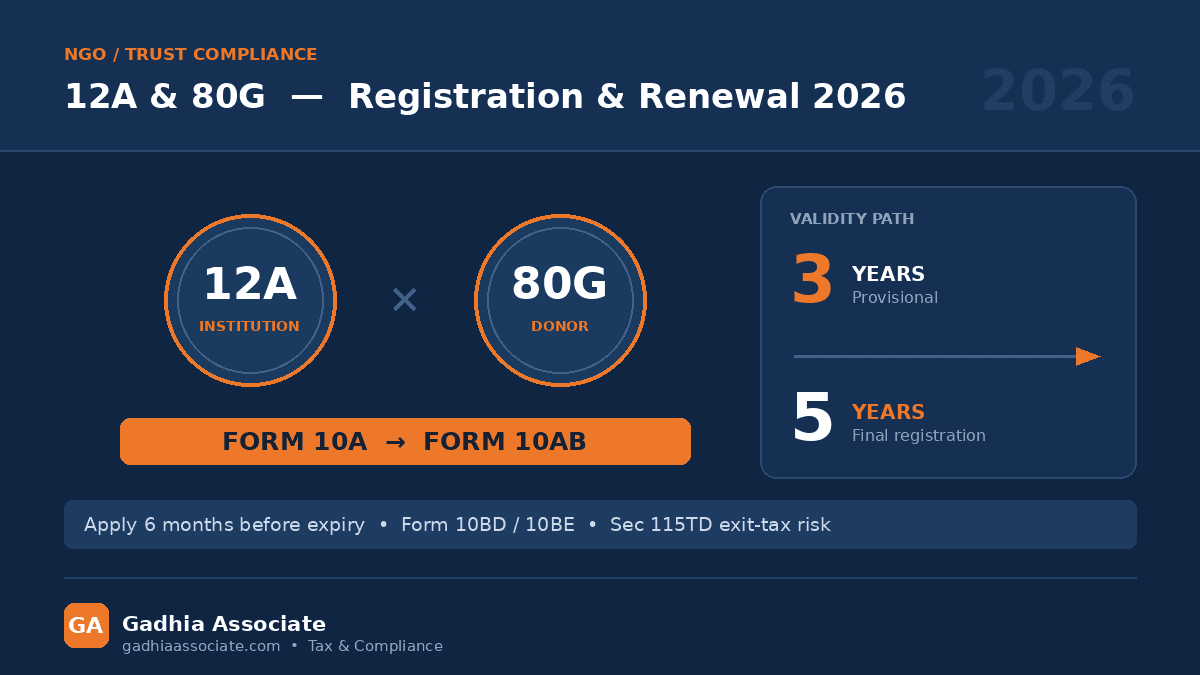
12A and 80G registration and renewal is now a time-bound, repeat exercise rather than a one-time formality. A trust or NGO first obtains provisional registration under sections 12AB and 80G (valid for three years) using Form 10A, and then converts it into final registration using Form 10AB, which is generally granted for five years. Miss the Form 10AB window and the organisation can lose its exemption entirely, with donors losing their 80G deduction and the trust exposed to accreted income tax under section 115TD.
Since the new registration regime replaced the old perpetual registrations, thousands of NGOs, charitable trusts and Section 8 companies across Gujarat and the rest of India have discovered the hard way that exemption is only as good as the last approval order on file. This guide explains what applies in 2026, the forms involved, the deadlines, and the cancellation risks.
What is the difference between 12A and 80G?
They are two separate approvals and organisations regularly confuse them. Registration under section 12A (now processed under 12AB) benefits the institution: it allows the trust or NGO to claim exemption on its income, provided the income is applied to charitable or religious purposes and the conditions of sections 11 and 12 are satisfied. Approval under section 80G benefits the donor: it allows a person donating to the institution to claim a deduction in their own return of income.
The practical consequence is important. An NGO can hold 12AB registration and still not be able to offer donors any tax benefit, because 80G approval is separate and must be applied for separately. Conversely, 80G approval is not granted or sustained without valid 12AB registration behind it. Fundraising organisations therefore need both, and both need to be kept alive.
Provisional registration versus final registration
New organisations do not get a five-year approval straight away. A newly formed trust applies in Form 10A and receives provisional registration valid for three years. Provisional registration is a genuine registration and exemption can be claimed during that period, but it is conditional and temporary. To move to final registration the organisation must file Form 10AB, at which point the department examines the genuineness of activities and compliance with other applicable laws before granting registration, ordinarily for five years.
The difference matters in practice: Form 10A is largely a documentary application, while Form 10AB is a substantive one. The Commissioner (Exemptions) can, and does, issue notices asking for activity reports, audited accounts, details of donations received, governing documents, FCRA position where relevant, and proof that the objects are actually being pursued. A shell trust with a bank account and no activity is the classic case that fails at Form 10AB stage.
What is Form 10AB and when should I apply for renewal?
Form 10AB is the online application used for two things: converting provisional registration into final registration, and renewing an existing five-year registration or approval. It is filed on the income tax e-filing portal with a digital signature or EVC, along with the trust deed or incorporation documents, PAN, registration certificates, audited financial statements, activity notes and details of the governing body.
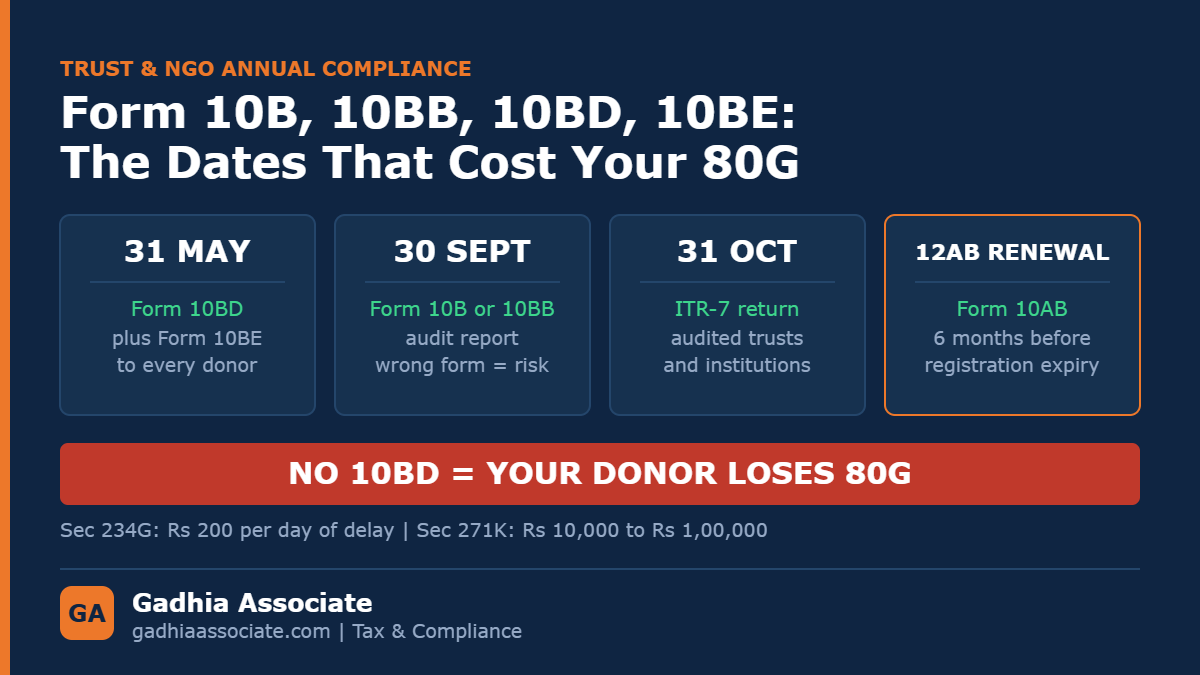
The timing rule that trips people up is this. For conversion from provisional to final registration, the application must be made at least six months before expiry of the provisional registration, or within six months of commencement of activities, whichever is earlier. For a subsisting five-year registration, the renewal application is due at least six months before the period of validity expires. In other words, the deadline is not the expiry date; it is six months ahead of it. Organisations that diarise the expiry date alone are already late by the time they act.
There have been condonation and relaxation measures issued by the CBDT for delayed Form 10AB applications in specific windows, and further relaxations may be notified. These are helpful but they are exceptions, not a substitute for filing on time, and their exact scope must be checked against the actual circular text before relying on them.
What happens if 12A registration is not renewed?
The consequences are heavier than a late fee. If registration lapses or is cancelled:
- The income of the trust ceases to be exempt and becomes taxable in the ordinary way, at rates applicable to the entity.
- Donations no longer qualify for 80G deduction, so donors and CSR funders quietly move elsewhere.
- The organisation can be exposed to tax on accreted income under section 115TD — effectively an exit tax on the net value of assets — which for an older trust with land, buildings or corpus funds can be very large.
- CSR funding and many government and institutional grants become unavailable, since funders insist on valid 12AB and 80G orders.
- Fresh registration is possible, but it restarts the cycle and does not automatically repair the intervening exempt years.
Cancellation risk is not limited to late filing. Registration can be cancelled for specified violations, including applying income for purposes other than the objects, benefiting specified persons, holding investments outside permitted modes, materially incorrect statements in the application, or failing to comply with other laws material to achieving the objects.
Is 80G renewal mandatory every 5 years?
Yes, as the regime is structured, 80G approval is granted for a fixed period and must be renewed before it runs out, using Form 10AB. There is no automatic rollover. Some organisations wrongly assume that because they received an order under 80G with an approval number, the benefit continues indefinitely. It does not. Check the validity period printed on the Form 10AC or 10AD order itself and work backwards six months.
Note also that reporting and validity periods have been the subject of amendment, including relaxations for smaller trusts. Where an organisation's income is below the prescribed threshold, a longer validity may be available on renewal. Because these thresholds change through Finance Act amendments and CBDT notifications, confirm the position applicable to your own order before assuming a longer cycle.
Form 10BD, Form 10BE and the annual audit
Renewal is not the only recurring obligation. An institution approved under 80G must file a statement of donations in Form 10BD for each financial year and issue each donor a certificate in Form 10BE. Donors are increasingly unable to substantiate their deduction without the Form 10BE certificate, so failure here damages relationships as well as attracting a fee for late filing.
Separately, where total income before exemption exceeds the basic exemption limit, accounts must be audited and the audit report filed in Form 10B or Form 10BB, depending on which applies to the institution. The choice between the two is driven by prescribed criteria such as income level and receipt of foreign contribution, and filing the wrong form has itself become a common defect. The audit report is due before the income tax return, and the return in ITR-7 must be filed within the due date, because a belated return can put the exemption claim at risk.
Compliance checklist for NGOs and trusts in 2026
- Locate your Form 10AC or 10AD order and note the exact validity period for both 12AB and 80G.
- Set an internal reminder six months before expiry, not on the expiry date.
- Keep audited accounts, activity reports and governing body details ready before filing Form 10AB.
- Maintain donor-wise records with PAN or Aadhaar so that Form 10BD can be filed accurately.
- Issue Form 10BE certificates to donors each year and retain acknowledgements.
- File Form 10B or 10BB correctly, and file ITR-7 within the due date.
- Keep investments within permitted modes and avoid any benefit to specified persons.
- Update the department promptly on any change of objects, address or trustees.
Getting the paperwork right the first time
Most rejections we see are avoidable: mismatched objects between the trust deed and the application, an unsigned or unregistered deed, missing activity evidence, bank details that do not match PAN, or an application filed under the wrong section code. The section code selection inside Form 10AB is a frequent error, because the same form serves several different situations and choosing the wrong clause can produce an invalid application that cannot simply be corrected later.
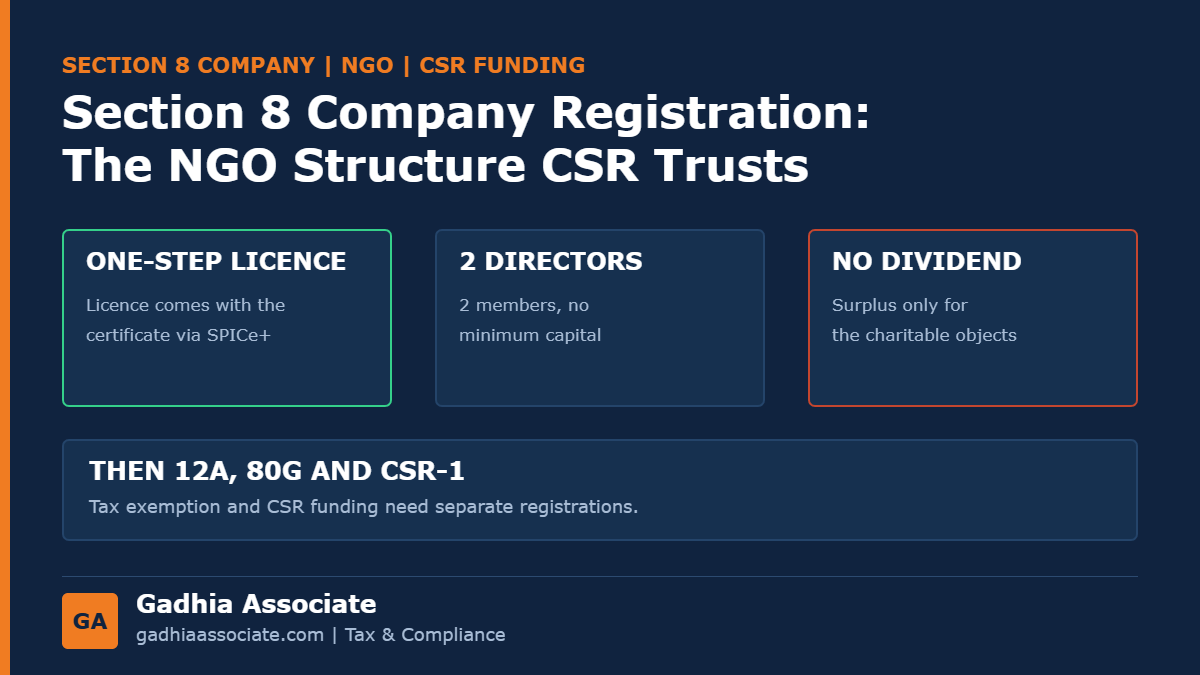
If your organisation is also registered for GST on any commercial activity, or is planning to sell or transfer immovable property held by the trust, those transactions interact with the exemption position. Our GST Calculator and Capital Gain Tax Calculator on this site are useful for a quick working, and our Income Tax services page covers the return and assessment side. If you are still setting up, see our Company Registration page for Section 8 company formation, and our NGO / Trust Compliance page for the full annual compliance cycle.
How Gadhia Associate Can Help
Gadhia Associate works with trusts, societies, Section 8 companies and CSR-funded NGOs in Junagadh and across Gujarat on the entire exemption lifecycle: fresh Form 10A registration, conversion and renewal through Form 10AB, replying to notices from the Commissioner (Exemptions), Form 10BD and 10BE filings, audit reports in Form 10B or 10BB, and ITR-7. If your provisional registration is approaching its three-year mark, or you are unsure whether your 80G approval is still valid, get in touch for a free consultation and we will review your orders and map your deadlines.
This article reflects the position as of August 2026. Provisions relating to sections 12AB, 80G and 115TD, prescribed forms and deadlines change through Finance Act amendments and CBDT notifications and circulars. Please confirm the current position with a qualified professional before acting.