Section 8 Company Registration in 2026: Process, Documents, Cost, Timeline and When It Beats a Trust for CSR Funding
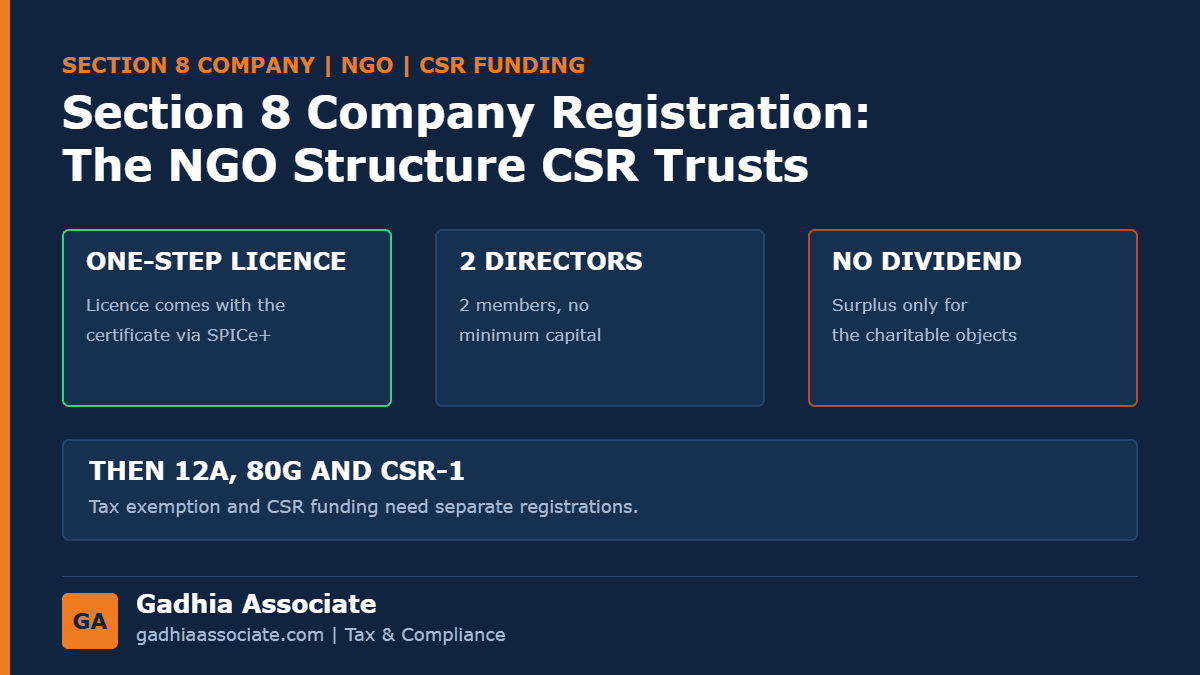
A Section 8 company is the NGO structure CSR funders trust most, and it can be registered online with the MCA in about three to four weeks.
A group of doctors in Junagadh wants to run a charitable dialysis centre. A Rajkot company is willing to fund the machines from its CSR budget. The first question from the company's CSR team is not about the project. It is about the entity: is it a trust, a society or a Section 8 company, and does it have 12A, 80G and CSR-1? The doctors had planned a trust. For a project that will depend on corporate money, a Section 8 company may serve them better.
This article explains when a Section 8 company makes sense, how it is registered, what it costs, and the rules that come with it.
Short answer: A Section 8 company is a company registered under Section 8 of the Companies Act, 2013 to promote charitable objects such as education, health, social welfare, art, sport or environment protection. Its profits must be used only for those objects, and it cannot pay dividends. It is registered online through the MCA's SPICe+ forms, and the Section 8 licence is issued along with the certificate of incorporation. A private Section 8 company needs at least two directors and two members, and there is no minimum capital. The process usually takes three to four weeks. After registration, it applies for 12A and 80G, and for CSR-1 if it wants CSR funding.
Section 8 company, trust or society?
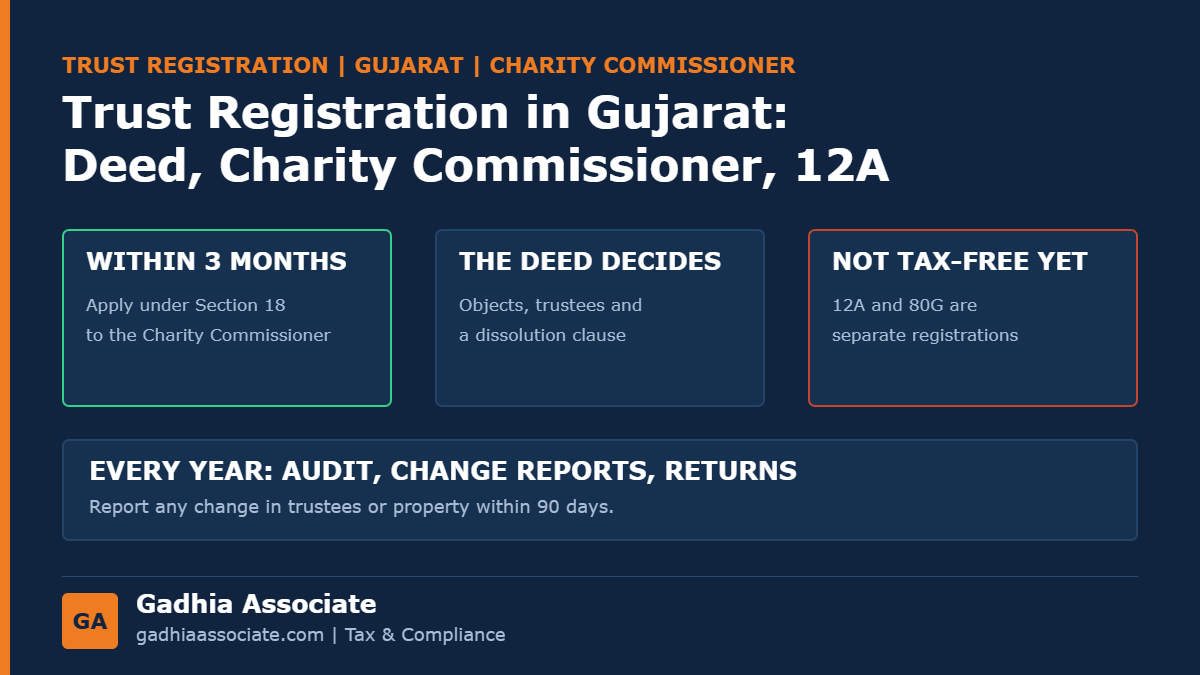
- Public trust: the simplest and cheapest, run by trustees and supervised by the Charity Commissioner in Gujarat. It suits local charities, temples, gaushalas and family-led causes. We explained trust registration in Gujarat separately.
- Society: a membership body with elected office-bearers, registered under the Societies Registration Act and, in Gujarat, also as a public trust.
- Section 8 company: governed by the Companies Act and the MCA, with a board of directors, audited accounts and annual filings. It is not supervised by the Charity Commissioner, it can work across states easily, and its governance is familiar to corporates.
Choose a Section 8 company if you expect CSR funding, want to work in more than one state, plan a large institution such as a hospital or school, or want professionals and funders on the board. For a hospital, we compared the two structures in Section 8 company or trust.
What are the requirements?
- Objects: charitable or not-for-profit, such as commerce, art, science, sports, education, research, social welfare, religion, charity or protection of the environment.
- Directors and members: a private Section 8 company needs at least two directors and two members. A public one needs at least three directors and seven members.
- Capital: no minimum. Many start with a small share capital that the founders contribute.
- Name: usually includes words such as Foundation, Forum, Association, Federation, Council or Chambers, and must not be similar to an existing name.
- Registered office: an address in India with proof and the owner's no-objection letter.
How is a Section 8 company registered?
- Digital signatures for the proposed directors and subscribers.
- Name approval through SPICe+ Part A. The approved name is reserved for 20 days, within which the incorporation form must be filed.
- Drafting the MOA and AOA with the charitable objects, the ban on distributing profits, and what happens to assets if the company is wound up.
- SPICe+ Part B with the MOA and AOA, the declaration by a professional in Form INC-14, a declaration by each applicant in Form INC-15, and the estimated income and expenditure of the next three years.
- Licence and certificate: the licence under Section 8 is granted with the certificate of incorporation. The company's PAN and TAN are issued along with it.
- Post-incorporation: bank account, commencement of business declaration where there is share capital, and then the income tax registrations.
Which documents are needed?
- PAN, Aadhaar, photographs and address proof of every director and subscriber
- Proof of the registered office: a recent utility bill, and a rent agreement with the owner's NOC where applicable
- Consent of each director to act
- Details of the proposed objects and activities, and estimated income and expenditure for three years
- Where an institution such as a trust or company is a member, its authorisation
How much does it cost, and how long does it take?
For a Section 8 company with a small capital, the MCA fees and stamp duty are modest. The main costs are digital signatures and the professional work of drafting the objects, MOA and AOA properly. Plan for three to four weeks from start to certificate, depending on name approval and whether the MCA raises queries on the objects.
Time spent on the objects clause is time well spent. Vague or commercial-sounding objects are the most common reason for queries, and the same wording will later be read by the income tax department when you apply for 12A and 80G.
What rules apply after registration?
- No dividend: income and surplus must be used only for the company's objects.
- No private benefit: directors and members can be paid only reasonable remuneration for services actually rendered, as the law allows.
- Changes need approval: the MOA and AOA cannot be altered without the approval that the Act requires.
- Winding up: remaining assets go to another Section 8 company with similar objects, never to the members.
- Licence can be revoked if the company breaks these conditions.
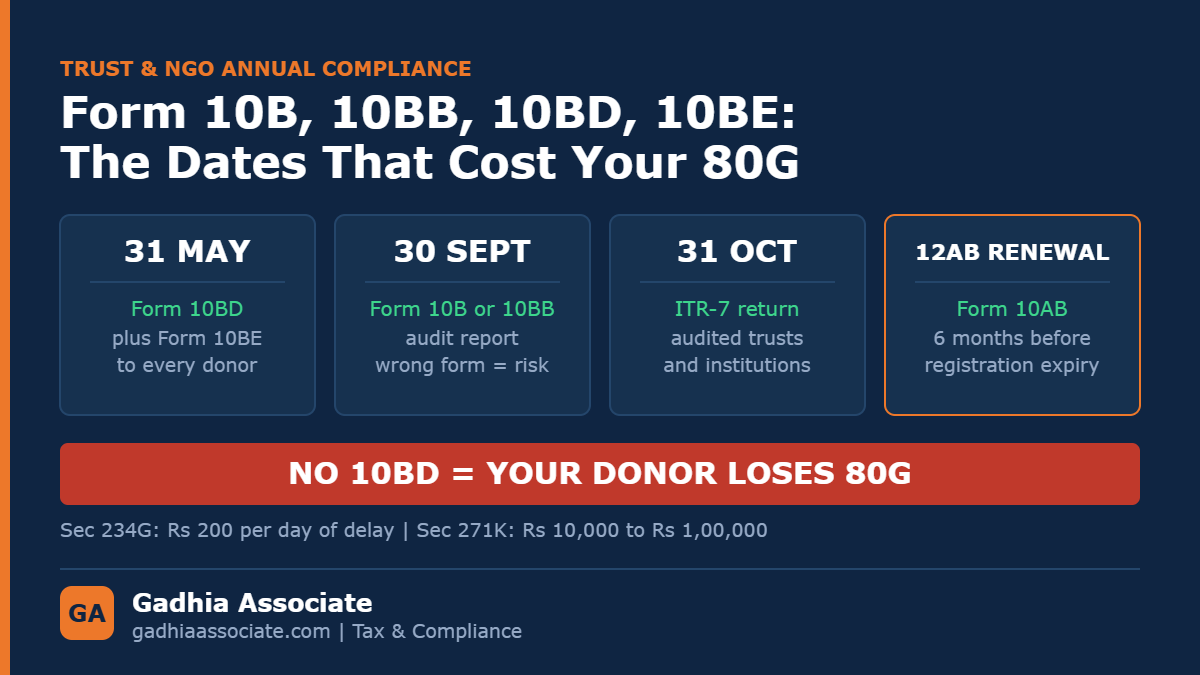
- Annual filings: audited accounts, AOC-4, the annual return, board meetings and the auditor's appointment, as for any company, with some relaxations for Section 8 companies.
12A, 80G and CSR-1: the registrations that bring funds
A Section 8 company is not tax-exempt merely because it is registered. It needs:
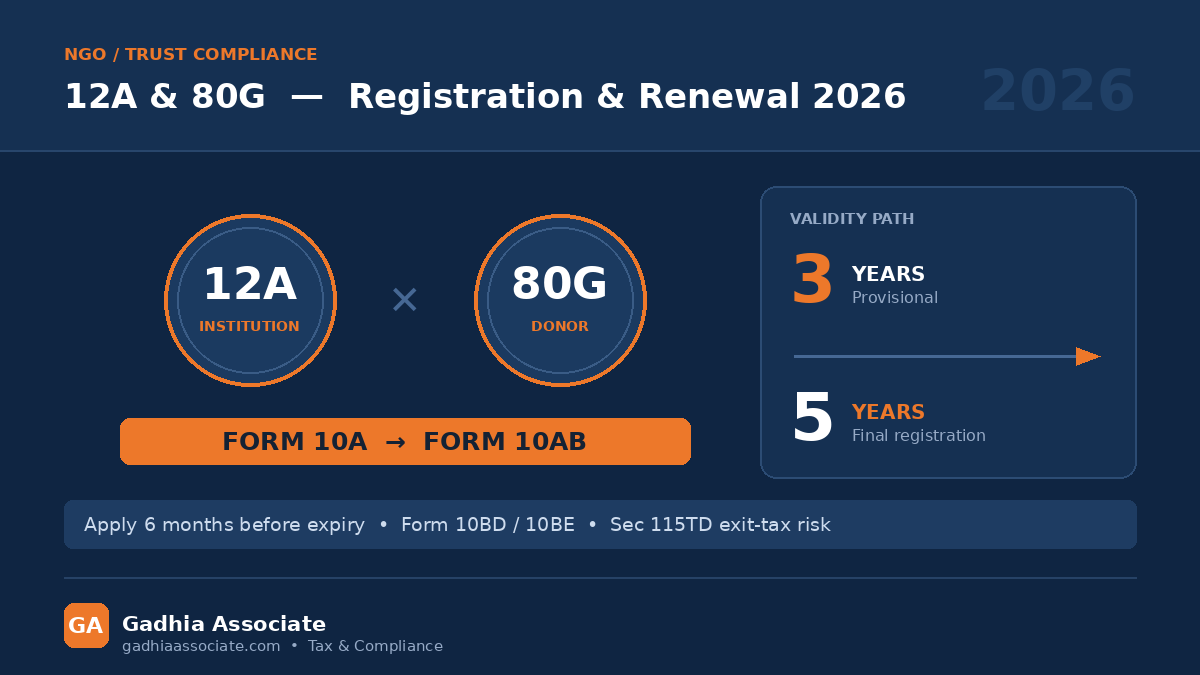
- 12A registration, first provisional and later regular, so that its surplus used for the objects is not taxed.
- 80G approval, so that donors can claim a deduction under the old tax regime.
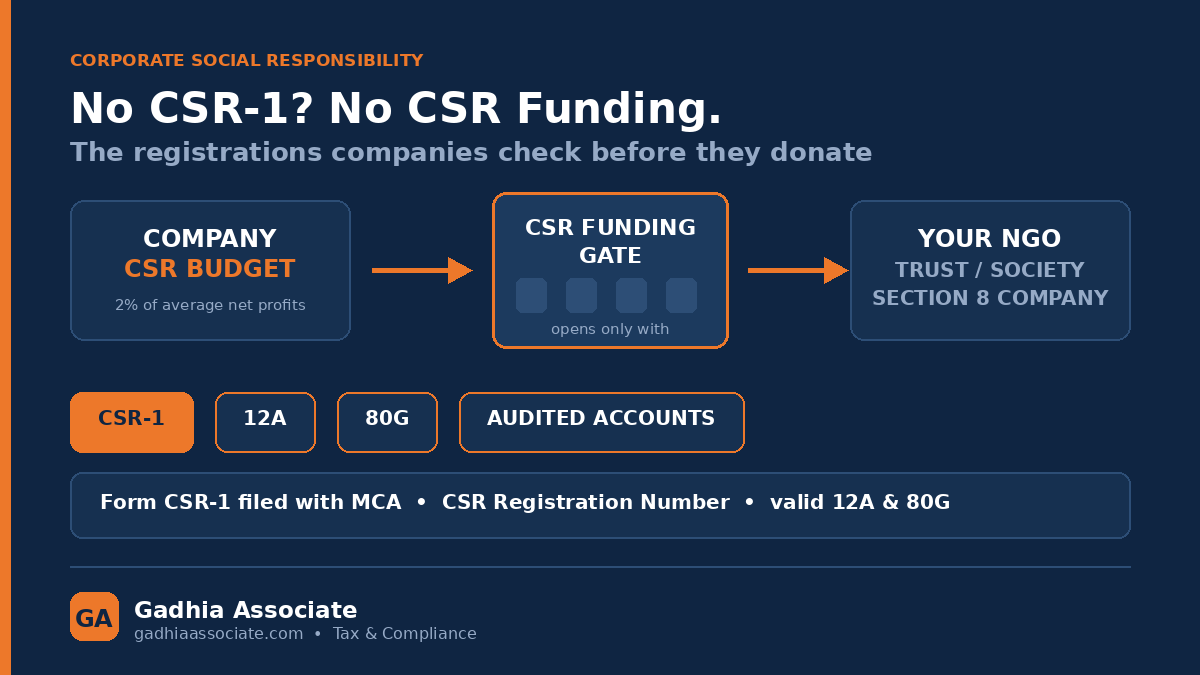
- CSR-1 registration with the MCA, which companies check before giving CSR funds.
- NGO Darpan registration for government grants, and FCRA registration later if it will receive foreign contributions, which usually needs a track record.
See our guides to 12A and 80G registration and CSR-1 and CSR funding.
Common mistakes
- Choosing a Section 8 company for a small local charity that would be simpler as a trust.
- Objects written so broadly, or so commercially, that they draw queries or later block 12A.
- Promising 80G receipts to donors before the approval is granted.
- Paying founders' relatives salaries that cannot be justified by work done.
- Missing annual MCA filings, which leads to penalties and can put the licence at risk.
What we do for you
- Advise whether a Section 8 company, trust or society suits your cause and your funders
- Draft the objects, MOA and AOA, and handle name approval and SPICe+ filing
- Obtain the certificate, licence, PAN and TAN, and help open the bank account
- File for provisional and regular 12A registration and 80G approval
- Register for CSR-1 and NGO Darpan, and prepare the documents CSR funders ask for
- Maintain accounts, audit them and file all annual MCA and income tax returns
Gadhia Associate has been in practice since 2007 and has handled work for over 7,000 clients across Saurashtra and Gujarat, with a 5.0 Google rating from more than 100 reviews. Founders of foundations, hospitals, schools and community organisations from Junagadh, Rajkot, Veraval, Porbandar and Amreli come to our Junagadh office, where same-day appointments are available. Section 8 registration is fully online, so we handle it for organisations anywhere in India. Fixed-fee and monthly plans are available.
Starting an NGO that will need CSR funds? Talk to us before you choose the structure. Call or WhatsApp +91 82005 28355. The first consultation is free.
Frequently asked questions
How long does Section 8 company registration take?
Usually three to four weeks, including digital signatures, name approval and the MCA's processing of the incorporation form.
Is there a minimum capital for a Section 8 company?
No. There is no prescribed minimum capital.
Can a Section 8 company pay salary to its directors?
It can pay reasonable remuneration for services actually rendered, within the conditions of the law. It cannot distribute profits or pay dividends.
Is a Section 8 company better than a trust for CSR funding?
Both can receive CSR funds if they have 12A, 80G and CSR-1. Many corporates are more comfortable with a Section 8 company because of its MCA governance and audited filings.
Does a Section 8 company need 12A and 80G separately?
Yes. Registration under the Companies Act does not give income tax exemption. 12A and 80G are separate applications to the income tax department.
Can a trust be converted into a Section 8 company?
Not directly. Usually a new Section 8 company is formed and the activities and assets are transferred with the necessary approvals, which needs careful planning.
Position as of 26 September 2026. MCA forms, fees and procedures change from time to time, and the income tax provisions for charitable organisations have been renumbered under the Income-tax Act, 2025 from 1 April 2026; familiar names such as 12A and 80G are used here because that is how people still search for them. Take advice on your own facts before you register.