Converting a Private Limited Company into an LLP in 2026: Process, Tax-Free Conditions, GST and Whether It Is Worth It
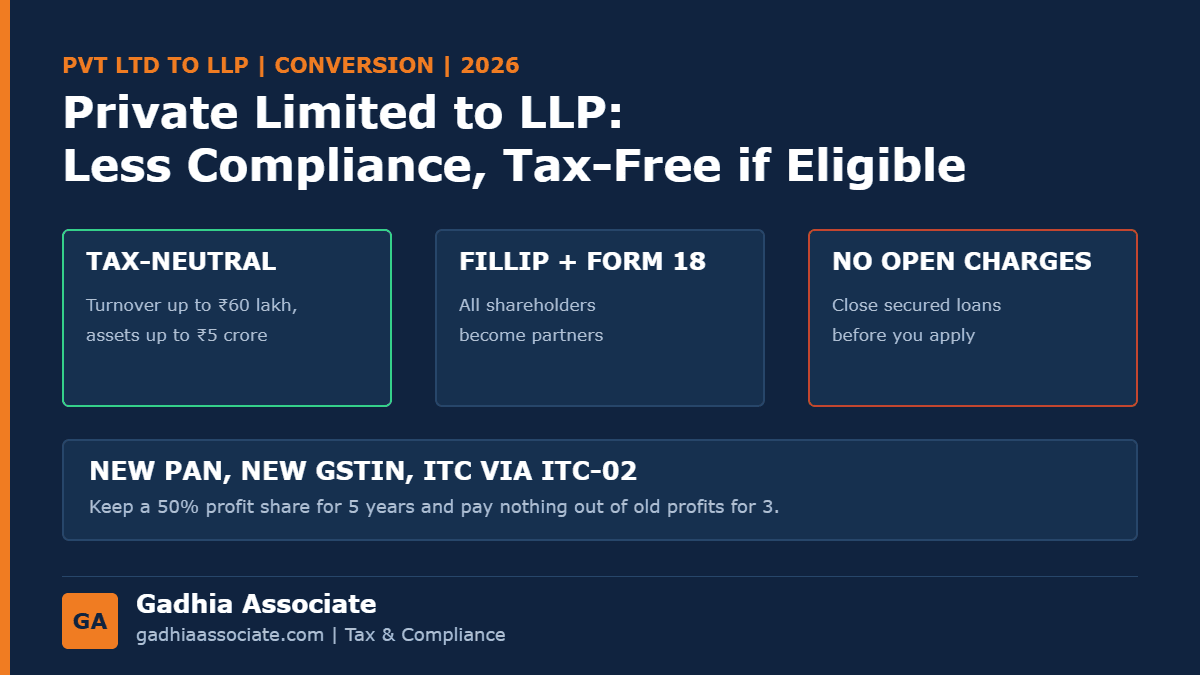
Converting a private limited company into an LLP cuts compliance, and it can be tax-neutral if turnover and assets stayed within the limits.
A Jamnagar family formed a private limited company in 2017 to qualify for a tender. The tender is long gone. What remains is a small brass components business owned by two brothers, with no outside investors, and a yearly bill for statutory audit, board minutes, AGM papers, AOC-4, MGT-7 and DIR-3 KYC. Every March they ask the same question: can we just become an LLP?
Often, yes. This article explains the conditions, the process, the tax rules that decide whether conversion is tax-free, and the cases where it is better not to convert.
Short answer: A private limited company can convert into an LLP under Section 56 and the Third Schedule of the LLP Act, 2008, if no security interest in its assets is outstanding and all its shareholders, and no one else, become partners. The application is made to the MCA through FiLLiP along with Form 18. On registration, the company is dissolved and its assets, liabilities, contracts and proceedings pass to the LLP. For income tax, the conversion is not treated as a transfer if the conditions of the old Section 47(xiiib) are met, including turnover of not more than Rs 60 lakh and total assets of not more than Rs 5 crore in each of the three preceding years. The LLP needs a fresh GST registration and can transfer unused input tax credit.
Why do owners convert a company into an LLP?
- Lower compliance: no board meetings or AGM, and no statutory audit where turnover is within Rs 40 lakh or partners' contribution is within Rs 25 lakh. A private company needs a statutory audit every year, whatever its size.
- Fewer filings: an LLP files Form 11 and Form 8 each year, against the company's AOC-4, annual return, auditor filings and director KYC.
- Simpler profit extraction: an LLP's profit, once taxed, is not taxed again when partners take their share, while a company's dividends are taxed in shareholders' hands.
- Flexibility: admitting or retiring partners and changing profit shares is simpler than share transfers and allotments.
We compared the running cost and filings of both structures in private limited vs LLP vs proprietorship, and the company's yearly filings in private limited company annual compliance.
Which companies can convert?
- No outstanding security interest: any charge on the company's assets, such as a bank loan secured on its property or stock, must be satisfied and the charge closed before applying.
- All shareholders become partners: every shareholder, and nobody else, must become a partner of the LLP.
- Up-to-date filings: pending annual returns and financial statements should be filed first, as the MCA and creditors will look at them.
- Consents: all shareholders must consent, and creditors must be listed, with their consent or no-objection.
How does the conversion work?
- Board and shareholder approval for the conversion, and consent of all shareholders.
- Digital signatures and DPINs for the proposed designated partners, who are usually the existing directors.
- Name reservation through RUN-LLP. The LLP can usually keep the company's name, ending in "LLP".
- FiLLiP with Form 18, the application for conversion, attaching the statement of assets and liabilities certified by the auditor, the list of creditors with their consent, the latest income tax return, and the shareholders' consent.
- Certificate of registration of the LLP. From this date, the company stands dissolved and everything it owned or owed belongs to the LLP.
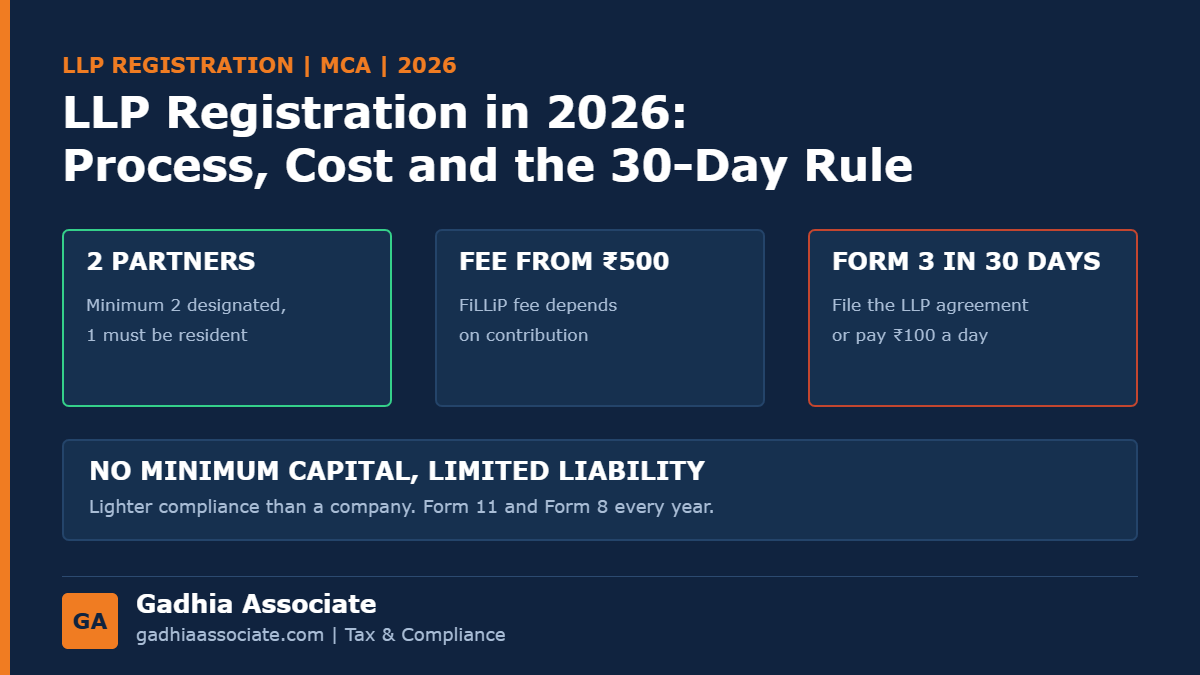
- After registration: inform the Registrar of Companies about the conversion in Form 14 within the prescribed time, and file the LLP agreement in Form 3 within 30 days.
The whole process usually takes four to eight weeks, most of it spent closing charges and collecting creditor consents. For the LLP side of the filings, see our guide to LLP registration.
When is the conversion free of capital gains tax?
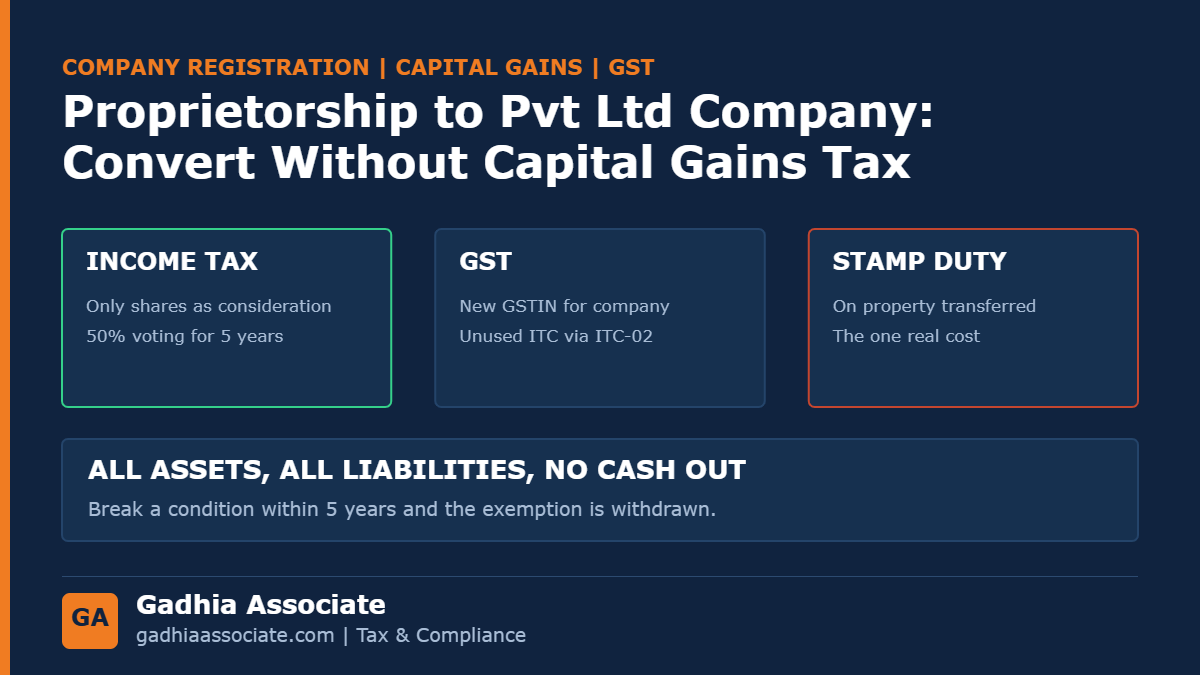
The transfer of the company's assets to the LLP, and of the shareholders' shares, is not treated as a transfer for capital gains if all of these conditions are met:
- All assets and liabilities of the company immediately before the conversion become those of the LLP.
- All shareholders become partners, in the same proportion as their shareholding.
- Shareholders receive nothing other than a share in the LLP's profit and capital contribution.
- The former shareholders together keep at least 50% of the profit share of the LLP for five years.
- The company's turnover did not exceed Rs 60 lakh in any of the three years before conversion.
- The company's total assets as per the books did not exceed Rs 5 crore in any of those three years.
- No amount is paid to any partner out of the company's accumulated profits for three years after conversion.
If a condition is broken later, the exemption is withdrawn and the gain becomes taxable in the year of the breach, in the LLP's hands for the assets and in the shareholders' hands for their shares. When the conditions are met, the company's unabsorbed losses and depreciation can generally be carried forward by the LLP. Any MAT credit of the company is lost.
A company whose turnover crossed Rs 60 lakh can still convert, but the conversion may then attract capital gains tax on the difference between the value of its assets and their cost. Work out that figure before deciding.
What happens to GST, bank accounts and licences?
- PAN and GST: the LLP is a new entity with a new PAN, so it needs fresh GST registration. Unused input tax credit can be transferred from the company's GSTIN to the LLP's through Form GST ITC-02, after which the company's registration is cancelled.
- Bank accounts: accounts are changed to the LLP's name and PAN, with the conversion certificate.
- Licences and registrations: Udyam, IEC, FSSAI, factory and pollution licences, and professional tax must be updated or obtained afresh.
- Property: immovable property vests in the LLP by law, but land records must be updated. Check the stamp duty position for your property with the local authority.
- Contracts: inform customers, suppliers and lenders, and update invoices and letterheads.
When should you not convert?
- You plan to raise equity from investors or issue ESOPs. Investors prefer companies.
- Turnover or assets exceeded the limits and the capital gains cost is high.
- A secured loan cannot be closed yet.
- Large accumulated profits need to be distributed soon, which would break the three-year condition.
- Shareholders cannot agree to all become partners.
- Profits are mostly kept in the business. A company can pay tax at 22% under the concessional regime, against 30% for an LLP, so conversion pays best when profits are taken out.
What we do for you
- Work out whether conversion saves you money, including the tax cost if the limits are crossed
- Bring pending MCA filings up to date and help close charges with lenders
- Prepare the auditor's statement, creditor consents and shareholder approvals
- File RUN-LLP, FiLLiP and Form 18, and the post-conversion forms
- Draft the LLP agreement so profit shares meet the tax conditions for five years
- Move GST registration and input tax credit, and update bank, licences and records
Gadhia Associate has been in practice since 2007 and has handled work for over 7,000 clients across Saurashtra and Gujarat, with a 5.0 Google rating from more than 100 reviews. Family businesses and small companies from Junagadh, Rajkot, Jamnagar, Veraval, Porbandar and Amreli come to our Junagadh office, where same-day appointments are available. MCA filings are online, so we handle conversions for companies anywhere in India. Fixed-fee and monthly plans are available.
Tired of company compliance for a small family business? Send us your last three years' financials and we will tell you whether conversion makes sense. Call or WhatsApp +91 82005 28355. The first consultation is free.
Frequently asked questions
Can a private limited company be converted into an LLP?
Yes, under the LLP Act, if no security interest in its assets is outstanding and all shareholders become the partners of the LLP.
Is conversion of a company into an LLP tax-free?
It is not treated as a transfer for capital gains if all the conditions are met, including turnover up to Rs 60 lakh and total assets up to Rs 5 crore in each of the three preceding years.
How long does conversion take?
Usually four to eight weeks, depending mainly on closing charges and getting creditor consents.
Does the LLP need a new GST registration?
Yes. The LLP has a new PAN, so it registers afresh and can transfer unused input tax credit from the company through Form GST ITC-02.
Can the LLP keep the company's name?
Usually yes, with "LLP" at the end instead of "Private Limited", subject to name approval.
What happens to the company after conversion?
It is dissolved on the date of the LLP's registration, and its assets, liabilities, contracts and proceedings pass to the LLP.
Position as of 26 September 2026. MCA forms and procedures change from time to time, and the income tax provisions have been renumbered under the Income-tax Act, 2025 from 1 April 2026; the older section references are used because that is how people still search for them. Stamp duty and land record practice vary by state. Take advice on your company's numbers before you decide.