LLP Registration in 2026: Step-by-Step Process, Documents, Total Cost in Gujarat and the 30-Day LLP Agreement Deadline
LLP registration in 2026 takes about two to three weeks: reserve a name, file FiLLiP with the MCA, then file the LLP agreement within 30 days.
Two engineers from Rajkot leave their jobs to start a CNC job-work unit. They want limited liability, a simple structure and low compliance, so they choose an LLP. The registration goes through in two weeks and they get busy with machines and customers. Nine months later, while applying for a bank loan, they find the LLP agreement was never filed. The late fee has been running at Rs 100 a day, and it is now about Rs 24,000.
An LLP is one of the best structures for small and medium businesses and professional firms. But the registration has two parts, and the second part is the one people forget. This article covers both, with the documents, the real cost and the timeline.
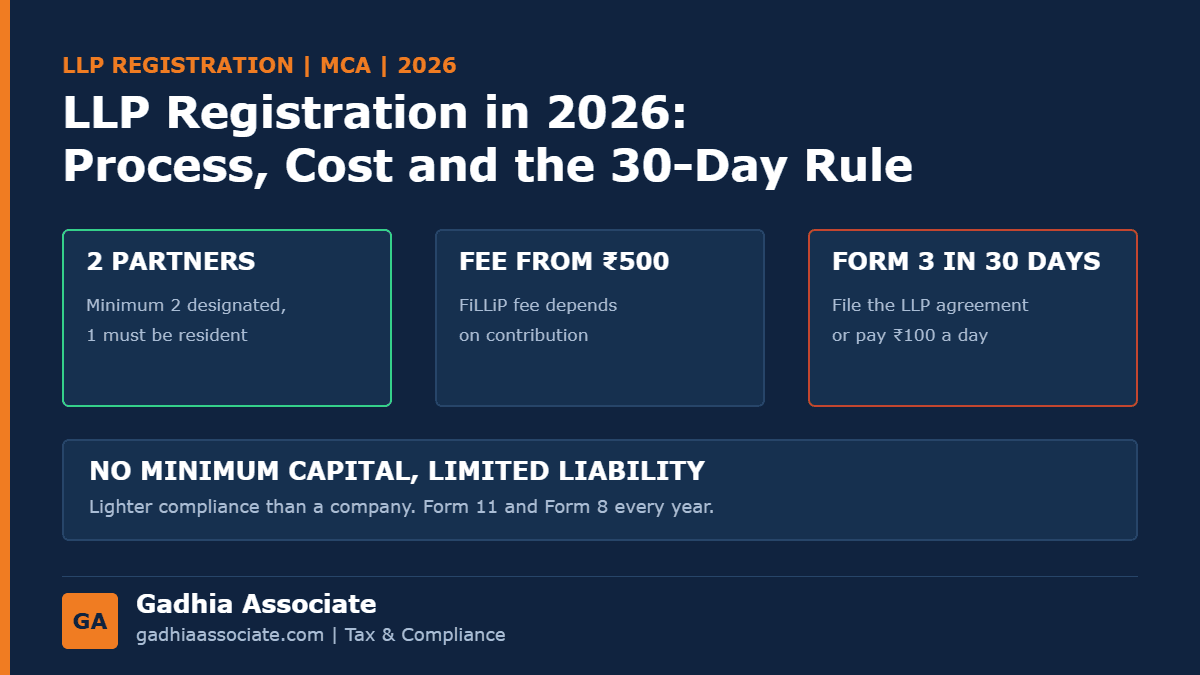
Short answer: A limited liability partnership is registered with the Ministry of Corporate Affairs under the LLP Act, 2008. You need at least two partners, at least two designated partners, and at least one designated partner who is resident in India. The steps are: digital signatures for the designated partners, name reservation through RUN-LLP, the incorporation form FiLLiP (which also allots DPINs and applies for PAN and TAN), and the certificate of incorporation with your LLPIN. The LLP agreement must then be stamped and filed in Form 3 within 30 days, or a late fee of Rs 100 per day applies. The government fee for FiLLiP ranges from Rs 500 to Rs 5,000 depending on the partners' contribution, and there is no minimum capital.
Is an LLP the right structure for you?
An LLP sits between a partnership firm and a private limited company. Partners are not personally liable for the LLP's debts beyond their agreed contribution, which a partnership firm cannot offer. And its annual compliance is lighter than a company's: no board meetings, no statutory audit below the thresholds, and no dividend distribution to worry about.
- Choose an LLP for a family business, a trading or manufacturing unit, a professional practice, or a partnership that wants limited liability without company paperwork.
- Choose a private limited company if you plan to raise equity from investors, issue ESOPs, or want to present as a company to large clients.
- Stay a partnership firm or proprietorship only if the business is small and the risk is low.
We compared all three structures, with costs and yearly filings, in our guide to private limited vs LLP vs proprietorship.
What are the requirements to register an LLP?
- Partners: at least two. A partner can be an individual or a company or another body corporate. There is no maximum.
- Designated partners: at least two individuals, who handle compliance and sign filings. At least one must be resident in India.
- Registered office: an address in India, with proof such as a recent electricity bill and the owner's no-objection letter.
- Capital: no minimum. The contribution can be as small as the partners agree, and it decides the government fee.
- Name: must end with "LLP" or "Limited Liability Partnership" and must not be identical or too similar to an existing company, LLP or registered trademark.
How do you register an LLP, step by step?
- Digital signature certificates for the proposed designated partners.
- Name reservation through RUN-LLP on the MCA portal, with one or two proposed names. The fee is Rs 200. You can also reserve the name within FiLLiP itself.
- FiLLiP (Form for incorporation of LLP) with the details of partners, contribution, registered office and documents. It allots DPINs to up to two designated partners who do not have one, and applies for the LLP's PAN and TAN.
- Certificate of incorporation with the LLP identification number (LLPIN), usually within a week or two of filing if the documents are clean.
- LLP agreement drafted, stamped and signed by all partners, and filed in Form 3 within 30 days of incorporation.
- Bank account, GST and other registrations as needed, such as Udyam, professional tax and the import-export code.
Which documents are needed?
- PAN and Aadhaar of each partner, and passport for foreign nationals or NRIs
- Address proof of each partner: a recent bank statement, utility bill or mobile bill
- Passport-size photographs
- Registered office proof: electricity or gas bill not older than two months, plus rent agreement and owner's NOC where the premises are not owned
- Consent of each partner to act as partner or designated partner
- Where a company is a partner, its board resolution and the nominee's details
How much does LLP registration cost?
The government fee for FiLLiP depends on the total contribution of the partners:
- Contribution up to Rs 1 lakh: Rs 500
- Above Rs 1 lakh and up to Rs 5 lakh: Rs 2,000
- Above Rs 5 lakh and up to Rs 10 lakh: Rs 4,000
- Above Rs 10 lakh: Rs 5,000
Add to this Rs 200 for RUN-LLP, a small fee for filing Form 3, the cost of digital signatures for the designated partners, and stamp duty on the LLP agreement. In Gujarat, stamp duty on partnership instruments is based on the capital, and for a small LLP it is usually a few hundred to a few thousand rupees. Professional fees for drafting the agreement and handling the filings are separate.
An example: two partners in Junagadh start an LLP with a contribution of Rs 2 lakh. The FiLLiP fee is Rs 2,000, plus Rs 200 for the name, plus stamp duty on the agreement and two DSCs. The government side of the cost stays well below what most people expect. The real cost comes later if Form 3 or the annual filings are missed.
What should the LLP agreement say?
The agreement decides how the LLP actually works. Without one, the default rules in the First Schedule of the LLP Act apply, which include equal sharing of profits whatever each partner contributed. A good agreement covers:
- Each partner's contribution and profit-sharing ratio
- Rights and duties of partners and designated partners
- Remuneration and interest to working partners, drafted so that it is allowed as a deduction for income tax
- Admission, retirement and death of partners, and how a leaving partner's share is paid out
- Banking powers and borrowing limits
- Dispute resolution and winding up
Remuneration and interest to partners are allowed for income tax only within the limits and conditions of the law, and TDS now applies on such payments above Rs 20,000 in a year. See our note on TDS on partners' remuneration and interest.
The deadline matters. Form 3 must be filed within 30 days of incorporation. After that, a late fee of Rs 100 per day applies until it is filed, and it adds up quickly.
What does an LLP have to file every year?
- Form 11 (annual return): by 30 May
- Form 8 (statement of account and solvency): by 30 October
- Income tax return: by 31 July, or 31 October if the accounts must be audited
- Audit of accounts: needed if turnover exceeds Rs 40 lakh or contribution exceeds Rs 25 lakh
- DIR-3 KYC for designated partners, as applicable
Late filing of Form 11 and Form 8 also attracts Rs 100 per day per form. Our guide to LLP annual compliance has the full calendar.
Common mistakes when registering an LLP
- Forgetting to file the LLP agreement in Form 3 within 30 days.
- Choosing a name that is too close to an existing brand or trademark, and having it rejected.
- Using a partner's residential address without the owner's NOC or a current utility bill.
- Copying an agreement template that has no clause on partner remuneration, so the payments are disallowed for tax.
- Showing a large contribution on paper that the partners never actually bring in.
- Not registering for GST when the business needs it from day one, such as for inter-state sales.
What we do for you
- Advise whether an LLP, a company or a firm suits your business and your tax position
- Arrange DSCs and reserve the name through RUN-LLP
- File FiLLiP with the MCA and obtain the certificate, PAN and TAN
- Draft the LLP agreement for your business, handle the stamping and file Form 3 on time
- Register for GST, Udyam and professional tax, and help open the bank account
- Handle yearly compliance: accounts, audit, Form 11, Form 8 and income tax returns
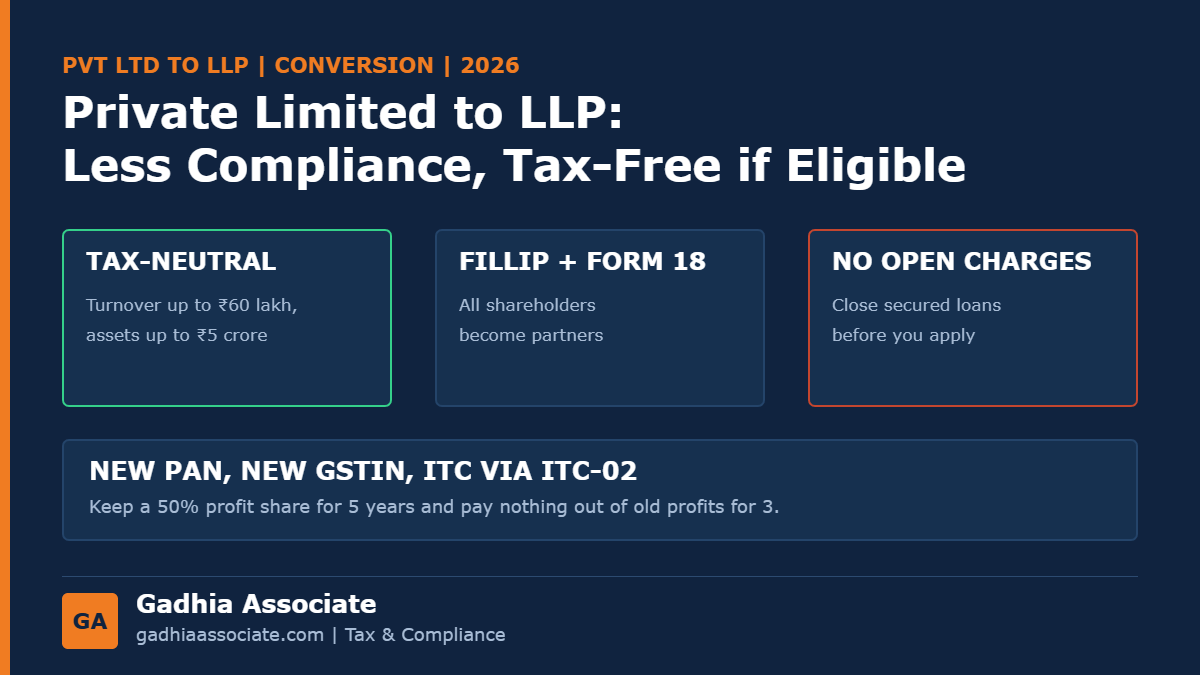
- Convert an existing partnership firm or private limited company into an LLP
Gadhia Associate has been in practice since 2007 and has handled work for over 7,000 clients across Saurashtra and Gujarat, with a 5.0 Google rating from more than 100 reviews. Founders, family businesses and professionals from Junagadh, Rajkot, Veraval, Keshod, Porbandar and Amreli come to our Junagadh office, where same-day appointments are available. LLP registration is done fully online, so we handle it for clients anywhere in India. Fixed-fee and monthly plans are available.
Planning to start an LLP? Send us the partners' details and we will tell you the total cost and timeline the same day. Call or WhatsApp +91 82005 28355. The first consultation is free.
Frequently asked questions
How many days does LLP registration take?
Usually two to three weeks from getting digital signatures to receiving the certificate, if the name is approved on the first attempt and the documents are in order.
What is the minimum capital to start an LLP?
There is no minimum. The partners decide the contribution, and the government fee is based on it.
Can an LLP have only two partners?
Yes. Two partners, both acting as designated partners, is the minimum, and at least one must be resident in India.
What happens if the LLP agreement is filed late?
A late fee of Rs 100 per day applies from the end of the 30-day period until Form 3 is filed.
Is an audit compulsory for every LLP?
No. Accounts must be audited only if turnover exceeds Rs 40 lakh or contribution exceeds Rs 25 lakh in a year. A tax audit may apply separately under income tax.
Can an NRI be a partner in an LLP?
Yes, an NRI or a foreign national can be a partner, subject to foreign investment rules for the sector. At least one designated partner must be resident in India.
Position as of 25 September 2026. MCA forms, fees and portal procedures change from time to time, stamp duty depends on the state and the capital, and the income tax provisions have been renumbered under the Income-tax Act, 2025 from 1 April 2026. Confirm the current position for your case before you file.