LLP Annual Compliance 2026: Form 11, Form 8, DIR-3 KYC, Due Dates and the Rs 100 Per Day Penalty
LLP Annual Compliance 2026: The Short Answer
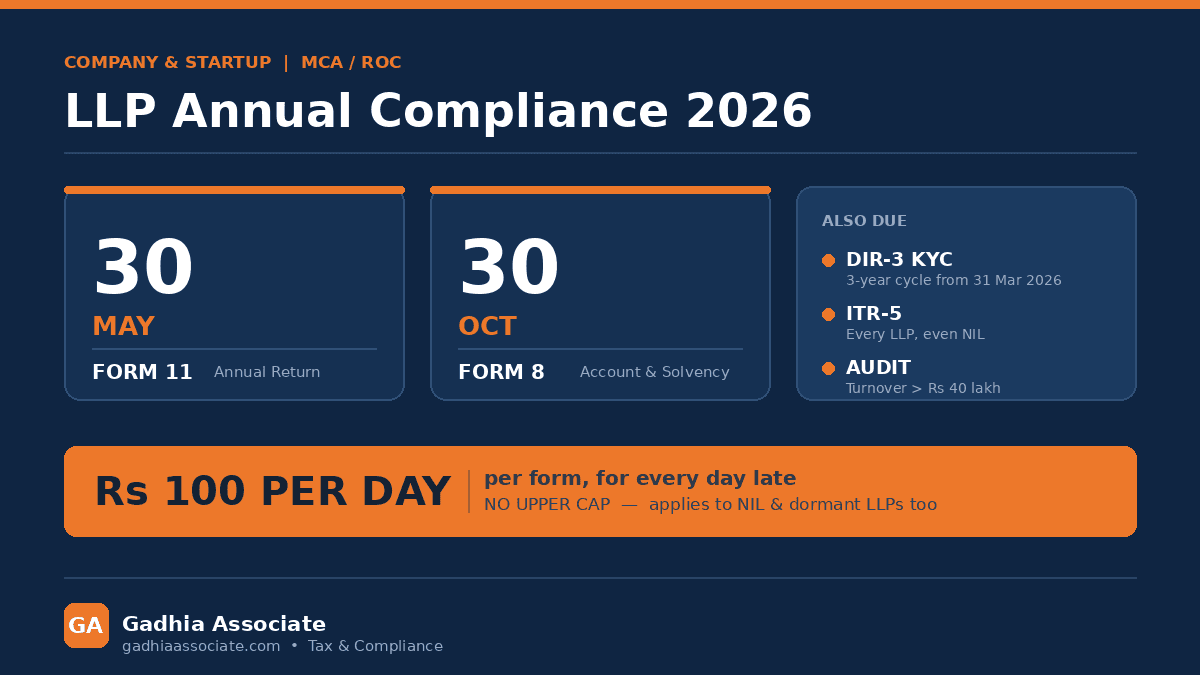
LLP annual compliance in 2026 rests on two mandatory MCA filings and one income tax return. Form 11, the Annual Return, is due by 30 May each year; Form 8, the Statement of Account and Solvency, is due by 30 October. Both are compulsory for every registered LLP regardless of turnover, profit or activity, and late filing attracts an additional fee of Rs 100 per day per form with no upper limit.
That last point is what turns a forgotten filing into a serious problem. Unlike most penalties, the Rs 100 per day charge simply keeps accumulating, and a dormant LLP that has been ignored for a few years can easily face a liability many times the cost of having filed on time. This guide sets out the forms, dates, thresholds and the DIR-3 KYC change taking effect in 2026.
What is LLP Form 11?
Form 11 is the Annual Return of a Limited Liability Partnership, filed with the Registrar of Companies. It captures the LLP's basic constitutional information for the financial year: the number of partners and designated partners, total contribution received, details of partners and their contributions, particulars of any body corporate partners, and details of penalties or compounding offences if any.
Form 11 is due within 60 days of the close of the financial year, which in practice means 30 May each year for a financial year ending 31 March. It must be digitally signed by two designated partners, and where the total contribution exceeds Rs 50 lakh or turnover exceeds Rs 5 crore, it also requires certification by a Company Secretary in practice. The information is drawn largely from the LLP agreement and partner records rather than from the accounts.
What is the due date for Form 8?
Form 8 is the Statement of Account and Solvency, and it is due by 30 October, being within 30 days from the end of six months after the close of the financial year. It contains the LLP's statement of assets and liabilities, statement of income and expenditure, and a declaration by the designated partners that the LLP is solvent and able to meet its liabilities.
Form 8 also requires disclosure on contingent liabilities and on statutory compliances such as whether the LLP has complied with applicable provisions. It is digitally signed by two designated partners and certified by a practising Chartered Accountant, Company Secretary or Cost Accountant. Where the LLP falls within the audit threshold, the auditor's involvement feeds directly into this form.
Form 11 versus Form 8: how they differ
The two forms are often spoken of together but they do different jobs and they are not interchangeable. Form 11 is about who the LLP is — partners, designated partners, contribution and structural information — and it is due early in the financial year at the end of May. Form 8 is about how the LLP performed and whether it is solvent — the financial statements in summary form plus a solvency declaration — and it comes five months later at the end of October.
Filing one does not excuse the other, and each carries its own Rs 100 per day additional fee. An LLP that files Form 11 punctually but forgets Form 8 for two years is accumulating penalty on Form 8 alone the entire time. Both must be filed even if the accounts show nil figures.
Do I have to file if my LLP had no transactions?
Yes. This is the single most expensive misunderstanding in LLP compliance. The obligation to file Form 11 and Form 8 arises from the fact of registration under the LLP Act, not from having earned income. A dormant or NIL LLP — one that was incorporated and never commenced business, or that has stopped trading — must still file both forms every year with nil figures, and must still file its income tax return.
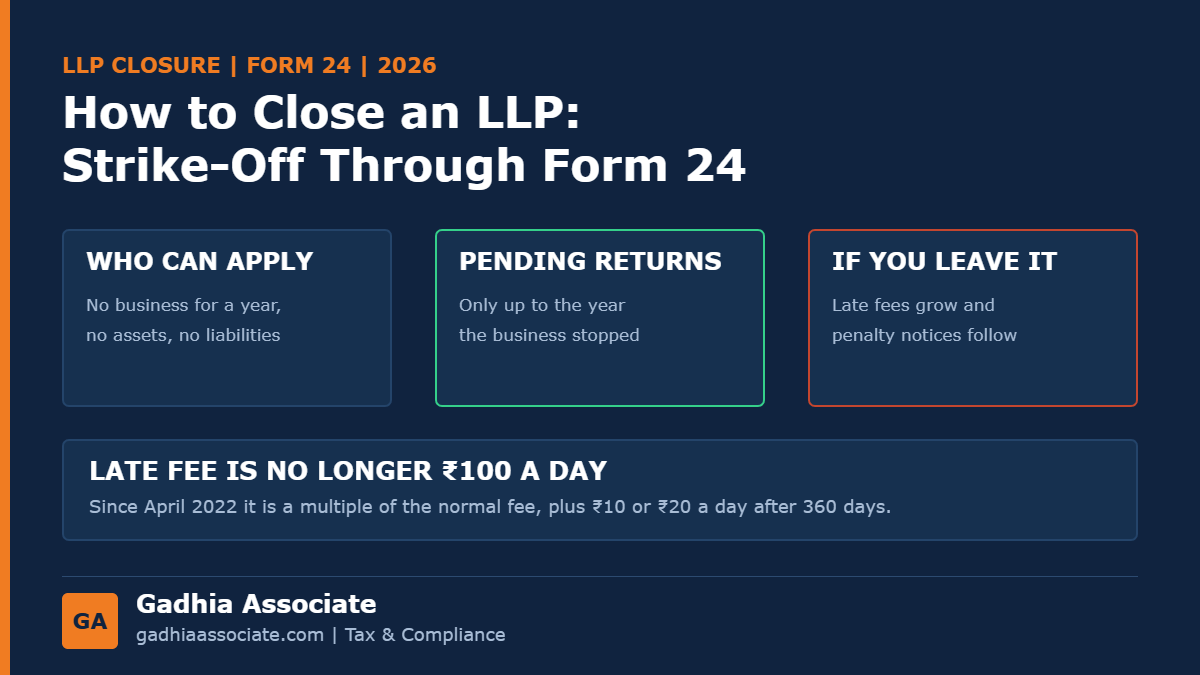
Many LLPs in Junagadh and across Gujarat were incorporated with good intentions, never traded, and were then simply abandoned. Years later, when the partners want to close the LLP or the designated partners want to be appointed elsewhere, the accumulated additional fee surfaces and has to be cleared before the LLP can be struck off through Form 24. If the LLP is genuinely not going to be used, the cheaper route is to keep filings current and then close it formally rather than let it drift.
What is the penalty for late LLP filing?
The additional fee for late filing of Form 11 and Form 8 is Rs 100 per day per form, with no maximum cap. It runs from the day after the due date until the form is actually filed. Because there is no ceiling, the exposure is genuinely open-ended: a form that is three years late attracts roughly a six-figure additional fee on its own, and both forms late means the amount doubles.
Beyond the additional fee, the LLP Act also provides for penalties on the LLP and its designated partners for non-compliance, and persistent default can result in the LLP being flagged as non-compliant, affecting bank facilities, tender eligibility and due diligence in any funding or sale transaction. Designated partners carry personal responsibility for these filings, which is worth remembering before agreeing to be named as one.
Does an LLP need an audit?
Not always. An LLP is required to have its accounts audited by a Chartered Accountant where its turnover exceeds Rs 40 lakh in a financial year, or where its contribution exceeds Rs 25 lakh. Below both thresholds, statutory audit under the LLP Rules is not required, though the LLP must still maintain proper books of account and file Form 8 with a certification.
The audit threshold also drives the income tax return due date. An LLP whose accounts are not required to be audited generally files its return by 31 July, while an LLP subject to audit files by 31 October, with the tax audit report where applicable due before that. LLPs with international or specified domestic transactions requiring a report under section 92E have a later date. Note that an LLP must file an income tax return every year even if there is no income, and it cannot use the presumptive schemes available to individuals and firms in the way many partners assume.
DIR-3 KYC for designated partners in 2026
Every individual holding a DPIN or DIN must complete KYC with the MCA. Historically this was an annual filing due by 30 September, later extended in some years, done through DIR-3 KYC where details have changed or DIR-3 KYC Web where they have not. Failure deactivates the DPIN, and reactivation requires payment of a fee of Rs 5,000 — a charge that applies per partner.
The significant change for 2026 is that the MCA has moved KYC to a three-year cycle, with the amendment taking effect from 31 March 2026. Designated partners who completed KYC for the current cycle will next be due in the applicable year of the new triennial cycle rather than every twelve months. This is a welcome simplification, but the details of the transition matter: whether you fall due next year or in the new cycle depends on when you last filed, and a deactivated DPIN blocks Form 11 and Form 8 signing entirely. Verify your own status on the MCA portal rather than assuming the relaxation applies to you.
LLP annual compliance checklist
- Maintain books of account on cash or accrual basis at the registered office throughout the year.
- Prepare the Statement of Account and Solvency within six months of the financial year end.
- Get accounts audited if turnover exceeds Rs 40 lakh or contribution exceeds Rs 25 lakh.
- File Form 11 by 30 May, with practising CS certification where the contribution or turnover thresholds apply.
- File Form 8 by 30 October with two designated partner signatures and professional certification.
- Complete DIR-3 KYC for every designated partner and keep the DPIN active.
- File the income tax return in ITR-5 by the applicable date, even for a NIL LLP.
- File Form 3 or Form 4 within 30 days for any change in the LLP agreement, partners or contribution.
- Keep GST returns current if the LLP is registered — our GST Calculator is handy for quick workings.
Keeping it simple
The practical answer for most LLPs is to treat 30 May and 30 October as fixed calendar events and to reconcile books quarterly so that neither date becomes a scramble. If your LLP already has arrears, filing sooner rather than later is always cheaper because the additional fee accrues daily. For LLPs that have outgrown the structure, our Company Registration page covers conversion to a private limited company, and our Income Tax services page covers ITR-5, tax audit and assessment support. If a partner is planning to exit and transfer their interest, the Capital Gain Tax Calculator will give a first estimate of the tax impact.
How Gadhia Associate Can Help
Gadhia Associate handles end-to-end LLP compliance for clients in Junagadh, across Gujarat and elsewhere in India: incorporation, Form 11 and Form 8 filing, audit where applicable, DIR-3 KYC, LLP agreement amendments through Form 3, income tax returns, arrears clean-up for dormant LLPs, and closure through Form 24. If you are unsure what is pending on your LLP, contact us for a free consultation and we will check your MCA filing history and give you a clear position.
This article reflects the position as of August 2026. LLP due dates, additional fees, audit thresholds and KYC requirements change through MCA notifications, LLP Rules amendments and CBDT circulars. Please confirm the current position with a qualified professional before acting.