LLP to Private Limited Company Conversion in 2026: Process, Form URC-1, Timeline, Tax-Free Conditions and What Changes for You
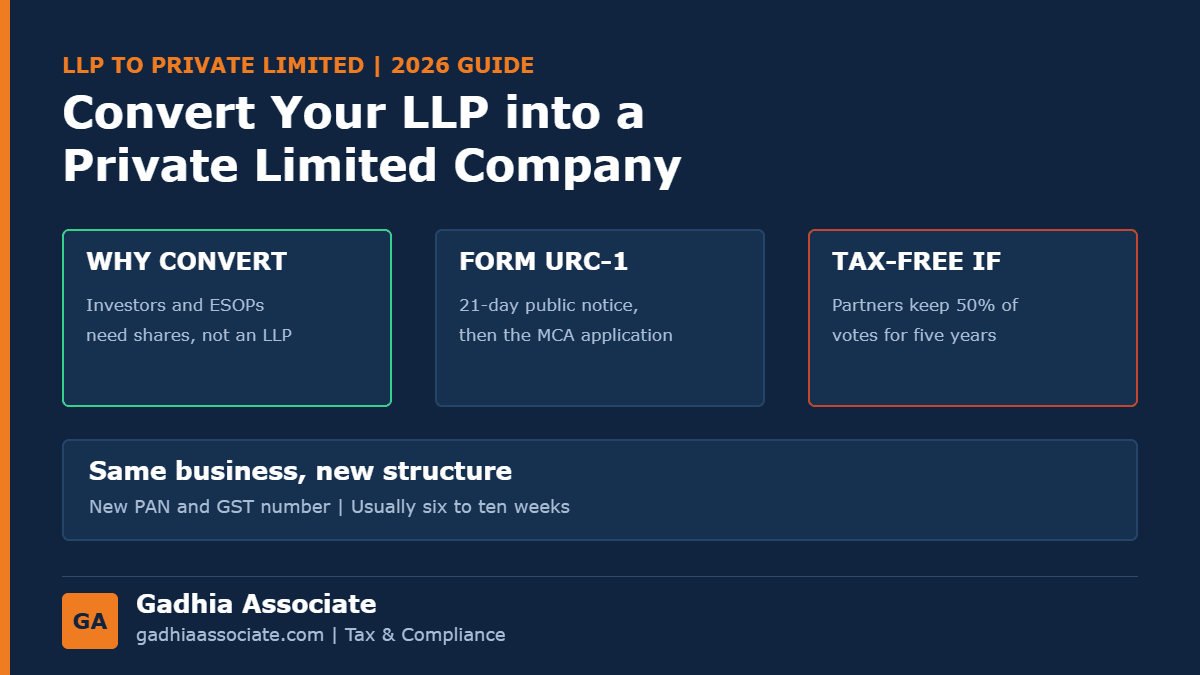
An LLP can be converted into a private limited company under Section 366 of the Companies Act, usually when investors or ESOPs come into the picture.
Two cousins in Rajkot started a packaged namkeen brand as an LLP in 2021, because an LLP was cheap to run and needed no audit in the early years. Sales have now crossed Rs 6 crore, and an investor from Ahmedabad is ready to put in Rs 2 crore. His term sheet has one line they did not expect: the money will come only into a private limited company, against shares.
They do not have to close the LLP and start again. The law lets an LLP register itself as a company and carry its assets, contracts, staff and track record with it. Here is how that works in 2026, what keeps it tax-free, and what changes once you are a company.
In short: Under Section 366 of the Companies Act, 2013, an LLP with two or more partners can register as a private limited company. It takes a no-objection from its secured creditors, publishes a notice in Form URC-2 in two newspapers, waits 21 clear days for objections, and then applies in Form URC-1 along with the incorporation form, SPICe+. On registration, everything the LLP owned or owed passes to the company, and the Registrar is informed within 15 days so that the LLP is dissolved. For income tax, the change is not treated as a transfer if all partners become shareholders in the ratio of their capital accounts, receive nothing but shares, and together keep at least 50% of the voting power for five years. The company gets a new PAN and a new GST registration.
Why do LLPs convert?
- Equity funding: an LLP has partners and capital contribution, not shares. Angel investors and venture funds invest against shares, with rights that company law recognises.
- ESOPs: only a company can grant stock options to its employees.
- Foreign and NRI investment: the rules are simpler for a company than for an LLP. Our guide for an NRI starting a private limited company covers them.
- Tax on profit kept in the business: a company can opt for a 22% rate, about 25.17% with surcharge and cess, against 30% plus cess for an LLP.
- Larger customers and lenders: some tenders, big buyers and lenders prefer a company, whose accounts are audited every year.
Who can convert?
- Two or more partners: they become the first shareholders, and at least two people must be directors, one of them resident in India.
- All partners on board: each partner signs the consent and an affidavit, and the tax exemption needs every partner to become a shareholder.
- Secured creditors: the bank or any lender holding a charge must give a written no-objection.
- Filings up to date: the LLP's Form 8, Form 11 and income tax returns must be filed before you apply.
- No new shareholders in the conversion: investors are issued shares after the company is registered, not as part of the conversion.
The directors' documents are the same as for a new company, listed in our guide to private limited company registration in Gujarat.
How does the conversion work?
- Partners' resolution approving the conversion and authorising a partner to apply.
- Digital signatures and DINs for the proposed directors. Designated partners usually have them already.
- Name approval through SPICe+ Part A. The company can usually keep the LLP's name, ending in "Private Limited".
- No-objection letters from the bank and other secured creditors.
- Newspaper notice in Form URC-2, in one English and one Gujarati newspaper circulating in the district, giving 21 clear days for objections.
- Statement of accounts of the LLP, made up to a date not more than 15 days before the application and certified by a chartered accountant.
- Form URC-1 with SPICe+ Part B, attaching the memorandum and articles, the list of partners, consents and affidavits, the LLP agreement, the latest income tax return and the newspaper cuttings. The MCA's Central Registration Centre processes it.
- Certificate of incorporation, with a new company number, PAN and TAN. From this date the LLP's property vests in the company, and its debts, contracts and pending cases continue in the company's name.
- Intimation to the Registrar of LLP within 15 days, with the papers for dissolving the LLP.
- First steps as a company: issue share certificates to the partners, hold the first board meeting and appoint the auditor.
The whole process usually takes six to ten weeks. Three of those weeks are the notice period, which cannot be shortened, and the bank's no-objection is often the slowest part.
How do you keep the conversion tax-free?
For income tax, an LLP is treated as a firm. When a company takes over a firm's business, the transfer of its assets is not treated as a transfer for capital gains under Section 70(1)(zd) of the Income-tax Act, 2025, the old Section 47(xiii), if four conditions are met:
- All assets and liabilities of the business become those of the company.
- All partners become shareholders, in the same proportion as their capital accounts on the date of conversion.
- The partners receive nothing other than shares in the company.
- The partners together hold at least 50% of the voting power, and keep it for five years.
Three points need care:
- Shares follow capital, not profit share. If two partners share profit equally but their capital accounts stand at 70:30, the shares must be allotted 70:30. Set the capital accounts right before you convert.
- Nothing but shares. Paying a partner cash for his share of the business breaks the condition. Decide in advance how each partner's capital and current account will be carried into the company.
- The five-year rule and your investor. If new investors take the founders below 50% of the voting power within five years, the exemption is withdrawn and the gain is taxed in the company's hands in that year. Work out that figure before you sign the term sheet.
When the conditions are met, the LLP's unabsorbed losses and depreciation pass to the company. Two income tax returns are filed for the year of conversion: the LLP's up to the date of conversion, and the company's after it.
What changes once you are a company?
- Audit every year: a company's accounts are audited whatever its turnover.
- Meetings and records: board meetings, an annual general meeting, minutes and statutory registers.
- Yearly filings: AOC-4 and the annual return in MGT-7A or MGT-7 replace Form 8 and Form 11. See private limited company annual compliance.
- Taking money out: there are no drawings in a company. Partners' remuneration and profit share give way to directors' salary and dividends, and loans from the company to its directors are restricted. Our guide on taking money out of a private limited company explains the options.
- Tax on what you take: dividends are taxed in your hands at slab rates, while a partner's share of an LLP's profit was tax-free.
- Money lent by partners: loans given to the LLP must now fit the company rules on loans from directors and members.
What happens to GST, the bank and licences?
- GST: the company has a new PAN, so it needs a new GST registration. The takeover of the whole business as a going concern is not charged to GST, and unused input tax credit moves from the LLP's GSTIN to the company's through Form GST ITC-02. The LLP's registration is then cancelled.
- Bank: accounts and loans move to the company's name and PAN, and the bank's charge is registered with the Registrar of Companies.
- Licences: Udyam, IEC, FSSAI, PF and ESIC, professional tax, factory licence and GPCB consent must be updated or obtained in the company's name.
- Property: land and buildings vest in the company by law, but the revenue records must be updated. Check the stamp duty position before you file.
- Customers and suppliers: inform them, and start a new invoice series under the new GSTIN.
When should you not convert?
- No outside investor is in sight and the partners take out most of the profit every year. An LLP is usually cheaper to run and to draw money from.
- The bank is not ready to give its no-objection.
- Investors will take more than half the voting power within five years and the business holds assets that have risen in value, such as land or a brand. Get the tax worked out first.
- The partners' capital accounts do not reflect the shareholding they want. Correct that first.
Thinking of going the other way? A company can become an LLP too, within limits, as our guide to converting a private limited company into an LLP explains.
What we do for you
- Check whether conversion suits your LLP, and what it will cost in fees, stamp duty and tax
- Bring the LLP's Form 8, Form 11 and tax returns up to date
- Prepare the statement of accounts, partners' consents and affidavits, and the creditors' no-objection letters
- Publish the URC-2 notice and file SPICe+ and Form URC-1
- Draft the memorandum and articles with the tax conditions and your funding plan in view
- Move PAN, TAN, GST registration and credit, bank accounts and licences, and set up the company's yearly compliance
Gadhia Associate has been in practice since 2007 and has handled work for over 7,000 clients across Saurashtra and Gujarat, with a 5.0 Google rating from more than 100 reviews. Partners of LLPs in Junagadh, Rajkot, Jamnagar, Morbi, Veraval and Porbandar come to our Junagadh office, where same-day appointments are available. MCA filings are online, so we also convert LLPs registered anywhere in India. Fixed-fee plans are available.
Has an investor asked you to become a company? Call +91 82005 28355 or message us on WhatsApp. The first consultation is free.
Frequently asked questions
Can an LLP be converted into a private limited company?
Yes, under Section 366 of the Companies Act, 2013, by applying in Form URC-1 with SPICe+, after a 21-day newspaper notice and a no-objection from secured creditors.
How long does it take to convert an LLP into a private limited company?
Usually six to ten weeks, including the 21-day notice period.
Is the conversion of an LLP into a company taxable?
Not if all partners become shareholders in the ratio of their capital accounts, receive only shares, and together keep at least 50% of the voting power for five years.
Does the company get a new PAN and GST number?
Yes. Both are new, and unused GST credit can be moved from the LLP through Form GST ITC-02.
What happens to the LLP after conversion?
Its assets, liabilities and contracts pass to the company, and the LLP is dissolved after the Registrar is informed within 15 days.
Can investors come in at the time of conversion?
The partners become the first shareholders. Investors are issued shares after the company is registered.
Position as of 5 October 2026. MCA forms, fees and procedures change from time to time, and stamp duty differs from state to state. The tax treatment depends on the facts of each LLP. Take advice on your own LLP before you convert.