How to Take Money Out of Your Private Limited Company Legally: Salary, Dividend, Director's Loan and the Section 2(22)(e) Trap
Your company had a profitable year. The cash is sitting in the company's current account, and whenever money is needed at home you transfer it across. Your accountant books it to "director's current account", nobody asks a further question, and the balance has been climbing for three years. If that is your company, this article is for you. That one line in the books is the most expensive habit we see in owner-managed private limited companies, and it has a section number attached to it.
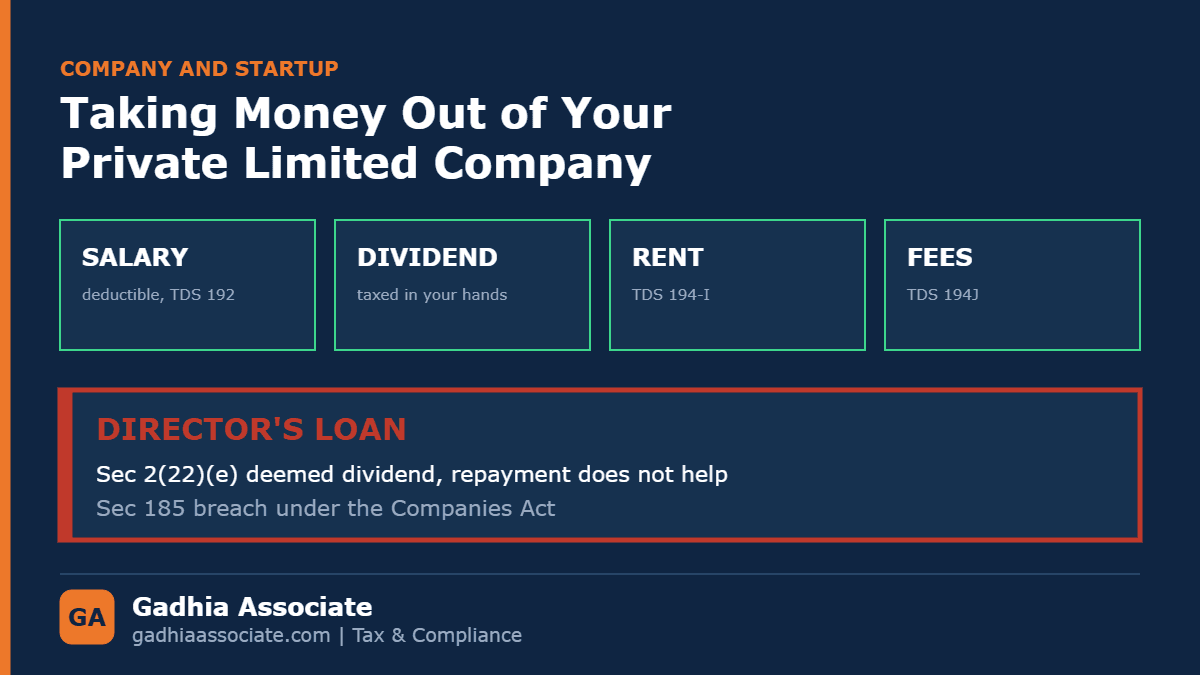
Short answer: Profit can reach you legally through four routes - director's salary, professional fees, dividend, and rent for premises you own. Salary, fees and rent are deductible for the company; dividend is not. An unrecorded withdrawal or a company loan to you can be taxed as deemed dividend under Section 2(22)(e) of the Income-tax Act, 1961, and repaying it does not help.
What are the legal ways to take money out of a private limited company?
Four routes work. Two get people into trouble.
- Salary or director's remuneration - deductible for the company, taxed as salary in your hands, TDS under Section 192.
- Professional or consultancy fees - deductible, TDS under Section 194J at 10 per cent once payments cross Rs 50,000 in the financial year.
- Dividend - paid out of profits under Section 123 of the Companies Act, 2013. Not deductible for the company, taxed at your slab rate, TDS under Section 194.
- Rent - where the company occupies premises you own. TDS under Section 194-I.
The two that cause damage are a loan or advance from the company to you, and a plain unrecorded withdrawal parked in a current account. The current account itself is not illegal. How it is treated at the year end decides everything.
How do I pay myself a salary from my own private limited company?
Salary is usually the cleanest route, and a private limited company has far more freedom to fix it than most owners realise.
Section 197 of the Companies Act, 2013 - the overall managerial remuneration ceiling of 11 per cent of net profit - and Schedule V apply to public companies. A private limited company sits outside Section 197, so there is no statutory percentage cap on what it pays its directors. What there is instead: a board resolution authorising the remuneration, an appointment letter or service agreement stating the amount and terms, TDS deducted under Section 192 and deposited on time, Form 16 issued, and the figure disclosed in the financial statements.
Then there is the version of this we actually see. In the last week of September the auditor asks for the resolution authorising the managing director's pay. Someone types it that evening and dates it 12 April. It usually passes. It does not always. A resolution nobody can produce turns a deductible expense into an argument you will lose on a bad day.
The figure also has to be commercially sensible against what you actually do. Section 40A(2) lets the assessing officer disallow the excessive part of a payment to a related person. We see this raised most often where a spouse or a son sits on the payroll at a large number with no defined role and no attendance anywhere in the records.
If you have run a partnership firm before, this is a different regime entirely. The Section 40(b) ceilings on partners' remuneration and interest that our article on the partnership firm deed explains do not apply to a company. A company has no percentage cap. It has paperwork instead.
Are professional fees to a director better than salary?
Sometimes, but only where the arrangement is genuinely professional. TDS runs under Section 194J at 10 per cent, with a threshold of Rs 50,000 for the year. The department recharacterises the payment as salary where the director keeps fixed hours, has no other clients, raises no invoices, has no engagement letter, and draws a round monthly figure. When that happens you get a TDS shortfall under Section 192 with interest, and the company's deduction is not the thing that saves you.
What about sitting fees?
Sitting fees are capped at Rs 1,00,000 per meeting of the board or of a committee under Rule 4 of the Companies (Appointment and Remuneration of Managerial Personnel) Rules, 2014. That is useful for a non-executive director. It is not a way to move real money out of a trading company.
Is dividend better than salary for a director?
For most owner-managed companies, no. Dividend is taxed twice.
A dividend is payable out of the profits of the year or out of accumulated profits under Section 123 of the Companies Act, 2013. Dividend distribution tax was abolished with effect from 1 April 2020, so the company no longer pays DDT on it - the dividend is taxable in the shareholder's hands at slab rates. TDS applies under Section 194 at 10 per cent where dividend paid to a resident shareholder exceeds Rs 10,000 in a financial year, a threshold raised from Rs 5,000 with effect from 1 April 2025. Against dividend income you may claim interest expenditure only, capped at 20 per cent of the dividend, and nothing else.
The part people miss: a dividend is not an expense. The company pays tax on the profit, and then you pay tax on the dividend out of what is left.
Illustrative example: taking Rs 10,00,000 out as salary or as dividend
Illustrative only. Round numbers, company at 25 per cent, director at 30 per cent, cess and surcharge ignored.
- Salary route. The company pays Rs 10,00,000 as salary. It is deductible, so corporate tax on that slice is nil. You pay about Rs 3,00,000. Reaching home: roughly Rs 7,00,000.
- Dividend route. The company must earn Rs 10,00,000 before tax, pays Rs 2,50,000 corporate tax, and has Rs 7,50,000 to distribute. You pay 30 per cent on Rs 7,50,000, which is Rs 2,25,000. Reaching home: roughly Rs 5,25,000.
About Rs 1,75,000 of difference on one withdrawal. Your real numbers will move with the regime you are in, whether the company has opted for 22 per cent under Section 115BAA, your other income, surcharge and cess. The direction of the answer rarely moves.
Want to know what your director's account is actually holding?
Send us the last three balance sheets. We will tell you what is sitting in that account and what the department would call it. The first consultation is free.
Call or WhatsApp +91 82005 28355. Gadhia Associate is based in Junagadh, Gujarat, and works with private limited companies across India.
What is the Section 2(22)(e) deemed dividend trap?
Section 2(22)(e) is the provision that turns a director's current account into taxable income in your hands.
It treats a loan or advance by a company in which the public are not substantially interested - which is every ordinary private limited company - to a shareholder holding not less than 10 per cent of the voting power, or to a concern in which such a shareholder has a substantial interest, as a dividend to the extent of the company's accumulated profits.
Four points decide most cases:
- It is taxed in your hands. The company gets no deduction for it either.
- Repaying the loan does not undo the tax. The charge fixes when the money leaves the company.
- There is no small-amount threshold. A Rs 4,00,000 advance to a 50 per cent shareholder of a company with accumulated profits is squarely inside it.
- The 10 per cent test is voting power, and a loan routed to your partnership firm or to another company where you hold a substantial interest is caught the same way.
A Junagadh trading company came to us with a debit balance of about Rs 22 lakh in the director's account, built up over four years. Roughly half of it was genuine business expenditure paid on a personal card and never claimed. A quarter was a property instalment. The rest, nobody could identify. Separating real reimbursements from advances took three weeks and two people's bank statements. Reconciled every quarter, it would have been an hour's work. If you are now looking at correcting earlier returns because of this kind of thing, our article on mistakes found in a filed ITR sets out what revision can and cannot fix.
Can my company give me a loan as a director?
Usually not, and the Companies Act problem is separate from the income tax one.
Section 185 of the Companies Act, 2013 prohibits a company from advancing a loan, or giving a guarantee or security for a loan, to its directors or to any person in whom a director is interested. A loan to a body corporate in which a director is interested can be given only with a special resolution in general meeting, with the full disclosure in the explanatory statement, and the borrower must use the funds for its principal business activity. The penalty on the company runs from Rs 5,00,000 to Rs 25,00,000. The officer in default and the director who took the loan face the same range, or imprisonment up to six months.
So one transfer can be deemed dividend on you under Section 2(22)(e) and a Section 185 breach by the company at the same time. That is why "I will just show it as a loan" is not a fix.
Two neighbours are worth knowing. Section 186 limits inter-corporate loans, guarantees and investments, and anything beyond the prescribed limits needs a special resolution. Section 188 covers related party transactions, with board approval and, past the prescribed thresholds, a members' resolution - though transactions in the ordinary course of business and at arm's length fall outside it, which is exactly why the paperwork proving arm's length is the valuable part.
Can I lend money to my own company instead?
Yes, and money moving in that direction is far simpler.
A private limited company may accept a loan from its director. It is not treated as a deposit under the deposit rules if the director gives a written declaration that the money is his own funds and is not borrowed or accepted as a loan from anyone else. Keep that declaration on file - it is the entire basis of the exemption - and disclose the amount in the board's report.
Form DPT-3, the annual return of deposits and of amounts not considered as deposits, is due by 30 June for the year ended 31 March. Director's loans are reported there as amounts not considered deposits. Idle companies miss this form more than any other.
Interest you charge on that loan is deductible for the company if the rate is commercially reasonable, taxable as your income from other sources, with TDS under Section 194A at 10 per cent once interest crosses Rs 10,000 in the year for a non-bank payer. Where the funding needs to come from outside the family, our article on business loans for a private limited company covers CGTMSE-backed lending and GST-turnover-based limits.
What about rent, interest and genuine reimbursements?
These three are the quiet, efficient part of the picture and they get ignored.
Rent first. If the company trades from a shop or office you own personally, a registered leave and licence or lease agreement at a market rent gives the company a deduction, and gives you rental income against which you claim the 30 per cent standard deduction under Section 24(a). TDS under Section 194-I applies where rent exceeds Rs 50,000 for a month or part of a month, at 10 per cent for land, building and furniture.
Reimbursements next. Actual expenses you paid personally on the company's behalf, backed by bills, claimed on a voucher, are not your income. A round monthly sum described as reimbursement with no bills behind it is an advance, and then you are back in Section 2(22)(e).
Is a share buy-back still a good way to take money out?
Much less so than it used to be. For buy-backs on or after 1 October 2024, clause (f) of Section 2(22) treats the whole amount the company pays on purchasing its own shares under Section 68 of the Companies Act, 2013 as a dividend in the shareholder's hands, taxed at slab rates with TDS under Section 194. Section 46A now deems the sale consideration to be nil, so the shareholder books a capital loss equal to the cost of the shares, usable only against capital gains. Buy-back stopped being the capital gains route it once was. Confirm the position with your advisor before planning around it.
What mix of salary and dividend actually works?
It depends almost entirely on the profit level, which is why no blog can give you a number.
- Profit up to roughly Rs 15 to 20 lakh. Take nearly all of it as salary, with rent on top if you own the premises. Salary is deductible and your personal slab is usually the cheaper side of the double-tax comparison.
- Middle range. Salary to a figure you can defend commercially, plus rent, plus interest on any loan you have given the company, and dividend only for amounts you were going to leave in and draw later anyway.
- Higher profits where cash has to stay in for working capital or a tender deposit. Leave it in, pay corporate tax, and take dividend in a later year when your personal income is lower.
An honest aside. Nobody can give you the right split without seeing the company's profit, your other income, your regime and what the money is for. If someone quotes you a flat "70 per cent salary, 30 per cent dividend" rule without opening your balance sheet, they have not looked at your file.
Get the withdrawal route fixed before the next year end
We will look at your last three years, tell you what the current account exposure is, and put the resolutions, the appointment letter and the TDS workings in place so next year's withdrawals are boring.
Call or WhatsApp +91 82005 28355. We have been practising since 2007, work with over 7,000 clients across Saurashtra and Gujarat, and hold a 5.0 Google rating from more than 100 reviews. Same-day appointments at the Junagadh office, digital service anywhere in India, and fixed-fee or monthly plans so you know the cost in advance.
Frequently asked questions
Is there a legal limit on director's salary in a private limited company?
No percentage cap applies. Section 197 of the Companies Act, 2013 and Schedule V, which impose the 11 per cent of net profit ceiling, apply to public companies. A private company fixes remuneration by contract, supported by a board resolution. Income tax still requires the payment to be commercially reasonable, because Section 40A(2) allows disallowance of the excessive portion paid to a related person.
Does repaying a director's loan remove the deemed dividend tax?
No. Section 2(22)(e) fixes the charge when the loan or advance is made, measured against the company's accumulated profits at that time. Repayment in the same year or a later year does not reverse it, and the company gets no deduction either. This is the single most common surprise in a private company assessment, and it is entirely avoidable with planning.
Do I have to deduct TDS on dividend paid by my own company?
Yes, if the amount crosses the threshold. Under Section 194 the company deducts 10 per cent where dividend paid to a resident shareholder exceeds Rs 10,000 in a financial year, a limit raised from Rs 5,000 with effect from 1 April 2025. Without a PAN the rate goes to 20 per cent. The shareholder then pays tax at slab rates and claims the credit.
Can the company pay rent to me for the house I live in?
Only for the portion genuinely used by the business, and only with an agreement, a commercial rate and actual use you can show. A company paying full rent for a director's residence that the business does not occupy is a perquisite question at best and a disguised withdrawal at worst. Where a real office or godown is involved, the rent route is clean and useful.
Is a loan I give the company reportable anywhere?
Yes. Keep the director's written declaration that the funds are his own and not borrowed, disclose the amount in the board's report, and report it in Form DPT-3 by 30 June as an amount not considered a deposit. Interest paid to you attracts TDS under Section 194A at 10 per cent once it crosses Rs 10,000 for the year.
Position as of September 2026. Fees, thresholds, forms and due dates change through MCA and CBDT notifications, and the Income-tax Act, 2025 has renumbered the income tax provisions with effect from 1 April 2026. Confirm the current position before acting on anything here.