Section 194R: TDS on Gifts, Gold Coins, Foreign Trips and Dealer Incentives Your Business Gives Away
Your company gave forty dealers a gold coin each at Diwali. The three who hit their annual target got a trip to Bangkok. Somebody's wife went along on one of them. None of it went through a TDS entry, because none of it was a payment - it came out of sales promotion expenses, and that felt like the end of it. Then the auditor asked, in that flat way auditors ask things, whether tax was deducted under Section 194R. If you run a manufacturing, distribution, pharma or FMCG business in Gujarat that rewards its channel in kind, this is your problem, and it is usually discovered in the audit rather than in the year the gift was given.
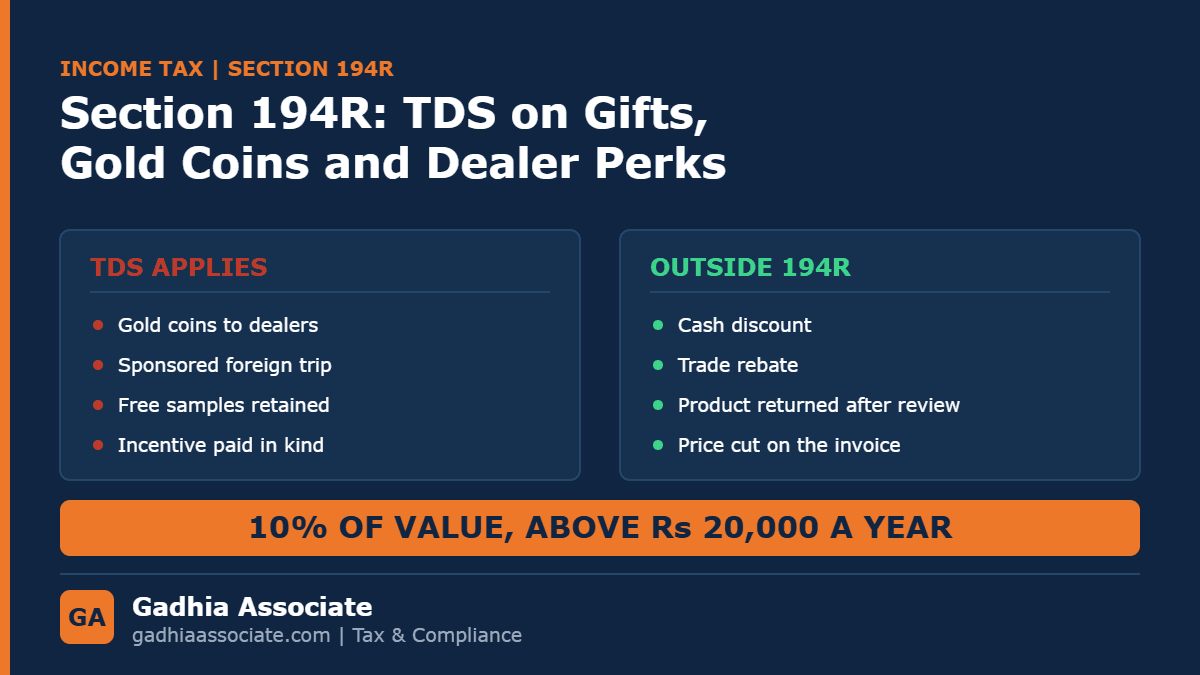
Short answer: Section 194R requires anyone providing a benefit or perquisite to a resident, arising out of that resident's business or profession, to deduct tax at 10% of its value. The threshold is Rs 20,000 per recipient per financial year. Gold coins, sponsored trips, retained samples and incentives settled in kind are covered. Discounts and rebates are not.
What does Section 194R actually cover?
It covers anything of value you hand to a business counterparty that they do not pay for and that arises from their business relationship with you. The provision was inserted by the Finance Act 2022 with effect from 1 July 2022, and it applies whether the benefit is in cash, in kind, or a mix of both. Cash is the easy case. Kind is where the whole difficulty lives.
What we see triggering it in practice, drawing on CBDT Circular 12 of 2022 and Circular 18 of 2022:
- Gold coins, silver articles and gift hampers given to dealers and distributors
- Sponsored foreign trips and conference travel for channel partners
- Incentive schemes settled in kind - a two-wheeler, a car, a television for hitting a target
- Free samples that the recipient keeps, including medicine samples given to doctors
- Capital assets given free, such as a branded deep freezer or a display counter left at a retailer
- Expenditure that was legally the other person's liability which you paid on their behalf
The Circular also made a point that surprises people: a product given to someone for review or use in rendering services is not a benefit if it comes back. If you send a car to a reviewer and the car is returned, nothing to deduct. If the reviewer keeps it, that is a benefit and 194R bites. The same logic runs through influencer arrangements, which is why our article on income tax for influencers deals with 194R too - the person on the receiving end of the free outfit has a tax position, not just the brand giving it.
Are discounts and rebates covered by 194R?
No, and this is the most common confusion in dealer businesses. CBDT Circular 12 of 2022 is explicit that sales discounts, cash discounts and rebates allowed to a customer are outside Section 194R. The reasoning is straightforward: a discount reduces the sale price. You realised less, the buyer paid less, and the invoice tells the whole story. There is no separate thing of value changing hands.
Where it gets awkward is the middle ground. A 5% discount on the invoice is a discount. An extra ten cartons free with every hundred is arguably also a pricing adjustment, and the Circular took a favourable view of free units of the same product in certain cases. But a gold coin for crossing a target is not a discount by any reading, however your accounts classify it. The test is not what ledger it sits in. It is whether the price of a supply came down, or whether something extra was given.
Honest caveat: the boundary between a quantity incentive and a benefit in kind has produced genuine disagreement among practitioners, and the Circular does not resolve every scheme structure. If your incentive scheme is unusual, get it looked at rather than assuming it falls on the safe side.
What is the Rs 20,000 threshold and who does not have to deduct?
You deduct only if the aggregate value of benefits to a single recipient exceeds Rs 20,000 in a financial year. It is per recipient and cumulative - four gifts of Rs 6,000 each to one dealer crosses it, even though no single gift does. Once crossed, tax is on the whole value, not just the excess. So the Diwali gold coin at Rs 60,000 plus a Rs 8,000 hamper in March is one aggregate of Rs 68,000 for that dealer.
The exemption from deducting is narrow. An individual or HUF providing the benefit does not have to deduct if their business turnover did not exceed Rs 1 crore, or their professional gross receipts did not exceed Rs 50 lakh, in the immediately preceding financial year. Note what that means: every company, LLP, firm and trust deducts regardless of size. The relief is only for small proprietors and HUFs. Most businesses that run dealer schemes at any scale are well past those limits anyway, and if you are near the Rs 1 crore line you are probably also thinking about tax audit under Section 44AB.
How do you deduct 10% on a gold coin?
You cannot withhold a tenth of a gold coin, which is the practical heart of the problem. Section 194R requires the provider to ensure the tax is paid. Two workable routes.
Route one, recover it from the recipient. You buy the coin, you tell the dealer that Rs X will be deducted from their next credit note or commission payment as 194R tax, and you deposit it. Cleanest, and the dealer gets full credit in Form 26AS. Route two, bear it yourself and gross up, because the tax you pay on their behalf is itself a further benefit to them.
Illustrative example, round numbers. You give a dealer a gold coin that cost you Rs 90,000. If you recover the tax, you deduct Rs 9,000 - 10% of Rs 90,000 - from a payment due to them and deposit it. If instead you decide to absorb the tax, the benefit in the dealer's hands is the coin plus the tax you paid, so the value has to be grossed up. At 10% the grossed-up value is Rs 90,000 divided by 0.9, which is Rs 1,00,000, and the tax to deposit is Rs 10,000. Your real cost of that gift is Rs 1,00,000, not Rs 90,000. Illustrative only - build the gross-up into the scheme budget before you announce it, because discovering it in March means it comes out of margin.
On value: it is the fair market value of the benefit, except that where you purchased the item, the purchase price is taken, and where you manufactured it, the price you charge customers is taken. Keep the purchase invoice for every gifted article. That is the document the assessing officer asks for.
CBDT Circular 18 of 2022 also allowed a practical alternative - the deductor can rely on a declaration from the recipient along with the advance tax challan showing the recipient has themselves paid the tax on the benefit. Useful for large one-off benefits to sophisticated dealers. It needs actual paperwork on file, not an email promise.
What about dealer conferences and foreign trips?
A genuine dealer or business conference is not a benefit to the extent the expenditure is for business purposes - educating dealers on products, sales technique, obtaining orders, explaining a new scheme. That is the CBDT's own position. So the hall, the sessions, the materials and the travel attributable to the business portion sit outside 194R.
What does get caught, per the Circular: the leisure component even when it is incidental to the conference, expenditure on family members who accompany the dealer, and the cost of days of prior stay or overstay beyond the conference dates. There is a small allowance here - one day immediately before and one day immediately after the conference are not treated as overstay, which accommodates real travel.
So the Bangkok trip in the opening paragraph needs splitting. If two of the five days were product sessions and three were sightseeing, the sightseeing portion is a benefit. The accompanying spouse's entire cost is a benefit. And if a dealer stayed on for four extra days at company cost, those four days are a benefit. We usually ask clients to get the tour operator to bill the conference and leisure legs separately, and to keep the agenda with attendance sheets. Reconstructing the split eighteen months later from one consolidated invoice is miserable, and the officer will not accept a round estimate.
On reimbursements: if you reimburse out-of-pocket expenses to a consultant or service provider and that reimbursement is already part of the gross bill on which you have deducted under Section 194J or 194C, there is no second deduction under 194R. But where you pay a bill that was the other person's liability, in their name, outside the invoice, that is a benefit.
Not sure whether your dealer scheme attracts 194R?
Gadhia Associate has been practising since 2007 and we review incentive and channel schemes for businesses across Saurashtra and Gujarat before the scheme goes out, not after the auditor finds it. First consultation is free. Call or WhatsApp +91 82005 28355 with a copy of your scheme circular.
Why do dealers push back, and what is their tax position?
Because the benefit is taxable in their hands as business income, and they had not planned for it. A dealer who accepted a gold coin as a gesture of goodwill now has Rs 90,000 added to their business income and a TDS entry in Form 26AS that they have to explain in their return. If they do not offer it, the mismatch shows up on its own.
Expect resistance the first year, particularly on the recovery route. The argument you will hear is that it was a gift and gifts are not income. It is not a gift in tax terms - it arose from their business relationship with you. Our experience is that this goes far better when the scheme circular says up front that benefits are subject to 194R and how the tax will be handled. Announcing a gold coin and then quietly cutting Rs 9,000 from a payment two months later damages the relationship more than the tax does.
One more thing dealers raise: they would rather have cash. If commercially you do not care, cash incentives against a credit note are often simpler - though watch the cash transaction limits if anyone suggests paying in actual currency, which our article on cash transaction limits covers.
How is 194R reported?
Tax deducted under Section 194R is deposited by the seventh of the following month, reported in the quarterly TDS return in Form 26Q, and certified to the recipient in Form 16A. Where the tax has been borne and paid rather than withheld, Circular 18 of 2022 requires the challan number to be reported in the 26Q, which is how the credit reaches the dealer's 26AS.
Two things that trip up the filing. The recipient's PAN has to be correct, and for gifts to a large dealer network that means collecting PANs before the scheme runs, not during return preparation. And the valuation has to be per recipient, so your promotion expense ledger needs a dealer-wise break-up. A single line reading "Diwali gifts Rs 24,00,000" is not a working paper. If a return does go wrong, defaults surface as notices from TRACES, and our article on handling TDS default notices from TRACES walks through the response.
What does ignoring 194R cost?
More than the tax. If you were required to deduct and did not, the expenditure is liable to disallowance under Section 40(a)(ia) - 30% of the amount, added back to your taxable income for that year. So on Rs 24,00,000 of dealer gifts, roughly Rs 7,20,000 goes back into income, which at a 25% corporate rate is about Rs 1,80,000 of additional tax before interest. And that is separate from the Rs 2,40,000 of TDS itself.
Alongside that, you are treated as an assessee in default under Section 201 for the tax not deducted, with interest under Section 201(1A) running at 1% per month from the date the deduction should have been made until it is made, and 1.5% per month where it was deducted but not deposited. Penalty exposure exists as well. The disallowance is reversible in the year you eventually deduct and pay, which softens the hit, but the interest is not.
The pattern we see is not defiance. It is a promotion budget managed by the sales team, a gift decided in October, and an accounts department that sees a consolidated bill in November with no recipient names on it. Fix the process, not the return.
Get the scheme reviewed before Diwali, not after the audit
Gadhia Associate is based in Junagadh, Gujarat and works with clients across India and with NRIs, with 7000+ clients, a 5.0 Google rating from more than 100 reviews, same-day appointments at the Junagadh office and fixed-fee or monthly retainer plans.
If your incentive scheme for this year is still on a draft note, send it to us on WhatsApp at +91 82005 28355. The first consultation is free and it is a lot cheaper than a 40(a)(ia) add-back.
Frequently asked questions
Is a Diwali gift to a dealer covered by Section 194R?
Yes, if the dealer relationship is a business one and the total value of benefits to that dealer crosses Rs 20,000 in the financial year. A gold coin, silver article or expensive hamper is a benefit in kind, and tax at 10% of its value has to be accounted for. A small token below the threshold for that recipient across the whole year does not attract deduction.
Does 194R apply to discounts given to distributors?
No. CBDT Circular 12 of 2022 keeps sales discounts, cash discounts and rebates outside Section 194R, because they reduce the sale price rather than transfer something extra. A discount on the invoice is a pricing adjustment. An award, gift or sponsored trip for achieving a target is a separate benefit and is covered, whatever ledger it is booked under.
Who pays the tax when the benefit is a gold coin?
The provider must ensure the tax is paid. You either recover 10% of the value from an amount otherwise payable to the recipient and deposit it, or you bear it yourself and gross up the value, since the tax you pay is a further benefit. A third route allowed by Circular 18 of 2022 is a recipient declaration with their advance tax challan on your file.
What happens if we never deducted 194R on past dealer gifts?
Exposure runs on two tracks. The expenditure faces 30% disallowance under Section 40(a)(ia) for that year, and you can be treated as an assessee in default under Section 201 with interest at 1% per month from when the deduction was due. Deducting and paying now restores the deduction in the later year, so acting early limits the cost.
Has 194R changed under the Income-tax Act, 2025?
The Income-tax Act, 2025 came into force on 1 April 2026 and reorganised the TDS provisions, so benefits and perquisites now sit under a renumbered section with the same 10% rate and Rs 20,000 threshold. Practitioners still say "194R" in conversation. Confirm the exact new section reference and payment code with your consultant before filing, since forms and challans use the new numbering.
This reflects the position as of September 2026. DGFT, CBIC and CBDT notifications change rates and procedures, and the transition to the Income-tax Act, 2025 has renumbered provisions and forms. Please confirm the current position before acting on anything in this article.