HRA Exemption: How Much You Can Claim, Rent Paid to Parents, and Why HRA Claims Get Disallowed
Your salary slip showed HRA every month. Your employer accepted the rent receipts you handed in around January, gave you the exemption in Form 16, and you filed on that basis. Then the intimation arrived and the exemption is gone, or a query has landed asking you to produce a rent agreement, bank proof and your landlord's PAN. If you are a salaried person in Junagadh, Rajkot, Ahmedabad or anywhere else in Gujarat, this is one of the most common reasons a refund shrinks or a demand appears. The money at stake is usually between Rs 15,000 and Rs 60,000 of tax, plus interest that keeps running while you argue.
How much HRA exemption can I actually claim?
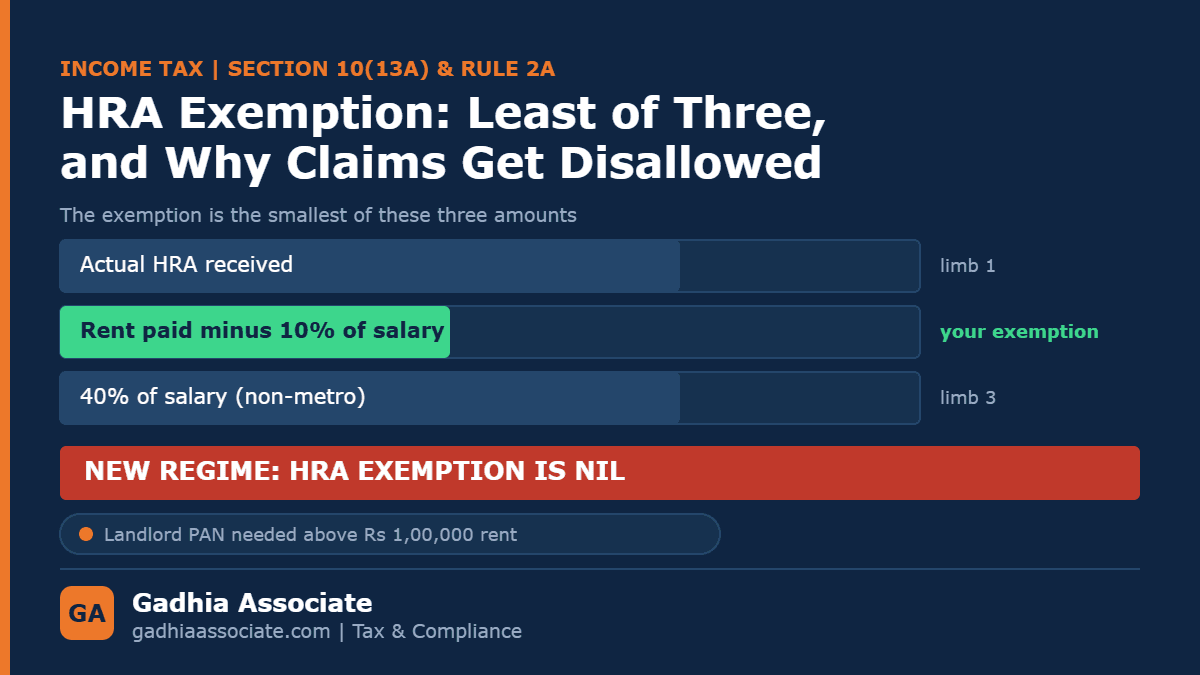
The least of the three amounts. Not the one you like best, and not the HRA figure printed on your slip. Rule 2A sets out the three limbs and you take the smallest:
- the HRA actually received from your employer for the period you occupied rented accommodation;
- rent actually paid, minus 10% of salary;
- 50% of salary for Delhi, Mumbai, Kolkata and Chennai, or 40% of salary everywhere else.
Only four cities get 50%. Bengaluru, Hyderabad, Pune, Gurugram, Noida, Ahmedabad, Rajkot and Junagadh all sit in the 40% bracket, whatever the rent market looks like on the ground. People argue about this every year and it goes nowhere, because the four-city list is in the rule itself.
"Salary" for this calculation is narrower than what lands in your bank account. It means basic pay, plus dearness allowance where the terms of employment say it forms part of pay for retirement benefits, plus commission fixed as a percentage of turnover. Nothing else. Special allowance, LTA, bonus, employer PF, other allowances: all outside. Getting this wrong in either direction is the second most common error we see, after the regime problem below.
How does the HRA calculation work for a salary in Junagadh?
Here is an illustrative example with round numbers. Assume basic pay of Rs 40,000 a month, no DA forming part of pay, HRA of Rs 16,000 a month, and rent of Rs 14,000 a month paid for a flat in Junagadh for the full year.
- Salary for Rule 2A: Rs 4,80,000
- Actual HRA received: Rs 1,92,000
- Rent paid minus 10% of salary: Rs 1,68,000 minus Rs 48,000 = Rs 1,20,000
- 40% of salary (non-metro): Rs 1,92,000
The exemption is Rs 1,20,000, the smallest of the three. The remaining Rs 72,000 of HRA is taxable salary. Notice which limb won. The second one almost always does, which is why the rent number, and your ability to prove it, is the whole ballgame. This example is illustrative only; run your own figures.
Why did my HRA exemption disappear even though my employer allowed it?
Because you were assessed under the new regime. HRA exemption is not available under the default regime in Section 115BAC. This is the single biggest reason claims vanish, and it catches people who did nothing wrong at all.
The trap is procedural. The new regime is the default. A salaried person without business income has to choose the old regime while filing, within the due date. Miss the due date, or file a belated return, and you are stuck with the default for that year, and every exemption and deduction you carefully documented, including HRA, simply falls away. We see this most in September and October, after the rush. If you have already filed and realised the regime is wrong, read our article on correcting mistakes in a filed ITR before you touch anything, because the window and the route depend on how you filed.
The other version of this: you changed employers mid-year, the new employer did not have your earlier salary details, and each one gave you the full exemption and the full standard deduction separately. Our article on changing jobs mid-year covers how to fix that before the department does.
Want someone to check your HRA position before you reply to the department?
Send us your Form 16, the rent agreement and your bank statement showing the rent debits. We will tell you within a day whether the claim holds and what the reply should say.
First consultation is free. Call or WhatsApp +91 82005 28355.
Can I claim HRA on rent paid to my parents?
Yes, and the law does not prohibit it. Whether it survives depends on three things, and most arrangements fail on at least one.
The parent must genuinely own the property, or hold it in a way that lets them let it out. If the flat is in your name, or jointly in yours, you are paying rent to yourself for your own share and that part goes. Second, rent must actually be paid, month by month, by bank transfer or UPI. A single lump-sum transfer in March to a parent's account, with twelve backdated receipts, is exactly the pattern the system flags. Third, the parent must show the rent as income from house property in their own return, claim the 30% standard deduction there, and pay tax if the total crosses the exemption limit.
Where it works, it works well: a parent with little other income may pay very little tax on rent that saves you a slab at 30%. Where it fails, you lose the exemption and the parent has already declared income they did not need to. This is where most claims fall apart, honestly, and usually because nobody moved actual money.
Rent paid to a spouse is a different matter. There is no clean statutory bar, but the position is not settled, and the arrangement is treated with suspicion because of the clubbing provisions and the difficulty of showing a real landlord-tenant relationship between people sharing one home. We do not recommend building a claim on it.
From 1 April 2026, the new Income-tax Rules also require you to disclose your relationship with the landlord in the employee declaration where annual rent crosses Rs 1,00,000. That is a deliberate change of direction, and it means family arrangements now announce themselves.
What if my landlord will not give me their PAN?
Where annual rent exceeds Rs 1,00,000, you must report the landlord's name, address and PAN to your employer in the prescribed declaration. Without it, your employer is not supposed to give you the exemption at source. The form salaried people knew as Form 12BB has been replaced by Form 124 with effect from 1 April 2026 under the Income-tax Rules, 2026, and the new form also asks for the landlord relationship.
If the landlord refuses, ask for a signed declaration giving their name, address and the reason PAN is unavailable, and keep it on file. That has been the accepted fallback for years, though it is a weaker document than a PAN and your employer may still decline. Practically, a landlord who will not share PAN is usually not declaring the rent, which tells you something about how the claim will look if it is examined. Small flats around Junagadh are often let informally, and this comes up constantly.
One more thing people miss: the employer's refusal at source does not extinguish the claim. If the exemption is genuinely due and your employer would not allow it, you can still claim it in the return, provided you are on the old regime and have the evidence. Expect the claim to be looked at.
What documents does the income tax department ask for when it questions HRA?
A consistent list, and it is worth assembling it before you are asked. Enquiries under the e-verification process, and notices under Section 133(6), typically ask for:
- the rent agreement for the relevant period, naming you as tenant and covering the whole claim;
- rent receipts, month by month, signed;
- bank statement entries showing the rent leaving your account and reaching the landlord;
- the landlord's PAN, and often confirmation that the rent appears in their return;
- proof you actually lived there, which can be as ordinary as an electricity bill or a gas connection.
The document nobody has is the rent agreement. Receipts get written up later; agreements cannot be. Second most missing item is the bank trail, because rent was paid in cash. The department can now see the landlord's declared rental income against your claim, and a mismatch surfaces without any human deciding to look. If the numbers in your AIS and Form 26AS do not line up with your return, our article comparing the two explains where the gaps come from, and our guide to income tax notices covers how to reply to a 133(6) enquiry properly.
Claiming an exemption you cannot support is a misreporting risk, with penalty and interest on top of the tax. That is the factual position.
What can I claim if I pay rent but get no HRA?
Section 80GG. It is for people who pay rent and receive no HRA at all: professionals, proprietors, and salaried employees whose package has no HRA component. The deduction is the least of Rs 5,000 a month (Rs 60,000 a year), 25% of total income computed in the prescribed way, or rent paid minus 10% of total income.
Two conditions bite. You, your spouse or minor child must not own residential property at the place where you work or reside. And you must file Form 10BA declaring that you meet the conditions. Like HRA, 80GG is unavailable under the new regime.
Do I have to deduct TDS on the rent I pay?
Yes, if monthly rent exceeds Rs 50,000. Section 194-IB applies to individuals and HUFs not subject to tax audit, at 2%, deducted once a year on the last month of the tenancy or of the financial year. Pay it with the challan-cum-statement in Form 26QC within 30 days of the end of that month, then issue Form 16C to the landlord. No TAN is needed. If the landlord has not given a PAN, the rate jumps under Section 206AA, capped at the last month's rent.
Miss it and you carry late fees and interest that often exceed the tax itself. Our article on TDS on rent under Sections 194-I and 194-IB sets out the mechanics, including the position where the landlord is an NRI, which is a different section again.
Note that the Income-tax Act, 2025 came into force on 1 April 2026 and renumbered these provisions. The substance carries over, but the section numbers in older articles and in your own notes will not match the new statute. Check the current numbering before quoting anything in a reply.
Ready to sort this out properly?
Gadhia Associate is a tax and compliance practice based in Junagadh, Gujarat, working with clients across India. We have been in practice since 2007 and now look after more than 7,000 clients across Saurashtra and Gujarat, with a 5.0 Google rating from over 100 reviews. Same-day appointments at the Junagadh office, fully digital service for clients elsewhere in India and for NRIs, and fixed-fee or monthly plans so you know the cost before we start.
Free first consultation. Call or WhatsApp +91 82005 28355.
Frequently asked questions
Can I claim HRA and a home loan deduction at the same time?
Yes, in the right facts. If you own a house in one city and genuinely rent in another because of your job, you can claim HRA on the rent and interest on the home loan. It also works where your own property is let out. It does not work where you live in the house you own and pay notional rent to a relative for the same address.
Is a rent agreement compulsory to claim HRA?
The rule does not name it as a document, so a claim can stand on receipts and bank proof. In practice it is the first thing asked for in an enquiry and the hardest to create afterwards. Get a written agreement, even a simple notarised one, covering the exact period and rent. Without it you are defending the claim on weaker material.
Can I claim HRA if I pay rent in cash?
Legally yes, but you will struggle to prove it. The verification system compares your claim against the landlord's declared income and looks for a payment trail. Cash rent with no matching withdrawals is the pattern most likely to be questioned. Switch to bank transfer or UPI for the current year, and keep the receipts.
My employer refused HRA because I could not give the landlord's PAN. Can I still claim it in my return?
Yes, if the exemption is genuinely due and you are filing under the old regime. Compute it yourself under Rule 2A and claim it, keeping the agreement, receipts, bank proof and the landlord's written declaration ready. Expect the claim to be examined, since the employer's Form 16 will not show it. A mismatch between Form 16 and your return draws attention.
Does HRA exemption apply if I stay in company-provided accommodation?
No. HRA exemption requires that you actually pay rent for accommodation you occupy. If your employer provides accommodation rent-free or at a concessional rate, that is a perquisite valued under separate rules, and any HRA paid alongside it is fully taxable. Claiming both is a straightforward disallowance.
This reflects the position as of September 2026. Income tax law changes regularly through CBDT notifications and circulars, and the Income-tax Act, 2025 has renumbered many provisions. Outcomes depend on your specific facts and documents. Please confirm the current position with us, or with your own adviser, before acting on anything here.