Filing the Income Tax Return of a Person Who Has Died: Legal Heir Registration, What You Must File and What You Are Liable For
A parent or a spouse has died. There is a PAN card in a drawer, a bank passbook showing TDS cut on fixed deposit interest, perhaps a refund sitting unclaimed, and nobody in the family is sure who is supposed to file the return now. If you are the person holding those papers, the answer is that it is your job. And if nobody does it, the refund is simply never released, and a notice can reach you three or four years later asking about income you had forgotten existed.
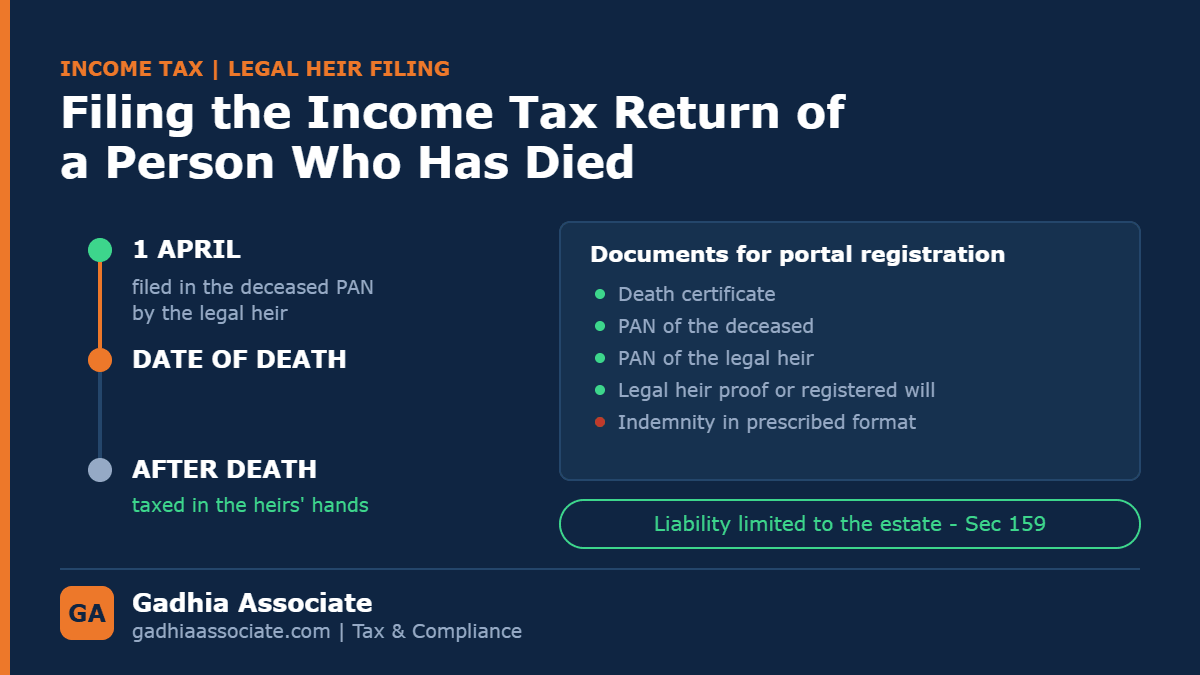
The direct answer: the legal heir or legal representative must file the return of a deceased person for income earned from 1 April up to the date of death, in the deceased's own PAN, after registering as a Representative Assessee on the income tax e-filing portal. Under Section 159 of the Income-tax Act, the heir's liability is limited to the extent of the estate inherited.
Who is legally required to file the income tax return of a person who has died?
The legal representative is required to file it, and Section 159 is where that obligation comes from. That section treats the legal representative as if they were the assessee for the purpose of assessment, recovery and proceedings. In practice the legal representative is usually the spouse or a child. Where the deceased left a registered will naming an executor, Section 168 brings the executor into the picture for the income of the estate.
Two things are worth being clear about, because families worry about both.
- You are not personally liable for your late father's tax beyond what you inherited. Section 159 limits the liability to the extent to which the estate is capable of meeting it.
- That protection has one hole. If you dispose of or create a charge on estate assets while a tax liability is still undischarged, you can be held personally liable up to the value of what you parted with.
So selling the flat quickly and distributing the money among three siblings, before checking whether there is a demand outstanding, is the one move that turns a limited liability into a personal one.
How do I register as a legal heir on the income tax e-filing portal?
You register from your own login, not the deceased person's. The path on the current portal is Authorised Partners > Register as Representative Assessee > Let's Get Started > Create New Request, then select the category "Deceased (Legal Heir)" and enter the PAN and date of death of the deceased along with the reason for the request.
The documents you upload are where almost every case stalls:
- Death certificate
- PAN card copy of the deceased
- PAN card copy of the legal heir
- Legal heir proof, being any one of a legal heir certificate issued by a court or the local revenue authority, a surviving family member certificate from the local revenue authority, a family pension certificate issued by the Central or a State Government, a registered will, or a letter on the letterhead of the bank or financial institution, with seal and signature, naming the nominee or joint holder of the deceased's account at the time of death
- A letter of indemnity, which must be in the format prescribed on the portal itself
The document families almost never have is the legal heir proof. They arrive with a death certificate and an affidavit made by a local advocate, and the affidavit is not on the list. In Gujarat the practical route is the surviving family member certificate from the Mamlatdar office, and in Junagadh that takes a few weeks between application, verification and issue, so start it the same week you start thinking about the return. The second common rejection is the indemnity. People draft their own version. Download the prescribed one from the portal and use that.
The request then goes to the department for approval. It sits at "Pending" for some days, commonly around a week, and you cannot file anything in the deceased's PAN until it is approved. Once approved you get an email and SMS, and the deceased's PAN appears in your login under the representative option.
What period does the return of a deceased person cover, and who pays tax on income after death?
The return filed in the deceased's PAN covers income from 1 April of that financial year up to the date of death. Income arising after the date of death does not belong there. It belongs to the legal heirs, or to the estate through the executor where Section 168 applies, and is reported by them in their own returns.
Deductions and the basic exemption are not pro-rated for the part-year. The deceased gets the full year's benefit of Chapter VI-A deductions and the slab exemption, while tax is charged only on the income up to the date of death.
An illustrative example, with round numbers only. Suppose a retired person in Junagadh died on 30 September. Pension and interest from 1 April to 30 September came to Rs 4,00,000, and the banks had deducted Rs 20,000 of TDS. Interest of Rs 2,00,000 arose from 1 October to 31 March on the same deposits, now inherited by two children in equal shares. The return in the deceased's PAN reports Rs 4,00,000 and claims the Rs 20,000 credit. The Rs 2,00,000 is split and reported by the two children at Rs 1,00,000 each in their own returns. These figures are illustrative and not a computation for any real case.
This split is the single biggest cause of mismatch letters, because the bank often keeps deducting TDS in the deceased's PAN for months after death. If you have read our article on AIS versus Form 26AS, the same logic applies here: the AIS keeps reporting against the old PAN until the bank is told to stop.
Talk to us before you start the paperwork
If you are not sure whether you even need to file, a short call usually settles it. Gadhia Associate is a tax and compliance firm based in Junagadh, Gujarat, working with clients across India and with NRI families. The first consultation is free.
Call or WhatsApp +91 82005 28355. If it is easier, bring the papers to the Junagadh office; same-day appointments are usually available.
How is the refund of a deceased person paid, and how do I claim the TDS credit?
The refund is processed against the deceased's PAN and released to a pre-validated bank account linked to that PAN. This is the step that goes wrong most often, because the family has already closed the deceased's savings account. If the account is closed, pre-validation fails, the refund fails, and you are back on the portal raising a refund reissue request. Where possible, keep one account of the deceased open until the refund lands, ideally one where a legal heir is a joint holder or nominee.
For TDS, check Form 26AS in the deceased's PAN and split the entries by date of death. Credit for TDS on income up to the date of death is claimed in the deceased's return. Where TDS has been deducted in the deceased's PAN on income that actually belongs to a legal heir, the ITR schedules allow that credit to be shown as transferred out to the heir's PAN, and the heir claims it in their own return. Get this wrong and the refund sticks. Our article on ITR refunds getting stuck covers what to do when it does.
Verification is done using the legal heir's own credentials as representative, not the deceased's Aadhaar OTP.
What happens if nobody files the return of a person who has died?
Nothing happens for a while, and then it does. The department's data does not know somebody has died. TDS entries and SFT reporting keep flowing against the PAN, a non-filing case is flagged, and a notice is issued. Reassessment notices are supposed to go to the legal representative, and where a notice under Section 148 is issued in the name of the dead person, courts including the Gujarat High Court have held such notices invalid. That sounds like good news. It is not much comfort in practice, because the department can then issue a fresh notice to the legal representative within the applicable limitation period, and by then the estate has usually been distributed and spent.
That is the real mess. Three heirs, money already divided, and one of them now has to answer for a demand. Penalties and prosecution cannot be pursued against a dead person as such, but tax and interest are recoverable from the estate, and the person who parted with the assets carries the exposure described earlier. Our article on income tax notices explains how to read what you have received before replying to it.
Should the PAN and Aadhaar of the deceased be surrendered, and when?
Yes, but not immediately. Surrender the PAN only after all filings, refunds, TDS credits and any pending proceedings are closed, because you need the PAN live to do all of it. Once everything is settled, the PAN can be surrendered to the jurisdictional Assessing Officer with the death certificate and a covering letter. Aadhaar cannot be cancelled in the same sense; the practical step is to inform UIDAI and the banks so the identity is not misused. There is no strict statutory deadline for surrendering a PAN, and we would rather see it live and closed properly than surrendered early and blocking a refund.
What about a joint bank account or jointly held property?
A joint account or joint property does not automatically make the whole income yours. What matters is who actually contributed the funds and who is entitled to the income after death. Interest up to the date of death on a deposit funded by the deceased goes in the deceased's return; interest after that follows the entitlement of the surviving holder or heirs. Where the succession is governed by a will or a gift made during lifetime, the documents decide it, which is why our article on choosing between a gift deed and a will is worth reading before the assets are split rather than after.
If you find an error in a return already filed for the deceased, it can usually be corrected. See our article on mistakes in a filed ITR for the routes available.
Get the filing done properly, once
Most of these cases are not complicated. They are just unfamiliar, and they stall on one missing certificate. We have been in practice since 2007 and work with over 7,000 clients across Saurashtra and Gujarat, with a 5.0 Google rating from more than 100 reviews, fixed-fee and monthly plans, and digital service for families outside Gujarat and abroad.
Send us the death certificate and the PAN details on WhatsApp at +91 82005 28355 and we will tell you what is actually pending. No charge for the first consultation.
Frequently asked questions
Can I file the return of a deceased person without registering as a legal heir?
No. Filing in the deceased's PAN requires the Representative Assessee registration to be approved first, through Authorised Partners on the e-filing portal. Until the department approves the request, the deceased's PAN will not appear in your login and no return can be uploaded or verified against it. Allow roughly a week for approval, sometimes longer.
Am I liable to pay my late parent's income tax from my own money?
Under Section 159 your liability is limited to the extent the estate can meet it, so you are not expected to pay from your own funds. The exception matters: if you sell, charge or part with estate assets while a tax liability is still undischarged, you become personally liable up to the value of what you parted with.
What is the due date for filing the return of a person who has died?
The same due dates apply as for any other individual for that assessment year, which is normally 31 July for non-audit cases, subject to any extension notified by the CBDT. Death does not create a separate deadline. If the due date has already passed, a belated or updated return may still be possible depending on the year involved.
The bank kept deducting TDS in my father's PAN after his death. What do I do?
Inform the bank in writing with the death certificate so the deduction stops and the deposit is transferred or re-titled. For TDS already deducted after the date of death on income belonging to you, use the TDS transfer-out facility in the ITR schedules so the credit moves to your PAN, and claim it in your own return for that year.
Have these provisions changed under the new law?
Yes, in numbering. The Income-tax Act, 2025 came into force on 1 April 2026 and renumbered the provisions dealing with legal representatives and estates. The substance of the position described here is the same, but the section numbers you see in a notice or an order may differ from the 1961 Act numbers. Check which Act a document refers to before responding to it.
This reflects the position as we understand it in September 2026. Rules, forms and due dates change through CBDT notifications and circulars, and outcomes depend on the facts of each family and each estate. Please confirm the current position with us, or with your own adviser, before acting on anything here.