Bank Account Frozen by the GST or Income Tax Department? Why It Happened and How to Get It Released
It almost never starts with a letter. A cheque bounces, or a salary transfer fails, and when you ring the branch you're told the account is "under attachment" and nothing more. If you run a business in Junagadh, or anywhere in Saurashtra, and this happened this morning, you're staring at supplier payments due tomorrow and a payroll date you cannot move. Nobody has explained why.
How do I find out which department froze my account and get the order copy?
Start at the bank, but expect a particular kind of unhelpfulness. The branch will almost never hand over the attachment letter — the line at the counter is that it's a departmental communication and you must approach the department. What the manager usually will tell you, in person rather than on the phone, is which department sent it and when. Then go to the portals. A DRC-22 sits under Services, then User Services, then Additional Notices and Orders, and that's where people lose days, because most taxpayers only check "View Notices and Orders". On the income tax portal, look under Pending Actions, then Response to Outstanding Demand.
What is provisional attachment under Section 83 of the CGST Act, and how long does it last?
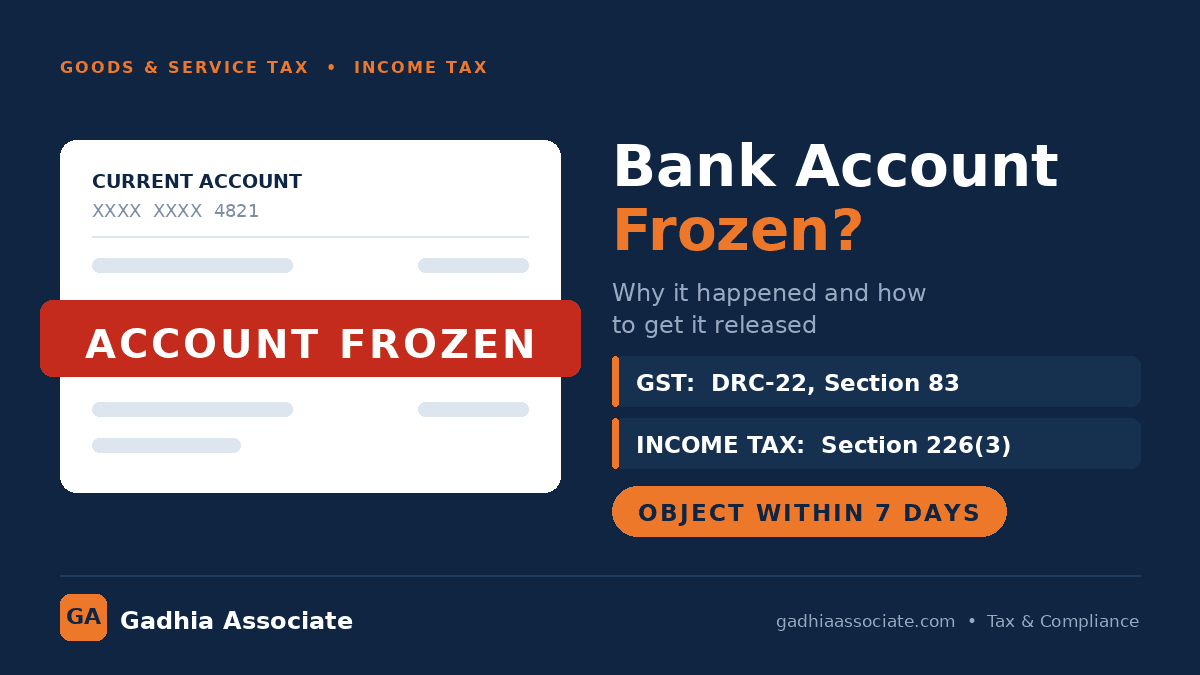
Section 83 lets the Commissioner attach property, including a bank account, once proceedings have started, and it dies after one year from the date of the order. Two conditions must hold. Proceedings must have been initiated under Chapter XII (assessment), Chapter XIV (inspection, search, seizure and arrest) or Chapter XV (demands and recovery) — that wider wording came in from 1 January 2022 through Notification No. 39/2021 – Central Tax. And the Commissioner must have formed an opinion that attachment is necessary to protect government revenue.
That opinion isn't a formality. CBIC's guidelines of 23 February 2021 say it must rest on tangible material and that the order should reach the taxpayer in time to object. In Radha Krishan Industries v. State of Himachal Pradesh, the Supreme Court called this power draconian and a measure of last resort. Where the DRC-22 just reproduces the words of the section with no reasoning, that's the weak point. And banks don't release accounts on their own when the year ends; many wait for a release order in Form GST DRC-23.
I only have seven days to object — what does Rule 159(5) let me do?
Rule 159(5) gives you seven days from the attachment to object that the property was not liable to be attached, and the Commissioner must hear you before deciding. Release comes through Form GST DRC-23. Use those seven days; the window is short and the clock usually started before anyone told you. A good objection isn't emotion. It's a statement showing the account is the one salaries run through, evidence that the liability is disputed and why, proof that returns are current, and a direct attack on whether the order records any material at all.
Why has the Income Tax Department told my bank to pay them directly?
Because an unpaid demand moved to the garnishee stage. The sequence is fixed: a notice of demand under Section 156, thirty days to pay under Section 220(1), interest under Section 220(2) at one per cent per month or part of a month, then recovery. Section 226(3) lets the Assessing Officer or Tax Recovery Officer write straight to your bank requiring it to pay over money held for you. A copy must go to you at your last known address, which is exactly why so many people hear it from the bank first. Amounts exempt from attachment by a civil court are protected, and a salary account is treated differently.
Can I get a stay so the bank releases the money?
Yes, through Section 220(6). Where an appeal is filed, you can ask the Assessing Officer to treat you as not in default and hold recovery until it's decided. CBDT's office memorandum of 31 July 2017, revising the earlier one of 29 February 2016, sets the benchmark at 20 per cent of the disputed demand while the appeal is pending before the CIT(A). Courts have said repeatedly that this is a guideline, not an inflexible precondition. The officer will still ask for it. Check one other door before paying: if the demand exists only because a TDS credit or challan didn't map, a rectification under Section 154 fixes it without an appeal.
What does it cost me if I wait a week?
More than you think, and some of it doesn't come back. The Rule 159(5) window is seven days and it doesn't reopen. Salaries stop, EMIs bounce, and a bounced cheque to a supplier in a market like Junagadh travels faster than any explanation you offer later. Under the income tax route the money doesn't just sit frozen — the bank can be required to pay it over, and recovering it then becomes a refund fight, not a release request.
Your account is frozen today and the clock is already running. Call or WhatsApp +91 82005 28355 now — attachment matters are same-day work here, and the first consultation is free. Send the DRC-22 or the 226(3) letter and we'll tell you today what gets filed first.
Should I pay part of the demand under protest, or fight the attachment?
It turns on whether the underlying demand is weak or merely inconvenient. Where it has real problems — a mismatch a rectification cures, an order passed without hearing you, ITC denied over a supplier's default — objecting is the better use of the seven days, because paying muddies the argument that attachment was never necessary. Where the liability is largely correct and cash flow is the only issue, a part payment with a written request to release the account usually lifts the marking fastest. Say "under protest" in writing if you intend to contest later. This part is genuinely stressful and there's no formula.
When is a writ petition to the High Court the realistic answer?
When the order is defective on its face, or the department stops responding. A writ before the Gujarat High Court is the practical remedy where the DRC-22 records no material behind the Commissioner's opinion, where the attachment continues past one year, where no proceeding under Chapter XII, XIV or XV was pending, or where a Rule 159(5) objection is neither heard nor decided. In the Radha Krishan matter the Supreme Court held the High Court should not have refused the writ merely because an alternative remedy existed.
What should I definitely not do while the account is attached?
- Don't quietly open a new account and route collections through it. This gets traced, and it turns a procedural dispute into an allegation of evading recovery.
- Don't ignore the underlying demand. The attachment is a symptom. Reply to the show cause notice, file the appeal, clear pending returns.
- Don't let seven days pass hunting for a contact inside the department. File the objection first.
Our articles on replying to GST notices, on ITC blocked under Rule 86A, on clearing pending GST returns and on income tax notices cover what usually caused the attachment.
Illustrative example. Say a demand of Rs 10,00,000 is raised, you've appealed to the CIT(A), and the account is attached under Section 226(3). On the CBDT benchmark, Rs 2,00,000 with a Section 220(6) application would typically be the basis for asking that recovery be held and the account released until the appeal is decided. Round figures, shown only to explain the mechanics.
Gadhia Associate is a tax compliance firm based in Junagadh, Gujarat, working with clients across India. In practice since 2007, over 7,000 clients across Saurashtra and Gujarat, a 5.0 Google rating from 100+ reviews, same-day appointments at the Junagadh office, digital service for clients elsewhere and for NRIs, and fixed-fee or monthly plans agreed upfront.
Don't sit on this. Free first consultation — call or WhatsApp +91 82005 28355, or come to the Junagadh office today. Bring the attachment order, six months of bank statements and the notice that started it.
What else do people ask when their bank account is frozen?
Can the GST department freeze my account without any notice first?
Not on its own. Section 83 requires that proceedings under Chapter XII, XIV or XV of the CGST Act have already been initiated — an inspection, an assessment, a search or a demand. If nothing was pending when the DRC-22 was passed, the attachment is open to challenge on that ground alone. Check which proceeding the order names before arguing anything else.
How long does a GST bank attachment last?
A maximum of one year from the date of the order under Section 83(1). It lapses on its own and can't be extended by reissuing the same order. In practice banks keep the marking until they receive a release order in Form GST DRC-23, so you may still have to chase the department after the year has ended.
The bank already paid the money to the Income Tax Department. Can I get it back?
Possibly, but it becomes a refund claim rather than a release. Once money is appropriated under Section 226(3), recovering it means succeeding in the appeal or rectification and then claiming the excess back, which takes months. That is why a Section 220(6) stay application filed early matters far more than one filed after the debit.
Do I need a lawyer, or can a CA handle this?
Objections under Rule 159(5), stay applications under Section 220(6), rectifications under Section 154 and appeals before the CIT(A) are handled by chartered accountants routinely. A writ petition needs an advocate on record. We handle the departmental side and bring in counsel where it has to go to court, so you aren't managing two conversations.
This article reflects the position as of September 2026. Rates, thresholds and procedures change through CBDT and CBIC notifications, circulars and instructions, and outcomes depend heavily on the facts of each case and the wording of the specific order. Attachment matters are time-sensitive and may need urgent legal representation. Please take advice on your own facts before acting.