Sold Shares or Mutual Funds? How Much Tax You Pay and How to Report It Correctly in Your ITR
You traded through the year, some of it deliberate and some because a tip sounded good in March. Now the broker's capital gains statement runs to forty pages, the AIS shows a different number entirely, and the deadline is closer than you'd like. If you're a salaried investor in Junagadh with a demat account, or a business owner parking surplus in mutual funds, this is where a small reporting error turns into a notice eighteen months later. The tax is usually manageable. The reporting is where people slip.
How much tax do I pay when I sell shares or mutual funds?
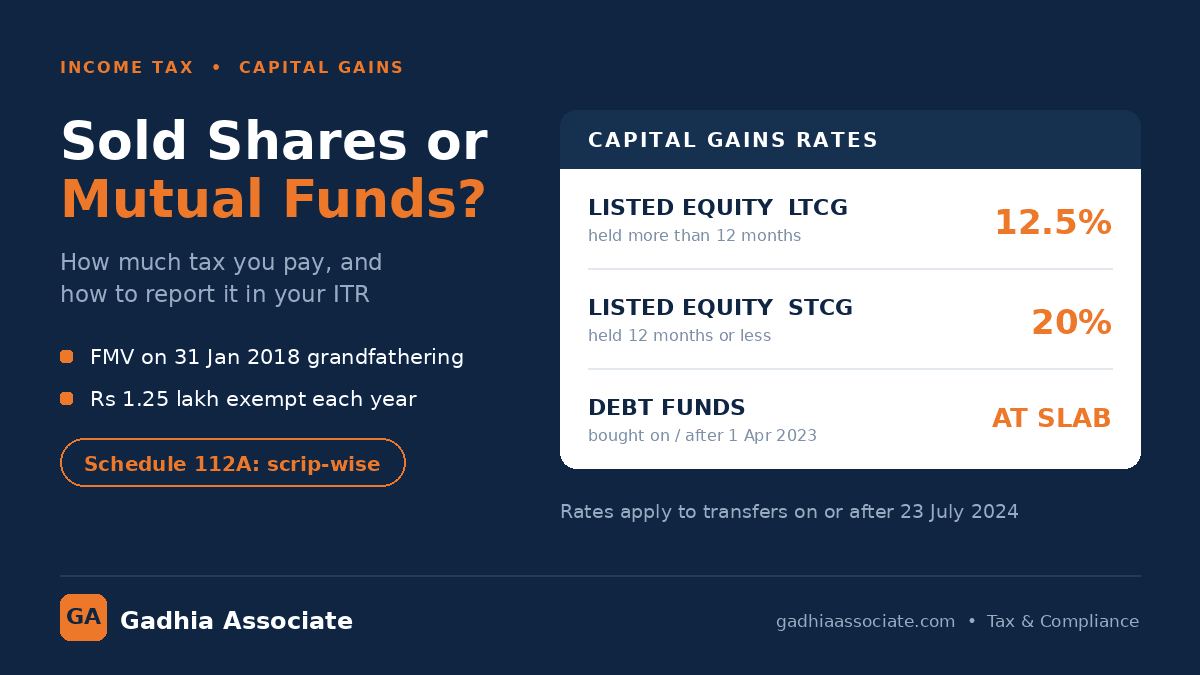
It depends on two things only: what you sold, and how long you held it. This is the position for transfers on or after 23 July 2024, when the Finance (No. 2) Act, 2024 changed the rates.
- Listed equity shares and equity-oriented mutual funds, STT paid. Held more than 12 months: long term, Section 112A, 12.5 per cent on gains above Rs 1.25 lakh in the year, no indexation. Held 12 months or less: short term, Section 111A, 20 per cent.
- Debt mutual funds bought on or after 1 April 2023. Deemed short term under Section 50AA no matter how long you held them, taxed at your slab rate. Three years or five, it makes no difference.
- Debt fund units bought before 1 April 2023. The older treatment continues for those units, so the purchase date matters more than the sale date. Check the folio, not the fund name.
- Unlisted shares, including pre-IPO holdings. Long term after 24 months at 12.5 per cent without indexation; below that, your slab rate.
The Rs 1.25 lakh is one annual exemption across all your Section 112A gains, not per scrip and not per broker. If you hold accounts with two brokers, nobody adds them up for you.
What is the 31 January 2018 grandfathering rule and how do I calculate it?
If you bought a listed share or equity fund before 1 February 2018, your cost gets stepped up so gains built up before that date aren't taxed. Take the lower of the fair market value as on 31 January 2018 and your actual sale price; then take the higher of that figure and your actual purchase cost. That's your cost of acquisition. For a listed share the fair market value is the highest price quoted on a recognised exchange on 31 January 2018; for a fund, the NAV on that date.
Illustrative example, round numbers. You bought 1,000 shares in 2015 at Rs 100, cost Rs 1,00,000. The highest quoted price on 31 January 2018 was Rs 250. You sold this year at Rs 400, so sale value is Rs 4,00,000. Lower of Rs 250 and Rs 400 is Rs 250; higher of that and your actual Rs 100 is Rs 250. Cost becomes Rs 2,50,000, the long-term gain is Rs 1,50,000, and after the exemption you pay 12.5 per cent on Rs 25,000 — Rs 3,125.
Brokers apply grandfathering automatically now and mostly get it right. Where they get it wrong is with shares transferred in from an old physical folio or another demat account, because the broker doesn't hold the original purchase date.
My broker statement and the AIS show different numbers — which do I use?
Use the broker's capital gains statement as your working figure and the AIS as a checklist to reconcile against. The AIS is built from reports filed by depositories, registrars and fund houses, and it generally shows sale consideration rather than gain, which explains much of the apparent gap on its own. It also misstates cost, especially for SIP units, bonus issues and inter-demat transfers. What the department compares is your reported sale consideration against what AIS holds, so if the broker says Rs 18,00,000 and AIS says Rs 21,00,000, find the missing Rs 3,00,000 before filing. Nine times out of ten it's a forgotten second demat account. Where an AIS entry is genuinely wrong, submit feedback against that line item rather than quietly filing a different figure. And download the statement for the financial year, not the calendar year. Sounds obvious. People still do it.
Not sure your AIS and broker statement agree? Send us both and we'll reconcile them before you file. Free first consultation — call or WhatsApp +91 82005 28355. Fixed fee, and you'll know the number before the deadline rather than after a notice.
Where exactly do capital gains go in the ITR?
Everything goes into Schedule CG of ITR-2, or ITR-3 if you also have business or professional income. ITR-1 and ITR-4 don't accommodate capital gains, so the moment you sell shares your form changes — which catches out salaried filers who've used ITR-1 for a decade. Within Schedule CG, long-term gains on listed equity flow from a separate Schedule 112A, and that's the part that eats time: it wants scrip-wise detail — ISIN, name of the share or unit, number of units, sale price per unit, cost of acquisition, and the fair market value as on 31 January 2018 where the asset was bought before 1 February 2018. Short-term gains under Section 111A sit in their own block.
The portal accepts a CSV upload for Schedule 112A and most brokers generate that file, turning a two-hour job into ten minutes. Check the ISINs came through, though — a blank ISIN row fails validation right at the end, when you're least patient.
Can I set off my losses, and what happens if I file late?
Losses help, but the rules run one way. A short-term capital loss can be set off against both short-term and long-term capital gains. A long-term capital loss can only be set off against long-term capital gains, never against short-term gains and never against salary. Whatever stays unabsorbed carries forward for eight assessment years. The carry-forward has one hard condition: the return must be filed by the due date under Section 139(1). Miss it and the loss is gone for good, even if you file a belated return a week later. That's the most expensive deadline mistake we see, because people who had a bad year assume there's nothing to report.
Which mistakes actually trigger a notice?
- Ignoring the AIS. A transaction reported to the department and missing from your return is the easiest thing for the system to flag.
- Treating a debt fund like an equity fund. A hybrid or balanced advantage fund may or may not be equity-oriented; the scheme's tax note settles it.
- Missing the buyback change. From 1 October 2024 the entire buyback consideration is taxed in the shareholder's hands as deemed dividend under Section 2(22)(f) at slab rate, and your cost of acquisition becomes a capital loss reported in Schedule CG. Filing it as a capital gain is common and avoidable.
- Forgetting a second demat account opened years ago with a bank and used twice.
- Reporting net figures instead of gross sale value and cost separately, which breaks the AIS comparison even when the tax is right.
One caution on section numbers. The Income-tax Act, 2025 came into force on 1 April 2026 and renumbered most provisions of the 1961 Act. The substance for capital gains is largely carried over, but the numbers in older articles may no longer match. We've used the familiar 1961 numbering here because that's what most statements and notices still refer to; check the corresponding provision of the 2025 Act before quoting a section formally.
Our related articles help if your year involved more than shares: capital gains on property with exemptions under Sections 54, 54F and 54EC, the difference between AIS and Form 26AS, how crypto and virtual digital assets are taxed, and our free Capital Gain Tax Calculator.
Gadhia Associate is a tax compliance firm based in Junagadh, Gujarat, working with clients right across India. In practice since 2007, over 7,000 clients across Saurashtra and Gujarat, a 5.0 Google rating from 100+ reviews, same-day appointments at the Junagadh office, fully digital service for clients elsewhere and for NRIs, and fixed-fee or monthly plans agreed upfront.
Get the capital gains schedule right the first time. Free first consultation — call or WhatsApp +91 82005 28355, or visit the Junagadh office. Send your broker tax P&L and your AIS, and we'll come back with the taxable figure and what you owe.
What else do investors ask about capital gains on shares?
Is the Rs 1.25 lakh exemption available every year?
Yes. Under Section 112A the exemption applies to long-term gains on listed equity shares and equity-oriented mutual funds in each financial year, and it resets annually. It is a single limit across all such gains, not per scrip, per fund or per broker. Gains above Rs 1.25 lakh are taxed at 12.5 per cent without indexation. It does not cover short-term gains or debt funds.
Do I have to file a return if my gain is below Rs 1.25 lakh?
Usually yes, if you want to be safe. The exemption removes the tax, not the reporting. Where the transaction shows in your AIS, a return that discloses it and claims the exemption is far cleaner than no return at all. And if you had losses that year, filing by the Section 139(1) due date is the only way to carry them forward.
How are gains taxed if I sold before 23 July 2024?
The earlier rates apply to those transfers. In the transition year, transfers up to 22 July 2024 were taxed at the old rates and transfers from 23 July 2024 onward at 12.5 per cent long term and 20 per cent short term. What matters is the date of transfer, not the date of purchase. The utility handles this through separate date-wise blocks in Schedule CG.
What if I don't know the 31 January 2018 price of an old holding?
The fair market value is the highest price quoted on a recognised stock exchange on 31 January 2018, and where the scrip didn't trade that day, the highest price on the closest earlier trading day. Exchange archives carry this and most brokers apply it automatically. For mutual funds the equivalent is the NAV on 31 January 2018, available from AMFI records.
Can I deduct brokerage and STT from my gains?
Brokerage, transaction charges and other expenses incurred wholly and exclusively on the transfer are deductible in computing the gain. Securities Transaction Tax is specifically not deductible for gains taxed under Section 111A or Section 112A. Broker statements show both, so check what the tax P&L has already netted off before deducting twice.
This article reflects the position as of September 2026. Rates, thresholds, forms and reporting requirements change through CBDT and CBIC notifications and circulars, and the Income-tax Act, 2025 has renumbered provisions with effect from 1 April 2026. Outcomes depend on your individual facts and on the documents you hold. Please take advice on your own case before filing.