Changed Jobs This Year? Why You Suddenly Owe Extra Tax and How to Stop It Happening Again
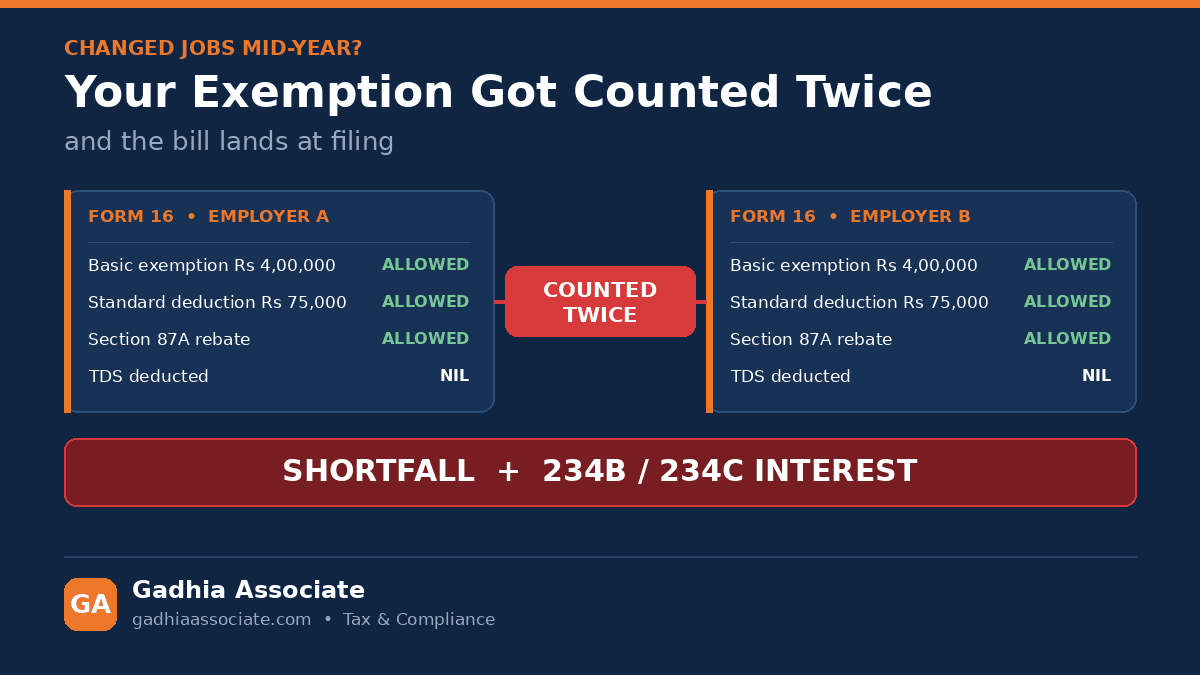
You switched employers mid-year. Two Form 16s arrived, both showing hardly any tax deducted, and you went into filing season expecting a small refund. Instead the utility threw up a demand running into tens of thousands. No fraud, no clerical slip. Both payroll teams did exactly what the law tells them to do, and the arithmetic collided.
Left alone, the gap grows. Interest under Sections 234B and 234C runs at 1% a month from instalment dates that have already passed, so by the time you file you're paying tax plus eight to twelve months of interest on money nobody told you to set aside.
Why do I owe tax when both my employers already deducted TDS?
Because neither employer knew about the other. Section 192 requires an employer to estimate your salary for the year and deduct tax on that estimate. The old employer estimates using the months you worked there. The new one, unless you tell it otherwise, starts from zero. Each applies the Rs 4,00,000 exemption slab, each applies the standard deduction, and each checks the Section 87A rebate. Two people doing the same sum on half the data.
This catches almost everyone who moves at a decent salary. It bites hardest around Rs 12,00,000, because that is where the 87A rebate switches off under the default new regime.
How much can this double-counting actually cost me?
Illustrative example. Round numbers, default new regime, no other income.
- Employer A, April to September: salary Rs 6,00,000. Less standard deduction of Rs 75,000 gives Rs 5,25,000. Tax of Rs 6,250, wiped out by the Section 87A rebate. TDS: nil.
- Employer B, October to March: salary Rs 8,00,000. Less Rs 75,000 gives Rs 7,25,000. Tax of Rs 16,250, again covered by the 87A rebate. TDS: nil.
Now the real position. Total salary Rs 14,00,000, one standard deduction of Rs 75,000, taxable income Rs 13,25,000. New regime slabs give Rs 78,750, and at that income the 87A rebate is gone. Add 4% cess: roughly Rs 81,900, against TDS credit of zero.
Two Form 16s, each showing nil tax, adding up to a five-figure bill. Your figures will differ. The shape of the problem won't.
Why is there interest under Section 234B and 234C on top?
Because you were meant to pay advance tax during the year and didn't. Section 234B charges 1% a month once advance tax paid falls below 90% of assessed tax, counted from 1 April of the assessment year until you pay. Section 234C charges 1% a month on each instalment you fell short on, measured against the 15%, 45%, 75% and 100% cumulative targets due by 15 June, 15 September, 15 December and 15 March.
On the Rs 81,900 above, filing in July would attract roughly Rs 7,000 to Rs 8,000 of combined interest, again illustrative. What it isn't is negotiable. Nobody has discretion to waive 234C because your HR never asked for a form.
And leaving the old salary out is not an option. Both employers file TDS returns, both Form 16s sit on TRACES, and the salary appears in your Annual Information Statement. Our piece on AIS versus Form 26AS explains why the AIS is the first thing a processing system looks at.
Who should I speak to before this becomes a demand notice?
Gadhia Associate is a tax and compliance firm based in Junagadh, Gujarat, working with salaried professionals, businesses and NRIs across India. Practising since 2007, 7,000+ clients across Saurashtra and Gujarat, 5.0 Google rating from 100+ reviews.
First consultation is free. Call or WhatsApp +91 82005 28355 and send both Form 16s — a job-change shortfall takes about twenty minutes to size up. Junagadh office with same-day appointments, everything else handled digitally.
What do I give my new employer, and is Form 12B still the form?
Give the new employer your previous employment details in writing, in the first month, before payroll locks. The prescribed route has long been Form 12B under Rule 26A of the Income-tax Rules — previous employer's name and TAN, period of employment, salary paid, exemptions allowed, deductions claimed, TDS already deducted. The new employer must then consider all of it under Section 192(2) and issue a Form 16 reflecting the combined figure.
Most large employers won't hand you a paper Form 12B. They point you at a "previous employer income" tab in the payroll portal and ask you to key in the numbers, with the old Form 16 uploaded as backing. Same declaration, different wrapper. What doesn't work is the line HR usually gives — "just claim it while filing your return." You can, and you'll pay the whole shortfall yourself with interest.
Is Form 12BAA the same thing as Form 12B?
No, and the two get mixed up constantly. Form 12BAA was notified by the CBDT in October 2024 for a different purpose: telling your employer about TDS and TCS suffered on non-salary income — bank interest, dividends, TCS on a car or a foreign remittance — plus any house property loss, so salary TDS can be reduced. Form 12B is about your previous employer. Form 12BAA is about your other credits.
One more thing. The Income-tax Act, 2025 came into force on 1 April 2026 and renumbered these provisions, so salary TDS is now cited under the new Act's numbering rather than Section 192. Rates, thresholds and the obligation itself were untouched by the renumbering. Forms and payroll systems are still catching up, so confirm the current section reference before quoting it.
I've already switched this year — how do I fix it before filing?
Compute the real liability now and pay it as advance tax, not next July. Add both salaries, take one standard deduction, apply the slabs, check whether the 87A rebate survives, subtract TDS deducted so far, pay the balance by the next instalment date. With 15 September on us, paying now stops 234C for the remaining quarters and shrinks the 234B base. Our article on advance tax and the 15 September instalment sets out the challan steps.
Waiting until July costs twice over. Interest keeps running, and a return filed with a large unpaid demand sits in processing far longer — we've written separately on why ITR refunds get stuck. Already filed and only now found the second Form 16? The fix is a revised return, and the piece on correcting mistakes in a filed ITR walks through it.
What about joining in the last quarter, or overlapping salaries?
Four situations behave differently, and these are the ones that surprise people.
- Joined in January, February or March. One or two payroll runs are left. Even with your Form 12B details the new employer often cannot deduct enough. Pay the balance yourself by 15 March.
- Overlapping employment. Serving notice with one employer while on the rolls of another means two salaries in the same month, each taxed standalone. Declare both.
- Notice-pay recovery. The old employer recovers notice pay from your settlement, yet the Form 16 may still show gross salary. Whether a deduction is available isn't fully settled. Keep the settlement letter.
- Gratuity and leave encashment on exit. These exemptions carry their own ceilings, applied once across employers rather than fresh with each.
Can someone just check my numbers before I file?
Yes, and it costs far less than the interest. Send both Form 16s, your AIS and a payslip from each employer.
Free first consultation. Call or WhatsApp +91 82005 28355. Fixed-fee filing and monthly plans available.
What else do people ask after a mid-year job change?
Do I have to submit Form 12B, or can I ignore it?
Not optional in any useful sense. Rule 26A prescribes Form 12B for reporting previous employment income to a new employer, and Section 192(2) requires the employer to consider it. Skip it and they deduct on their own salary only — correct for them, expensive for you. Most employers now collect the same details through a payroll portal instead of a paper form.
Will my new employer see my old salary if I file Form 12B?
Yes, that is the point of it. The declaration carries the previous employer's salary, the exemptions allowed and the TDS deducted, and payroll needs those figures to compute correctly. If that bothers you, skip the declaration and pay advance tax yourself before 15 March instead. Either route works. Doing neither is what creates the demand and the 234B interest.
Can I avoid the shortfall by choosing the old tax regime?
Rarely, and not by itself. The new regime is the default, and the double-counting happens under either one — the old regime simply duplicates a different exemption limit and the Chapter VI-A deductions instead. Regime choice changes how much total tax you owe, not the fact that two employers each computed on half your income. Compare both on combined figures before filing.
Is a small shortfall really worth paying before 31 March?
Usually yes. Section 234B triggers once advance tax paid falls below 90% of assessed tax, with interest running from 1 April of the assessment year at 1% a month. A four-month delay on Rs 50,000 is roughly Rs 2,000, before 234C is even counted. Pay in March and it costs nothing beyond the tax itself.
Position as of September 2026. Slabs, thresholds, forms and section numbering change through Finance Acts and CBDT notifications, and outcomes depend on individual facts. Please confirm the current position with a qualified professional before acting on anything here.