GSTR-1 and GSTR-3B Don't Match? The DRC-01B Intimation, the Seven-Day Clock and Why Your Next Return Gets Blocked
You logged in to file this month's GSTR-1 and the portal would not let you start. Somewhere on the dashboard sits an intimation nobody opened, comparing two of your own returns and telling you they disagree. Your accountant says it's just a system message. It isn't. Until you answer it, your outward return stays shut and your customers stop seeing your invoices in their GSTR-2B.
The cost of sitting on it isn't a penalty in the first week. It's the billing chain. A blocked GSTR-1 means the invoices you raised never reach your buyers' GSTR-2B, buyers hold back payment, and a bigger client routes the next order elsewhere. Around Junagadh and Saurashtra this hits traders and job-work units hardest, because their whole receivable cycle runs on the buyer seeing credit.
Where do I actually find the DRC-01B intimation on the GST portal?
Log in and go to Services > Returns > Return Compliance. Both DRC-01B and DRC-01C live under that tile, separate from the notices section people usually check, which is why they get missed for weeks. Pick the ARN, open Part A, and you'll see the tax period, the liability per GSTR-1 or IFF, the liability per GSTR-3B and the computed difference, split across IGST, CGST, SGST and cess.
An email and SMS also go to the registered contacts. If that email still belongs to a consultant you parted ways with three years ago, nothing reaches you. Fix that first.
What difference is the system comparing, and what is the threshold?
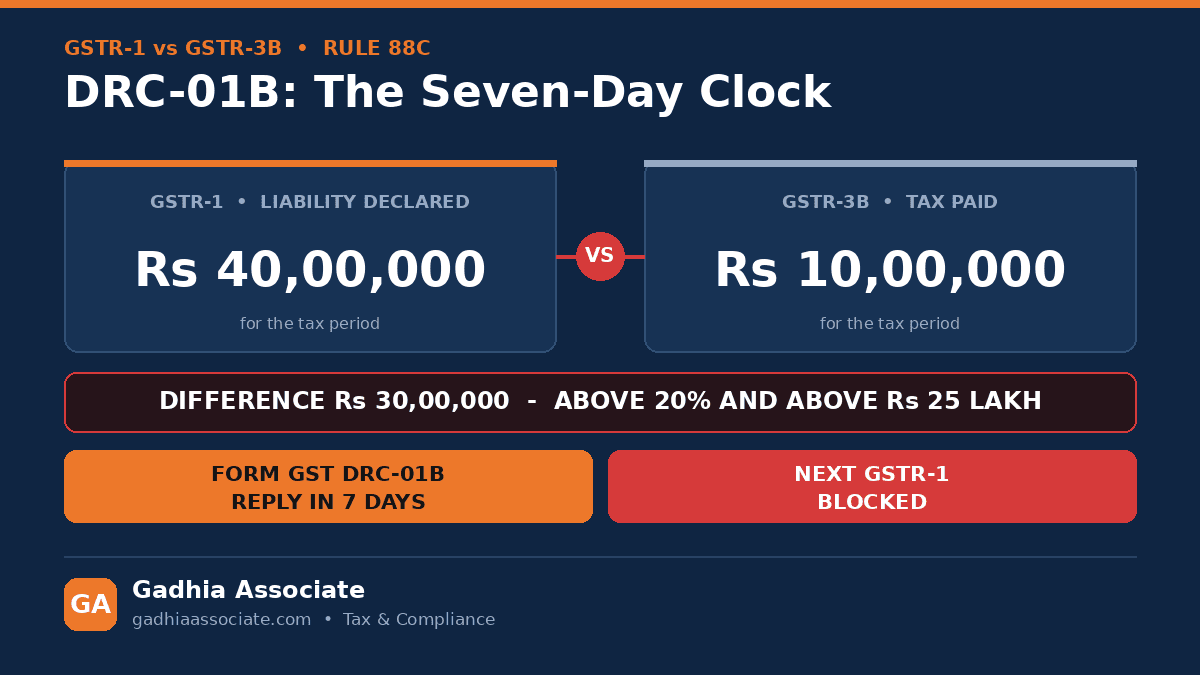
The system compares tax payable declared in your GSTR-1 or Invoice Furnishing Facility against the tax actually discharged in the GSTR-3B for the same period. Rule 88C does not hard-code a figure. It says the intimation goes out where the excess crosses "such amount and such percentage as may be recommended by the Council." The recommendation on record is a difference exceeding 20% and also exceeding Rs 25 lakh. The exact parameter the system runs on is not published, and we would rather say so than quote a number as gospel. Working benchmark, not a guarantee.
Why does my GSTR-1 not match my GSTR-3B when I have done nothing wrong?
Most of these differences are timing, not evasion. The common ones:
- Amendments made in a later month. You correct a January invoice through Table 9A of the March GSTR-1. The value shows as March liability, but the tax went out in the January GSTR-3B.
- Credit notes. Reported in GSTR-1 while the 3B for that month already carried a net figure, or the note lands in a different month altogether.
- Exports and SEZ supplies. Zero-rated supplies under LUT carry no tax in 3B. Keyed as taxable in GSTR-1, they read as a shortfall that doesn't exist.
- Reverse charge liability. RCM tax is paid in GSTR-3B and never appears in GSTR-1, pushing 3B above GSTR-1. Harmless in itself, confusing during reconciliation.
- Advances received. Tax paid on the advance in 3B, invoice reported in GSTR-1 a period or two later.
- Year-end timing. March invoices in the March GSTR-1 but paid in April's 3B, or the other way round.
Every one of these is defensible. None of them defends itself.
Who can look at this before the seven days run out?
Gadhia Associate is a tax and compliance firm based in Junagadh, Gujarat, working with businesses across India and with NRI clients. Practising since 2007, 7,000+ clients across Saurashtra and Gujarat, 5.0 Google rating from 100+ reviews.
First consultation is free. Call or WhatsApp +91 82005 28355 with the ARN and your GSTR-1 and 3B for the period, and we'll tell you the same day whether this is a payment or an explanation. Junagadh office with same-day appointments, filings handled digitally.
Should I pay through DRC-03 or explain in Part B?
Pay only if the difference is a genuine short payment. Reconcile, and if you find tax declared but never discharged, pay it through Form GST DRC-03 with interest under Section 50, then enter that ARN in the first sub-part of Part B. Faster, and it closes the file cleanly.
Explain if the difference is timing. Part B gives you a dropdown — amendments, credit notes, supplies covered by other returns, tax paid in a subsequent period, clerical error, and a residual "other" — plus a text box. Don't pay tax you don't owe just to make the block disappear. A DRC-03 filed on a timing difference is money you then chase through a refund, and our article on GST refunds explains how long that takes.
How should I word the Part B explanation so it gets accepted?
Reconcile first, write second. Explanations that go through without follow-up do three things: tie the exact rupee figure in the intimation to specific documents, state where the tax was actually paid, and do it in one paragraph rather than five.
Illustrative example. Say the intimation shows GSTR-1 liability of Rs 40,00,000 against GSTR-3B of Rs 10,00,000 — a difference of Rs 30,00,000, or 75%. Your reply might read: the difference of Rs 30,00,000 relates to invoices originally issued in an earlier tax period and amended in Table 9A of this period's GSTR-1; tax on those invoices was discharged in the GSTR-3B of that earlier period, and the invoice-wise reconciliation with challan details is attached. Figures illustrative. The shape is what matters — number, cause, where the money went, proof.
Attach the working as a PDF rather than typing tables into the box, and keep a copy of what you filed. If an officer opens a formal enquiry later, this reply is your first line of defence; the piece on replying to GST notices covers what follows.
What is DRC-01C, and how is it different from DRC-01B?
DRC-01C is the input tax credit version, issued under Rule 88D of the CGST Rules, notified in August 2023. It compares the ITC available in GSTR-2B against the ITC claimed in GSTR-3B. Where the claim exceeds the auto-populated credit beyond the prescribed limit, Part A of Form DRC-01C goes out. Seven days again, to pay the excess with interest through DRC-03 or explain in Part B. Failing to respond blocks the next GSTR-1 or IFF, exactly as with DRC-01B.
The threshold is where reporting genuinely differs. The Council minutes refer to more than 20% and more than Rs 25 lakh; several commentaries describe a much lower trigger in the system. We cannot confirm which parameter the portal applies today, so assume a sizeable ITC gap gets picked up. Our article on GST input tax credit sets out the Section 16 conditions these differences trace back to.
What happens if I just ignore the intimation?
Three things, in order. Your next GSTR-1 or IFF will not open, so nothing you invoice reaches your buyers' GSTR-2B. Late fees and interest then build on returns you cannot file on time — the article on pending GST returns explains how that compounds. And the unexplained difference stays on record, feeding a Section 73 or 74 demand and the reconciliation you will have to sign in GSTR-9 and 9C.
The knock-on to customers is what business owners underestimate. A buyer who cannot see your invoice in 2B has a real reason to hold payment, and you are now explaining a compliance block to your own client. That conversation costs more than the reply.
Can you handle the reply and the reconciliation for us?
Yes. With a seven-day window, call on day one rather than day six.
Free first consultation. Call or WhatsApp +91 82005 28355 for the reconciliation, the Part B wording and the DRC-03 if one is needed. Fixed-fee work and monthly GST plans available.
What else do people ask about DRC-01B and DRC-01C?
Can I get an extension beyond the seven days?
There is no extension built into Rule 88C. Seven days from the date of intimation is what you get, and the block on the next GSTR-1 or IFF follows automatically from the system, not from an officer's decision. If the reconciliation won't finish in time, file a Part B explanation with the workings you do have. A filed reply lifts the block and can be supported later.
Does filing DRC-03 automatically unblock my GSTR-1?
Not on its own. Paying through Form GST DRC-03 is half the step — you still have to open Part B of DRC-01B and enter the DRC-03 ARN against the intimation. People pay the money, assume it is done, and find the return still blocked the following month. Go back into Services > Returns > Return Compliance and complete the Part B submission.
Is a DRC-01B intimation the same as a show cause notice?
No. Part A of DRC-01B is a system-generated intimation of a difference, not an adjudication and not a demand under Section 73 or 74. Nothing is confirmed against you and no penalty is levied by the intimation itself. Ignoring it is what turns a reconciliation exercise into a formal proceeding, and by then you're answering an officer rather than a dropdown.
Will my GSTR-9 and 9C be affected by an unresolved difference?
Yes. The annual return and the reconciliation statement pull from the same GSTR-1 and GSTR-3B data, so an unexplained monthly gap surfaces again at year end in the tables reconciling turnover and tax paid. Resolve it when the intimation arrives and the annual reconciliation matches. Leave it and you explain the same difference twice, the second time with less documentation to hand.
Position as of September 2026. Thresholds, rules and portal behaviour change through CBIC notifications and GST Council recommendations, and outcomes depend on individual facts. Please confirm the current position with a qualified professional before acting on anything here.