GST Refund Stuck for Months? Export Refunds, Deficiency Memos in RFD-03 and How to Get Your Money Released
You exported the goods four months ago. The container sailed, the buyer paid, the shipping bill was filed — and your GST refund is stuck somewhere between the portal and your bank account. Meanwhile you fund the next order from your own pocket, or from an overdraft that costs you interest every day. If you are an exporter, merchant trader or manufacturer in Junagadh, Rajkot, Jamnagar or anywhere in Saurashtra, and you have been refreshing the refund status page for weeks, this is written for you.
In most cases nothing is wrong with your entitlement. The money is yours. It is sitting with the government because of a data mismatch, a form someone else in the chain never filed, or a deficiency memo you did not understand.
Which of the two export routes is your GST refund stuck in?
A zero-rated supply — export of goods or services, or supply to an SEZ — can be made through two routes, and the route decides where your money gets held up.
Route 1: Export under LUT, without payment of IGST
You furnish a Letter of Undertaking, export without charging IGST, then claim a refund of the unutilised input tax credit accumulated on your inputs. This is not automatic: you file Form GST RFD-01, select the correct period, upload statements and invoices, and wait for the officer. Almost every delay here is a filing or documentation issue.
Route 2: Export with payment of IGST
You pay IGST on the export invoice and claim it back. Here the shipping bill itself is treated as the refund application — you do not file RFD-01 at all. The system matches shipping bill data with your GSTR-1 and GSTR-3B, and if everything lines up the refund is credited to your validated bank account automatically. When this route stalls it is a mismatch or a missing Export General Manifest, and with no application to track, exporters often do not realise something has broken.
What is the real cost of leaving a GST refund stuck?
Three things happen quietly while you wait.
Your working capital is dead. Illustratively: a Junagadh exporter with ₹80,00,000 of annual exports and ₹12,00,000 of accumulated credit blocked for eight months. If that gap is bridged by a cash credit facility, the interest cost alone runs into lakhs over a year — money spent to borrow back your own refund.
What is the time limit for a GST refund?
A refund application under Section 54 generally must be filed within two years from the relevant date, and that relevant date is defined differently for goods and for services. For export of goods it is linked to when the goods leave India; for services it turns on receipt of payment or the invoice date. Sit on a period for two years and the credit is gone permanently. The clock is running quietly right now.
You are entitled to interest and almost never claim it. Where a refund is not sanctioned within 60 days of a complete application, interest is payable under Section 56 at the notified rate (commonly 6% per annum, higher in cases arising from an appellate order). Most exporters take the principal quietly and never ask.
Speak to us before the two-year window on your oldest period closes. The first consultation is free, and in one call we can usually tell you which stage your refund is stuck at. Call or WhatsApp +91 82005 28355 and we will look at your portal status with you.
Why is my GST refund not credited? The five real reasons
Refunds stall for a small number of repeatable reasons. Check them in this order.
1. Shipping bill does not match GSTR-1 Table 6A
Confirm: compare invoice number and date, taxable value, IGST amount, port code and shipping bill number and date in GSTR-1 Table 6A against the actual shipping bill. Even a leading zero breaks the match. Fix: amend the details in a later GSTR-1; some port and shipping bill errors are resolved through the customs officer's interface, not the GST portal.
2. EGM not filed by the shipping line
The Export General Manifest is filed by the carrier, not by you. If it is missing or erroneous, customs cannot treat the export as complete and the IGST refund never triggers. Confirm: track shipping bill status on the customs system. Fix: push your freight forwarder or CHA to file or amend the EGM. This is the most common reason a route-2 refund silently never arrives.
3. Bank account not validated or not linked
The refund is credited only to a bank account added to your GST registration and successfully validated against your PAN. A closed account, an IFSC changed after a bank merger, or a name mismatch holds the payment even after sanction. Fix: update the account in your registration profile and confirm validation shows as successful.
4. Input tax credit claimed does not appear in GSTR-2B
For LUT refunds, the credit claimed must be reflected in your GSTR-2B. If a supplier has not filed, or reported your invoice under the wrong GSTIN, that portion is disallowed. Fix: reconcile your purchase register against GSTR-2B before filing and chase non-filing suppliers. Our article on GST input tax credit covers this reconciliation.
5. Wrong refund period selected
Periods must be selected in the correct sequence, and once claimed the system will not let you go back casually. A wrong from-and-to period, or a financial year split incorrectly, produces a claim that does not tie to your returns and invites a deficiency memo.
What is a deficiency memo in RFD-03 — and why is it a trap?
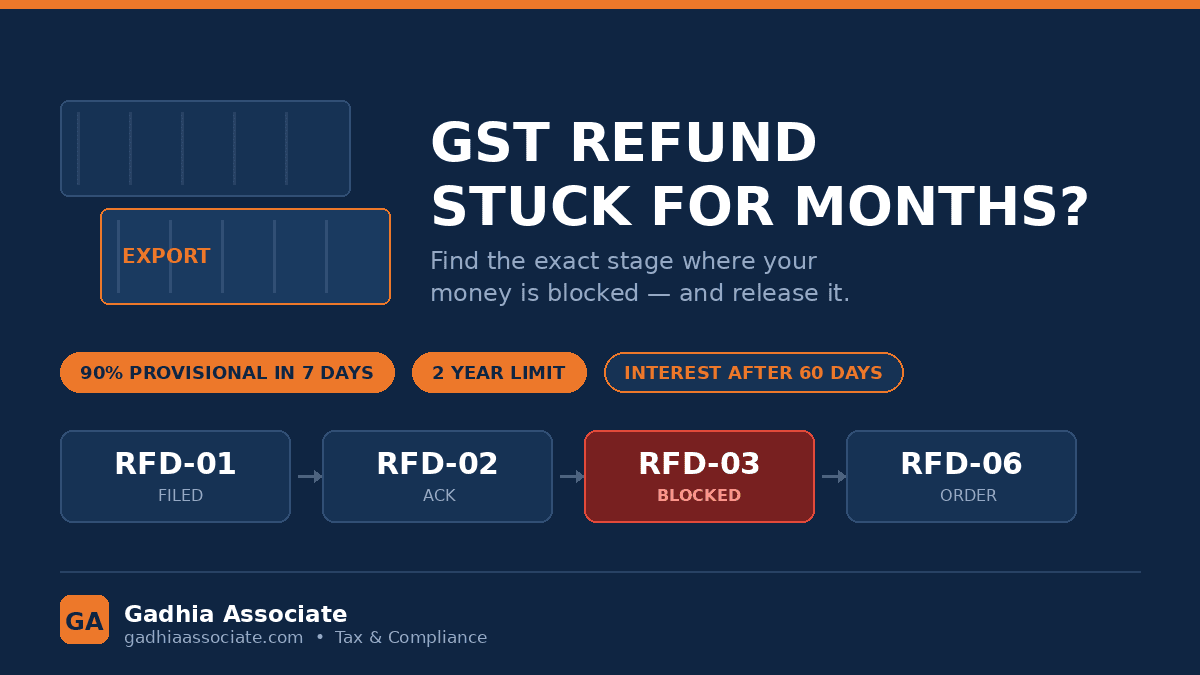
When you file RFD-01, the officer should issue an acknowledgement in Form RFD-02 within a short window. If instead the officer finds the application incomplete or defective, a deficiency memo in Form GST RFD-03 is issued.
Here is what exporters get wrong. An RFD-03 is not a query you reply to. The application is treated as closed, the credit is re-credited to your electronic credit ledger, and you must file a fresh refund application after rectifying the deficiency. Many businesses wait for a hearing that will never come.
The obvious worry is limitation. A proviso in the refund rules addresses it: the period from the date of the original RFD-01 up to the date the deficiency is communicated in RFD-03 is excluded when computing the two-year period for the fresh application. High Courts have also read Section 54 in a way that protects a rectified application filed after a deficiency memo. Helpful — but exactly the kind of position you want a professional to confirm against the current text and your facts before relying on it.
Two other timelines matter: for zero-rated supplies a provisional refund of 90% can be sanctioned in Form RFD-04, commonly within seven days of acknowledgement, with the balance released through the final order in Form RFD-06. Final sanction is expected within 60 days of a complete application — and that 60-day mark starts your interest entitlement.
Can I claim a refund under inverted duty structure?
Yes. If the tax rate on your inputs is higher than the rate on your output supply, you can claim refund of the accumulated credit even without exporting. Many Gujarat manufacturers — textiles, certain chemicals, some engineering items — sit permanently in this position.
Two things matter. First, the refund is not your ledger balance; it is computed through the prescribed formula in Rule 89(5), which works off turnover of inverted rated supply and net input tax credit. Second, and this catches people out, refund of credit on input services is not available in inverted duty cases — only credit on inputs (goods) enters the formula, following the position settled by the Supreme Court in the VKC Footsteps matter. If a large part of your cost base is job work, freight or professional services, your eligible refund will be materially smaller than your ledger suggests.
One recent piece of good news: Rule 96(10) of the CGST Rules, which restricted the IGST-refund route for exporters who had imported inputs under Advance Authorisation or EPCG, was omitted with effect from 8 October 2024. Pending claims and proceedings that turned on that restriction have been substantially relieved. If you were denied a refund or issued a notice on this ground, it is worth reopening the file — and worth reading our article on replying to GST notices first.
Get your GST refund unstuck
Gadhia Associate has been practising since 2007 — over 18 years — with more than 7,000 clients across Saurashtra and Gujarat and a 5.0 Google rating from 100+ reviews. We run refund files end to end: diagnosis, GSTR-1 and 2B reconciliation, RFD-01 preparation, deficiency memo re-filing, officer follow-up and, where due, the interest claim. Fixed-fee and monthly plans, a dedicated client manager, fully digital across India, same-day appointments at our Junagadh office. The first consultation is free — call or WhatsApp +91 82005 28355 with your GSTIN and the period involved, and we will tell you honestly what is recoverable.
Frequently asked questions
How long does a GST refund take?
A clean application should be acknowledged quickly and sanctioned within 60 days, with 90% coming provisionally within about a week for zero-rated supplies. In practice the delay is rarely the 60 days — it is the weeks lost to mismatches and deficiency memos before the clock properly starts.
Do I get interest on a delayed GST refund?
Yes. Where a refund is not sanctioned within 60 days of a complete application, interest is payable under Section 56 at the notified rate, commonly 6% per annum. It is not always paid automatically, and a written claim referencing the acknowledgement date is often needed.
My refund was rejected. Is that the end?
No. A formal rejection order is appealable within the prescribed period. A deficiency memo in RFD-03 is different — not a rejection at all, and the correct response is a corrected fresh application, not an appeal. Getting this wrong is how businesses lose valid claims.
Can my accountant just file it?
A straightforward RFD-01, yes. Where you need professional help is diagnosis: reading a deficiency memo correctly, reconciling books against GSTR-1, 2B, GSTR-9 and 9C, computing the Rule 89(5) formula, and handling limitation. A wrong claim is not merely refused — it can invite scrutiny of the underlying credit.
This article reflects the position as of September 2026 and is general information, not advice for your specific case. GST refund rules, rates and procedures change through CBIC notifications and circulars, and departmental practice varies by jurisdiction. Please confirm the current position with a qualified professional before acting.